
Main types and purposes of pruning fruit trees in the garden
7 min read
A complex of agrotechnical measures can be considered satisfactory if the tree grows well and fruits abundantly. Through skillful intervention in natural processes and by regulating their intensity and direction, the fruit grower can and must help the tree realize its potential for creating organic matter from basic components: water, carbon dioxide, and mineral salts.
Trees where growth predominates over fruiting are economically unprofitable to grow. In trees that have lost their growth capacity, the periodicity of fruiting intensifies, winter hardiness decreases, and the dieback of secondary and then larger branches progresses rapidly.
Pruning, carried out against a background of appropriate agrotechnics, allows for the regulation of the intensity of growth processes and also has a significant influence on the size and quality of the harvest. Before starting to prune, it is necessary to clearly define the goal and then choose the most effective method to achieve that goal for the given case.
Depending on the age of the tree and the pursued goal, there are three main types of pruning:
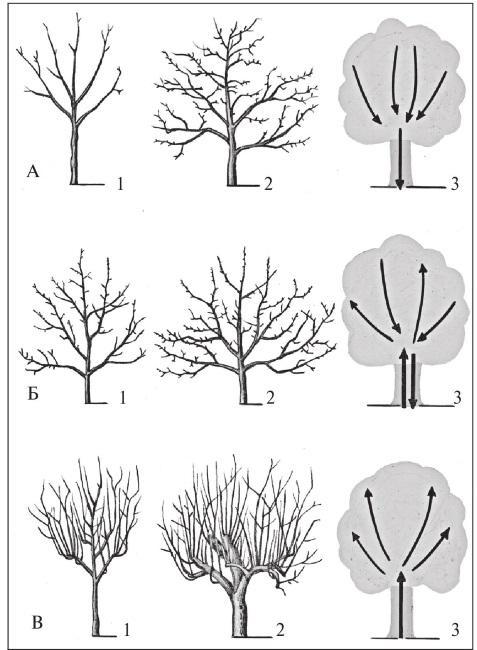
- Formative pruning — is carried out in the first, second, and third age periods, although the need for it often arises in older ages as well, for example, when forming new branches from water sprouts. The goal is to create a strong framework, ensure uniform placement of main and secondary branches within the canopy volume, provide good lighting conditions, and stimulate early fruiting.
- Regulating pruning (pruning for fruiting) — begins in the second age period, but the greatest need for it is felt in the third, fourth, and fifth periods. The goal is to ensure high annual yields of trees and create conditions for the constant renewal of fruit-bearing wood without allowing growth to cease.
- Rejuvenating pruning (restorative) — is applied to old fruit trees that are losing or have already lost their ability to grow. Individual branches are also rejuvenated at a younger age. The goal is to prevent the complete cessation of growth or to resume growth and balance it with fruiting.
In practice, all three types of pruning are often carried out simultaneously. When rejuvenating, for example, it is also necessary to form the tree or individual branches. During regulating pruning, it is often necessary to rejuvenate some of the branches, etc.
By time of execution, there is winter pruning — during the dormant period, and summer pruning — during the growing season.
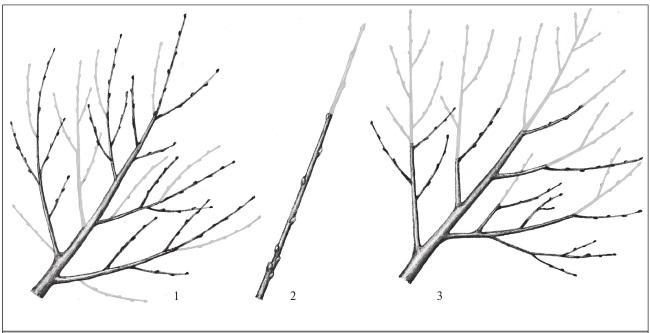
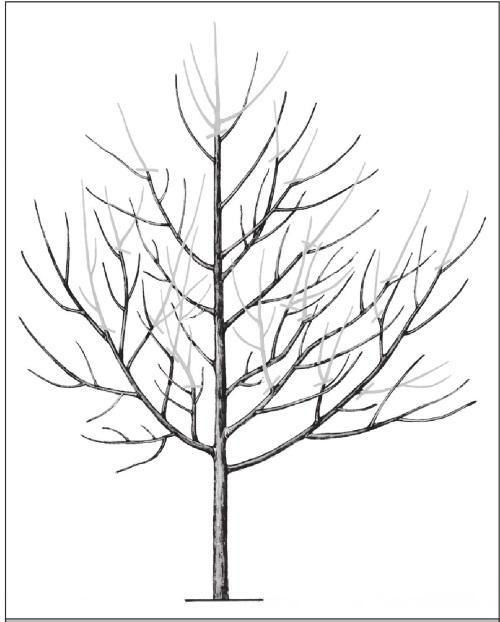
All existing methods of pruning are also divided into main and additional. The main ones are removal (thinning) and heading back (shortening) of branches. Both of these methods are difficult to distinguish, especially when acting on perennial wood. However, there are some significant differences.
- During thinning (removal), the branch is removed entirely, or entire branch systems are cut out from a large branch without reducing the length of the branch itself.
- During heading back (shortening), the upper (terminal) part of the shoot or fruit-bearing branch is removed.
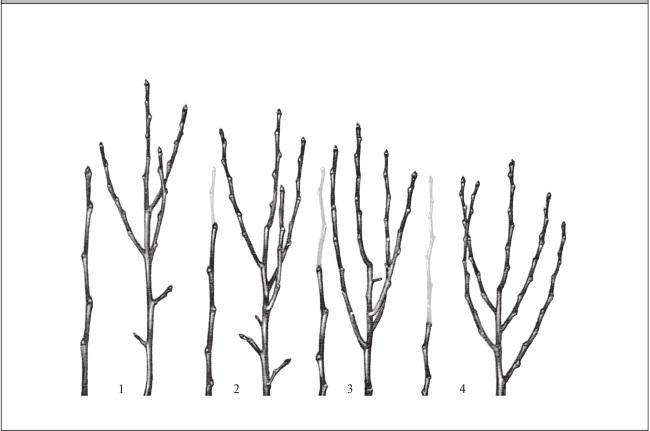
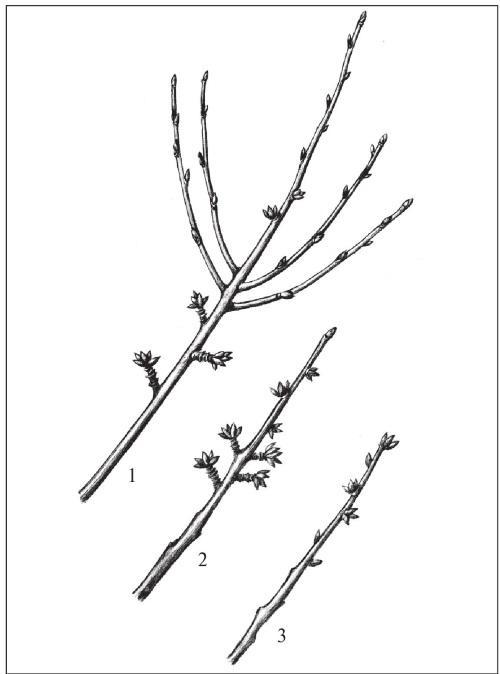
Depending on the degree of shortening, there is light, medium, and strong heading back. Such a division is also highly conditional and relates mainly to the pruning of annual growth on young trees.
The intensity of the impact during heading back is classified as follows:
| Type of shortening | Process characteristics |
| Light | Removal of only the upper part of the growth with weakly developed buds (less than 1/3 of the length) |
| Medium | Removal of one-fourth of the buds located on the growth (or 1/3 of the length) |
| Strong | Removal of the majority of well-developed buds or more than half the length of the shoot |
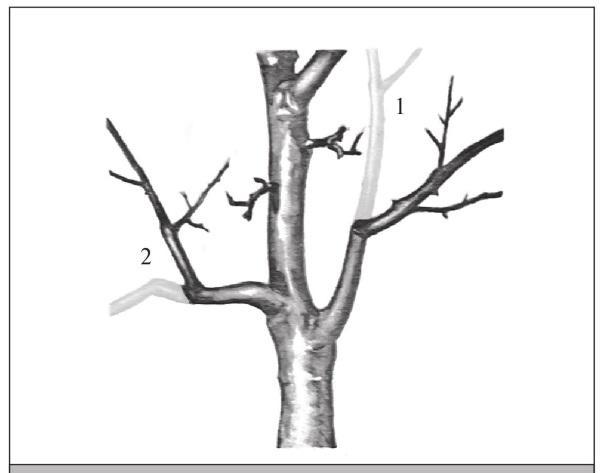
How to properly shorten branches and redirect growth
The method of shortening branches directly determines the timing of the onset of fruiting and the density of the canopy. With light (long) shortening, the tree does not experience stress, does not produce an excess of shoots, and enters fruiting on time. Use strong pruning selectively — for example, to weaken an overly developed branch or subordinate it to the central leader.
Strong shortening sharply reduces leaf area and delays the onset of fruiting. The canopy becomes dense quickly, and new shoots do not have time to ripen by autumn and freeze in winter.
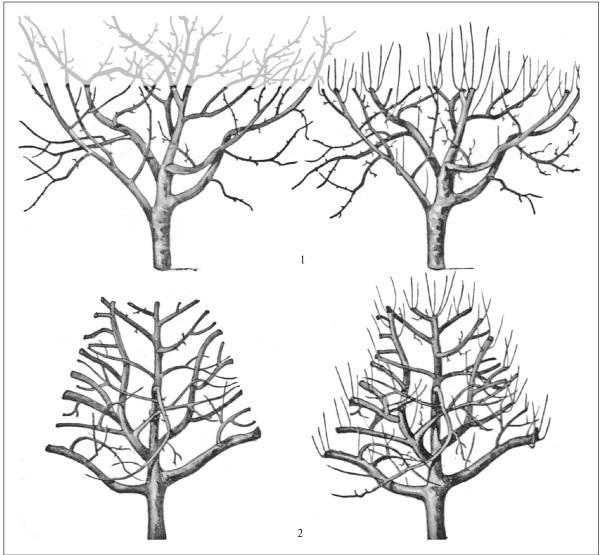
To rejuvenate trees with weakened growth, perform pruning on perennial wood (heading back). In practice, orienting oneself to the specific age of the wood is inconvenient for work in the garden. It is much easier to prune by branch tiers, counting tiers from the periphery of the canopy to the center: after determining the degree of pruning on one branch, all other branches of this cultivar and age are pruned analogously according to the tier rules.
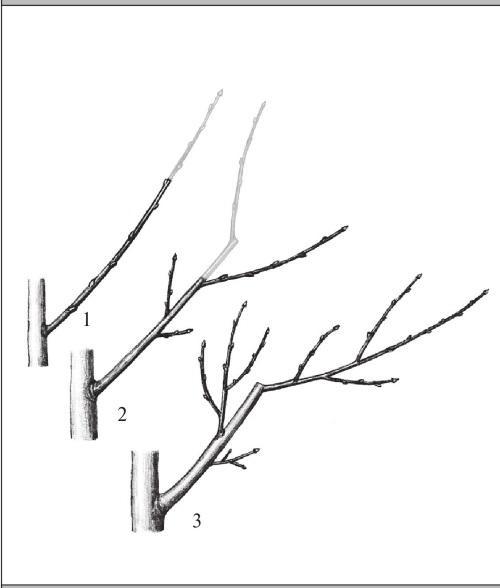
Pruning to a lateral (transfer pruning) is performed to change the direction of growth, limit canopy dimensions, or for rejuvenation. If you need to sharply change the direction of a branch, use the two-year "topping" method. Leave one additional bud or branch above the target bud, pointing in the opposite direction. This will force the required shoot (the second one from the cut) to grow at a wider angle, and the following year, the branch is finally redirected to it.
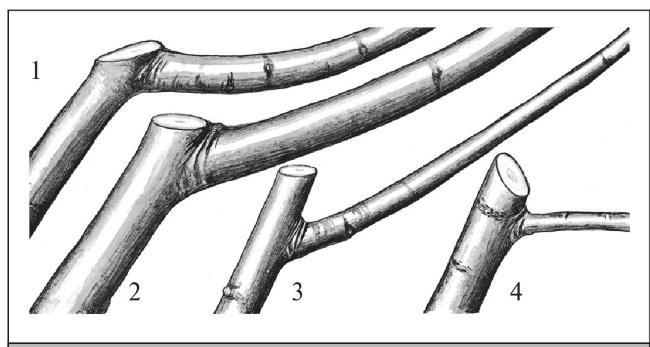
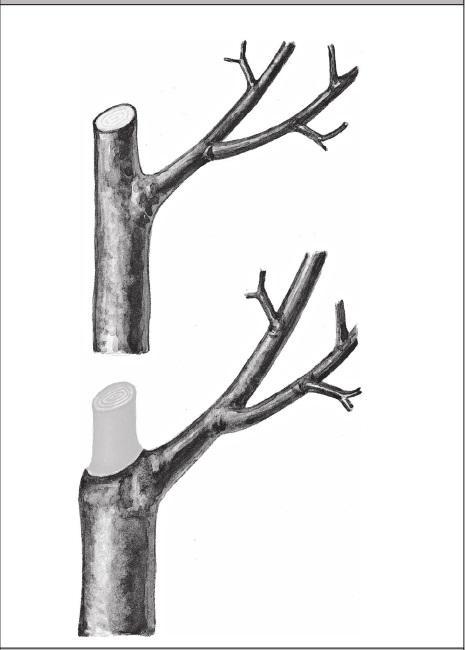
When redirecting to a branch that is significantly thinner than the part being removed, it is mandatory to leave a protective link (a temporary stub). This technique is necessary when lowering the canopy and removing a leader, as a large cut without protection can lead to drying out and winter injury of the bark at the base of the remaining branch. When the side branch thickens, the protective stub is removed completely.
- In early spring, perform pruning leaving a protective stub above the thin target branch.
- Allow the side branch to strengthen and thicken during the first half of the growing season.
- In June–July, cut off the remaining stub: during this period, the wound heals the fastest.
Water sprouts grow actively on protective links. Avoid leaving stubs where possible to avoid wasting time on tedious removal of water sprouts.
During mechanical contour pruning, "blind" shortening is performed without regard to the position of buds or branches. Circular saws and mower heads often leave splinters, stubs, and jagged wounds. However, at the periphery of the canopy, such damage is not dangerous for the tree: small stubs dry out quickly on their own, and large wounds are compensated for by the active sprouting of adventitious buds.
- Diameter of drying stubs — less than 1 cm
- Period for removing the protective stub — June–July
- Position of the target bud when redirecting — 2nd from the cut
- Time to complete branch redirection — 3rd year
Canopy thinning and regulation of fruiting
Full removal of branches flush with the collar is used when canopy shaping to combat overcrowding, as well as during the sanitary cleaning of neglected trees. Unlike shortening, this technique does not stimulate increased growth of the remaining part of the canopy. The effect of thinning is limited only to improving light penetration, and new shoots (water sprouts) can appear only immediately next to the wound itself.
Full branch removal is carried out for the following purposes:
- regulating canopy density at the stage of its formation;
- sanitary cleaning and thinning out of a neglected orchard.
Thinning the canopy improves light exposure and air circulation for the remaining branches. This directly stimulates the intensity of photosynthesis, accelerates the development of fruiting branches, and improves fruit quality. When lowering the height or limiting the width of the canopy, it is important to consider the reaction of branches to "blind" shortening to avoid unwanted shoot growth.
Regulating pruning is carried out in the third and fourth age periods of the tree, when an excess of fruiting branches and fruit spurs forms. Some of them must be removed to prevent overloading the tree with a harvest. This technique helps to avoid biennial bearing and prevents the fruit from becoming undersized.
Practical experience shows that up to 1/3 or even more of the flower buds present on a tree can be removed without harming the volume of the harvest.
Read next
Pruning and training For gardeners
Fundamentals of canopy formation and pruning of sweet cherry in the orchard
Pruning and training For students
The effect of pruning on the biological equilibrium and growth of fruit trees
Pruning and training For gardeners