
The effect of pruning on the biological equilibrium and growth of fruit trees
5 min read
Every fruit tree strives for a constant balance between its root system and its aerial part. The gardener's intervention — whether it be pruning of the canopy, mechanical damage to the roots, or winter freezing — disrupts this equilibrium. In response, the plant instantly redirects nutrients to restore the lost organs.
The tree's reaction to the loss of branches depends on the degree of intervention:
- Minor branch loss stimulates shoot growth only at the periphery of the canopy.
- Moderate pruning awakens dormant buds and provokes the appearance of vigorous watersprouts.
- Severe pruning forces the tree to produce root suckers to compensate for the deficit of green mass.
- Critical pruning (like deep freezing of branches) leads to the death of part of the root system.
When roots are damaged by rodents, machinery, or due to excessive soil moisture, the tree redirects water and assimilation products downward for regeneration. If the underground part is damaged too severely, the plant sacrifices the canopy. In this case, the tops of the skeletal branches wither (dieback manifests) or the entire aerial part dies completely.
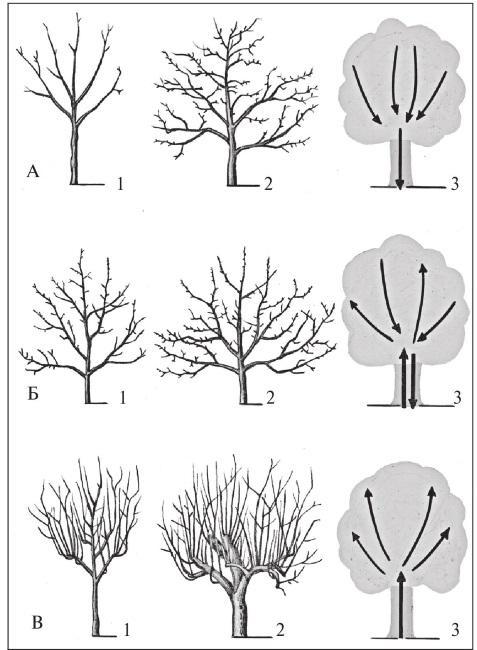
The influence of external factors and the degree of shortening on canopy development
The direction and nature of shoot growth are determined not only by pruning. The gardener must take into account the natural physical and biological factors that influence the geometry of branches in the garden every day. The main ones are shown in the table below.
| Factor | Influence on branch growth |
|---|---|
| Negative geotropism | Stimulates the tree to grow vertically upward. |
| Gravity | Bends branches downward, moving them into a drooping position. |
| Sunlight | Directs branch growth towards better illumination. |
| Electric potential difference | Activates tissue growth on the underside of the branch, lifting its tip. |
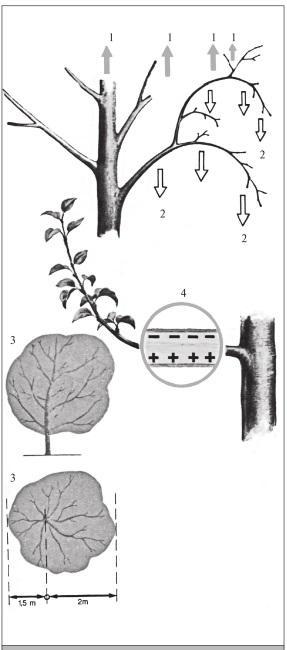
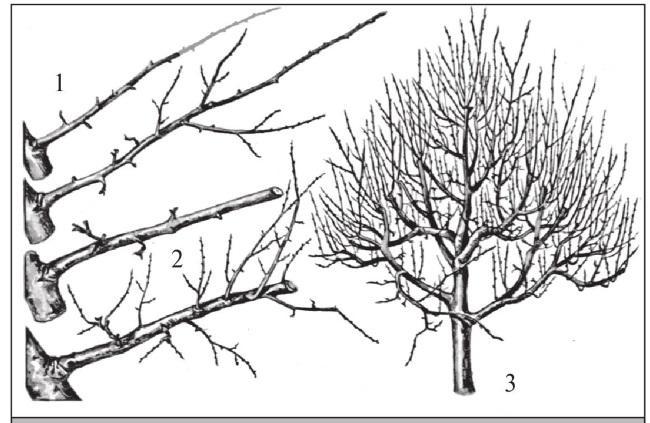
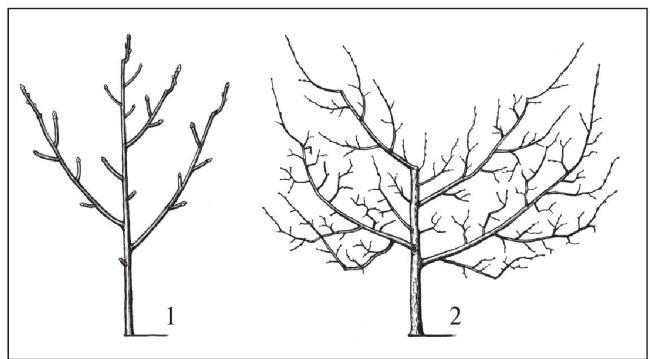
Any pruning is a tool for managing the tree's balance. Light shortening (long pruning) acts exclusively locally. Only the buds right at the cut awaken to grow, which allows for avoiding the mass appearance of unnecessary shoots and does not stress the plant.
Severe shortening (short pruning), on the contrary, sharply reduces the total length of shoots and leaf area. The newly formed branches often emerge at sharp angles, weakening the strength of the canopy. This delays the onset of commercial fruiting, and the overall canopy volume ends up smaller than that of unpruned trees.
Regular severe pruning traps the tree in a vicious cycle. Vigorous compensatory shoot growth in the current season will require heavy thinning in the next. The plant spends all its resources on restoring wood instead of setting fruit, and the young shoots do not have time to harden off before winter and freeze.
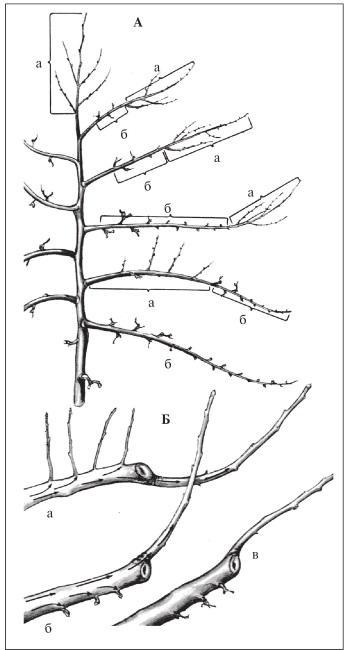
When branches are completely removed to the branch collar, there may not be a clear compensatory growth at one point. The flow of released plastic materials is redistributed through vascular connections between branches located above the cut site. However, if the cutting technique is improper, the tree reacts with watersprout formation.
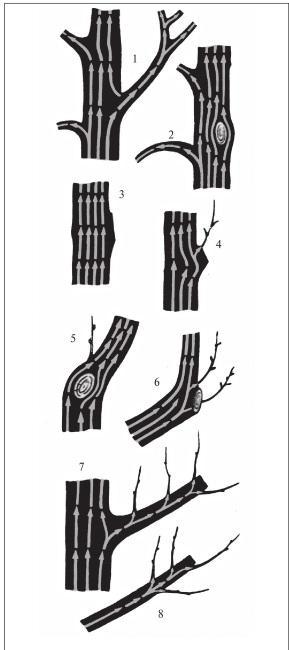
- 1 – without pruning;
- 2, 3 – with correct branch removal;
- 4 – with incorrect removal (possibility of watersprouts);
- 5, 6 – watersprout formation when pruning to a thin branch (parts located above are unable to use the additional flow of plastic materials switched to them);
- 7, 8 – with mechanical blockage of the pathways for the movement of plastic materials.
Pruning to a branch that is too thin (variants 5 and 6) results in the upper part of the canopy being unable to absorb the influx of nutrients. The excess of plastic substances is dumped through dormant buds at the cut site, causing vigorous development of watersprouts.
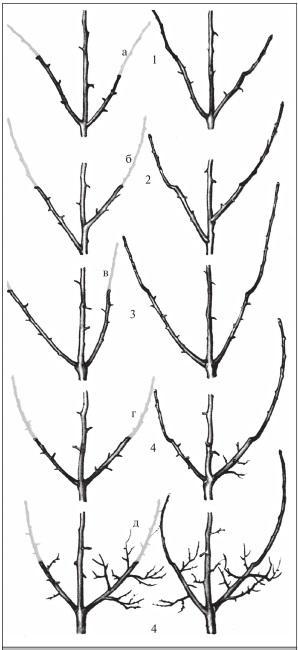
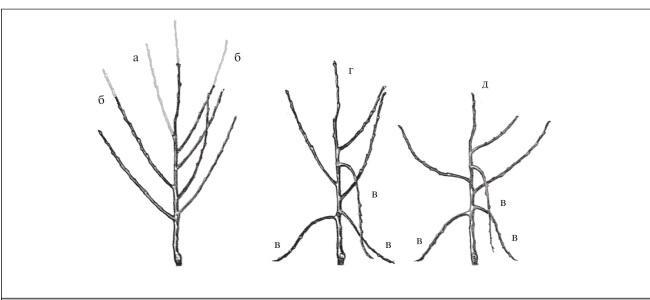
| 1 | The angle of emergence, thickness, and length (before pruning) are identical, growth is stronger in branch a, which underwent a lesser degree of shortening |
| 2 | The angle of emergence and strength of development of the branches are identical; with an equal level of pruning, growth is stronger in branch b, located higher on the trunk |
| 3 | The strength of branch development and the degree of pruning are identical, the reaction is stronger in branch c, which has a more vertical growth direction |
| 4 | Ceteris paribus, branches that are more developed (d) or have more fruiting wood (e) react more strongly to the same degree of pruning |
When pruning to a lateral branch, bud sprouting and growth stimulation will occur primarily on the side of the branch where the cut is made. Thus, when pruning to a downward-oriented branch, one should expect the appearance of water sprouts on the upper side of the remaining part of the branch near the cut site, or increased growth of the branches already present there.
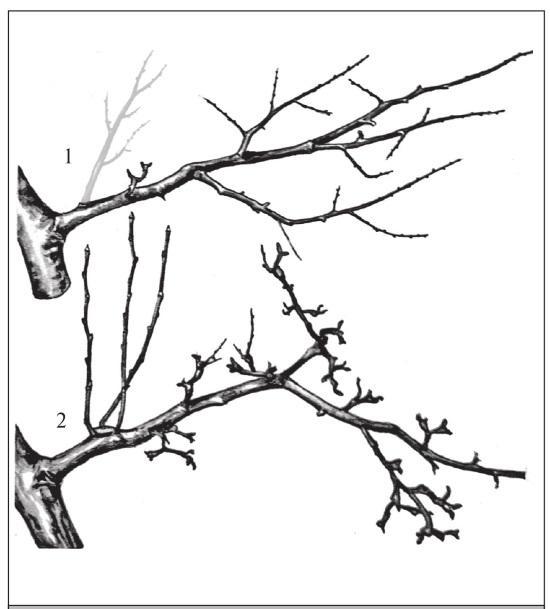
Disruption of growth correlation also occurs as a result of changing the orientation of branches in space. With vertical growth of branches, the strongest shoots develop from the terminal and adjacent buds.
As the branch moves from a vertical to a horizontal position, bud dormancy decreases, and shoot growth from the apex to the base of the branch becomes more uniform. Shoots are usually weaker, but also more prone to fruiting. Furthermore, in trees with pronounced apical dominance, rapid growth of one specific branch is observed, while in trees with weak apical dominance, there is more or less uniform growth of all branches.
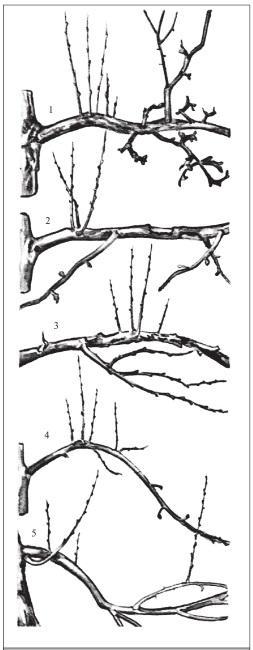
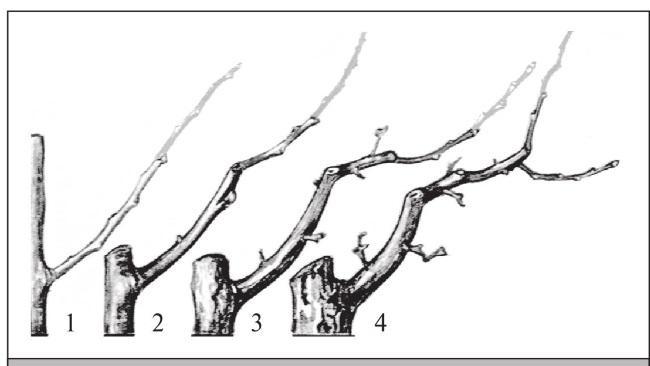
- 1 – branch aging;
- 2 – mechanical damage;
- 3 – frost damage;
- 4 – branch bending;
- 5 – natural drooping growth of branches.
With improper branch bending, an excessive number of bent branches, as well as in a number of cultivars whose trees are characterized by natural drooping growth, strong vertically growing water sprouts inevitably appear. Such shoots utilize that part of the water and mineral nutrient elements which the upper part of horizontal and drooping branches is unable to utilize.
Read next
Pruning and training For gardeners
The influence of pruning time of fruit trees on their growth and fruiting
Pruning and training For gardeners
Techniques and rules for the first post-planting pruning of fruit trees
Pruning and training For gardeners