
Techniques and rules for the first post-planting pruning of fruit trees
2 min read
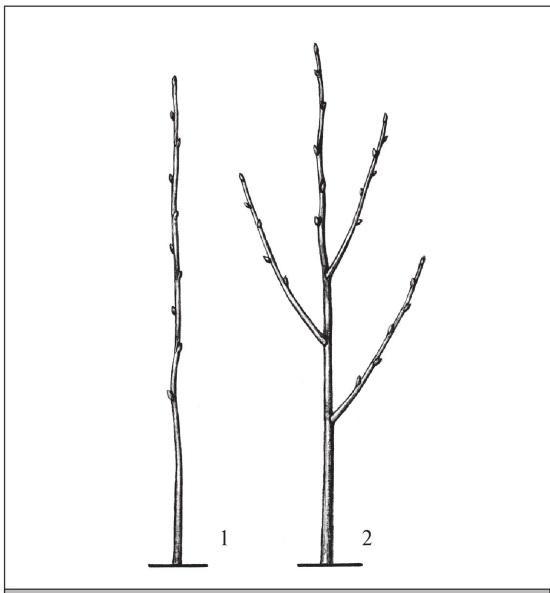
The first post-planting pruning determines the development of the fruit tree for years to come. The main task of the agronomist during this period is to correct development defects of the nursery plant acquired in the nursery. It is also important to compensate for the inevitable damage to the root system and branches after digging, transportation, and planting. A correctly performed operation ensures the dominant position of the central leader and balanced development of skeletal branches with minimal removal of healthy shoots.
- Number of skeletal branches — 2–3 pcs.
- Leader height above branches (pyramidal canopy) — 20–25 cm
- Leader height above branches (spreading canopy) — 10–15 cm
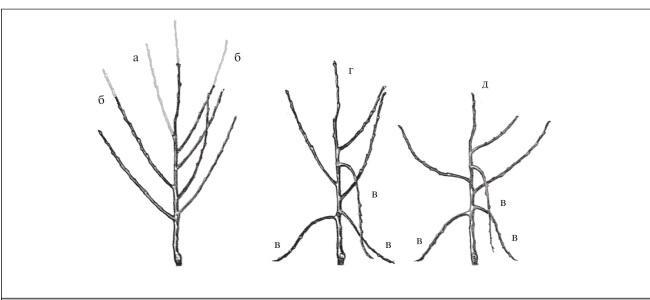
Technique for canopy formation and branch subordination
When working with well-developed nursery plants that have a distinct central leader and strong lateral growth, strict rules of subordination must be followed. Branches that grow vertically or have significant thickness at the base are always pruned more severely than the others. This is necessary to balance their growth vigor with other parts of the canopy and prevent them from suppressing the leader.
- Select 2–3 of the strongest existing branches to serve as the main (skeletal) ones.
- Balance their growth vigor through pruning or by changing their inclination angle.
- Subordinate the selected main branches to the central leader, maintaining the necessary cut height.
- Completely remove competitor branches of the leader by cutting them "to the ring".
- Bend all other branches that are not part of the canopy framework into a horizontal or drooping position.
Avoid critical errors during branch subordination: cutting branches at the same level weakens the leader, excessive leader height exposes the trunk, and unequal branch quality or excessively short pruning disrupts the balanced development of the tree.
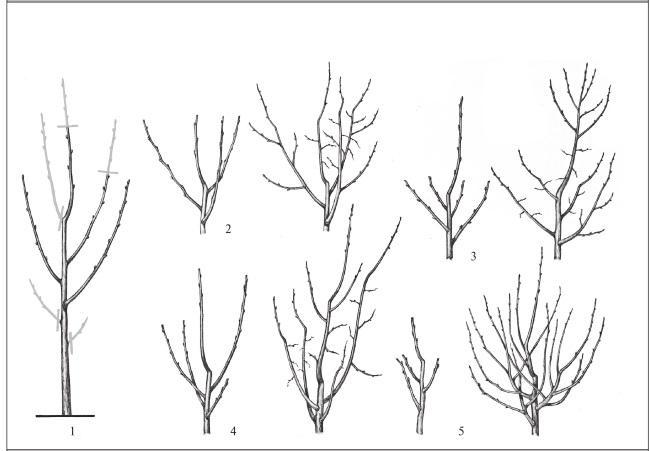
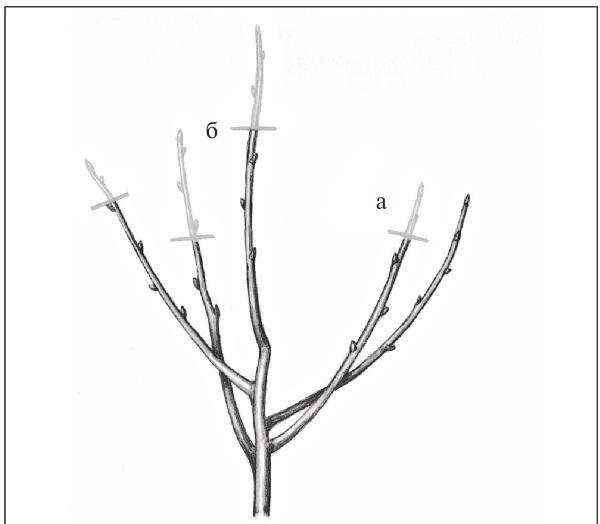
The degree to which the central leader exceeds the skeletal branches depends on the biological characteristics of the specific cultivar. During pruning, it is important to strictly observe these parameters to avoid canopy deformation in the future. To determine the optimal cut height, use the standards provided below.
| Canopy type | Leader height above main branches |
|---|---|
| Cultivars with drooping growth | 10–15 cm |
| Cultivars with pyramidal growth | 20–25 cm |
The timing of pruning depends on the moisture availability of the zone. In conditions of insufficient moisture, pruning is carried out in the year of planting (in spring) or in the spring of the following year if the nursery plants were planted in the autumn. With sufficient rainfall, the first post-planting pruning is performed one year after planting.
Read next
Pruning and training For gardeners
Technologies for shaping nursery plants of fruit trees in a nursery
Pruning and training For agronomists
Modern methods of canopy training for flat crowns and palmettes in fruit trees
Pruning and training For gardeners