
Technologies for shaping nursery plants of fruit trees in a nursery
4 min read
Growing one-year-old nursery plants without canopy formation is the simplest and most cost-effective way to obtain high-quality nursery plant material in a nursery. Such plants are cheaper to produce, provide maximum yield per unit area, and are not damaged during lifting or transport. They establish significantly better in the garden, resume growth faster, and it is easier to form a canopy of any desired type from them.
When growing non-canopied two-year-old plants, lateral branches grow freely. The only zone where shoot growth must be strictly restricted is the future trunk. Buds here are removed at the very beginning of growth, and green shoots are broken off when they reach a length of 6–8 cm.
If the shoots in the trunk zone have already become lignified, prune them "flush" strictly after the end of the growing season. In extreme cases, this work can be postponed to the stage of planting nursery plants in the garden.
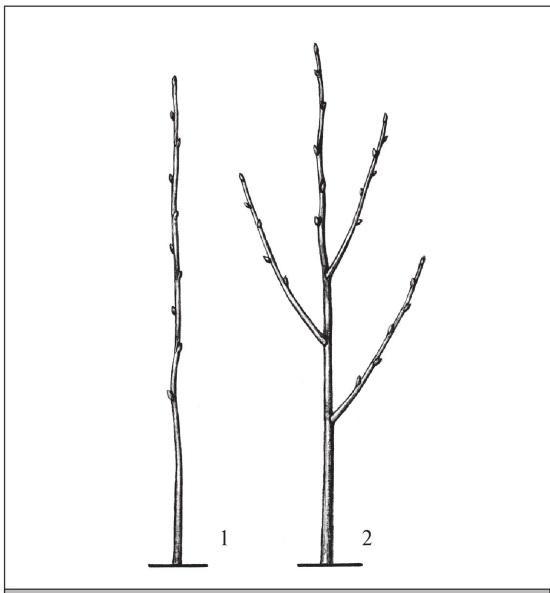
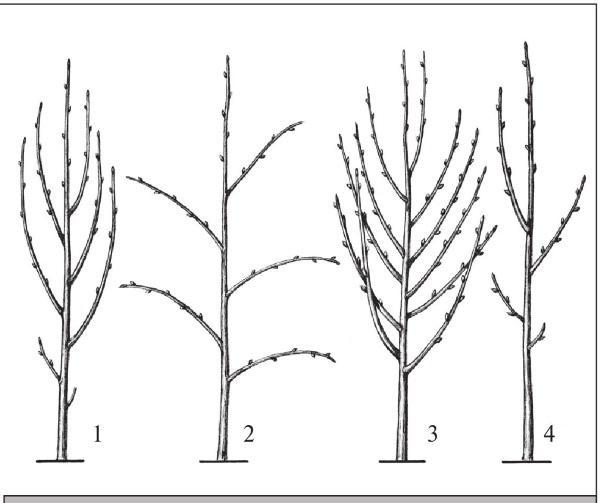
The production of non-canopied two-year-old plants significantly reduces the risk of branch breakage during transport. Due to abundant lateral branching, the accidental loss of one or two branches is not critical: the canopy framework is easily formed from the remaining ones. Furthermore, with free branching, narrow crotch angles occur extremely rarely — usually only in shoots near the apex.
Technology for two-year-old canopy formation
Production of canopied two-year-old plants directly in the nursery requires high qualifications from workers. Here, it is critically important to strictly control the number of branches, their crotch angles from the trunk, and their uniform distribution in space. Only strong, well-developed one-year-old plants can serve as a reliable foundation for a high-quality canopy.
Do not use weak or medium one-year-old plants to establish a canopy. Weak nursery plants branch very reluctantly the following year, and often only the apical bud sprouts. Medium one-year-old plants form lateral branches only in a clustered tier near the very apex, from which it is impossible to form a proper framework.
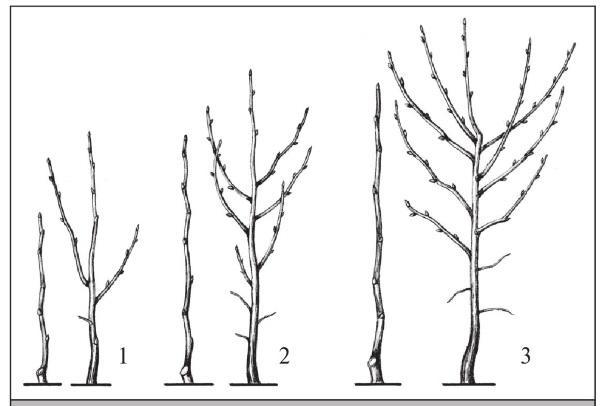
When establishing the future tree canopy, orient yourself toward the following technological parameters:
- Trunk on dwarfing rootstocks — 40 cm
- Trunk on vigorous rootstocks — up to 60 cm
- Trunk for mechanical harvesting — 70–80 cm (up to 1 m)
- Zone for placing main branches — 40–60 cm
- Crotch angle of skeletal branches — 45–60°
- Pruning height of a one-year-old plant — 80–100 cm
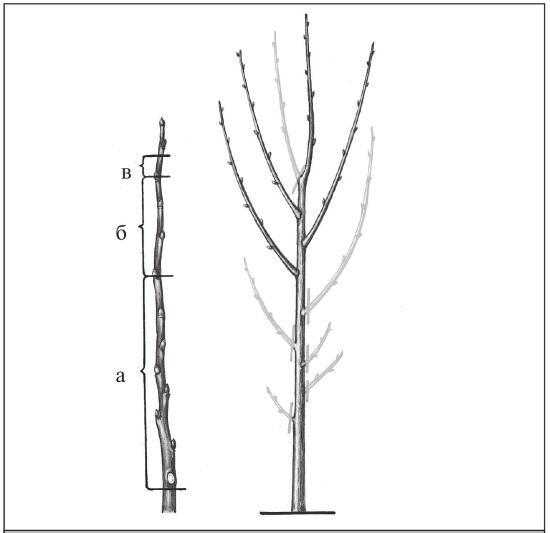
Forming the canopy framework on strong one-year-old plants is performed strictly step-by-step:
- Mark the zones for the trunk and main branches. Measure the trunk height depending on the rootstock and the zone for future branches (40–60 cm above the trunk).
- Clean the future trunk zone. Completely remove all buds before growth begins or rub off green shoots immediately after they sprout.
- Prune the one-year-old plant to height. Make the cut at a height of 80–100 cm. Choose the bud for the cut strictly vertically above the site of the rootstock stub removal to avoid trunk curvature.
- Form a tier of skeletal branches. From the shoots above the trunk, select the strongest branches with crotch angles of 45–60° according to the canopy scheme. Leave 1–2 additional branches as a reserve.
- Prune the central leader. Make the cut to a bud without leaving a stub. If the leader deviates strongly to the side, cut it with a stub about 5 cm high (de-budding it) and tie the extension shoot to it.
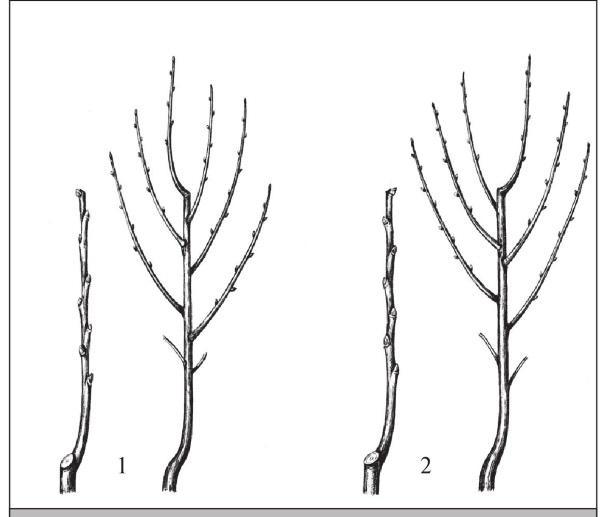
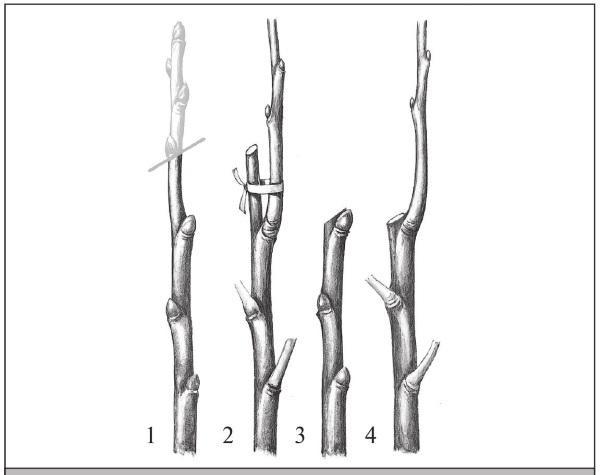
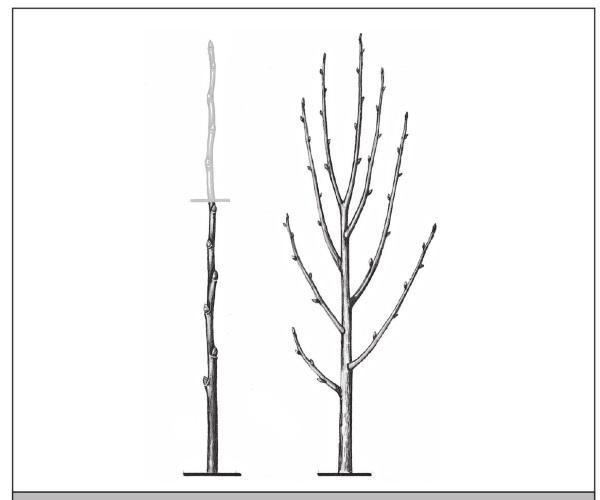
When pruning vigorous one-year-old plants in the nursery, a problem often arises with the crotch angles of future skeletal branches. If a naturally developing plant forms wide angles, then with severe shortening, shoots below the cut point begin to grow at an acute angle. Such branches are unsuitable for establishing a canopy framework, as they easily break off under the weight of the harvest.
The more severely you prune a one-year-old plant in the canopy establishment zone, the sharper the crotch angles of the new branches will be. This critically reduces the strength of the tree's future skeleton.
To avoid the formation of narrow crotch angles, one-year-old nursery plants should be shortened as little as possible. At the same time, the standard trunk height must not be increased. In a nursery, this task can be solved using two practical methods of light shortening.
Methods for Lowering the Scaffold Branch Initiation Zone
Formation by leaving a stub is carried out according to the following scheme:
- A longer stub is left on the leader.
- The extension shoot is tied to the remaining stub.
- All other shoots appearing on this stub are removed at a later date.
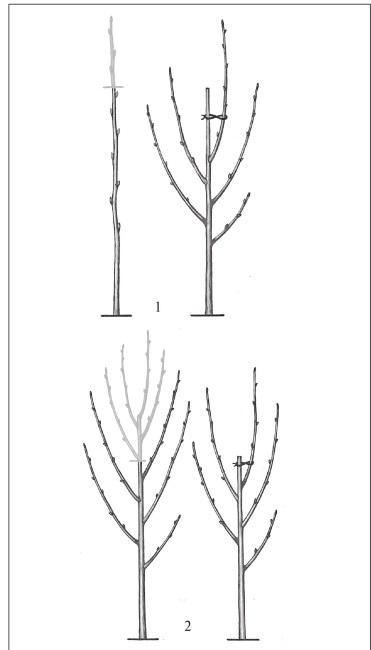
Re-pruning to a new leader is carried out in three stages:
- The one-year-old nursery plant is first pruned moderately.
- A second pruning is performed lower down, transferring growth to a new central leader.
- The main scaffold branches are selected only from those shoots that emerge at an optimal angle.
Read next
Pruning and training For agronomists
Methods for forming columnar and spindle-shaped canopies of fruit trees
Pruning and training For gardeners
Fundamentals of canopy formation and pruning of sweet cherry in the orchard
Pruning and training For gardeners