
Methods for forming columnar and spindle-shaped canopies of fruit trees
6 min read
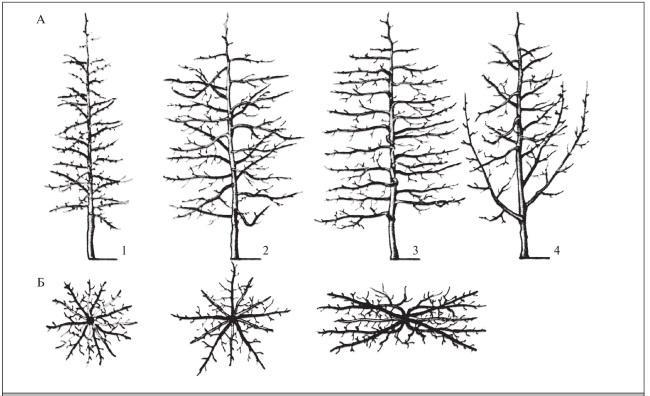
Pillar crown formation
A columnar crown, or pillar (a modern vertical cordon), allows for significantly denser planting due to the complete absence of permanent lateral branches. Its productivity is maintained through the annual cyclical replacement of fruiting wood. The structure consists of a sturdy central leader, on which short fruiting units are evenly distributed. This layout ensures excellent illumination of each fruit and facilitates manual work in the orchard.
- Central leader height — up to 2 m
- Crown diameter — approx. 1 m
- Number of fruiting branches — 20–25 pcs.
- Spacing of units on the leader — 10–12 cm
- Load per fruiting branch — 3–4 fruits
- Working with one-year-old plants. If shoot formation is weak, shorten the nursery plant slightly in spring; if strong, leave it without pruning. During the first growing season, allow all shoots to grow freely.
- Pruning in the spring of the second year. Remove all strong shoots (especially those with narrow crotch angles) and very weak branches flush to the collar. Shorten the remaining branches to two well-developed buds.
- Pruning in the spring of the third year. From the two shoots that grew on each of the previous year's stubs, prune one short to two buds for replacement, and leave the second one unpruned for fruiting. Shorten new one-year-old branches on the leader to two buds, and remove strong vertical and weak ones flush to the collar.
- Annual cyclical rotation. In spring, completely remove the three-year-old branch that has finished fruiting, leaving a small stub. Leave the two-year-old branch and one one-year-old branch unpruned for fruiting, and shorten the second one-year-old branch to two buds to prepare for replacement.
The pillar crown should not have branches older than three years, except for the central leader. To avoid overloading the tree and to obtain large, marketable fruit, strictly regulate the yield by leaving no more than 3–4 fruits on each unit.
Technology for creating spindle-shaped crowns
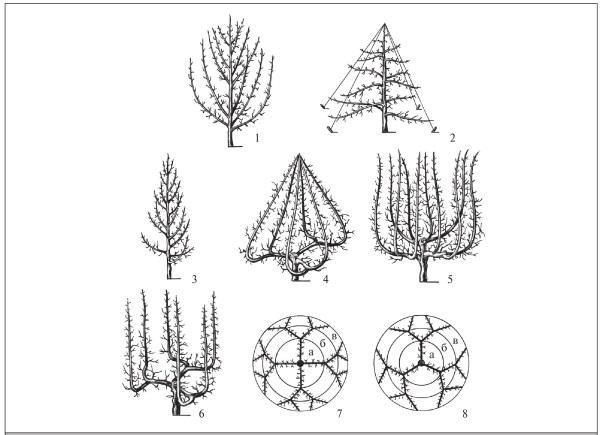
Spindle-shaped crowns are simple to form, ensure excellent leaf illumination, and facilitate early entry of the orchard into fruiting. Depending on the vigor of the rootstock and the planned planting density, agronomists choose a classic spindle bush (spindelbusch), a flat spindle bush, or a freely growing cordon without main branches. The choice of a specific shape depends directly on the rootstock's vigor and the biological characteristics of the cultivar.
A classic spindle bush is formed on one-year-old nursery plants grafted onto dwarfing and semi-dwarfing rootstocks, arranging branches on the leader in tiers or in a spiral at a 10–15° angle to the horizon. In a flat spindle bush, which combines features of a spindle and an espalier, the first two pairs of branches are directed at an angle of 45–50° along the row, while temporary branches are oriented strictly horizontally. A freely growing cordon consists exclusively of temporary horizontal branches, which are freely distributed along the trunk, adjusting their number depending on the available space.
- Spindle bush height — 2.5–3 m
- Flat spindle bush height — 3–3.5 m
- Flat spindle bush trunk height — 45–60 cm
- Cordon branch length — no more than 50 cm
- Flat crown width along the row — 4 m
- First pruning. In spring, shorten the one-year-old nursery plant at a height of 70–90 cm from the ground.
- Summer fixation (July — August). Move all developed lateral branches into a horizontal position. Tie the lower shoots to the trunk or stakes in the ground, and secure the upper ones to the branches located below.
- Stimulation of branching (spring of the second year). Shorten the leader shoot of the central leader at a height of 25–40 cm from the last bent branch. If the cultivar has good branching or weak growth, leave the leader without pruning.
- Fixation of the second tier (end of summer). Give new growth a horizontal position and tie them to the branches below. Repeat this operation in subsequent years of formation.
- Growth restriction. When the tree reaches a height of 2.5–3 m, cut the central leader above one of the horizontal branches.
When bending branches, ensure that an arc does not form at the bend, otherwise the branch may break. If the branches have sagged heavily under the weight of the harvest, prune their ends, transferring to a strong vertical side shoot, and bend them back to a horizontal position.
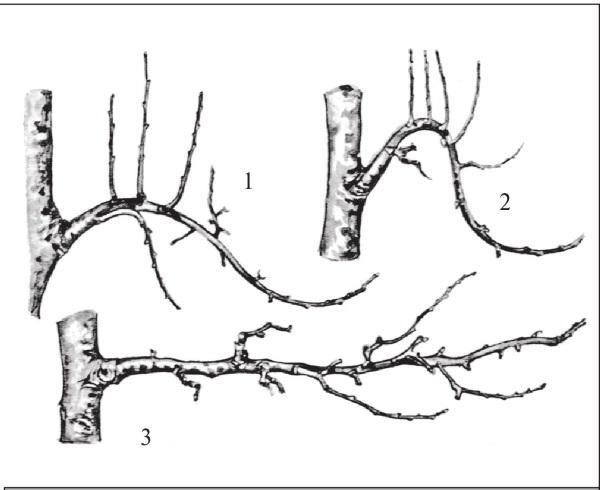
Without regular thinning, a spindle bush quickly loses productivity. If the crown is neglected, branches become excessively long and droop, the light regime deteriorates, and fruiting shifts to the periphery. As a result, lower branches die off, fruit becomes smaller, and tree maintenance and harvesting become much more complicated.
To avoid crown overcrowding, timely remove the following categories of branches:
- strong vertical shoots that cannot be brought into a horizontal position;
- aging and low-productivity branches;
- branches that create heavy shade and those already shaded.
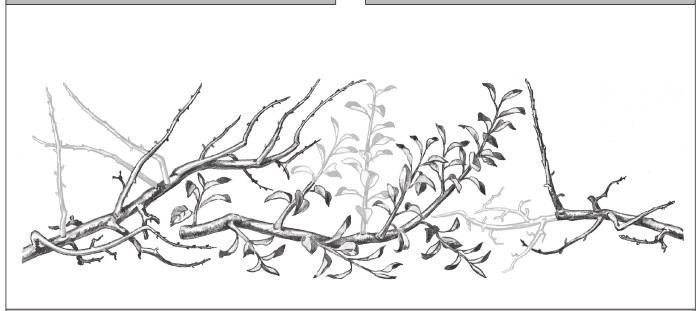
Regularly check the tension of the twine when bending branches. As the wood thickens, the tie may cut into the bark and form a constriction. If the fastener is not removed in time, the branch at the point of constriction may easily break under the weight of the harvest or due to strong wind.
When forming a spindle bush (spindelbusch), it is important to monitor the light and nutrient balance of the canopy. The upper part of the tree should not suppress the lower part, so always establish the lower branches to be longer and more vigorous. If a branch needs to be rejuvenated or replaced, it is pruned back to a strong vertical shoot. Once the shoot has strengthened, it is bent into a horizontal position.
The classic spindle bush is valued by gardeners for the simplicity of its training, quick entry into fruiting, and high labor productivity during harvesting. This scheme is best suited for precocious cultivars with moderate growth, good bud break, and a wide-spreading canopy, whose branches naturally take on a horizontal position. Cultivars with vigorous growth and excessive branching are much more difficult to train using the classic type.
Modified spindle bush forms for intensive orchards
Special modifications of the spindle-shaped canopy have been developed for modern intensive plantings. They allow for the optimization of nutrient area for trees and significantly simplify orchard care.
- Fruit wall thickness — 1.5–2 m
- Number of branches in the lower tier of a flat spindle bush — 2 pcs.
- Number of branches in the lower tier of a free-growing bush — 3–4 pcs.
The flattened spindle bush is trained as simply as the classic one, but all its branches are directed strictly along the row. In the lower tier, only two branches are left at a slight angle to the horizon. Closing in the row, the trees form a continuous fruit wall. This modification allows for the successful cultivation of even those cultivars prone to strong branching, which are poorly suited for a standard spindle bush.
| Fruit wall parameter | Value |
|---|---|
| Thickness | 1.5–2 m |
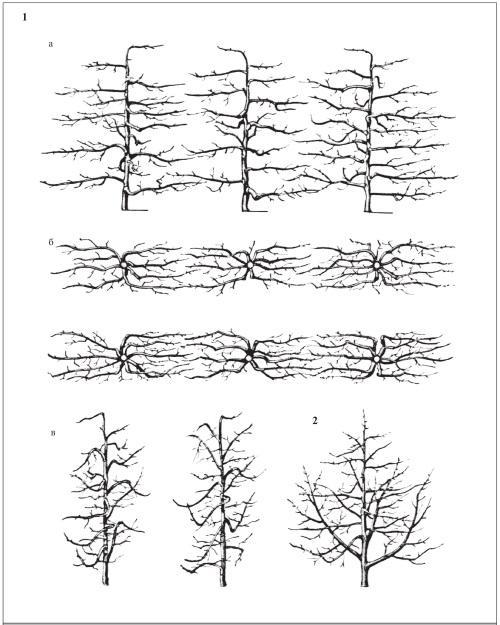
The free-growing spindle bush requires minimal pruning and is free of the drawbacks of the classic form. The lower 3–4 branches here are established in a sparse tier and are allowed to grow freely and in an upright position. The fruiting branches on them and on the central leader are arranged horizontally.
When pruning a free-growing canopy, follow these rules:
- remove only competitor shoots and vigorous vertical branches;
- shorten fruiting branches only if they become excessively long or to rejuvenate the fruit wood;
- to maintain the dimensions of the canopy, transfer elongated branches to well-positioned side shoots.
Read next
Pruning and training For agronomists
Modern methods of canopy training for flat crowns and palmettes in fruit trees
Pruning and training For gardeners
Pruning and canopy formation of fruit-bearing trees in the orchard
Pruning and training For gardeners