
Fundamentals of canopy formation and pruning of sweet cherry in the orchard
2 min read
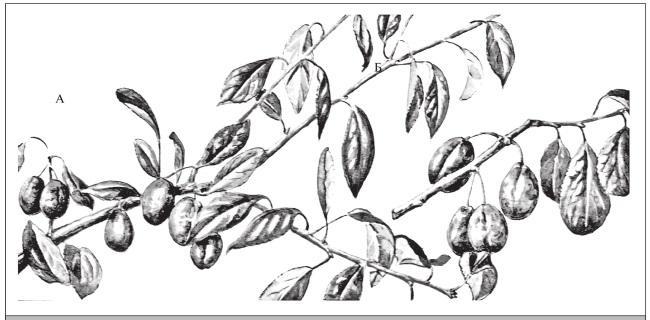
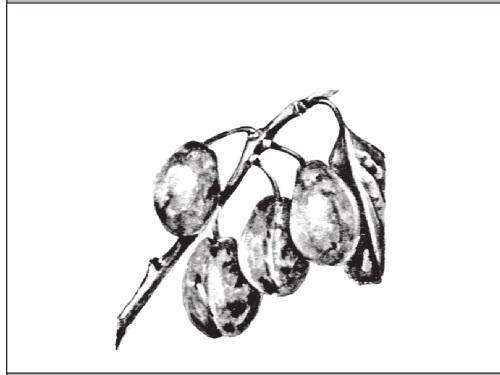
Sweet cherry has a high bud burst capacity, but forms shoots poorly. Due to this biological trait, the trees quickly become bare, stretch upward significantly, and form distinct tiers of branches. The bulk of the harvest on mature trees is formed on spur clusters, so the primary task of pruning is their regular renewal.
- Share of the harvest on spur clusters — more than 3/4
- Pruning height of a one-year-old plant — 1–1.1 m
- Number of branches in the first tier — 3–4
- Distance between tiers — 0.5–0.8 m
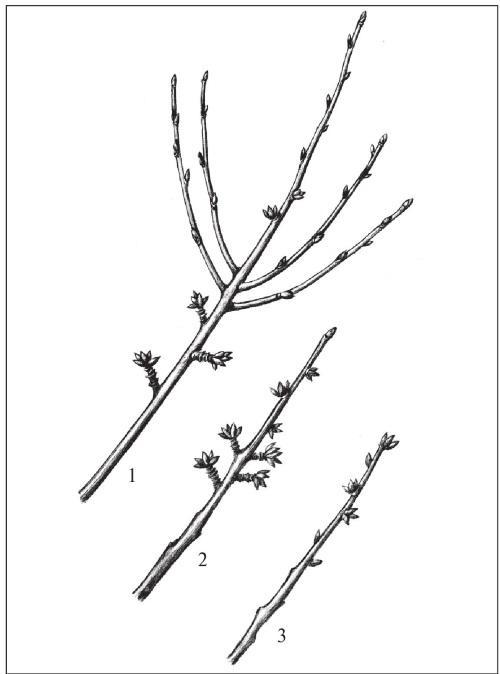
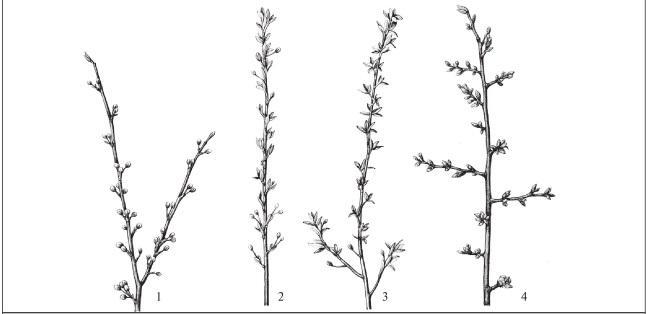
The branching pattern of the sweet cherry depends directly on the length of annual growth. By regulating this parameter, you can control the setting of buds and future lateral shoots. The development of buds on a branch follows these patterns:
- Growth over 30–40 cm: lateral shoots develop actively on the branch.
- Growth of 20–30 cm: exclusively spur clusters are formed.
- Growth of less than 10–15 cm: only lateral flower buds and only one terminal vegetative bud are set.
Canopy formation technology and cultivar-specific pruning
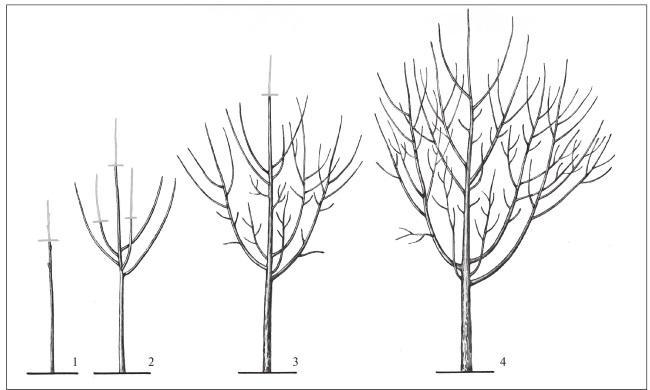
A sparsely layered canopy shape consisting of three tiers of branches is optimal for sweet cherry. When creating it, it is important to avoid sharp-angled crotches and to keep in mind the cultivar-specific growth traits of the tree. Canopy formation is carried out sequentially, starting from the first year of planting.
- Assess the height of the one-year-old plant. If the nursery plant is shorter than 1 m, it is left without pruning. If it is taller than 1 m, the plant is shortened to a level of 1–1.1 m.
- Form the first tier. Leave 3–4 scaffold branches. Remove all excess shoots to the collar or shorten them by half.
- Set subsequent tiers. Maintain a distance between tiers within 0.5–0.8 m. In each subsequent tier, leave one branch fewer than in the previous one.
- Regulate the growth of the leader. The central leader is not shortened if its length does not exceed 1 m.
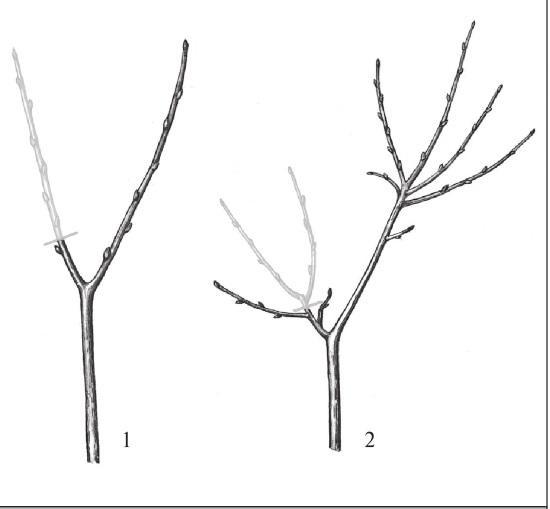
The pruning method is chosen based on the growth direction of the branches for a specific canopy type. This allows for balancing the tree's dimensions and improving light penetration to the inner parts.
| Canopy type | Shortening method |
|---|---|
| Pyramidal | Cut to an outward-facing lateral branch |
| Spreading | Cut to an inward-facing lateral branch |
Cultivars with strong branching (e.g., 'Francuzskaya chernaya') are formed primarily by thinning out. Upon entering the fruiting stage, vigorous and moderately branching cultivars are also pruned by thinning the canopy. For poorly branching cultivars, a differentiated approach is required:
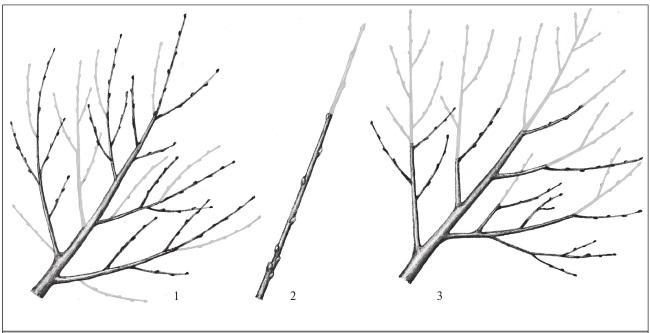
- one-year-old branches longer than 60 cm are shortened by 1/4–1/3 of their length to stimulate branching;
- short branches (30–40 cm) are left without shortening;
- when "clusters" of branches form at the sites of previous cuts, some shoots are removed, and the remaining ones are pruned to 4–5 buds.
Do not shorten weak branches shorter than 30 cm. Such pruning is undesirable, as it leads to a loss of harvest due to a reduction in the number of flower buds. Only vigorous growth should be pruned to stimulate branch development.
When the orchard enters the period of full fruiting, the canopy dimensions in height and width are limited using contour mechanical pruning. After the machinery passes, detailed manual refinement of the canopy is mandatory.
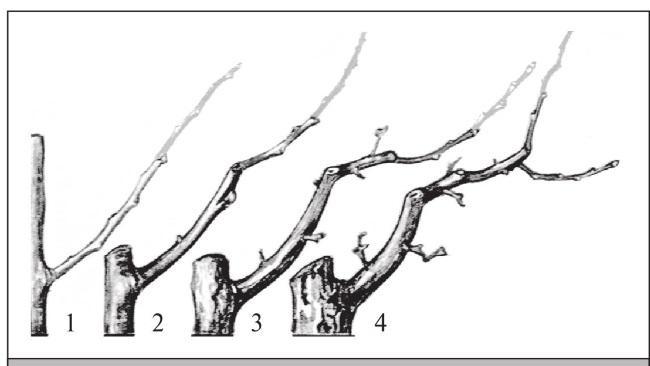
Rejuvenating pruning begins when the length of annual growth drops to 15–20 cm. The degree of rejuvenation depends on the vigor of the shoots: the weaker they are, the more severe the pruning should be. Branches are cut back to lateral side branches.
Do not perform severe pruning on weakened trees: this provokes excessive gummosis, and cuts and wounds on such plants heal extremely poorly.
Read next
Pruning and training For gardeners
Features of forming and pruning tree-type and bush-type cherry cultivars
Pruning and training For gardeners
Pruning and canopy formation of fruit-bearing trees in the orchard
Pruning and training For agronomists