
Training and pruning of plum trees considering the type of fruiting and cultivar
3 min read
Plum trees are characterized by high growth rates, so it is necessary to lay the foundation for the future harvest from the first years of the orchard's life. Early-bearing cultivars, such as Pamyat Timiryazeva and Volzhskaya krasavitsa, produce their first commercial harvest as early as 3–4 years after planting. Late-ripening cultivars — Skorospelka rozovaya and Vengerka moskovskaya — enter fruiting in the 5–6th year. With proper care, a plum orchard fruits steadily for 20 years or more, provided that the annual shoot growth is maintained at an optimal level.
- Entry into fruiting (early-bearing) — 3–4th year
- Entry into fruiting (late cultivars) — 5–6th year
- Productive age of plantings — up to 20 years
- Optimal shoot growth — from 40 cm
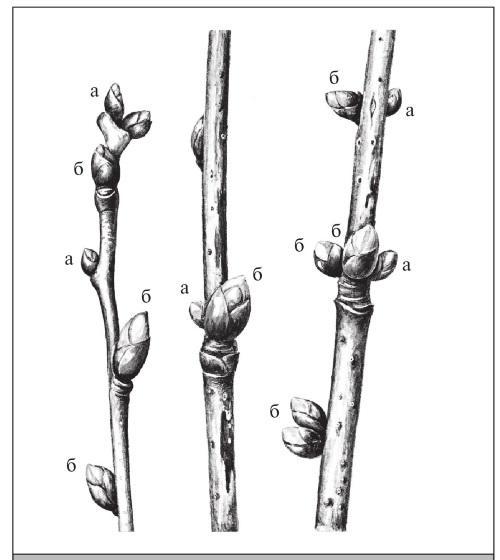
The nature of plum fruiting directly depends on the type of buds. On vigorous shoots, flower buds are set in the lower part, cluster buds in the middle, and solitary vegetative buds at the tip. In short shoots, all lateral buds are flower buds, and only the terminal one remains vegetative. If annual growth weakens, the reproductive organs (spurs and bouquet branches) dry out quickly, causing the tree branches to become bare.
Monitor the length of annual shoots. As soon as their growth drops below 40 cm, the process of mass desiccation of fruiting structures begins, leading to a sharp decrease in yield.
Taking into account the nature of growth and fruiting, all plum cultivars are divided into four main groups:
- First type (Ussurian, Chinese, Canadian, and American species). They fruit mainly on one-year-old branches of varying lengths. Bouquet branches and short shoots 10–15 cm long develop from vegetative buds, where almost all buds are flower buds. Due to the short life of these branches, the canopy quickly becomes bare.
- Second type (cultivars of European plum: Vengerka obyknovennaya, Vengerka moskovskaya, etc.). They possess good shoot-forming ability and medium bud dormancy release. The canopy of such trees is prone to excessive density, so the main maintenance practice becomes regular shortening of branches.
- Third type (cultivars of European plum: Renklod kolkhozny, etc.). They are distinguished by weak shoot-forming ability with medium bud dormancy release. The canopy does not become dense, and skeletal branches graft firmly to the trunk. To prevent the wood from becoming bare, it is necessary to regularly prune the branches.
- Fourth type (Renklod zeleny, etc.). They are characterized by medium bud dormancy release and moderate branching. The main practice here is the shortening of shoots to stimulate branching, combined with periodic thinning of the canopy to improve light penetration.
Rules for forming a central leader canopy
For plums, the central leader form of the canopy is most effective, as it provides uniform light access to all branches. In the process of forming the tree, it is important to strictly maintain the distance between tiers and individual skeletal branches. The optimal parameters for layout of such a canopy are given in the table.
| Canopy formation parameter | Recommended value |
|---|---|
| Trunk height | about 40 cm |
| Distance between branches in a tier | 10–15 cm |
| Distance between tiers | about 70 cm |
| Interval for individual branches | 30–40 cm |
| Total number of main branches | up to 8–10 |
Never leave branches with a branch angle of less than 40° as skeletal branches. Under the load of the harvest, breaks will inevitably occur at the sharp crotches, which can kill the tree.
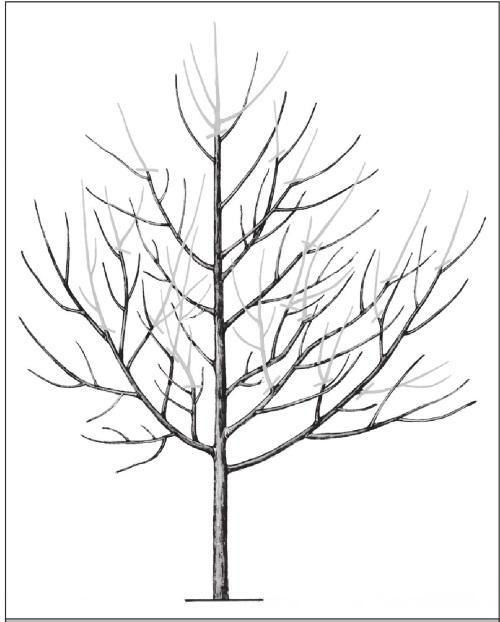
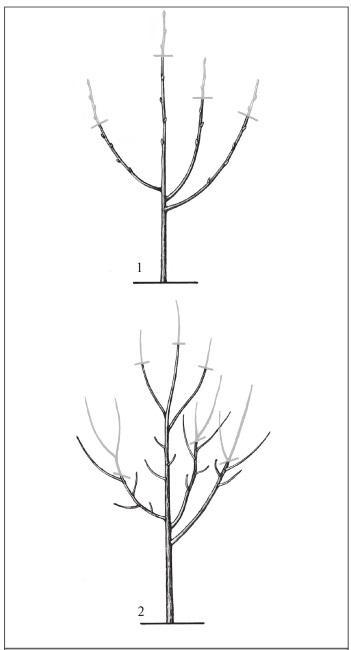
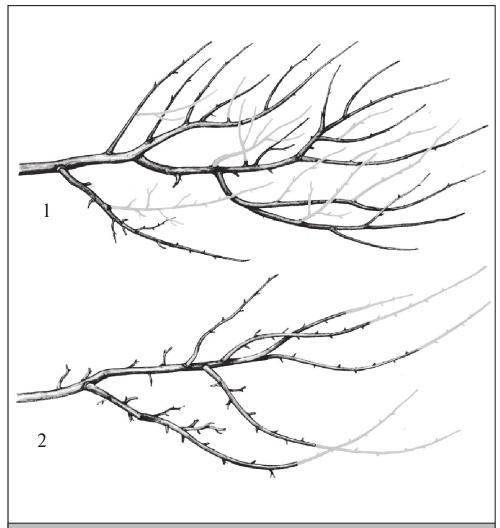
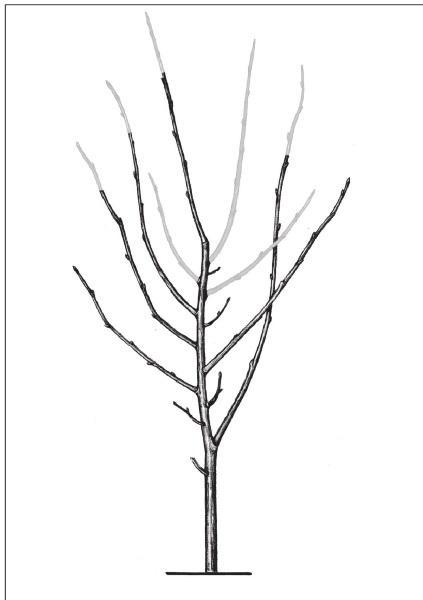
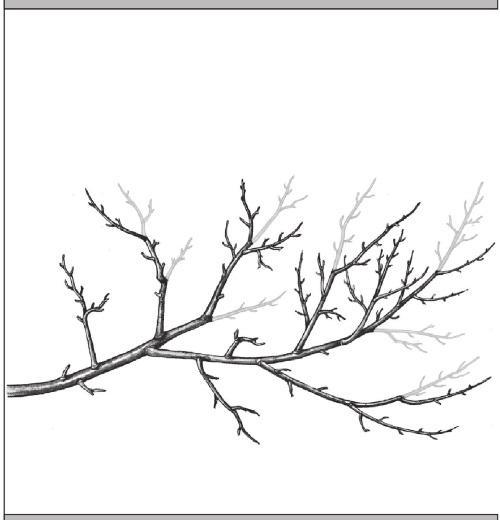
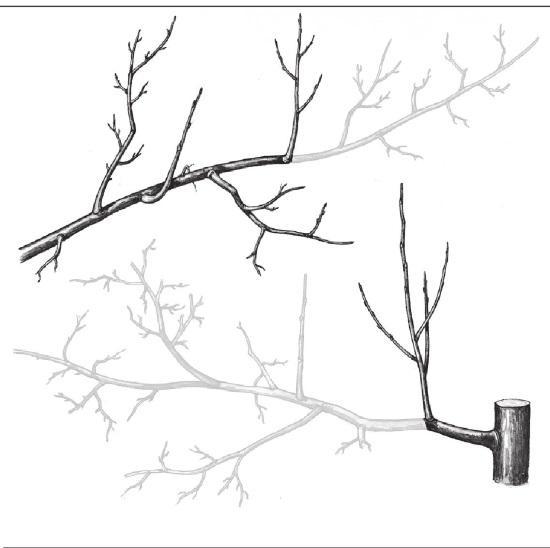
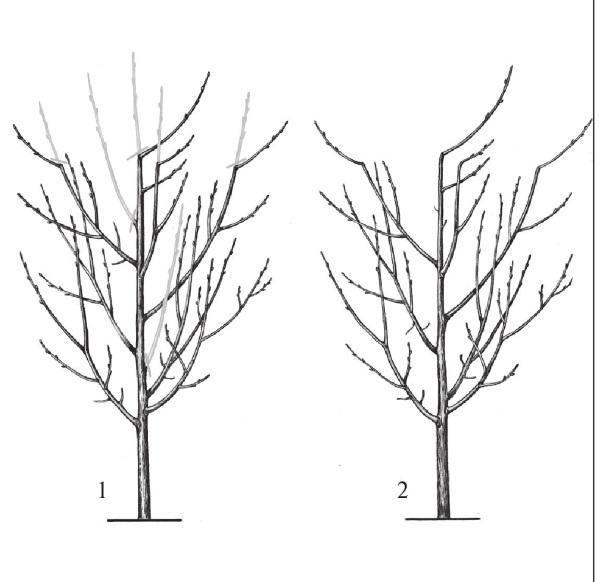
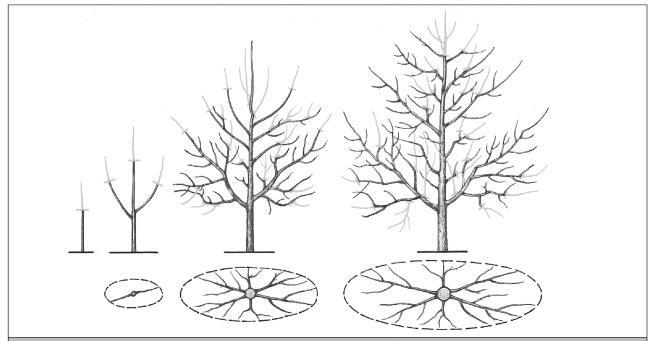
While the canopy formation of a young tree is underway, pruning is kept to a minimum to accelerate the orchard's entry into fruiting. At this stage, it is only important to properly establish the main skeletal branches, stimulate their growth with fruiting structures, and prevent the central part from becoming dense. For adult fruit-bearing trees, the main task of pruning changes — now it is necessary to maintain steady annual growth.
The length of annual growth is the main indicator for the agronomist. If new shoots grow by 40 cm or more, the tree is developing normally and no strong intervention is required. In this case, they limit themselves to light preventative thinning, which keeps the canopy healthy and improves its illumination.
In the process of sanitary and regulatory pruning of a fruit-bearing plum, it is necessary to timely remove unproductive elements. These include:
- diseased, broken, and dried-out branches;
- parts of the canopy damaged by winter frosts;
- rubbing branches and shoots that have become very bare and have stopped producing a harvest.
When shoot growth begins to decline, the orchard requires rejuvenating pruning to maintain productivity. The intensity of this operation directly depends on the degree of growth suppression. At the first signs of slowing growth, light rejuvenation is performed by cutting the branches above the nearest lateral branch. If the growth continues to fade, the degree of rejuvenation is increased, and the main branches are cut back to strong water sprouts.
Do not perform heavy rejuvenating pruning on diseased trees. If the trunk or the bases of the main branches are damaged, rejuvenation will not be effective — it is advisable to grub out such a tree and replace it with a new nursery plant.
Wall-trained culture and height limitation
Plum provides excellent results when grown as a wall-trained culture. In this case, the canopy is shaped into a fan-trained palmette, and the growth vigor is regulated by changing the angle of the branches. To prevent excessively strong shoot growth, additional branches and ramifications are established mainly on the lower side. The load of fruiting wood on the fan is regulated by pruning out excess branches.
Once the orchard enters full fruiting, it is necessary to limit the dimensions of the trees. To do this, the central leader is pruned back to a lateral branch. Subsequently, the size of the canopy is maintained using contour pruning, which must be followed by detailed manual refinement.
- Pinching of lateral branches (except for the main ones) — above the 5th–7th leaf
- Height limitation for the leader — 2.5–3 m
Read next
Pruning and training For gardeners
Features of forming and pruning tree-type and bush-type cherry cultivars
Pruning and training For gardeners
Pruning and canopy formation of fruit-bearing trees in the orchard
Pruning and training For agronomists