
The influence of pruning time of fruit trees on their growth and fruiting
2 min read
Choosing the optimal timing for pruning
Removal of dry or broken branches, or pruning of one or two small branches, can be carried out at any time of the year. This will not affect the tree's condition or the growth vigor of shoots. In all other cases, the timing of pruning is determined depending on its purpose and the extent to which the tree's response to pruning at a particular time will align with the desired outcome.
During winter, the tree is in a state of relative dormancy. The movement of stored resources to growth points is minimal. When pruning during this period, the bulk of reserves remains unspent. At the beginning of the growing season, they are distributed among the remaining growth and fruiting points. Since the number of such points decreases after pruning, their supply with plastic substances is noticeably improved. Consequently, the growth of leaves, shoots, and generative organs will intensify.
In late spring to early summer, almost all stored resources move toward the growth points. When pruning at this time, especially when heading back, the parts of branches most enriched with plastic substances are removed. After pruning, less developed shoots, leaf rosettes, and dormant buds remain. Naturally, the growth of branches from them can no longer be strong. Instead of long shoots, short ones grow, and sometimes just spurs and brindilles.
Recommendations for pruning trees of different ages
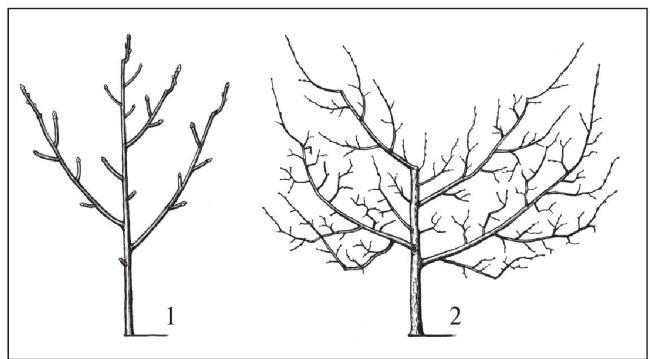
Consequently, for young trees, which are in the process of forming the canopy framework and increasing its volume, inhibiting growth by shifting the pruning time to the period after the start of the growing season is undesirable. This can severely weaken the tree. Such trees should be pruned at least four weeks before the visible start of the growing season.
It is also better to prune bearing trees with weakened growth early in the spring before the start of sap flow. This will activate growth processes, which is required in this case.
Mature, well-growing, and abundantly fruiting trees can be pruned before and after the start of the growing season, up until the end of flowering. If pruning is intended to be heavy, involving canopy reduction, it is better to perform it after the start of the growing season. The response to such pruning will be weaker, and fewer vigorous water sprouts will appear. However, in this case, pruning should be limited to the removal of large branches only.
Read next
Pruning and training For students
Developmental stages of fruit trees and principles of orchard pruning
Pruning and training For gardeners
Peculiarities of pruning and canopy formation of pear trees in the orchard
Pruning and training For agronomists