
Developmental stages of fruit trees and principles of orchard pruning
4 min read
The productivity of an orchard directly depends on how accurately the pruning technology corresponds to the age of the trees. Throughout its life, a tree constantly changes the ratio of vegetative and reproductive processes. The agronomist's task is to notice these changes in time and adjust the pruning method to balance the harvest load and maintain growth vigor.
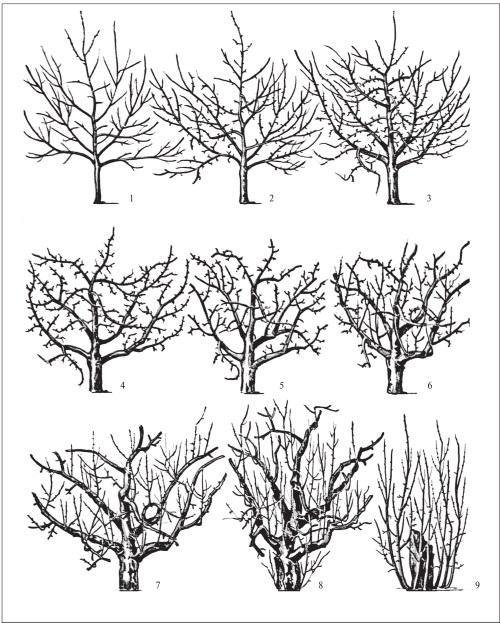
Nine age periods of a classical orchard
In traditional horticulture with natural tree development, the life cycle is divided into nine consecutive stages. At each stage, a tree has specific canopy dimensions and fruiting characteristics that require specific actions from the pruner. The entire system of canopy management in a classical orchard is based on this scheme.
| Age period | Growth and fruiting characteristics | Main pruning task |
|---|---|---|
| 1. Growth of vegetative parts (from planting or grafting to the first fruiting) | Roots and the above-ground system are actively growing. There are few fruiting branches, and fruiting is practically absent. | Form a strong tree framework, stimulate the emergence and development of fruiting branches. |
| 2. Growth and fruiting (from the first fruits to regular harvests) | Main branches show strong growth, and fruiting wood develops well. Yield increases annually. | Continue framework formation, distribute fruiting wood evenly throughout the canopy volume. |
| 3. Fruiting and growth (from stable fruiting to peak harvest) | Progressive growth slows down, terminal shoots on scaffold branches weaken. Old fruiting branches begin to die off, scaffold branches become bare. | Maintain growth processes, prevent branches from becoming bare deep inside the canopy. |
| 4. Fruiting (maximum productivity) | Scaffold branches cease to grow in length. Up to 95–100% of growth points are occupied by fruiting. The periodicity of fruiting increases, fruiting branches die off from the center to the periphery. | Rejuvenate branches to stimulate new growth, thin out excess fruiting wood, balance growth and fruiting. |
| 5. Fruiting and senescence | New shoots do not develop. First, weak fruiting branches dry out, then large scaffold branches begin to die off. | Restore growth activity through the rejuvenation of scaffold branches and the renewal of fruiting branches on them. |
| 6. Senescence, fruiting, and growth | The skeletal part of the canopy dies off en masse. Strong watershoots appear on the bare framework. Harvests drop sharply. | Replace the aging framework with new branches from watershoots (form a new canopy). |
| 7. Senescence, growth, and fruiting | First-order scaffold branches and fruiting structures die off en masse. New canopy tiers are actively formed from watershoots. | Replace old branches with new ones using watershoots. |
| 8. Senescence and growth | Scaffold branches and part of the central leader die off completely. | Pruning is impractical. |
| 9. Growth | The canopy dies off completely. New shoots appear in the form of root suckers near the root collar or below the soil level. | Pruning is not performed. |
Starting from the sixth period, when the canopy has to be restored using watershoots, tree maintenance loses its economic viability. It is more profitable to grub out such plantations and replace them with young plantings.
Specifics of pruning in intensive orchards
Modern intensive technologies fundamentally change the life cycle of plantations. The use of precocious cultivars, dwarfing rootstocks, high-density planting schemes, and cyclic pruning makes it possible to significantly shorten the time spent in each age phase. The first three periods here practically merge, as trees reach commercial fruiting in the shortest possible time.
- Reaching full fruiting in an intensive orchard — 4–5th year
- Reaching full fruiting in a super-intensive orchard — 2–3rd year
- Proportion of growth points with fruiting at peak period — 95–100%
The main task of the agronomist in an intensive orchard is to keep the canopy within optimal dimensions through constant cyclic pruning and timely renewal of fruiting spurs. This prevents the tree from moving into the classical phase of declining growth processes and branch bareness. From the point of view of pruning and formation, the entire cultivation cycle of intensive orchards is divided into just four main stages.
Intensive plantations are not kept until the senescence stage (periods five through nine). Maintaining the life of aging trees contradicts the principle of high profitability. After productivity decreases, such orchards are immediately grubbed out.
| 1 | Increase in vegetative mass (forming the canopy framework and replenishing it with fruiting branches). |
| 2 | Beginning of reproductive activity (completion of formation and limiting the canopy volume within defined parameters). |
| 3 | Balance between vegetative and reproductive activity (maintaining a dynamic equilibrium between growth and fruiting). |
| 4 | Senescence with the weakening of all vital functions (heavy rejuvenation pruning aimed at stimulating growth and maintaining the level of fruiting optimal for the given plantation; in case of a weak response to rejuvenation – grubbing out the orchard). |
Read next
Pruning and training For agronomists
Main types and purposes of pruning fruit trees in the garden
Pruning and training For gardeners
The influence of pruning time of fruit trees on their growth and fruiting
Pruning and training For students