
Patterns of cyclic branch replacement and growth of fruit trees
2 min read
Life span and developmental patterns of branches
Individual parts of the above-ground system of fruit plants vary significantly in their life span. The trunk can exist for up to a hundred years or more, the main branches – for several decades, fruiting branches – on average up to 10–15 years, with the strongest ones up to 20 years, and the weakest no more than 4–5 years. The life span of individual parts of a fruit plant depends on the cultivar biology, the type, intensity, and duration of branch growth, and growing conditions.
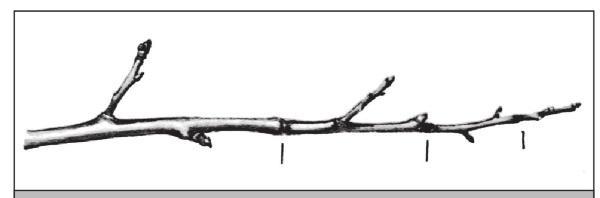
The length of annual shoots along the branch axis regularly decreases from its base to the tip. The longevity of fruiting branches also decreases from the base of the branch on which they are located toward the tip.
Mechanisms of cyclic renewal and receding growth
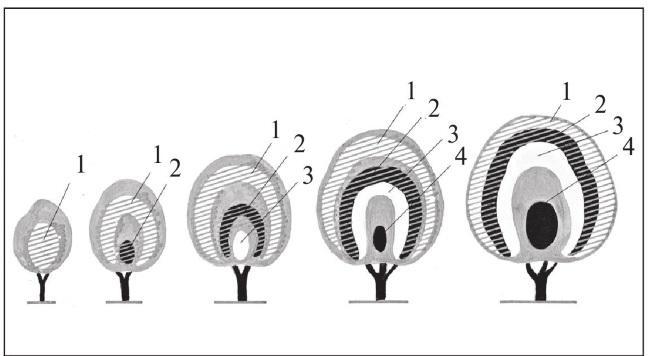
The first fruiting branches appear near the central leader. As the canopy increases, they appear further and further from the center. The branches formed in the center begin to die off first. The die-off spreads from the center to the periphery.
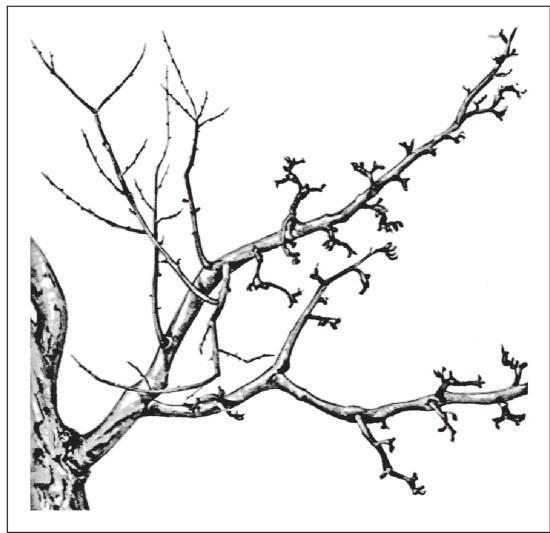
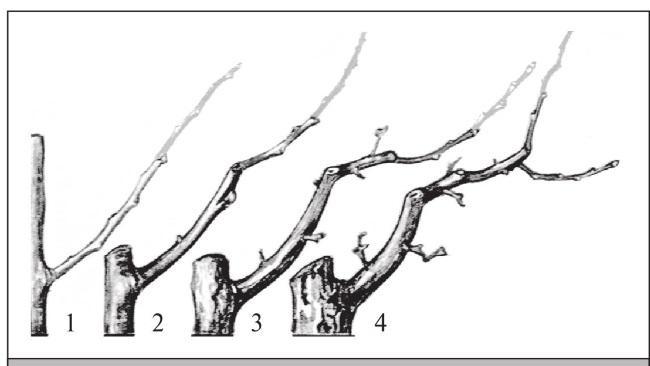
During mass die-off of fruiting branches located at the periphery, water sprouts appear at the base of the main ones from dormant buds. Their appearance is due to the fact that among all tree tissues, dormant meristematic apices (cells of the growth points of dormant buds, etc.) age the slowest.
The part of the branch above the water sprout dies off. A new one is formed, on which fruiting branches also first form and then die off from the base to the periphery. The cycle repeats. This phenomenon is called the cyclic renewal of main and fruiting branches, and the movement of growth zones closer to the center is called receding growth.
Read next
Pruning and training For students
Morphology and main structural elements of a fruit tree canopy
Pruning and training For gardeners
Pruning and canopy formation of fruit-bearing trees in the orchard
Pruning and training For gardeners