
Morphology and main structural elements of a fruit tree canopy
3 min read
The canopy of a fruit tree is its productive framework. The yield of the orchard, the convenience of tree maintenance, and the effectiveness of plant protection measures depend directly on its shape and condition. In natural conditions, the silhouette of a tree is determined by the cultivar, rootstock, and external growing factors.
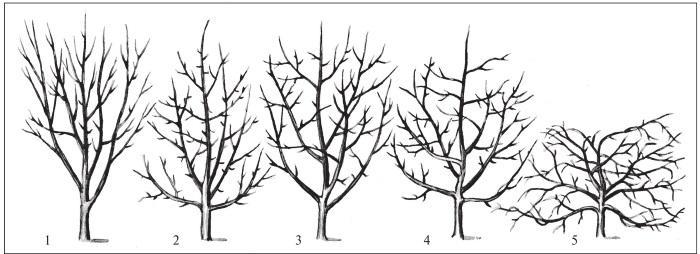
Most often, the following types of natural canopies are found in nature:
- broom-like;
- pyramidal (conical);
- obconical;
- globular;
- spreading to weeping.
In commercial horticulture, the canopy shape is regulated artificially to optimize illumination and facilitate manual or mechanized maintenance. By directing the growth of branches in one or several planes, trees are given the shape of a globe, pyramid, bowl, bush, or palmette. When forming artificial canopies, the trunk can be given an inclined, horizontal, or curved position, and in some technologies, it can be replaced by several equivalent branches.
Structure of the aerial part of a fruit tree
The trunk connects the root system with the canopy and supports the entire mass of branches, leaves, and fruits. It begins at the root collar — the place where the stem transitions into the root. In seed rootstocks, the root collar is true, while in vegetatively propagated ones, it is conventional, determined by the point where roots begin to form.
The trunk is divided into two main zones. The lower part from the root collar to the first branch is called the trunk. Above it along the axis is the central leader, on which branches of the first order are arranged in tiers or individually.
The trunk and the bases of the branches extending from the leader are the most vulnerable zones of the tree. Protect them from frost cracks, sunburn, rodents, and mechanical damage during tillage. Damage to these areas disrupts the connection between roots and leaves, which sharply reduces the overall productivity of the tree.
Canopy branches follow a strict hierarchy. Branches of the second order develop on branches of the first order, followed by the third and subsequent orders. The higher the order of branching, the weaker the growth. Small ramifications that are not part of the canopy framework are called fruiting or generative branches — it is on them that the main part of the harvest is formed.
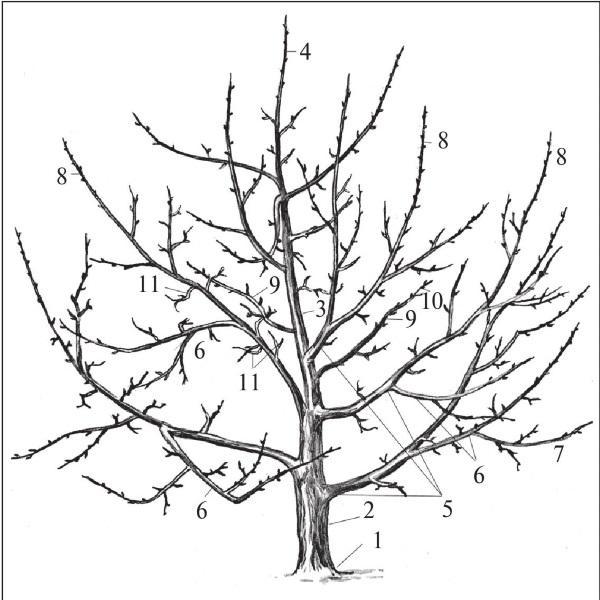
| No. on diagram | Structural element of the aerial part |
|---|---|
| 1 | Root collar |
| 2 | Trunk |
| 3 | Central leader |
| 4 | Extension branch of the central leader |
| 5 | Main branches of the first order |
| 6 | Main branches of the second order |
| 7 | Third order of branching |
| 8 | Extension branch of the main branches |
| 9 | Large fruiting branches |
| 10 | Extension branch of the fruiting branch |
| 11 | Fruiting branches |
Read next
Pruning and training For students
Patterns of cyclic branch replacement and growth of fruit trees
Pruning and training For agronomists
Modern methods of canopy training for flat crowns and palmettes in fruit trees
Pruning and training For agronomists