
Recommended canopy forms of fruit trees for harsh climates
3 min read
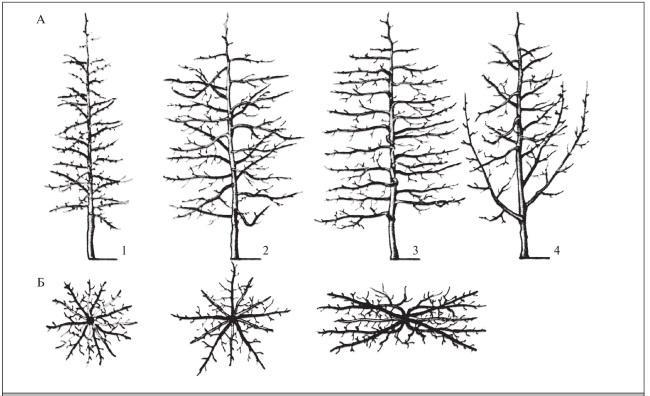
Growing fruit trees in Siberia and the northeastern regions of the European part of Russia is complicated by regular winter damage. To successfully conduct horticulture in these regions, select the canopy type for a specific crop and its frost resistance. For hardy ranetkas and semi-cultivated hybrids, bush-type canopies are suitable, as they are capable of quickly recovering the above-ground part after freezing. For less winter-hardy semi-cultivated hybrids, prostrate-bush canopies are formed, while for large-fruited cultivars, exclusively prostrate forms are used.
Standard high-trunk canopies in harsh climates are doomed to winterkill. The only way to save the trees is to shape them so that the main branches are under the protection of the snow cover in winter or as close to the ground as possible.
- Trunk of a bush-type canopy — no more than 30 cm
- Height of a bush-type tree — up to 3 m
- Height of a northern prostrate form — 2–2.5 m
- Diameter of a northern canopy — up to 5 m
- Height of a Krasnoyarsk prostrate form — 30–40 cm
Technologies for forming winter-hardy canopies
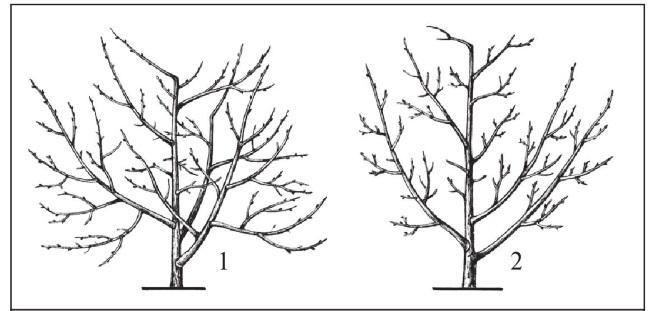
Bush-type canopy. It is established without a trunk or with a minimal trunk up to 30 cm high. The tree skeleton consists of the central leader and 5–6 main branches bearing subsequent orders of branching. The total canopy height is kept within 3 m.
Improved bush-type canopy. It differs in a more sparse distribution of branches along the stem. In the lowest tier, no more than three branches emerging from adjacent buds are left. All other branches are placed higher along the leader, either individually or in groups of two.
| Branch placement parameter | Distance |
|---|---|
| Between tiers | 30–40 cm |
| Between individual branches | 10–15 cm |
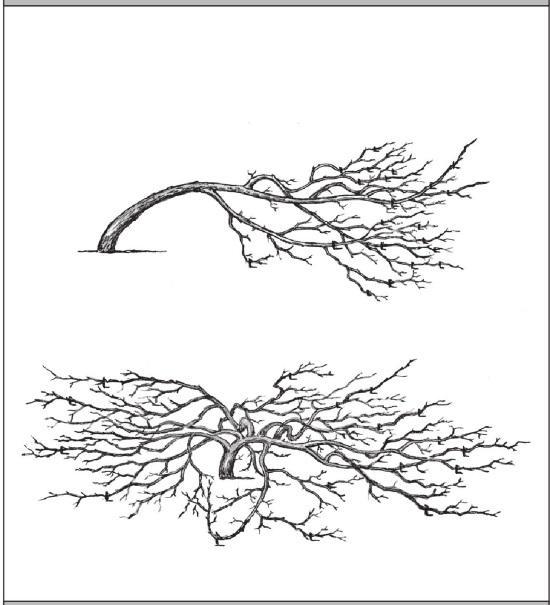
Northern prostrate-bush canopy. It is formed in two stages. For the first 3–4 years, the nursery plant is grown as a prostrate form, positioning the stem and skeletal branches horizontally a few centimeters above the ground. In subsequent years, the tree is allowed to grow freely upwards, cutting to the ring only the branches that cause overcrowding. As a result, a tree 2–2.5 m high and with a canopy diameter of up to 5 m is obtained.
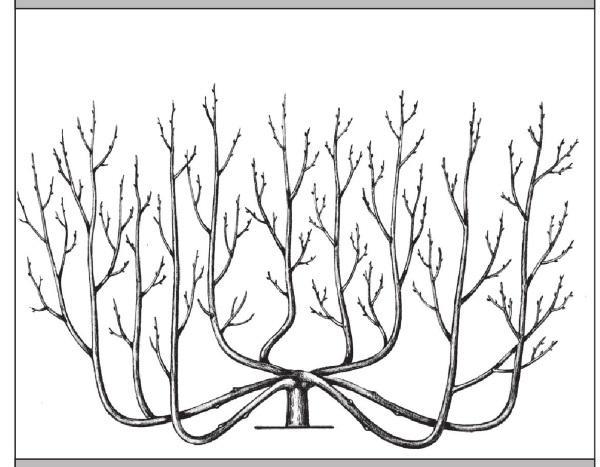
Crest-shaped prostrate-bush canopy. This form has a flat silhouette, elongated along the row. The base consists of two horizontal branches, on which 2–3 branches of equal strength grow vertically. The flattened silhouette improves light exposure for the leaves and allows for unhindered tillage in the row spacings using machinery.
Krasnoyarsk prostrate-bush canopy (Krasnoyarsk bush). It is formed from several horizontal arms up to 30 cm long. At the end of each arm, one strong vertical branch is left. This creates a well-lit cup-shaped canopy, the parameters of which are regulated by pruning.
Spindle-shaped prostrate-bush canopy. Formation begins with a one-year-old plant, which is planted at an acute angle or tilted horizontally. At a distance of 40–50 cm from the base, the stem is pruned. At the end of the resulting arm, a vertical leader is developed, and the lateral branches are moved to a strictly horizontal position.
The horizontal arm at the base of a spindle-shaped canopy is an insurance reserve. If the above-ground part of the tree suffers after a severe winter, the canopy can be quickly restored from this arm.
Arctic prostrate form. This canopy type is optimal for regions with a high level of snow cover. On a short section of the stem, main horizontal branches are established, directing them in different directions. The density of the fruiting wood is regulated depending on the nutrient area and available space.
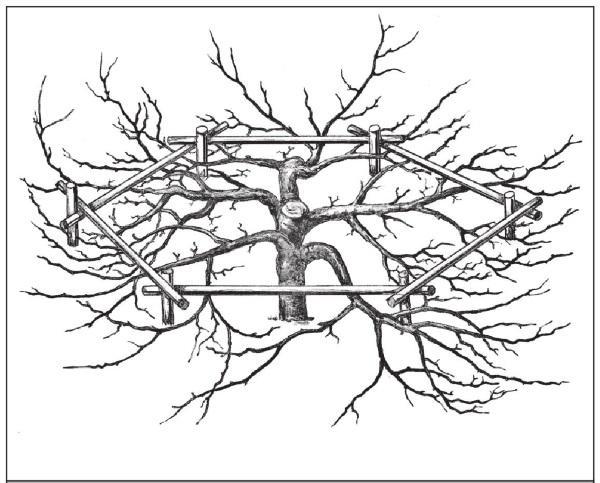
Krasnoyarsk prostrate form. The form is a simplified modification of the Arctic prostrate form. The canopy is established very low — at a height of 30–40 cm from the soil level. All branches appearing on this short section of the trunk are directed radially in all directions.
Krasnoyarsk two-armed prostrate form. Formation begins with a one-year-old nursery plant. At a height of 10–20 cm from the ground, the plant is bent horizontally. One of the strong lateral branches is directed in the opposite direction, creating a second arm. On both arms, horizontal branches of subsequent orders are distributed evenly.
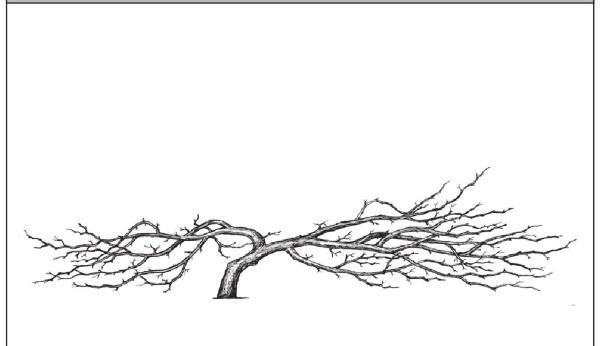
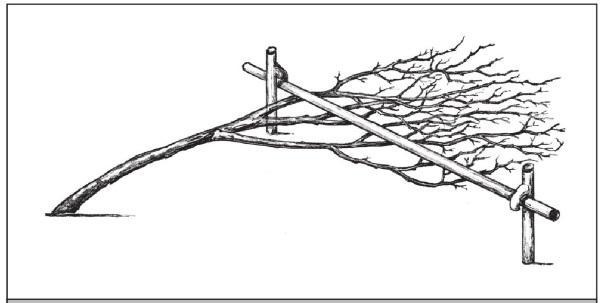
Gourd-type prostrate form. This form is obtained by planting a one-year-old plant at an angle. On the horizontally laid central leader, first-order branches are formed every 30–40 cm. Higher-order branches extending from them are directed into free zones.
To minimize traumatic pruning, actively use green operations during the growing season. Pinching and timely removal of excess shoots allow for the painless conversion of strong vertical growth into productive fruiting branches.
Minusinsk sprawling form (or semi-sprawling form). A one-year-old nursery plant is planted at an angle of 30–40°. Every summer, all branches grow freely. For the winter, they are bent to the ground and covered. Green operations are not performed. All work related to pruning is carried out early in the spring.
Read next
Pruning and training For gardeners
Training and pruning of plum trees considering the type of fruiting and cultivar
Pruning and training For gardeners
Methods and rules for canopy reformation of fruit trees in the orchard
Pruning and training For agronomists