
Methods and rules for canopy reformation of fruit trees in the orchard
7 min read
When creating a canopy from scratch, it is shaped according to pre-defined parameters and then maintained in the required state through systematic pruning. However, if existing canopy forms do not meet changed requirements, the problem of their reshaping arises. Before starting this work, it is necessary to set a realistic, fully achievable goal. For example, it is impossible to transform an ordinary rounded canopy that has reached its final size into a classic or even a modern free-growing palmette. Such reshaping is out of the question. The easiest and best results from ordinary rounded canopies are obtained with bowl-shaped, as well as vertically or horizontally flattened forms. The former are expedient for plantations with row spacing of up to 6 m, while the latter are for wider ones. It is also possible to carry out lobing of the canopies. In some cases, cutting channels in the upper central part of the canopies along the entire row of trees yields good results.
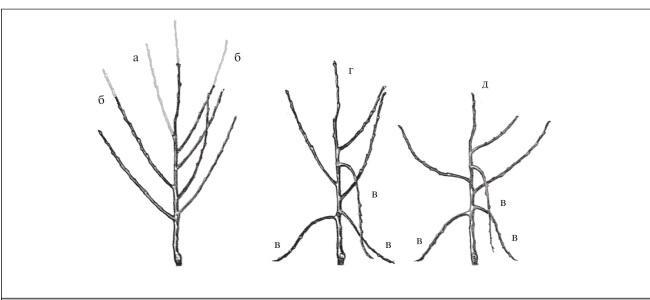
Reshaping a rounded canopy into a palmette. Such reshaping is possible only in young trees (four to five years old), whose branches are still sufficiently flexible. Among them, two branches oriented along the row or close to it are selected. If the direction of their growth does not quite coincide with the row direction, they are given the necessary orientation by tying them to temporary supports. Particular precision is not needed here. Other branches are heavily pruned or bent to a horizontal or drooping position. Pruning is done to a branch growing along the row. The cut site should be no more than 0.75 m from the row plane. Bending branches to a horizontal position is combined with bending them along the row, i.e., it is carried out simultaneously in two planes. All other, less vigorous branches are also directed along the row by pruning or bending. At a level of 0.5–0.7 m above the first-tier branches, two more well-developed branches are selected and directed along the row as well. The angle of emergence is about 50–60°; the ends should grow almost vertically.
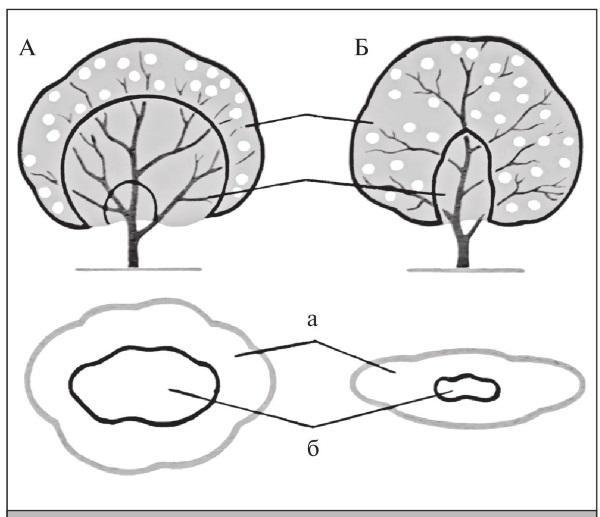
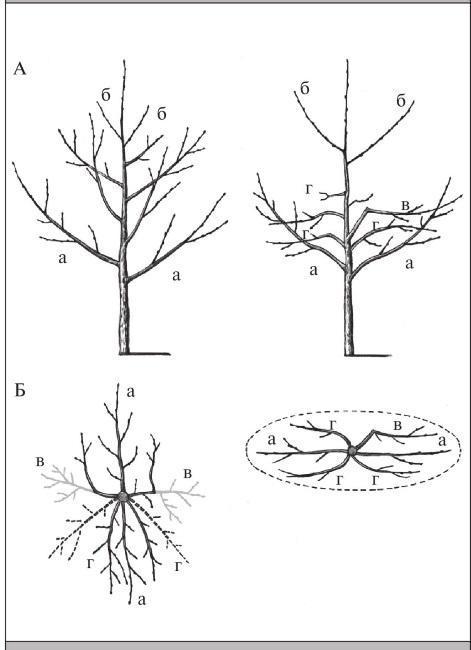
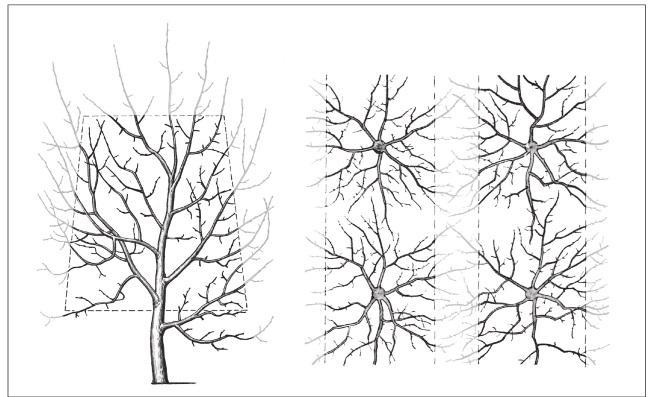
In the middle zone, one can limit oneself to two tiers of primary branches of the first order. All other branches located between the tiers and above the second tier should be significantly weaker or simply fruit-bearing wood. The total height of the canopy should be limited to 2.5–3 m.
Further care for such canopies consists of maintaining growth, preserving the leading position of the central leader and the four main branches located in two tiers, and limiting the canopy thickness to within 2 m.
Older trees at the age of 10–12 years cannot be reshaped in this way. In this case, it is necessary to create a vertically-flattened canopy by limiting the width.
The width of a vertically-flattened canopy at the base should be within 2 m, and at the top – about 1.5 m. The length along the row – until it meets the neighbor. Limiting the canopy width is achieved by pruning all branches extending beyond the established dimensions. Large branches are pruned by transferring to lateral shoots directed along the row.
The plane of the cuts should be distanced from the central plane of the row by approximately 0.8–1 m at the bottom and 0.5–0.7 m at the top. A transverse vertical section will result in a truncated pyramid:
| Parameter | Lower base | Upper base |
| Size, m | 1.5–2 | 1–1.5 |
This is necessary so that the growth of the lower branches is not weakened too much and solar radiation is utilized more fully.
After limiting the canopy from the sides, thinning of branches or rejuvenation is carried out if necessary. The height of the vertically-flattened canopy should be within 2.5–3 m. If trees subject to such reshaping are more than 3 m high, they must be lowered.
One should not attempt to bring adult trees (15 years or older) to a vertically-flattened canopy immediately, as this severely disrupts correlations. As a result, many water shoots and root suckers may appear, or conversely, severe suppression of the above-ground and root systems may occur, sometimes leading to the death of the plants.
It is better to divide the pruning of large neglected trees over several years. In the first year, the center is opened up. It is very important to create conditions for good illumination of the leaf canopy located in the inner parts of the canopy. This task is not always solved by merely lowering the canopy and limiting its thickness. For trees prone to overcrowding, additional thinning is necessary.
Converting a round canopy of fruit trees into a horizontally flattened one improves light penetration to the branches and ensures even distribution of fruit throughout the entire volume. In practice, such pruning forms an "inverted umbrella" type of canopy. It captures solar energy with maximum efficiency and facilitates manual harvesting.
- Target canopy height — 2–2.5 m
- Cut height of the leader — 1.5 m
- Pruning height of lateral branches — 2 m
- Maximum age for simple training — 10–12 years
- Cut out a portion of the central leader or the branch occupying the center of the canopy at a height of about 1.5 m.
- Prune all lateral branches at a height of about 2 m to horizontal sub-branches directed from the center toward the periphery.
- Lift overly drooping branches by pruning them to an upward-oriented sub-branch.
- Thin and rejuvenate branches as necessary without limiting the width of the canopy.
Retraining trees older than 10–12 years is significantly more difficult due to the bareness of the inner parts of the branches. Spread the work over several seasons: in the first year, open the center to improve the light regime, and only in subsequent years reduce the height of the remaining branches and thin the canopy.
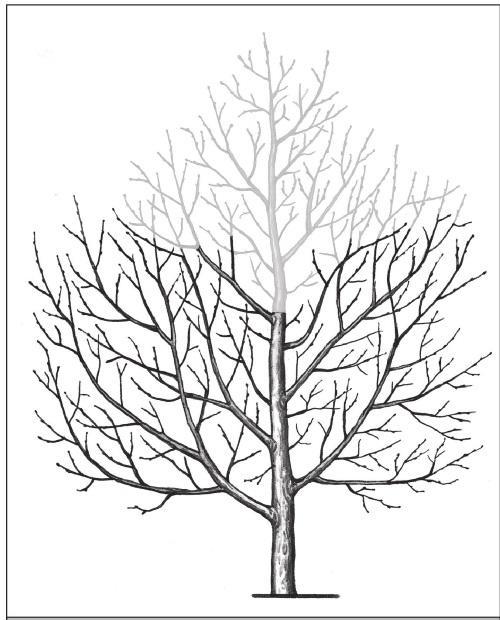
A horizontally flattened canopy contradicts the tree's natural tendency to grow upward. The response to pruning will be vigorous formation of water sprouts in the center, with their quantity directly depending on the age of the tree and the volume of wood removed. To maintain the shape, prune some of the water sprouts annually in the spring, turn others into fruiting branches, and break off excess green shoots in the summer. Also, take into account that such canopies require a large feeding area in the row, and their fruit yield per unit of volume is lower than that of vertically flattened analogs.
Lobe formation consists of creating vertical light gaps (corridors) between the main scaffold branches of the first tier. This technique significantly increases the active surface of the canopy, improves the light regime in the depth, and increases the overall yield of the tree. The gaps are cut to the full height of the canopy, without reaching the central leader.
- Gap depth along the radius — 0.7–1 m
- Gap width at the periphery — about 1 m
- Gap width at the center — up to 0.5 m
- Number of main gaps — 3–4
The number of corridors depends on the number of branches in the first tier and the dimensions of the tree. If, after creating the main corridors, the light inside the canopy remains insufficient, make 2–3 additional gaps of smaller depth in the most dense areas. In the future, annually prune all branches appearing in the gaps, preventing them from spreading and blocking the light.
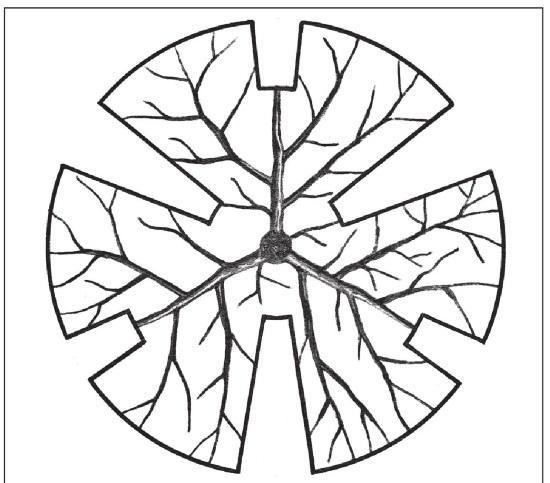
Canal-fan pruning system
The canal-fan system is the simplest and most efficient way to reduce tree height and improve the light regime in the orchard. The method consists of creating a continuous longitudinal light channel along the entire row. Since the pruning is carried out according to a single template, this process can be fully mechanized.
- Cut a continuous horizontal channel along the entire row, pruning the central leader at a height of about 2 m.
- Completely remove the lower drooping branches or redirect them to upward-oriented sub-branches to facilitate maintenance of the tree-trunk strip.
- Perform detailed thinning and rejuvenation of the remaining branches.
- Annually break off water sprouts on the upper sides of branches and the leader so that the channel does not become overgrown.
Read next
Pruning and training For gardeners
Pruning and canopy formation of fruit-bearing trees in the orchard
Pruning and training For gardeners
Fundamentals of canopy formation and pruning of sweet cherry in the orchard
Pruning and training For gardeners