
Cultivation technologies for sorrel and mushroom growing in greenhouses
7 min read
The plant is shade-tolerant, grows best in slightly acidic, fertile soil, and requires moisture. However, excessive moisture, and especially waterlogging, suppresses sorrel. The plant is cold-hardy: seeds can germinate at a temperature of 2-3 °C, and leaves begin to grow as soon as the snow melts. The optimal temperature for plant growth is 15-16 °C. Higher temperatures lead to the coarsening of small leaves and earlier bolting.
Sorrel is grown in one place for 3—4 years. A site that clears of snow early and has a southern slope is most suitable for sorrel cultivation. Loamy soil with a permeable subsoil layer is desirable.
In damp areas, it is more practical to grow sorrel on raised beds. Sowing seeds is carried out in early spring or in July-August.
During soil preparation, 6-8 kg of humus, 20—30 g of superphosphate, 15—20 g of potassium chloride, and 10-15 g of ammonium nitrate per 1 m² are applied. Seeds are sown in furrows with 40 cm row spacing or in 5 rows 25 cm apart. Seeding depth seeds">Seeding depth is 1.5-2 cm. After sowing, the soil is firmed with a board or a trowel. After seedling emergence, the sorrel plantation is loosened and weeded.
Spring-sown sorrel is given 2-3 top dressings; the first and second top dressings consist of 10 g of ammonium nitrate, 15 g of superphosphate, and 10 g of potassium chloride per 1 m². The final top dressing is applied in late August using phosphorus-potassium fertilizers, which increase the winter hardiness of the plants. For summer sowing, sorrel is given 2 top dressings.
The following spring, film covers are installed on the sorrel plantation, with snow previously shoveled off the beds. When the soil thaws, dead leaves are removed, the inter-row spaces are loosened, and top dressing is applied (20 g each of superphosphate and ammonium nitrate and 10 g of potassium chloride per 1 m²).
Cutting of sorrel under covers is carried out 2-3 weeks earlier than in open soil. By the time sorrel starts growing in open soil, two cuttings are usually made under the covers. After each cutting, the plants are watered and given top dressing.
Mushrooms in a greenhouse
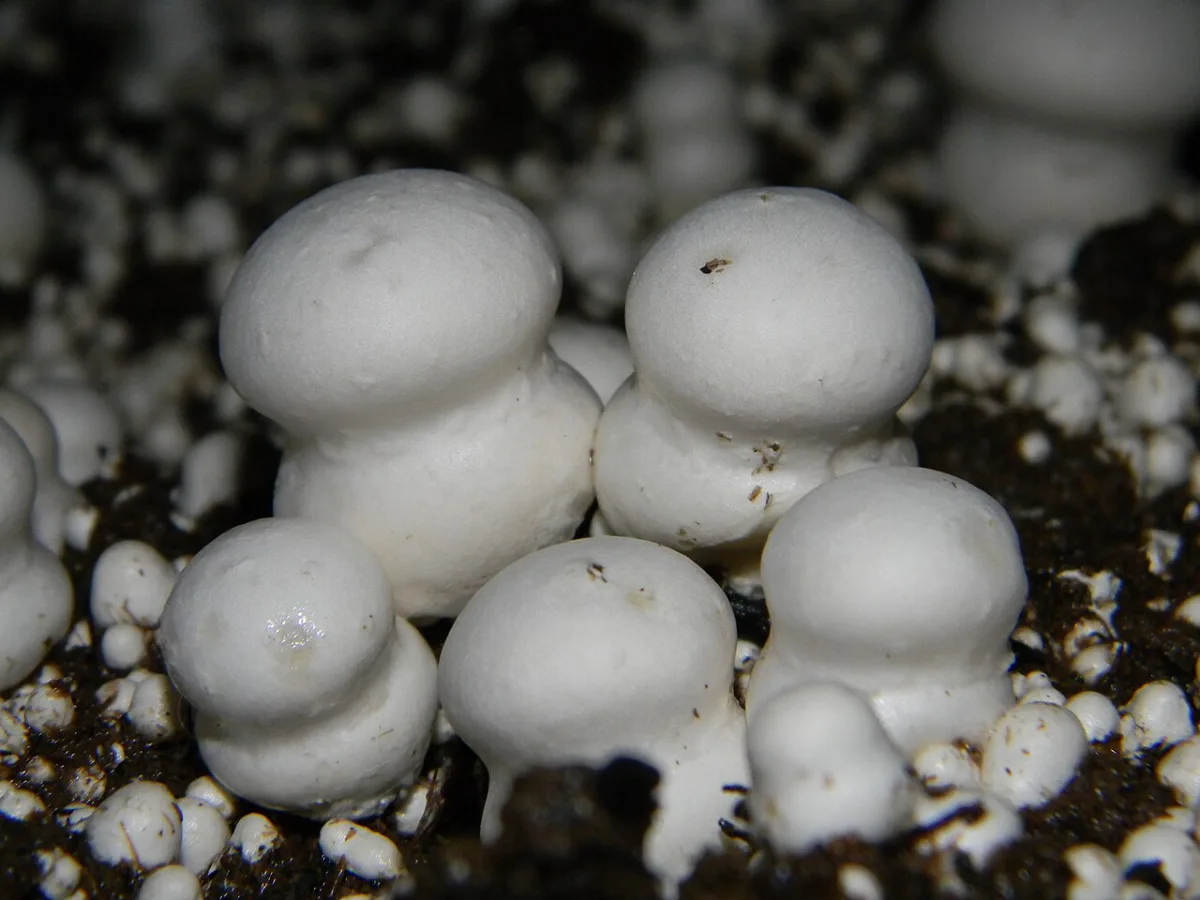
Mushrooms belong to the family of gilled fungi. They are classified as saprophytic fungi that feed on the decomposition products of organic matter. The mushroom can grow in the dark since it lacks chlorophyll. It reproduces vegetatively by division of the mycelium (spawn) and by spores.
The substrate is prepared in advance. The best is semi-decomposed horse manure.
When planting the mycelium and during the fruiting period, the substrate temperature is lowered to 20 °C, and the air temperature to 14-16 °C. During 9 Greenhouses, hotbeds... 257 fruiting, the optimal substrate temperature is 14-18 °C, and air temperature is 11-15 °C. The relative humidity of the air is 72-90%, and the substrate moisture is 60-65%. Mushrooms are watered once every 3—5 days at a rate of 2 liters of water per 1 m².
Mushrooms can be grown in temporarily vacant storage facilities, winter wall-attached greenhouses (in the autumn-winter period), and in basements.
It has been proven that in heated film greenhouses in the autumn period, after harvesting cucumbers, one can also grow mushrooms. One of the main requirements is maintaining the temperature regime. The film cover is usually repaired or updated, and the greenhouse itself is not shaded.
The experience of growing mushrooms in non-stationary adapted facilities is interesting for amateur vegetable growers.
Before laying the substrate, the heated film greenhouse must be warmed up, after first spreading old polyethylene film on the soil as a disinfectant. The beds are made flat, as they are faster and easier to work with. The height of the covered substrate layer with manure is 20-22 cm. After laying, the temperature of the manure in the beds reaches 45 °C.
The surface of the beds, as well as the heap before planting the mycelium, is treated with pesticides.
As a nutrient medium, it is best to use horse manure without straw bedding. It is mixed with wheat or rye straw in a 7:3 ratio.
When starting to form the heap, its width at the base is made 2.5 m, at the top 1.5 m, with an arbitrary length. When forming the heap, it is necessary to thoroughly moisten the straw with hot water and layer it with manure. This mixture is watered until fully saturated.
After the formation is complete, the heap is sprinkled on top with ammonium nitrate or urea in the quantity indicated in the table.
Four days later, when the manure has warmed up well, the first turning is performed. When forming the heap during turnings, it is desirable to make the walls vertical and compacted, and the surface horizontal; the middle of the heap should be loose. Its width is reduced during subsequent turnings.
. 258 Table: Addition of components to the substrate for mushroom cultivation Day of turning Components added per 1 m? of substrate 1 Moistening the substrate with water until fully saturated | 4 kg of ammonium nitrate 4 First turning 1 kg of chalk and moistening with water. 8 Second turning 100 kg of alabaster + 4 kg of superphosphate 12 Third turning 10 kg of alabaster + 4 kg of superphosphate
The finished compost must have a pH of 7–7.5; contain approximately 2% total nitrogen and phosphorus, 1–2% potassium; substrate humidity in winter — 55–60%, in summer — 60–65%.
By the 23rd–25th day, the substrate is ready. The beds are arranged across the greenhouse. The application rate of manure is 100 kg per 1 m?. When the substrate at a depth of 5 cm warms up to 22–28 °C, the mycelium (spawn) is planted, using 350–400 g per 1 m?. The mycelium is placed in a staggered pattern at a distance of 25 cm from each other. After five to seven days, its survival is checked by carefully lifting the manure layer. It is considered good if the mycelium has spread at least 12 cm from the planting site. In this case, the substrate bed is covered with soil (usually on the 18th–22nd day). The casing layer consists of 3 parts of sod soil, 1 part of peat, 5 kg of chalk (per 1 m3 of mixture).
During the incubation period, the paths are watered to maintain relative humidity at a level of 85–90%. During the fruiting period, fresh air supply is monitored. The outside temperature should be around 15–20 °C, and in the beds — approximately 25 °C. The paths are disinfected weekly with a 3% solution of chlorinated lime.
9* 259 Mushrooms are harvested carefully by pressing down slightly and twisting them out of the soil (without damaging the mycelium). First, healthy mushrooms are collected, then dead and diseased ones, which are placed in a separate bucket, filled with a formalin solution, and taken out of the mushroom growing area. The depression left by the harvested mushroom is filled with a 3 cm layer of fresh soil. Fruiting lasts 2–2.5 months.
Engineer B. Belokrys obtains a double harvest in a greenhouse of his own design. He specifically planted mushroom mycelium in a film cover together with pattypan squash, and in a hotbed — with cucumbers.
НЫ 9 —— № с биииииикикый В ОА 5 2 К АЫ РА Ч У д! С. РКК 29 ИР 2 И о М 2 к Е | $ РА о, хх 3% 2 ТРЕЕ О 57 и К я 7 й а ГРМ = Я Ра т | ан мы Ф ([А ая, 5 ь > у. ны А | и вание ЕЕ - 97 1 т В Не ОИ рева Я 5 и. = КОК а ИИ. _ Г в ЕВЕ: Г. Е р = ыы 9 | 6 м Е 10 у г. 1600
Cross-section of a film cover for mushrooms (dimensions in centimeters): 1 — reel; 2 — slotted structure; 3 — perforated film; 4 — casing soil; 5 — trough;
6 — walkway; 7 — pin; 8 — pot; 9 — vegetable soil;
10 — sawdust manure; 11 — cucumbers (non-bitter); 12 — hoop 10;
13 — polyethylene film (0.1 mm)
All experiments conducted showed that the joint cultivation of mushrooms with cucurbits (cucumbers and pattypan squash) is not only possible but also beneficial to both crops. The roots of the cucurbits abundantly absorb moisture from the soil, preventing the mycelium from rotting.
Reciprocal gas exchange has a beneficial effect on the growth and development of both crops: mushrooms receive oxygen from the cucurbits, supplying them, in turn, with carbon dioxide. This simplifies mushroom care, as with the standard cultivation method, they require regular ventilation. The leaves of the cucurbits, by shielding the mushrooms from direct sunlight, create an optimal microclimate.
In one of the covers, nearly 5 kg of mushrooms and 9.7 kg of cucumbers were harvested per 1 m2.
Based on the experience, a greenhouse was developed, which is most convenient for the joint cultivation of the two crops. Cucumbers can be grown here using the trellis method, and mushrooms — on two tiers.
Read next
Greenhouses and covers For gardeners
Cultivation and propagation of rhubarb in open field and protected soil
Greenhouses and covers For gardeners
Technology for forcing green crops in spring hotbeds
Greenhouses and covers For gardeners