
Cultivation technology for leaf and head lettuce in a greenhouse and soil
3 min read
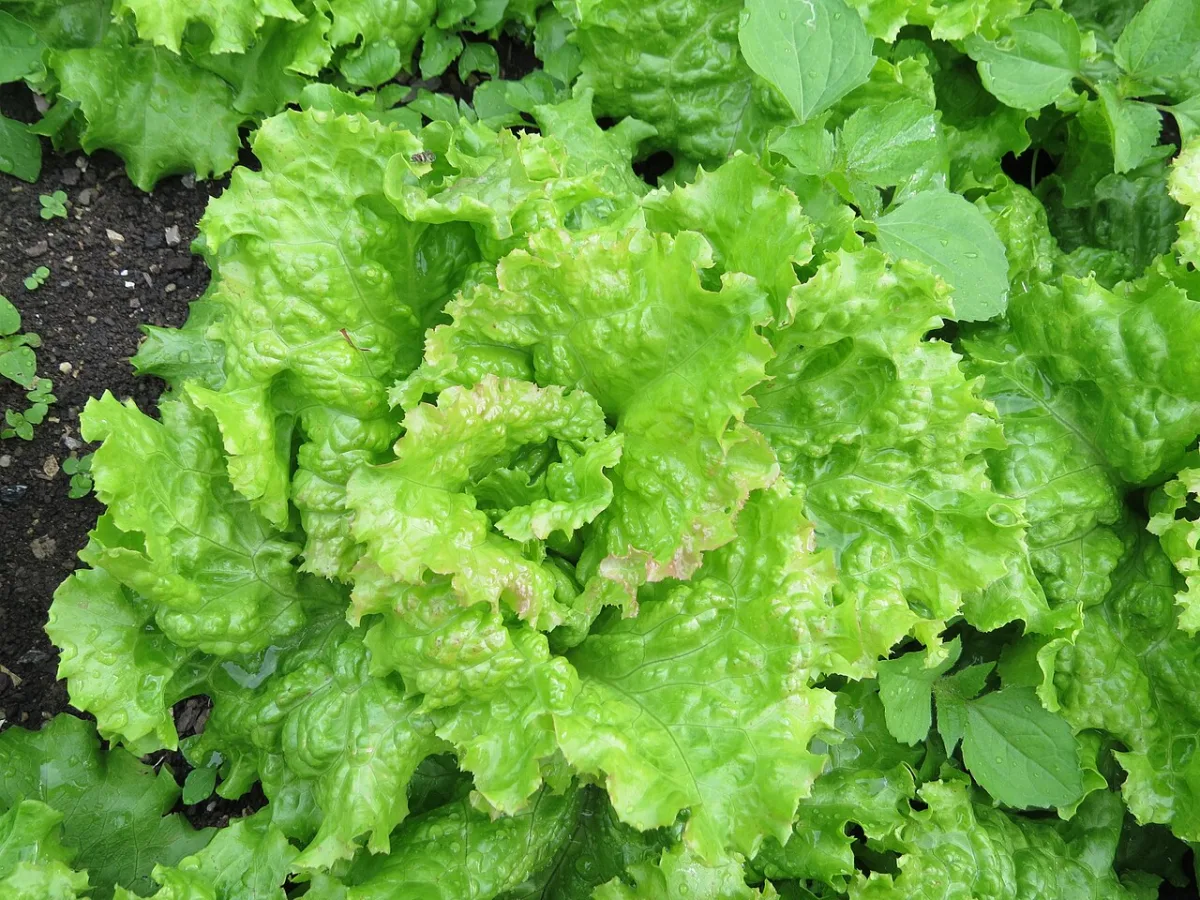
Lettuce is an annual plant of the Asteraceae family. In the early stages of life, the plant forms a shortened stem with a rosette of leaves. The optimal temperature for the growth of lettuce is 15-20 °С, but it can also grow at 5 °С.
Young lettuce plants are less resistant to frost than plants with already formed heads. Lettuce is light-loving. When grown under film, bolting is intensified by sharp fluctuations in air and soil temperature and low soil moisture.
Leaf lettuce cultivars are grown by sowing seed into the soil. In film greenhouses, lettuce is sown in early April, and in small-sized covers — in mid-April.
During soil preparation, 4—5 kg of humus, 30—40 g of superphosphate, 25-30 g of ammonium nitrate, and 15-20 g of potassium chloride are applied per 1 m².
Lettuce is sown in rows with a spacing of 10 cm between rows or according to a 6x6 cm pattern. The application rate is 0.3-0.5 g of seed per 1 m². The seed is sown to a depth of 1—2 cm and mulched with peat or humus. Earlier emergence is achieved by covering the sowings with film.
Leaf lettuce is ready for consumption 30—40 days from the moment of emergence.
Head lettuce is grown both by the transplant method and by sowing seed into the soil. The sowing dates and soil preparation methods are similar to those for leaf lettuce.
For good head formation, the distance between plants should be 20-25 cm. When growing lettuce in soil, these distances are created by thinning the crops twice. The first thinning is done at the three-leaf stage, and the second — when 4—5 leaves appear. The pulled-out plants can be used for food.
To obtain an early harvest, head lettuce is grown via transplants. Seed is sown into transplant pots where the temperature is maintained at 18-20 °С until emergence. Upon emergence, the temperature is lowered to 10-12 °С.
Seedlings of head lettuce at the one- to two-true-leaf stage are pricked out into 5x5 cm pots filled with a soil mixture of peat, humus, and sand. To increase nutrient content, 15 g of ammonium nitrate, 10 g of potassium chloride, and 20 g of superphosphate are added to every 10 kg of the mixture. Lettuce transplants can also be grown by direct sowing of seed into pots followed by the removal of excess plants.
Transplants grown indoors are moved to a greenhouse 5—7 days before planting. Transplants are planted at the age of 30-35 days. Planting is carried out so that the root collar of the plant is at soil level. Plants planted too deeply will rot.
Plant care consists of soil loosening, irrigation, and top dressing. Plants are watered rarely but abundantly, along the rows during morning hours. A liquid top dressing of 10 g of ammonium nitrate and 15 g of potassium chloride dissolved in 10 l of water is applied to 1-1.5 m².
The temperature in film structures when growing lettuce is maintained at 17—20 °С. For early cultivars, a temperature above 20-22 °С causes premature bolting of the plants and a bitter taste in the leaves.
Lettuce is harvested early in the morning or in the evening; leaf lettuce is pulled up with the root, while head lettuce is cut with the leaf rosette. Head lettuce can be stored for 3—4 days in a fresh state at a temperature of 8—10 °С, and for approximately 18—21 days at 0 °С in plastic bags in a refrigerator.
Read next
Greenhouses and covers For gardeners
Technology of growing early white cabbage transplants in protected soil
Greenhouses and covers For gardeners
Cultivation technology for asparagus lettuce and radish in protected soil
Greenhouses and covers For gardeners