
Tomato mosaic virus: symptoms of the infection process and characteristics of the pathogen
12 min read
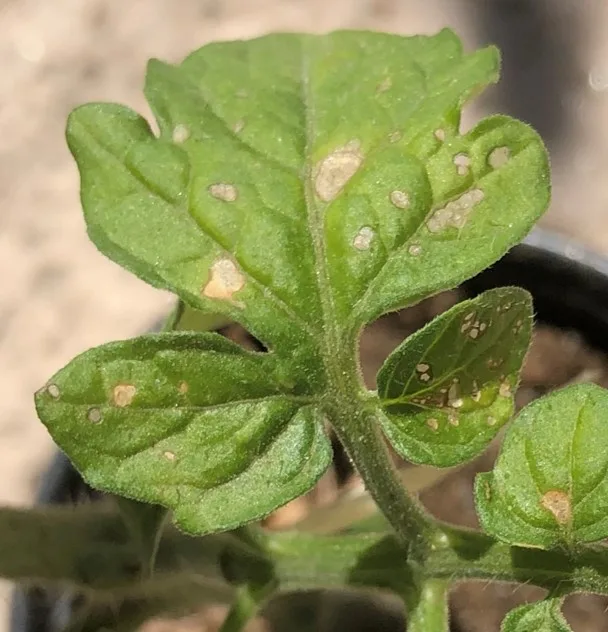
The causative agent of tomato mosaic tomato is a virus — ToMV. Mosaic has been the most serious and widespread disease; however, at present, following the development of resistant cultivars, it is relatively rarely observed in greenhouses. Of all phytopathogenic viruses, ToMV possesses the highest infectivity. Furthermore, it is very resistant to the influence of various physical factors, such as high or low temperatures. Posses-
Fig. 7.20. Mosaic tomato — aucuba strain, causing distinct bright yellow spots on green leaves.
sing significant viability, ToMV is able to remain viable for many years. The damage caused to a tomato crop under production conditions is difficult to estimate, but according to experimental data, yield reduction can reach up to 25%. In addition, infection with ToMV reduces fruit quality.
Symptoms. Symptoms of infection by ToMV are very diverse and depend on various factors, such as the virus strain, environmental conditions, and cultivar characteristics. Initially, an infected plant may wilt in sunlight, especially during active crop growth, but it quickly returns to a normal state after the temperature drops. This temporary wilting phase usually lasts 1–2 weeks after virus infection. The most common sign of ToMV infection is mosaic, ranging from seemingly harmless pale mottling to bright yellow and green, sharply defined tissue areas. Distinct yellowing symptoms are often considered a sign of infection by the aucuba strain.
Some ToMV strains are characterized by the narrowing of leaf blades, sometimes to such an extent that individual leaflets of a compound leaf become shoestring-like, and the whole leaf fern-like. Such leaf deformations are similar to those arising from treatment with herbicides of the growth regulator type or from infection with cucumber mosaic virus (CMV), but they differ from them in the sequence of development on leaves of different ages (Fig. 7.21). On lower leaflets, the dissection is weakened; Fig. 7.21. Tomato leaves infected with tomato mosaic virus (ToMV) when affected by a deforming or fern-leaf strain: a — leaf developed during infection, small changes in proximal leaflets are visible; b — complete change of all leaf leaflets; c — only the top leaflet is strongly affected; d — fern-like leaf. In neighboring leaves, the fern-like appearance weakens and the leaf gradually acquires a normal shape but has a pronounced mosaic pattern. Such types of deformation are typical for plants infected with these strains, and to a lesser extent for weaker infection by deforming strains.
Recovering plants with severely deformed leaves initially form pinnate leaves. New leaves have a normal shape, but, as a rule, with visible mosaic patterns. The general process of modification can cover from six to eight leaves. Irreversible deformation of all leaves on a plant is not typical for ToMV. Some strains of this virus influence leaf shape significantly less, although the dissection of the blades may decrease.
On the stems of adult plants, signs of infection appear as dark green and black streaks, and this process (streaking) is often accompanied by a yellowish-bronze coloration of aging leaves. A similar symptom is characteristic of a mixed infection of ToMV and potato virus X (see page 179).
Mosaic symptoms on fruits are very diverse; the most important of them is bronzing (also called internal browning), which is distinguished from uneven coloring. Bronzing symptoms initially appear on green fruits, especially at the base, where tissues around the vascular bundle become necrotic. Such a color change is clearly visible through the skin. As the fruit ripens, the affected area often remains green and firm, and sometimes turns yellow. Affected fruits completely lose their marketability. Bronzing usually spreads to 1–2 trusses, and sometimes more.
The appearance of non-infectious bronzing, caused by physiological factors, is also possible. Lesions of this type can be distinguished by black lines, which are clearly visible at the apex of the fruit.
At the base of the fruit, sunken brown or black spots (pitting) sometimes form; several fruits with such signs usually appear during the development of bronzing. Of all types of fruit damage by ToMV, bronzing and pitting are the most important.
ToMV can significantly influence fruit set; as a result of fruit drop or flower sterility, part of the harvest (one or more trusses) is lost. Flower sterility is observed on trusses flowering during ToMV infection. Usually, one truss is severely affected, while on others, mosaic symptoms develop more weakly. Subsequently, fruit set occurs normally.
ToMV strains. The strains of ToMV identified to date are classified as 0, 1, 2, 1:2 and 2?. Strains 0 and 1 infect all susceptible cultivars; strain 1, in addition, infects cultivars with the Tm-1 resistance gene (see Fig. 5.1; p. 80).
Sources of infection and routes of virus spread
Tomato mosaic virus (ToMV) infects not only tomatoes but also other solanaceous crops. Different strains of the virus are identified by symptoms: fern leaf, aucuba mosaic, or green mosaic. For example, the tobacco strain causes mosaic in tomato and tobacco, while the tomato strain is harmless to most tobacco cultivars. No clear relationship has been established between strains regarding resistance genes, host range, or symptom manifestation types.
The primary sources of infection are infected seed and plant residues. The virus survives in plant residues for a long time, although its concentration gradually decreases. As roots decompose, the pathogen enters the soil but survives there for only a few days. Seeds are usually superficially infected — the virus is located on the seed coat; it rarely penetrates the endosperm and is never found in the embryo. Infection of the endosperm occurs only if plant infection coincides with fruit set.
Additional sources of infection include plant residues on greenhouse structures, work clothing, and smoking tobacco. The primary vector of the virus in the greenhouse remains the staff during plant care and harvesting. The spread of the disease usually follows the direction of technical operations. Symptoms are most pronounced on plants in the outer rows and near pathways, which confirms the contact method of infection transmission.
Methods of protection and disease prevention
Growing resistant cultivars is the most reliable way to combat mosaic. Hybrids with the Tm-2² resistance gene are now widely used, which has significantly reduced the harmfulness of the disease. The following cultivars, hybrids, and resistance genes to various virus strains are used in production:
| Cultivar / Hybrid / Gene | Cultivar / Hybrid / Gene | Cultivar / Hybrid / Gene | Cultivar / Hybrid / Gene |
|---|---|---|---|
| A-Bipda | Apve!a | BeШpa Ciga | CigaЪe] |
| Cigaфyu | |] | Ra{opa | aut |
| Ouraпfo | E]ze | EzteПa | MPogez |
| Mop4a! | Metafo | Obte | Ozopa |
| Pawe!a | Ruaщo | RezIpo | YuKaщo |
| Koyaю | Zappa | ZmHey | ZoBea |
| Zo!ara | ZopaHpe | Zopafo | Ta-tara |
| Targa | U!cogez | U!poza | KpaЮra Cgozz |
| Rappat Cgo$$ | Tm-1 | Tm-2 | Tm-22 |
A set of preventive measures is used to prevent the introduction of the virus via seed. When saving your own seed, fruits are collected only from the first or second cluster to exclude endosperm infection. Chemical extraction with hydrochloric acid is also carried out, which reduces the viral load on the seed material.
- Seed heating temperature — 70 °С
- Seed heat treatment time — 4 days
- Soil steaming temperature — 100 °С
- Soil temperature holding time — 10 min
- Diameter of uncleaned roots — from 0.5 cm
- Remove diseased seedlings from the nursery, avoiding their contact with healthy seedlings.
- Thoroughly wash and disinfect your hands immediately after removing infected plants.
- Be sure to change work clothing before moving to other greenhouses.
Standard fermentation extraction does not free seed material from viral infection. For guaranteed seed sanitation, thermal or chemical treatment is mandatory.
It is extremely difficult to completely eradicate the virus in soil containing root residues. To reduce the infection background, soil steaming is applied, or a two-year break in tomato cultivation is observed. Large root residues with a diameter of more than 0.5 cm do not heat up completely, so the virus survives in them. To disinfect them, the soil temperature must be brought to the technical maximum.
Chemical soil sterilizers destroy beneficial microflora. This stops the decomposition of plant residues, causing the virus to survive in the soil significantly longer.
The impact of mosaic on the harvest is reduced if there are no conditions in the greenhouse for vigorous vegetative plant growth. Nitrogen top dressing at the first signs of the disease slightly weakens the symptoms but does not change the situation fundamentally. Regulating air temperature to combat the virus is ineffective: increasing it intensifies leaf chlorosis, while decreasing it leads to their deformation.
Moderate and almost asymptomatic ToMV strains are used for inoculation of susceptible cultivars during the early stages of seedling development to protect against infection by more virulent strains. This method allows for a significant reduction in harvest losses and fruit quality decline. Plants acquire resistance to infection a few days after artificial inoculation. A suspension of viral particles is applied under a pressure of about 1.5 atm, holding the spray gun at a height of 10 cm above the plants. 1 g of carborundum (600 mesh) is added to every 100 ml of suspension, which slightly damages the leaf surface and allows the virus to penetrate tissues more easily.
Mixed streak (TMV and potato virus X)
Symptoms of mixed virus streak include dark brown or black streaks on stems and pitting of fruits on at least one truss. Streaks are usually elongated, thread-like; sometimes they cover a large part of the stem length. A typical mosaic usually appears on the young tissues of the plant apex and on lateral shoots. Such symptoms can be caused by a TMV strain known as the streak strain, but most often it is the result of a mixed infection by any TMV strain in combination with potato virus X (PVX). Streak appears only if infection with the X-virus occurred first or if both viruses entered the plant simultaneously. If the first pathogen is TMV, the mosaic signs intensify upon subsequent infection with PVX, but streak does not develop. Tomato plants infected only with PVX show almost no symptoms or none at all; in rare cases, slight chlorosis is noticeable on aging leaves, and pinpoint necroses on other leaves.
All TMV and PVX strains are highly infectious and spread easily, so streak can quickly affect the entire crop. With the advent of TMV-resistant cultivars, the disease has become less common.
Control. Control measures for TMV, when applied against mixed streak, lose their effectiveness. It is necessary to identify the source of PVX to prevent the introduction of the infection. The main reservoir of PVX is potato, plants of which appear accidentally in greenhouses, especially in new ones. Clothing can also be a source of PVX, particularly when greenhouse workers work on potato crops, for example, in backyard plots.
17° д, м одни + 9 к’ ах ‚ | } Е 7 Ри. #\ ы 2. з (й ме ы у: м ь | Fig. 7.26. Seedless tomato fruits formed as a result of aspermia virus infection.
Upon the appearance of streak, affected tomato plants should be carefully dug up and removed from the greenhouse, avoiding contact with the leaves of healthy plants if possible. This procedure must be carried out at the end of the working week. After culling diseased plants, it is necessary to change work clothes and wash hands three times with soap and a brush so that even microscopic pieces of affected tissues do not remain under the nails. This prevents secondary introduction of the infection into the greenhouse.
Read next
Plant protection For agronomists
Diagnostics and prevention of viral diseases of sweet pepper in a greenhouse
Plant protection For agronomists
Viral diseases of roses in a greenhouse and methods for their control
Plant protection For agronomists