
Prevention of weed resistance in chemical plant protection of winter wheat
16 min read
History and causes of weed resistance development
Introduction. In the 1970s, the intensive and prolonged use (starting from 1945) of 2,4-D and 2M-4H herbicides and their analogues in cereal crop fields across the former USSR contributed to the spread of resistant (tolerant) weed plants. These include:
- cleavers;
- scentless mayweed;
- field pansy;
- common hemp-nettle;
- knotweed species;
- annual grass weeds (loose silky-bent, barnyard grass, annual meadow grass).
Even after chemical weeding of the fields, these plants reduce the crop yield of cereals by 15% or more.
In countries with intensive crop production, the resistance of certain species of weed plants to preparations is increasingly rising. Resistance is the ability of various organisms to withstand certain chemical preparations. It can be:
- natural — based on the characteristics of a given organism that is not affected by certain chemical compounds;
- acquired — emerging as a result of the selection of resistant individuals during the systematic use of the same preparation.
Populations of weed plants are considered resistant to herbicides if they do not react or react weakly to the treatment with a preparation that has been repeatedly used previously at the recommended application rate. As a result, the effectiveness of the preparation is significantly reduced.
Mechanisms of emergence and methods for managing resistance
Weed populations usually become resistant when preparations containing the same active ingredient are applied to the same field for several consecutive years (from 4 to 10). There is an opinion that weeds mutate under the influence of a herbicide's active ingredient and, as a result of natural selection, acquire traits that contribute to the emergence of resistance.
This phenomenon can be managed by applying preparations that contain at least two active ingredients with different mechanisms and modes of action. At the same time, the implementation of plant protection measures must have a reliable scientific basis related to the choice of the correct herbicide, which is impossible without phytosanitary monitoring and assessment of weed sensitivity to the active ingredients of the preparations.
The spread of resistant weed plants depends on the biology of the species, crop rotation, methods of tillage, the level of development of the chemical industry, etc. In recent years, an intensive development of weed resistance to herbicides of new classes of highly selective chemical compounds has been noted, in particular sulfonylureas.
Sulfonylureas, as a herbicide class, were discovered by the DuPont company in the 70s unexpectedly while developing medical drugs. After intensive study, the first sulfonylurea was submitted for registration in 1975, and two years later chlorsulfuron and the first commercial herbicide based on it, called Glean, were registered. This was followed by the rapid development of this class. Today, there are about 1,500 patents alone.
Spread of weed resistance globally
The widest spread of resistant weed plants has been recorded in the most developed countries. In Poland, resistant biotypes of scentless mayweed and common poppy to tribenuron-methyl have been identified.
Weed plants of the Poaceae family make up 25% of all weed species but provide 40% of resistant biotypes. Resistance of loose silky-bent to sulfonylurea herbicides, in particular iodosulfurons, as well as to the active ingredient flufenacet, has been identified.
The survey conducted indicated the widespread occurrence of this weed in Poland (6 million hectares were infested). Recent studies have shown that in addition to this species, the following species, which differ in size, color, and shape of the panicle, have been noted in Poland:
- interrupted windgrass;
- intermediate windgrass;
- seashore windgrass.
When conducting route surveys of winter cereal crop fields for weed infestation before harvesting in Belarus, it was noted that the fields are dominated by annual dicotyledonous and grass weeds (cleavers, scentless mayweed, common chickweed, field speedwell, field pansy, loose silky-bent, barnyard grass, annual meadow grass, bristle grass species, etc.). Many species, as already noted in the literature, show resistance to certain active ingredients of herbicides. In order to prevent the emergence of resistance of weeds to herbicides, studies were conducted to examine the effectiveness of combined herbicides containing active ingredients from different chemical classes with different mechanisms of action.
Methodology for studying the effectiveness of combined herbicides
Studies on the effectiveness of herbicides were conducted in 2019 and 2020 in accordance with the "Methodological Guidelines..." at the experimental field of the RUE "Institute of Plant Protection" (Minsk district, ag. Priluki) in winter wheat crops of the Oda cultivar, cultivated using intensive technology. Agrotechnical parameters of the experiment:
| Sowing rate | 4.5 million viable seeds/ha |
| Soil | sod-podzolic, light loamy |
| Mineral fertilizers | N20Р90К90 (pre-sowing) and N70 (top dressing) |
| Sowing time | 3rd decade of September |
| Plot area | 20 m2 |
Herbicides were applied in the spring at the tillering stage of winter wheat using a sprayer
In small-plot trials, studies were conducted using herbicides whose active ingredients belong to different classes of chemical compounds (urea derivatives, phenyl ethers, oxyacetamides, triazinones, phenoxyherbicides) and have different mechanisms of action. The herbicide compositions included active ingredients with the following mechanisms of action:
- photosynthesis inhibitors in photosystem II (isoproturon, metribuzin);
- acetolactate synthase inhibitors (thiencarbazone-methyl, iodosulfuron);
- inhibition of carotenoid biosynthesis at the phytoene desaturase stage (diflufenican);
- inhibition of very-long-chain fatty acid synthesis (flufenacet);
- synthetic auxins (2,4-D).
The following herbicides were used in the trials: Morion, SC (isoproturon, 500 g/l + diflufenican, 100 g/l), Complit Forte, SC (diflufenican, 233 g/l + flufenacet, 200 g/l + metribuzin, 83 g/l); Hussar Activ Plus, OD (2-EHE 2,4-D-acid, 300 g/l + iodosulfuron-methyl-sodium, 10 g/l + thiencarbazone-methyl, 7.5 g/l + mefenpyr-diethyl/antidote/, 30 g/l).
The production trial was established at JSC "Shchomyslitsa", Minsk district, in winter wheat crops (cultivar Figura). The experimental plot area was 10 ha, with 2-fold replication. Weeding of the crops was performed with the herbicide Hussar Activ Plus, OD at an application rate of 1.0 l/ha at the tillering stage of the crop. Crops where plant protection technologies for grain crops accepted on the farm were applied served as a standard. In the experimental fields, the phytosanitary situation was monitored during the growing season of winter wheat using counting and observation methods accepted in plant protection. Herbicides were applied by the broadcast spraying method using a "Zubr" tractor sprayer. The application rate of the working solution was 200 l/ha.
Before the application of herbicides, a quantitative assessment of weed infestation was conducted to determine the species composition of weeds and their density; one month after herbicide application, a quantitative-weight assessment of weed infestation was carried out. Harvesting">Harvesting was conducted by direct combining per plot using an "85" combine. The obtained data were processed by the analysis of variance method.
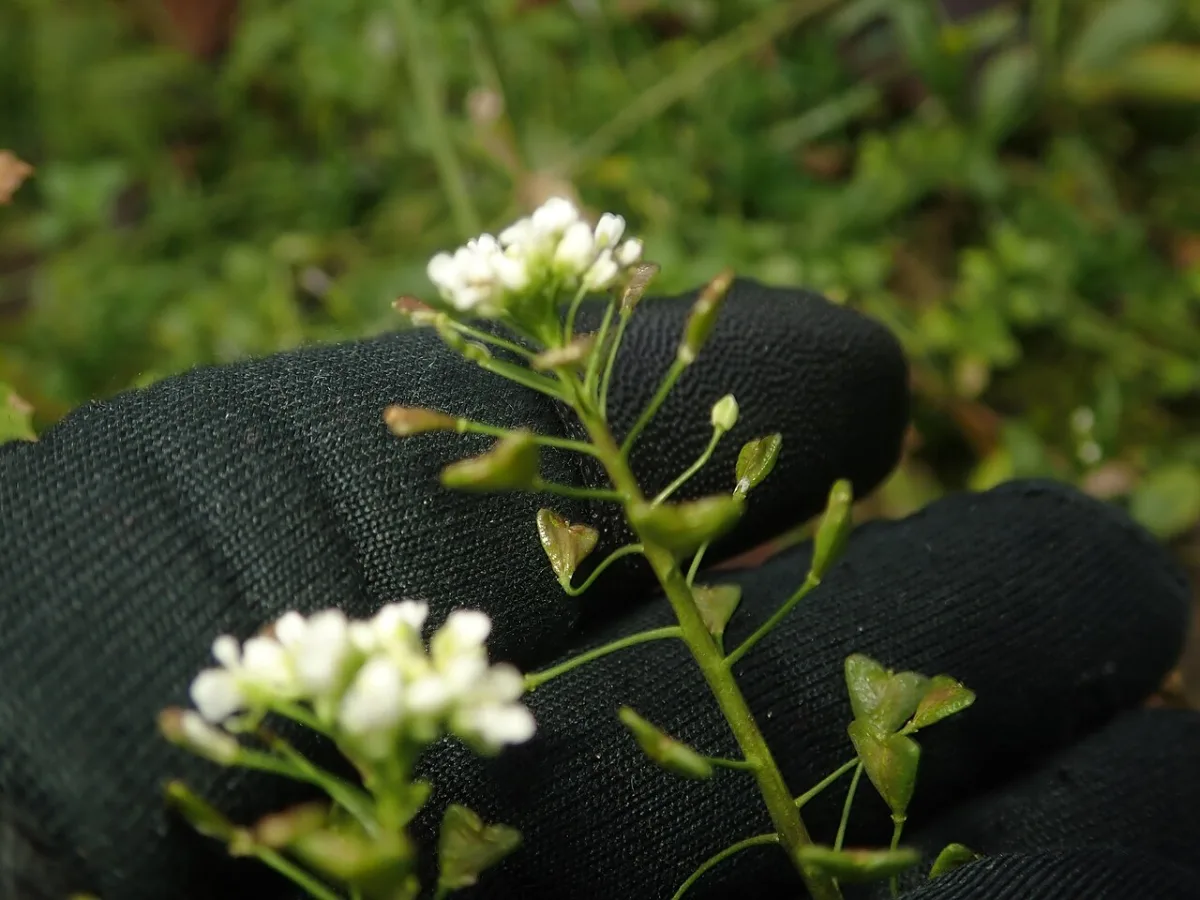
Research results. In the conditions of 2019, before the application of herbicides in winter wheat crops in the spring at the tillering stage of the crop, the following were dominant: scentless mayweed, field pansy, cleavers, shepherd's purse, field pennycress, windgrass. In the crop agrocenosis, there were single plants of knotweed species – black bindweed and common knotgrass, common chickweed, common lambsquarters, field speedwell, etc. The total number of weed plants by variant was 165.4–226.0 pcs./m2.
When applying herbicides, the weeds were of different ages and were at the following stages of development: scentless mayweed, shepherd's purse, field pennycress, knotweed species, field pansy – leaf development (BBCH 12–18), cleavers – formation of lateral shoots (BBCH 20–24), windgrass – tillering (BBCH 23–25).
Application of the herbicides Complit Forte, SC and Hussar Activ Plus, OD reduced the population of cleavers, scentless mayweed, and shepherd's purse by 86.1–100%, and their vegetative mass by 86.2–100%. Table 1 – Efficacy of herbicides during spring application in winter wheat crops (field trial, RUE "Institute of Plant Protection", count on May 21, 2019)
Weed mortality, % relative to the control without
Preserved yield, c/ha weeding (numerator – number of weeds, denominator – their mass)
Yield, c/ha windgrass cleavers dicotyledonous (excluding shepherd's purse, field pansy) field pansy all annual scentless mayweed
Control without 77.3 23.3 28.7 24.0 116.7 29.3
52.4 – weeding* 160.3 82.3 215.0 57.3 446.7 140.7
Morion, SC – 67.3 81.3 90.6 69.6 88.0 89.3
60.5 8.1 1.0 l/ha (standard) 75.5 88.3 97.5 81.3 90.1 86.3
Complit Forte, 54.3 94.4 87.1 86.3 88.6
100 59.5 7.1 SC – 0.4 l/ha 80.5 96.7 88.4 86.2 92.2
Complit Forte, 55.1 94.4 86.1 95.8 92.5
100 62.4 10.0 SC – 0.6 l/ha 83.6 98.4 92.4 86.9 95.8 Hussar Activ
81.0 97.0 97.6 96.0 Plus, OD – 100 100 63.7 11.3
87.7 97.6 99.7 96.3 1.0 l/ha LSD05 2.8 Note: * in the control without weeding, density – pcs./m2, mass of weeds – g/m2.
The efficacy of the herbicide Morion, SC against these species was slightly lower and was at the level of 69.6–90.6% by density and 81.3–97.5% by mass.
Weed infestation by field pansy decreased by 54.3–81.0% by density and by 75.5–87.7% by mass; the highest sensitivity of the weed was noted to the herbicide Hussar Activ Plus, OD. Mortality of all annual dicotyledonous weeds (excluding field pansy) in the variant using the herbicide Complit Forte, SC was 88.6–92.5%, their vegetative mass decreased by 92.2–95.8%; in the variant with the herbicide Hussar Activ Plus, OD – by 96.0% and 96.3%, and in the standard one – by 88.0% and 90.1% respectively.
Under the influence of the herbicides Complit Forte, SC and Gusar Aktiv Plus, OD, loose silky-bent was completely (100 %) controlled; the efficacy of the herbicide Morion, SC was 89.3 % in terms of population and 86.3 % in terms of biomass.
In all trial variants, knotweed species and common lambsquarters were completely (100 %) controlled; insufficient efficacy of the herbicides against field speedwell was noted.
In the 2020 season, before herbicide application in the spring, the winter wheat crops were dominated by such weeds as scentless mayweed, field pansy, cleavers, shepherd's purse, purple dead-nettle, volunteer rapeseed, common chickweed, field speedwell, field forget-me-not, cornflower, loose silky-bent, etc., with a total population of 203.0–242.0 plants/m2.
Prior to herbicide application, the weeds were at the following development stages: scentless mayweed, field pansy, cornflower – leaf development (BBCH 13–19), cleavers – lateral shoot formation (BBCH 22–26), shepherd's purse, purple dead-nettle, common chickweed, volunteer rapeseed – budding (BBCH 51–55), loose silky-bent – tillering (BBCH 23–25).
The highest biological efficacy (93.2–96.2 %) against annual broad-leaved weeds was shown by the herbicide Gusar Aktiv Plus, OD. Shepherd's purse, purple dead-nettle, volunteer rapeseed, and cornflower were completely (100 %) controlled in the crop. The populations of cleavers and scentless mayweed decreased by 91.9–95.5 %, and their vegetative biomass decreased by 93.2–99.1 %.
The efficacy of the herbicide Complit Forte, SC was at the level of the standard variant, amounting to 86.6 % for the population of annual broad-leaved weeds and 89.2 % for vegetative biomass. Crop infestation with cleavers and scentless mayweed decreased by 87.0 % and 54.5 % in terms of population, and by 87.7 % and 86.0 % in terms of biomass. The mortality of purple dead-nettle, volunteer rapeseed, and cornflower was 83.3–89.2 %, and their vegetative biomass decreased by 84.6–94.1 %. Shepherd's purse was completely (100 %) controlled.
The effect of the herbicides on individual weed species differed significantly. Field pansy was less sensitive (population decreased by 74.7–81.9 %, biomass – by 75.7–84.2 %).
Table 2 – Efficacy of herbicides upon spring application in winter wheat crops (field experiment, RUE "Institute of Plant Protection", recorded May 22, 2020)
Weed mortality, % of the unweeded control (numerator – weed population, denominator – their biomass)
Yield, dt/ha of all annual broad-leaved loose silky-bent cleavers (excluding field pansy, purple dead-nettle, cornflower, volunteer rapeseed, scentless mayweed) Variant
81.0 44.0 22.0 19.0 19.0 6.0 212.0 10.0 Unweeded 79.9 -
162.0 309.0 212.5 118.0 188.0 184.0 1468.5 137.5 control* Morion,
74.7 74.2 76.6 87.2 89.2 83.3 79.3 88.0 SC – 1.0 L/ha 87.5 7.6
75.7 75.7 85.5 94.1 94.1 78.0 85.5 89.2 (standard) Complit
77.0 87.0 54.5 84.2 89.5 83.3 86.6 90.0 Forte, SC – 90.3 10.4
78.7 87.7 86.0 94.1 90.5 84.6 89.2 91.2 0.6 L/ha Gusar Aktiv
81.9 91.9 95.5 93.2 Plus, OD – 100 100 100 100 96.8 16.9
84.2 93.2 99.1 96.2 1.0 L/ha LSD05 4.3 Note: * in the unweeded control, population – plants/m2, weed biomass – g/m2.
High efficacy of the products (90.0–100 %) was noted against loose silky-bent.
During the years of the study, in small-plot experiments with the use of the herbicide Complit Forte, SC, the value of saved yield was 7.1–10.4 dt/ha, and in the variant with the use of the herbicide Gusar Aktiv Plus, OD – 11.3–16.9 dt/ha.
In the production trial under 2020 conditions, the weed population in winter wheat crops before herbicide application was 79.5 plants/m2. Dominant species were: field pansy, shepherd's purse, corn spurry, perennial sowthistle, loose silky-bent, and other weeds.
Based on quantitative and weight-based assessment in the unweeded control, the weed population was 100.0 plants/m2, and vegetative biomass was 616.8 g/m2. With the use of the herbicide Gusar Aktiv Plus, OD, scentless mayweed, cleavers, field forget-me-not, and field pennycress were completely (100 %) controlled. The population of field pansy and shepherd's purse decreased by 90.9 % and 97.2 %, respectively, with a reduction in their vegetative biomass by 91.8 % and 95.7 %. The mortality of loose silky-bent was 93.3 % by population and 91.5 % by biomass. Biological efficacy in terms of weed vegetation population was 90.5 %, and 89.0 % in terms of their biomass.
In the production trial, the winter wheat grain yield in the variant using the new technology was 77.1 dt/ha, and the value of saved yield was 13.5 dt/ha.
Conclusions. The analysis of the efficacy of the herbicides Complit Forte, SC and Gusar Aktiv Plus, OD showed that the application of these products in the spring at the tillering stage of winter wheat effectively (over 85.0 %) suppresses annual broad-leaved weeds (cleavers, shepherd's purse, purple dead-nettle, knotweed species) and annual grass weeds (loose silky-bent). The value of saved yield in the variants with the use of the herbicide Complit Forte, SC was 7.1–10.4 dt/ha, and with the use of the herbicide Gusar Aktiv Plus, OD – 11.3–16.9 dt/ha.
The use of herbicides containing active ingredients from different chemical classes and with different mechanisms of action, in accordance with the species composition of weeds during the growing season, and their alternation throughout the crop rotation cycle helps to prevent the emergence of resistance or significantly slows down its formation process.
Lansky, M. To keep weeds from developing herbicide resistance / M. Lansky // Belorus. sel. hoz-vo. – 2014. – No. 9 (149). – P. 80–81.
Read next
Plant protection For agronomists
Control of grass weeds in industrial crop sowings with Galoshans herbicide
Plant protection For agronomists
Application of post-emergence herbicides in mixed crops of maize and sunflower
Viticulture For agronomists