
The efficacy of the herbicide Russel 100 in maize and wheat crops
18 min read
Infestation of crops and choice of herbicide
Weeds deteriorate the water, nutrient, and light regimes of crops, which directly reduces crop yield. In the agroecosystems of winter grain crops, more than 100 weed species from 29 botanical families are found before weeding. Among them, 43.6% are annual dicotyledonous, 28.8% are perennial monocotyledonous, 16.2% are annual monocotyledonous, and 10.9% are perennial dicotyledonous weed plants. In maize crops, even after protective measures, 55 species from 19 families grow, with a dominance of dicotyledonous species: 67.4% when grown in monoculture and 56.2% in crop rotation.
- Reduction in maize yield with heavy infestation — by 1.5–2 times or more
- Reduction in maize yield with moderate infestation — 15–20%
- Reduction in maize yield with light infestation — 5–10%
For the protection of winter wheat and maize, more than 100 herbicides based on over 30 active ingredients are registered. Protective measures are based on the assessment of the economic threshold of harmfulness and the selection of a herbicide for a specific weed floristic composition. Since annual dicotyledonous weeds prevail in the crops, field trials evaluated the biological and economic efficacy of the herbicide Russel 100, SC (active ingredient — florasulam) produced by Innvigo, Poland. This product has a broad spectrum of action against dicotyledonous species, including cleavers, cruciferous species, mayweed, sow thistle, creeping thistle, and other weeds.
Methodology and results of field trials
Research was conducted in 2020–2021 in the Central zone of the Republic of Belarus. Crop cultivation technology was standard for this region. Maize was sown at a rate of 100 thousand viable seeds/ha (row spacing — 70 cm), the plot area was 20 m², with four replications using a randomized block design. Winter wheat of the Elegiya cultivar was sown at a rate of 4.5 million seeds/ha on plots of 18 m² with a four-fold randomized layout.
The following weed control scheme was used during the trials:
- Quantitative assessment of the initial density and species composition of weed plants before treatment.
- Application of the herbicide using a Jacto knapsack sprayer with a working solution application rate of 200–250 l/ha. In maize, the product was applied at the 1–3 and 4–6 leaf stages of the crop; in winter wheat, in autumn during the tillering stage.
- Quantitative and weight-based assessment of infestation: in maize crops — 1 and 2 months after treatment; in winter wheat crops — 1 and 2 months after the resumption of spring growing season.
Before chemical weeding, the following weed plants prevailed in the maize trial fields:
- common lambsquarters (Chenopodium album L.),
- black-bindweed (Polygonum convolvulus L.),
- shepherd's purse (Capsella bursa-pastoris (L.) Medik.),
- field pansy (Viola arvensis Murray),
- common hemp-nettle (Galeopsis tetrahit L.),
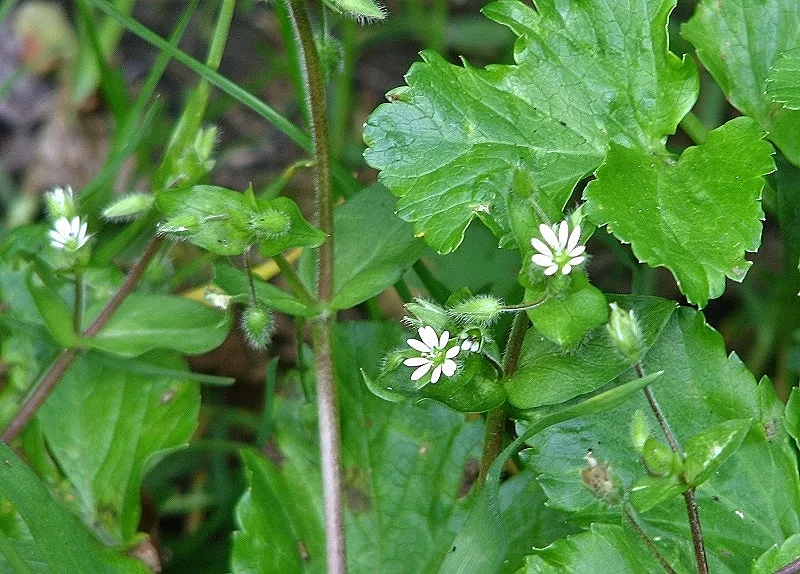
- common chickweed (Stellaria media (L.) Vill. s. l.),
- scentless false mayweed (Tripleurospermum inodorum (L.) Sch. Bip.),
- hairy smartweed (Persicaria scabra (Moench) Mold.),
- rapeseed volunteers (Brassica napus ssp. oleifera Metzg.),
- cleavers (Galium aparine L.),
- field pennycress (Cerastium arvense L.),
- field forget-me-not (Myosotis arvensis (L.) Hill.),
- perennial sowthistle (Sonchus arvensis L.),
- cornflower (Centaurea cyanus L.).
Common lambsquarters showed relative resistance to the herbicide Russel 100, SC when treated both at the 1–3 leaf stage of maize and at the 4–6 leaf stage. Therefore, the total efficacy of the product against annual dicotyledonous weeds was calculated excluding this species.
The efficacy of applying the herbicide Russel 100, SC at the 1–3 leaf stage of maize one month after treatment (field trial data for 2020, Ronaldiño hybrid) is presented in the table.
| Weed agrophytocenosis / Weed species | Plant mortality, % | Reduction in fresh vegetative mass, % |
|---|---|---|
| Annual dicotyledonous weeds (excluding common lambsquarters) | 86.5–90.0 | 95.9–98.5 |
| Field pansy | — | 93.3–95.0 |
| Common hemp-nettle | — | 88.8–98.0 |
| Cleavers | — | 96.0–100 |
| Black-bindweed | 83.3–85.1 | 93.0–96.7 |
| Hairy smartweed | 92.3–100 | 98.9–100 |
Biological efficacy of this herbicide in a mixture with the adjuvant Assistent+ differed insignificantly and amounted to 86.2–93.8% by count and 97.4–98.7% by mass one month after application. Under the action of the herbicides, shepherd's purse, common chickweed, field forget-me-not, field pennycress, cornflower, and scentless false mayweed were completely (100%) eliminated.
A decrease in the herbicide's efficacy, both when used alone and with the addition of the Assistent+ adjuvant, was noted at the 4–6 leaf stage of the crop compared to application at the 1–3 leaf stage. Thus, the mortality of annual dicotyledonous weeds at the 4–6 leaf stage was 84.7–88.0%, and their mass decreased by 85.7–90.6%, which indicates varying sensitivity of weeds to the product at different developmental stages. Some weeds (black-bindweed, hairy smartweed, common hemp-nettle, scentless false mayweed, common chickweed, field pansy, and rapeseed volunteers) had outgrown the vulnerable phase, so the herbicide's efficacy against them decreased slightly compared to the first treatment. Efficacy against black-bindweed was 85.5–89.1% by count and 80.5–86.5% by mass; against hairy smartweed — 55.0–80.0% and 84.0–94.7%, respectively. Vegetative mass of scentless false mayweed decreased by 95.3–97.4%, common chickweed by 94.3–98.6%, cleavers by 88.9–100%, cornflower by 32.9–100%, and rapeseed volunteers by 89.6–97.4%.
Table 1 – Biological efficacy of the herbicide Russel 100, SC in maize crops one month after application (field trial, RUE "Institute for Plant Protection", 2020)
Reduction in weed density, % of the unweeded control, biomass of all annuals, scentless mayweed, black bindweed, common chickweed
Application of herbicides at the 1–3 leaf stage of the crop (assessment 26.06.2020) Control pcs/m2 275 114 34 10 13 25 26 12 12 289 unweeded g/m2 857 272 152 41 47 31 30 189 189 972 Prima, SE – 0.6 l/ha 90.2 74.6 5.9 90.0 92.3 92.3 33.3 73.0
100 100 (standard) 96.3 87.5 53.3 98.8 93.6 95.0 48.0 87.0 Russel 100, SC – 60.7 85.1 55.9 92.3 84.6 83.3 86.5
100 100 100 0.04 l/ha 43.4 93.0 88.8 98.9 93.3 96.0 95.9 Russel 100, SC + adjuvant Assistant+ –
68.8 84.2 64.7 84.6 86.2 100 100 100 100 100
50.4 98.5 90.8 91.7 97.4 0.04 + 0.1 l/ha Russel 100, SC – 69.8 83.3 82.4 92.3 90.0
100 100 100 100 100 0.05 l/ha 58.0 96.7 98.0 95.0 98.5 Russel 100, SC + adjuvant Assistant+ –
63.2 92.1 82.4 92.3 93.8 100 100 100 100 100
50.6 97.8 96.4 96.7 98.7 0.05 + 0.1 l/ha
Application of herbicides at the 4–6 leaf stage of the crop (assessment 09.07.2020) Control pcs/m2 244 110 41 14 20 27 27 11 14 366 unweeded g/m2 1107 318 179 191 206 70 42 546 45 2000 Prima, SE – 0.6 l/ha 97.1 86.4 65.9 78.6 70.0 88.9 40.7 85.7 82.5 (standard) 96.0 74.5 32.4 90.1 88.8 90.0 54.8 91.1 84.3 Russel 100, SC – 69.3 85.5 73.2 92.9 55.0 96.3 70.4 63.6 85.8 0.04 l/ha 42.8 80.5 61.5 97.4 84.0 98.6 71.4 89.6 85.7 Russel 100, SC + adjuvant Assistant+ –
70.1 85.5 68.3 85.7 80.0 96.3 81.5 81.8 86.9 100
36.0 81.8 54.2 95.8 89.8 95.7 83.3 94.7 90.0 0.04 + 0.1 l/ha Russel 100, SC – 72.5 86.4 73.2 92.9 80.0 96.3 74.1 63.6 88.0 0.05 l/ha 48.6 83.3 69.3 95.3 94.7 94.3 78.6 91.8 90.6 Russel 100, SC + adjuvant Assistant+ –
64.8 89.1 63.4 78.6 75.0 96.3 59.3 54.5 92.9 84.7
36.1 86.5 66.5 95.8 94.7 97.1 57.1 91.4 88.9 89.8 0.05 + 0.1 l/ha
The difference in the susceptibility of weeds to the herbicide at different application times was most noticeable in hemp-nettle and field pansy. At the 4–6 leaf stage of the crop, the mortality of hemp-nettle was 63.4–73.2%, biomass reduction – 54.2–69.3%, field pansy – 59.3–81.5% and 57.1–83.3%, respectively.
In all experimental variants using herbicides, shepherd's purse Shepherd's purse common">shepherd's purse, field forget-me-not, and field pennycress were completely eliminated (100%).
Assessing weed infestation two months after herbicide application in maize crops showed that the biological efficacy of the herbicide Russel 100, SC remained at the same level as in the first assessment. The mortality of annual dicotyledonous weeds in variants with the application of Russel 100, SC at the 1–3 leaf stage of the crop was 84.9–94.5%, and at the 4–6 leaf stage – 84.5–90.3%. When using Russel 100, SC in a mixture with the adjuvant Assistant+, the density of annual dicotyledonous weeds decreased by 87.0–95.0% when treated at the 1–3 leaf stage of the crop, and by 87.0–89.5% when treated at the 4–6 leaf stage of the crop.
In 2021, the efficacy of the herbicide Russel 100, SC remained at a high level: at the 1–3 leaf stage of the crop, the mortality of annual dicotyledonous weeds was 88.6–95.2%, and their biomass decreased by 93.8–95.2%; at the 4–6 leaf stage of the crop – by 85.2% and 88.4–89.4%, respectively. Similar results were obtained when applying the herbicide in a mixture with the adjuvant Assistant+.
In winter wheat crops in the autumn of 2020, the initial weed infestation before treatment was quite high and ranged from 78.0 to 108.5 pcs/m2. The density of all annual dicotyledonous weeds in the experimental variants was 74.0–104.5 pcs/m2, and perennials – 3.0–4.0 pcs/m2. The dominant species in the weed community were black bindweed, common chickweed, common lambsquarters, volunteer oilseed rape, shepherd's purse, cleavers, scentless mayweed, field pansy, creeping thistle (Cirsium arvense (L.) Scop.), and perennial sowthistle.
One month after the resumption of spring vegetation of the crop, the density of annual dicotyledonous weeds in the variants with herbicide application of Russel 100, SC decreased by 76.2–80.0%, and vegetative mass – by 93.5–95.9%. The mortality of volunteer oilseed rape was 90.0% with a 96.4% reduction in vegetative mass. The density of cleavers decreased by 87.5–100%, and vegetative mass – by 85.0–100%. In the standard variant, volunteer oilseed rape was completely eliminated (100%), the density of cleavers decreased by 87.5%, and its vegetative mass – by 90.0%. Under the action of the herbicide Russel 100, SC, field pansy mortality was 32.4–41.2%, its vegetative mass decreased by 76.1–86.6%; in the variant using the herbicide Ballerina, SE, the efficacy was at the same level. In all experimental variants, common chickweed, shepherd's purse, and scentless mayweed were completely eliminated.
Table 2 – Biological efficacy of the herbicide Russel 100, SC in maize crops one month after application (field trial, RUE "Institute for Plant Protection", 2021)
Reduction in weed density, % of the unweeded control, biomass of shepherd's purse, rough cocklebur, all annuals, scentless mayweed
Application of herbicides at the 1–3 leaf stage of the crop (assessment 26.06.2021)
Control unweeded pcs/m2 105 29 5 48 17 27 45 75 11 501 g/m2 309 209 15 144 56 78 45 181 40 1376
Prima, SE – 0.6 l/ha 97.1 89.7 97.9 88.2 62.2 98.7 84.2
100 100 100 (standard) 96.8 95.2 98.6 94.6 80.0 98.9 91.4
Russel 100, SC – 76.2 82.8 94.1 77.8 88.6
100 100 100 100 100 0.04 l/ha 75.7 93.8 98.2 86.7 93.8 Russel 100, SC + adjuvant Assistant+ –
68.6 86.2 94.1 68.9 89.4 100 100 100 100 100
76.7 95.2 96.4 86.7 93.3 0.04 + 0.1 l/ha Russel 100, SC – 56.2 96.6 97.9 77.8 98.7 95.2
100 100 100 100 0.05 l/ha 65.7 99.5 99.3 91.1 99.4 95.2 Russel 100, SC + adjuvant Assistant+ –
72.4 96.6 97.9 94.1 84.4 94.5 100 100 100 100
81.2 99.5 99.3 98.2 88.9 94.5 0.05 + 0.1 l/ha
Application of herbicides at the 4–6 leaf stage of the crop (assessment 09.07.2021) Control unweeded pcs/m2 156 35 22 21 16 19 53 37 9 452 g/m2 1185 400 172 180 113 100 135 207 35 2411 Prima, SE – 0.6 l/ha 97.4 82.9 90.9 76.2 32.1 85.0
100 100 100 100 (standard) 93.6 68.0 86.6 64.4 50.4 83.3 Russel 100, SC – 75.6 85.7 90.9 90.5 41.5 97.3 88.9 85.2
100 100 0.04 l/ha 62.4 83.8 85.5 91.7 59.3 98.1 94.3 88.4 Russel 100, SC + adjuvant Assistant+ –
78.2 88.6 95.5 95.2 93.8 30.2 97.3 85.2 100 100
68.9 91.0 91.3 95.0 92.0 52.6 99.0 88.6 0.04 + 0.1 l/ha Russel 100, SC – 71.8 88.6 90.9 95.2 35.8 85.2
100 100 100 100 0.05 l/ha 64.1 88.0 87.2 95.6 57.8 89.4 Russel 100, SC + adjuvant Assistant+ –
75.6 91.4 95.5 95.2 28.3 85.6 100 100 100 100
65.7 94.5 93.0 96.7 49.6 91.7 0.05 + 0.1 l/ha
Table 3 – Biological efficacy of the herbicide Russel 100, SC with autumn application one month after the resumption of spring vegetation of the crop in winter wheat crops (field trial, RUE "Institute for Plant Protection", 04.05.2021)
Reduction in weed density, % of the control without weeding of the mass of all perennials shepherd's purse field pansy volunteer oilseed rape field sowthistle scentless mayweed common cleavers all Control pcs/m2 10.0 16.0 12.0 2.0 34.0 82.5 2.5 3.5 6.0 88.5 without weedpcs/m2 40.0 14.3 15.6 8.5 16.8 116.9 8.5 5.5 14.0 130.9 ing Balerina, SE – 0.5 87.5 35.3 78.1 80.0 85.7 83.3 78.6
100 100 100 L/ha (standard) 90.0 76.1 93.4 85.3 86.4 85.7 92.6 Rassel 100, 90.0 87.5 32.4 76.2 74.0 71.4 72.5 75.8
100 100 SC – 0.03 L/ha 96.4 85.0 76.1 93.5 79.4 72.7 76.8 90.5 Rassel 100, 90.0 41.2 80.0 80.0 78.6 79.2 79.9
100 100 100 SC – 0.05 L/ha 96.4 86.6 95.9 88.2 88.2 88.2 95.2
For perennial dicotyledonous weeds (field sowthistle, creeping thistle), application of the herbicide Rassel 100, SC at an application rate of 0.05 L/ha had a more effective (over 78.6%) impact. The total number of weeds under the influence of the herbicides decreased by 75.8–79.9%, and vegetative mass by 90.5–95.2%.
Two months after the resumption of the spring growing season of the crop, the biological efficiency of the herbicides remained at a high level. Thus, the infestation of crop fields by dicotyledonous weed species when using the herbicide Rassel 100, SC decreased by 86.9–94.0% in terms of density and by 93.7–97.7% in terms of mass. Under the influence of the herbicide Balerina, SE, weed mortality was 90.1% with a reduction in vegetative mass of 96.3%.
The average yield of maize over the two-year study period in the control without weeding was 4.3 centner/ha. In the variants using herbicides, significant yield increases were obtained: from 38.2 to 60.4 centner/ha, depending on the experimental variant. The largest amount of preserved harvest was obtained in the variants with the herbicide Prima, SE – 53.1–60.4 centner/ha, and with the herbicide Rassel 100, SC in pure form and with the adjuvant Assistant+ at the maximum application rate – 49.8–52.4 centner/ha. The reduction of weed infestation in winter wheat fields with autumn application of the herbicide Rassel 100, SC ensured crop yield preservation by 12.4–15.6% (5.4–6.8 centner/ha), and the herbicide Balerina, SE – by 11.9% (5.2 centner/ha).
Table 4 – Biological efficiency of the herbicide Rassel 100, SC during autumn application two months after the resumption of the spring growing season of the crop in winter wheat fields (field experiment, RUE "Institute of Plant Protection", 27.05.2021)
Reduction in weed density, % of the control without weeding of the mass of all perennials shepherd's purse field pansy volunteer oilseed rape field sowthistle scentless mayweed common cleavers all Control pcs/m2 9.0 23.0 12.5 4.0 28.5 85.0 2.0 2.5 4.5 89.5 without weedpcs/m2 140.4 250.7 71.3 81.6 68.4 679.4 20.0 38.7 58.7 738.1 ing Balerina, SE – 70.3 90.6 87.5 80.0 83.3 90.1
100 100 100 100 0.5 L/ha (standard) 79.4 97.2 88.6 81.8 84.8 96.3
Rassel 100, SC – 62.2 88.0 75.0 70.0 72.2 86.9
100 100 100 100 0.03 L/ha 64.6 95.1 81.8 71.6 76.2 93.7
Rassel 100, SC – 83.8 94.9 87.5 80.0 83.3 94.0
100 100 100 100 0.05 L/ha 88.6 98.4 88.6 87.3 87.9 97.7
Conclusion. The results of the studies showed high biological efficiency of the herbicide Rassel 100, SC (florasulam, 100 g/L) against annual dicotyledonous weed species, both in maize and winter wheat crops. In the crop agrocenoses, scentless mayweed, volunteer oilseed rape, common chickweed, shepherd's purse, cornflower, and field pennycress were completely eradicated (100%). The density of common cleavers and knotweed species decreased by 83.3–100%. Infestation of winter wheat fields with perennial dicotyledonous species (field sowthistle, creeping thistle) decreased by 72.5–79.2% in terms of density and by 76.8–88.2% in terms of weed mass.
Based on the conducted studies, the herbicide has passed state registration and is approved for use according to the following regulations:
- spraying of maize crops in the 1–6 leaf phase of the crop against annual dicotyledonous weeds (except common lambsquarters) at a rate of 40–50 ml/ha;
- spraying of winter wheat crops in the autumn during the tillering phase of the crop against annual dicotyledonous weeds at a rate of 30–50 ml/ha.
Stashkevich, A. V. Dynamics of weed infestation in maize crops in Belarus / A. V. Stashkevich // Agrotechnical method of plant protection against pests: materials of the VI international scientific-practical conference, Krasnodar, June 17-21, 2013 / Russian Academy of Agricultural Sciences, Kuban State Agrarian University; executive editor M. I. Zazimko. – Krasnodar, 2013. – pp. 219–221.
Methodological guidelines for conducting registration trials of herbicides in agricultural crops in the Republic of Belarus / Scientific and Practical Center of the NAS of Belarus for Agriculture; Institute of Plant Protection; compiled by: S. V. Soroka, T. N. Lapkovskaya. – Nesvizh: Nesvizh Enlarged Printing House named after S. Budny, 2007. – 58 p.
A. V. Stashkevich, A. S. Pestereva, L. I. Soroka, N. S. Stashkevich RUE «Institute of Plant Protection», Priluki, Minsk region
EFFICIENCY OF THE HERBICIDE RASSEL 100, SC IN
MAIZE AND WINTER WHEAT
Annotation. The biological and economic efficiency of the herbicide based on florasulam in maize and winter wheat was studied. It was established that the application of the herbicide Rassel 100, SC reduced the infestation of the crops with wild camomile, rape drops, blue bottle flower and field pennycress by 100 %, knotweed species and catchweed bedstraw – by 83.3–100. In maize the efficiency of the herbicide against annual dicotyledonous weeds (excluding white goosefoot) was
86.2–98.7 %. In winter wheat the number of dicotyledonous weeds decreased by
86.9–94.0 %, including annual weeds by 88.0–94.9 % and perennial weeds by 72.2–
83.3 %. The reduction in weed infestation contributed to maintaining 49.8–52.4 c/ha of the maize yield and 5.4–6.8 c/ha of winter wheat yield.
Key words: maize, winter wheat, weeds, herbicide, efficiency.
Read next
Plant protection For agronomists
Application of post-emergence herbicides in mixed crops of maize and sunflower
Viticulture For agronomists
Methods of protecting vineyards from weeds and pests
Plant protection For agronomists