
Diagnostics and control methods for root and stem rots of chrysanthemums
18 min read
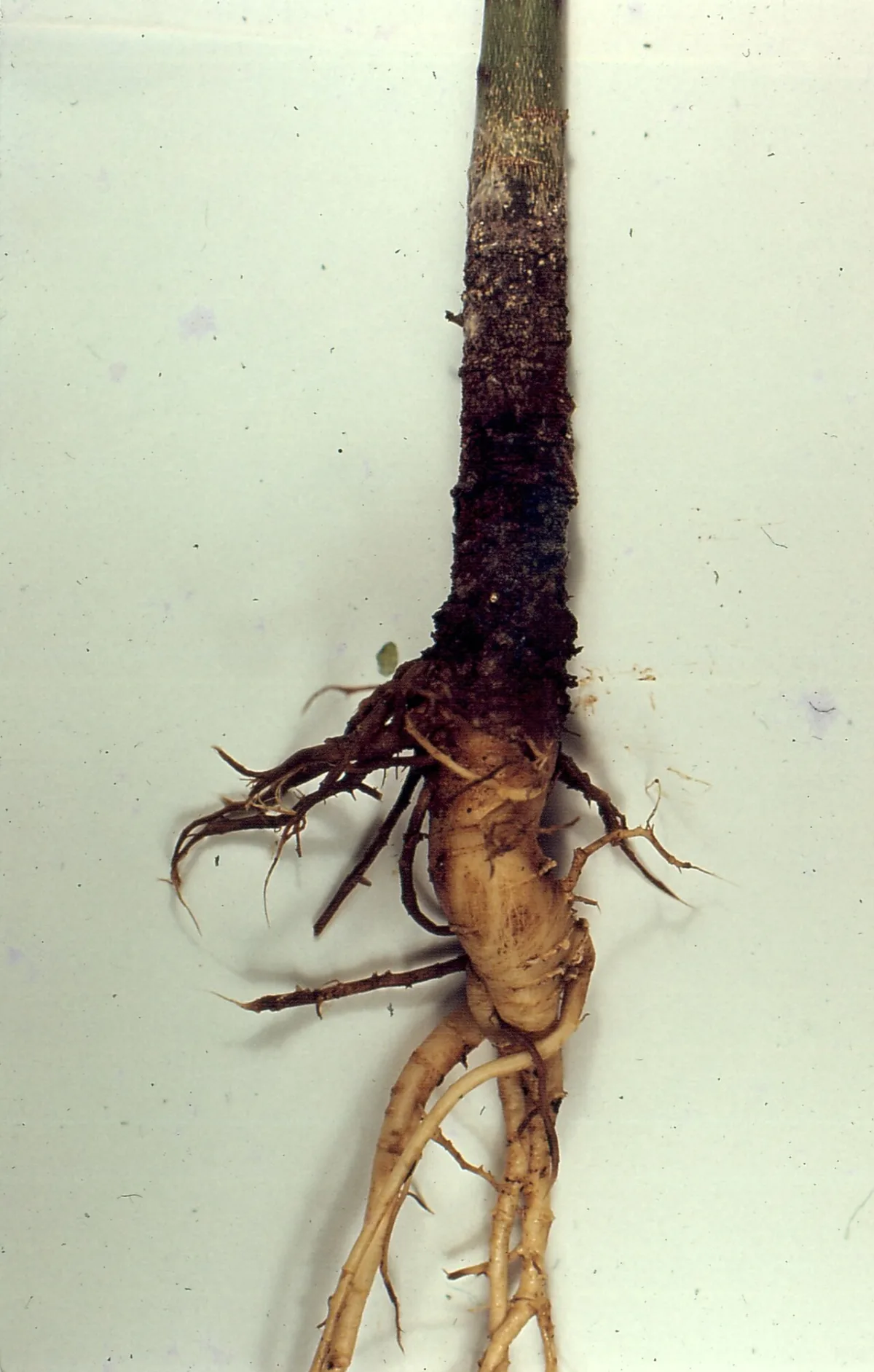
This disease is usually encountered in greenhouses where chrysanthemums are often grown, but soil disinfection is not practiced. Symptoms of infection include yellowing and necrosis of the lower leaves and stunting of the plants. Initially, red spots of various sizes develop on the roots, which quickly turn brown as the disease develops and eventually cause complete rotting of the root system. In cases of severe infection, the bases of the stems become corky, which negatively affects the production of cuttings from perennial stock plants. The affected crop often produces poor-quality flowers.
The pathogen survives for a long time in the soil, usually in infected root debris. The infection spreads through root contact and as a result of pathogen growth in the soil. Contaminated plant debris is spread across the surface of the beds by irrigation water.
Cultivars differ in their susceptibility to Phoma root rot: the most susceptible include the sports Snowerth and Syr, the cultivars Roigai, Valentine, Loveiness, Parade, Pogov \!1-
. ь7 и к с бы 7? 9, РА) №
7 у Ч к ие =” 7 м в А 7 * х О СВУ
Г. УТ“ А и М у Г) А
28: + ^^ х % ь НЙ ® и 3; Ч ы 4 (НИ Ч А)
2 \ 5,. \%\ Х \ у 5 у | А с“ \ ых Fig. 13.1 Root systems of chrysanthemum plants with symptoms of Phoma root rot (causative agent Phoma chrysanthemicola). In the center — severe infection, on the right — partial infection, on the left — healthy root system.
zon, Deiph. The cultivars Neuday, Superfor, Snowscar, and also the sport Princess Anne possess a certain resistance.
Control. Before each planting of chrysanthemums, it is necessary to carry out soil disinfection with steam or chemicals. If this is impossible, nabam is added to the irrigation water during each irrigation. This fungicide provides good results, especially in well-drained and structured soil. The addition of materials such as peat or gravel leads to increased efficiency of nabam. In greenhouses where Phoma root rot appears constantly, highly susceptible cultivars should not be planted.
Satisfactory results are also provided by growing chrysanthemums in an isolated substrate (peat bags) or using TIC.
Rhizoctonia stem rot (R. rhizoctonia solani)
This common disease can be dangerous, especially in year-round chrysanthemum cultivation. The disease develops most often in a warm environment, in moist (but not waterlogged) soil. Quite often, individual diseased plants or foci of infection appear in a newly planted crop. The affected area is located at the very soil surface, gradually extending upwards by 10 cm. The diseased tissue turns brown and dries out; upon detailed examination, the brown mycelium of the fungus can be found on it. Affected plants wilt and die in a short time.
R. solani is a common soil-borne pathogen that sometimes also contaminates peat. It multiplies rapidly and colonizes pasteurized soil with great speed. The infection is sometimes spread via cuttings.
Control. Regular steaming or chemical soil disinfection helps keep the disease at a low level. Before treatment, it is necessary to add peat or some other material to the soil. Good results are also obtained by incorporating quintozene or tolclofos-methyl into the soil before planting the cuttings. High-volume spraying with iprodione contributes to slowing the spread of the disease when treatment is carried out immediately after diseased plants are detected.
The disease severely affects certain cultivars. It was once particularly common on the Iceberg cultivar, which is why it is sometimes called Iceberg disease. Susceptible cultivars also include Leume, Hurricane, Pelenhum, and the sports Snowerth and Manapotis. Affected plants wilt unexpectedly and die quickly. A depressed black spot appears on the stem at the very soil surface, gradually growing in height by 20—25 cm. In some cases, lesions also appear quite high from the base of the plant. Diseased roots turn slightly brown and rot, especially near the root zone of the stem. According to some data, the pathogen can be carried on cuttings, especially when they are cut in the lower part of the stem. After periods of excessive soil moisture, Pythium rot often develops into an epiphytotic. Oospores of the pathogen persist in the soil for a long time; in a moist environment, it spreads either by zoospores or by vegetative mycelium.
Control. It is necessary to avoid excessive moistening of the beds by ensuring active soil drainage in the greenhouse. Steaming or chemical soil disinfection should be carried out regularly. An alternative method of control is tillage before or after planting by irrigation with etridiazole or propamocarb-hydrochloride (Previcur). In this case, one must be sure that the fungicides used are not phytotoxic to the cultivars being grown.
Didymella stem rot (Didymella chrysanthemi)
When plants are infected with Didymella stem rot, symptoms on the stems are very similar to those that develop with Pythium rot. A wet, black spot appears at the soil surface or slightly above, often spreading up to 10—15 cm in length. Upon examination of the spot under a magnifying glass, one can find small round pycnidia of the fungus, which serve as a diagnostic feature of the disease.
к % ди ПРАВУ ы %. ету у < 2 7 ва», *. № а 1 А н = В р \ ы 1 7 и РЕ. <
ра РЯ 8 ыы ПьчА ЕРВЕЕ | Fig. 13.2. Chrysanthemum infected with Didymella stem rot: a — section of the stem infected by Didymella chrysanthemi, the pathogen of stem rot; b — rot and flower drop develop when buds are affected.
Didymella stem rot is widespread; when cuttings are affected, it causes black stem necrosis and death of the growth point, and less frequently, black spots on the leaves. In adult plants, necrosis on leaves rarely develops, but may occur on lower leaves. They are black, more or less round, 10—15 mm in diameter, with pycnidia. The pathogen can also affect the roots; signs of infection are similar to those of Pythium rot, but root disease occurs rarely. Sometimes, affected plants exhibit deformation of the growth point without any other symptoms. It is believed that by affecting the base of the stem, D. chrysanthemi releases toxins responsible for the deformation of the growth point. Signs of infection appear relatively rarely on flowers. Sometimes the pathogen infects the top of the flowering shoot or inflorescence, which is accompanied by black rot and flower drop. Not showing external signs of infection at the time of harvesting, the pathogen develops during product transportation, and when unloading from boxes, the chrysanthemums shed their petals.
Most often, the infection is introduced into the greenhouse with infected cuttings, but the soil and plant residues also serve as possible sources. After the formation of pycnidia, spores spread quickly with water splashes or during the care of infected plants. For an outbreak of Didymella stem rot, a damp environment and high relative humidity are necessary.
Cultivars differ in susceptibility to Didymella stem rot, although this issue has not been studied in detail, and a list of susceptible and resistant cultivars has not been compiled. The cultivars 'Snookie' and 'Princess Anne' are distinguished by very high susceptibility.
Control. Primary control of Didymella stem rot should be carried out during chrysanthemum propagation. Growing healthy cuttings allows the disease to be kept at a very low level. It is necessary to avoid conditions favorable for disease development. Fungicides such as zineb, mancozeb, iprodione, and vinclozolin, applied via high-volume spraying, are highly effective against Didymella stem rot. The spread of infection occurs particularly quickly at high relative humidity and temperatures of approximately 15 °C. When the disease appears in plantings of stock plants, all affected specimens should be removed.
This pathogen is rarely the primary cause of stem disease, but it usually colonizes diseased tissues. Light-brown spots of various lengths appear on the stems, upon which a mass of dark gray-brown conidiophores of the fungus develops. Control measures for this pathogen are described in the section on gray mold of flowers (p. 315).
305. г. Чы м и”, м м 7 мене ^^ $ т —_ \ г ы { ы. [1% с $ р. №, $. К, < 9 ы ь 5 дичь и жа 9 “3 “. у 45% ий ® * \ м з к РА, [9 ь а д ай 1 Fig. 13.3. Gray mold (pathogen Botrytis cinerea) on a chrysanthemum stem. The pathogen penetrated the plant, apparently either through a wound at the node or through mechanical damage on a lateral shoot.
White mold, or Sclerotinia rot (Sclerotinia sclerotiorum)
Appearing sporadically on chrysanthemums, white mold rarely causes serious damage. The first symptom is usually the wilting of the affected plants. Light-brown necrosis can develop along the entire length of the stem, but most often somewhere in its middle part between the soil surface and the inflorescence. Gradually, the necrotic areas are covered with a thick coating of white mycelium, in which sclerotia up to 10 mm in diameter are embedded. Sclerotia can also be found in the core of the stem in the affected area, but they are somewhat longer and resemble small cylinders in shape. Sclerotia ensure the survival of the pathogen in the absence of a host. Under favorable conditions, they form mycelium or apothecia with ascospores, which initiate a secondary cycle of the disease. White mold develops over a wide temperature range (from 10 to 24 °C), although for ascospores, as disease initiators, high relative humidity of the air and leaf moisture are necessary.
Control. Diseased plants should be removed very carefully so that sclerotia do not fall onto the soil surface. Steaming or chemical soil disinfestation is accompanied by the death of most, and sometimes all, sclerotia, but those located deep in the soil persist for a long time and germinate under favorable conditions. High-volume spraying with iprodione or benomyl helps to suppress the spread of white rot. There have been several reports of effective biological control of S. sclerotiorum using the fungus Coniothyrium minitans, but industrial production of preparations of this fungus has not been established.
This common disease is characterized by a white powdery coating on the surface of leaves, and the pathogen can also affect stems and flower buds of the chrysanthemum. Spores, produced in huge quantities, are easily carried by air and germinate in high humidity, but not in free water. Chrysanthemum is the only host of O. chrysanthemi).
The perfect stage of the fungus is unknown; it survives only in the presence of the chrysanthemum. Conidia are short-lived without the host plant. Powdery mildew is very harmful under low-temperature conditions in the greenhouse, and this is exactly the situation that arises when chrysanthemum grown for sale at the end of December or mid-April reaches marketability too quickly.
Powdery mildew, septoria leaf spot, and bacterial gall of chrysanthemums
Powdery mildew can quickly ruin the marketability of chrysanthemums. Disease development is restrained at low relative air humidity, but if the white coating has already appeared, the agronomist needs to perform high-volume spraying with fungicides. Dinocap, oxythioquinox (Morestan), imazalil, and pyrazophos are suitable for controlling the pathogen. If the disease development is weak, a mixture of thiram and permethrin with refined (white) mineral oil also shows high effectiveness.
Chrysanthemum cultivars have different sensitivity to chemicals. If there are doubts about the phytotoxicity of a fungicide, first perform a test spraying on a few plants and only then treat the entire planting.
The application of a mixture of thiram, permethrin, and white mineral oil does not leave visible residue on chrysanthemum leaves. This allows protective treatments to be carried out shortly before the sale of cut flowers.
Septoria (wart disease, or leaf spot) most often affects stock plants and chrysanthemums in the open ground with dense foliage under high humidity conditions. Round brown or black spots up to 2 cm in diameter appear on the lower leaves, which, in case of severe infection, merge, causing leaf death. The infection spreads mainly with water splashes containing pycnospores, and infected cuttings usually serve as the main primary source of the disease. Septoria is controlled directly during the process of chrysanthemum propagation: high-volume spraying with benomyl, zineb, or mancozeb is carried out, and all diseased plants are immediately removed.
Bacterial gall appears on cuttings and stock plants in isolated cases, manifesting as small galls at the base of the cutting. The pathogenic bacterium lives in the soil and is spread by contaminated knives and workers' hands during maintenance. For the disease to cause noticeable damage, the concentration of inoculum in the root environment must be very high.
- Completely remove and burn all plants affected by bacterial gall.
- Carry out mandatory sterilization of the root environment (substrate) and work benches.
- Pay special attention to staff hygiene during propagation and pruning, as there are no chemical methods to control bacterial gall.
Brown and white rust: diagnostics and control measures
Brown rust on chrysanthemums appears much less frequently than white rust today. Small reddish-brown pustules the size of a pinhead develop on the underside of the leaves, arranged in scattered patterns or concentric circles. Spores germinate in high relative humidity or in water droplets and are easily spread by wind and splashes. The only host of the pathogen is the chrysanthemum, in the absence of which spores retain viability for only a few weeks.
- Diameter of septoria spots — up to 2 cm
- Size of white rust pustules — up to 4 mm
- Viability of brown rust spores without a host — several weeks
To protect plantings from brown rust, the agronomist needs to follow a complex of agrotechnical and chemical measures:
- avoid high air humidity, wetting of leaves, and water splashing during irrigation;
- conduct regular inspections of stock plant plantings to identify latent infection;
- carry out pre-planting hot water treatment of cuttings (in conjunction with nematode control);
- apply high-volume spraying with benodanil, oxycarboxin, triforine, triadimefon, zineb, or mancozeb.
White rust is recognized as a more dangerous disease. The first sign of the disease is yellowish spots on the upper side of the leaves, the center of which gradually turns brown. On the underside of the leaf, light yellowish-brown or pinkish pustules form, which then turn white and grow up to 4 mm in diameter. High relative humidity and leaf moisture are also favorable conditions for the germination of teliospores and basidiospores.
In Europe, white rust was first detected in 1963, where it was repeatedly introduced with infected cuttings and cut flowers. Since the host range of the fungus is limited only to chrysanthemums, it practically does not survive outside greenhouses, except for regions with a very mild winter climate. Spores in greenhouses die quickly, so they serve as a source of infection only during intensive year-round chrysanthemum cultivation, although volatile basidiospores effectively transmit the disease through the air to neighboring plantings.
As a preventive measure for controlling white rust, standard high-volume spraying of plantings is carried out, especially in high-risk zones. When choosing products, the agronomist should consider their actual efficacy against the pathogen, as the sensitivity of chrysanthemum cultivars to fungicides varies. To avoid phytotoxicity and leaf burns, be sure to conduct a trial spraying of a few plants before large-scale treatment.
| Efficacy against white rust | Fungicide active ingredients |
|---|---|
| Most effective | benodanil, bitertanol, oxycarboxin |
| Less effective | triforine, triadimefon, chlorothalonil, zineb, mancozeb |
This bacterial disease is quite common, but rarely harmful. The affected plant forms many thickened or deformed buds and shoots at the base of the stem. The bacterium is easily spread by contaminated hands and knives, as well as by water splashes. The main source of infection is diseased cuttings.
Control. All affected plants are removed and burned, and stock plants with weak symptoms of the disease are culled. Steaming or chemical soil disinfection ensures the eradication of the pathogen, and chrysanthemum plantings following an affected crop remain healthy.
Verticillium wilt (Verticillium dahliae, V. albo-atrum)
Verticillium wilt is a common and one of the most harmful diseases of the chrysanthemum. The leaves of affected plants turn yellow and wilt; yellowing often begins with one or several lower leaves. Gradually, the yellowing E =:
Ч 7 Ум №: ‚2 | я к. Ф; Нм к 5. / ' чае М — че» - и а л^] `. м и ччь Вх к, РО 4 2 \* + мм. г = о “ы 7 у в $. № 7 ъ й „м > а 4» 28. ь ь 7 1 1 >. 2.: у ры т 74 ь { а ею %®- $ 9% 2. ЕР ^ и >’ и аа т; д *. 1 д. $ “ [9 % * И = Щл у 27;Уэ. ‚4 у - ‚“ - 9-4 с \ м 87% м 1 5% Fig. 13.5. Verticillium wilt on potted plants of the cultivar Folen Princess Anne: a — healthy plant; b — plant with severe signs of wilting. Symptoms often become typical during the bud formation period.
spreads throughout the plant, the lower leaves turn brown and die off (Fig. 13.5). The fungus penetrates the plants through the roots and travels through the vascular system. Browning of vascular tissues does not always occur and cannot serve as an accurate diagnostic sign.
Both pathogens inhabit the soil and survive in it or in plant debris for many years. In addition, a common source of infection is affected cuttings. The spread of Verticillium wilt occurs through root contact, due to the growth of vegetative mycelium in the soil, and also with the help of conidia, which sometimes form on the surface of the affected stem.
Chrysanthemum cultivars differ in their susceptibility to Verticillium wilt, although to date there is still no list of resistant and susceptible cultivars.
Control. Obtaining cuttings from healthy stock plants plays a very important role, and the work of the national association for the production of mother plants in this direction has contributed to reducing the prevalence of Verticillium wilt. Regular steaming or chemical soil disinfection weakens the incidence of chrysanthemum. An alternative method of control is isolated cultivation of the crop. The use of fungicides does not give the desired result, although irrigation with benomyl during the early phases of plant development is successful in some cases.
This disease, caused by a viroid, has been affecting the chrysanthemum for many years, especially during year-round cultivation. The frequency of infection depends on the number of stock plants kept for obtaining cuttings. Stunting develops in many cultivars, causing a reduction in the number of leaves and flowers, accelerated flowering, and growth retardation. Flowers become deformed upon infection, their color fades, but the leaves in most cases do not change either color or shape. The pathogen is highly infectious and is transmitted on contaminated hands and with knives. Vectors (other than humans) and other natural hosts of the viroid are unknown.
For accurate diagnosis of stunt, grafting is performed onto the indicator cultivar M15, which develops bright chlorotic spotting 3—4 months after grafting if infected. In addition, the presence of the viroid can be determined in the laboratory using polyacrylamide gel electrophoresis.
Control. To ensure that all mother plants are free from the stunt viroid, a rigorous selection and testing program must be carried out, gradually building up a healthy mother plant stock. Against some strains of the vi-
9 ® + у А р м ыы м м 54 4 щ па >: 7 4.* ч ' ех У \ Г ^ у | т ы $? \ 4-1, 94 [7 | * И 21 #1 д ай Ра ” 2 ие. ®;: в 1 1 4 х, \ ь „ % а у > Ви и у К ЦТ РЯ = у, ют те ы % 7” о м ГЕ ‚7 Ц^ з Зз + 9.1: р. з са ПР *. ь С а В № * вы № ы | * -з 4. | зай и х пы { Е: ы в гу ый. к. Fig. 13.6. Chrysanthemum stunt is a viroid disease. Affected plants show stunted growth and bloom early; the inflorescences are often paler in color. roid, such as the causal agent of English stunt (Chrysanthemum stunt viroid), heat treatment and meristem culture are effective, but this method is unsuitable for clearing most other strains. Plantings with signs of stunting should be eliminated. If contamination is suspected, mother plants must not be used for propagation by cuttings.
Chrysanthemum chlorotic mottle (Chrysanthemum chlorotic mottle viroid)
Symptoms of chlorotic mottle are almost identical to those of stunt, but the damage is more visible on the leaves. Areas with distinct chlorotic or bright yellow mottling and spotting appear on them. These symptoms are particularly noticeable on the cultivar Blue Ridge. A viroid disease on the sport Princess Anne (either chlorotic mottle or infection by one of the stunt viroid strains) also causes typical symptoms: initially, small brown spotting is visible on the lower leaves, quite sparse, but as the plant develops and buds open, these leaves become chlorotic. Diseased plants lag in growth, flowering is accelerated, inflorescences have a paler color, and striping appears on some petals.
Control. The only way to control chlorotic mottle is to grow healthy mother plants. Affected plants are culled and destroyed.
Flower petal rot, or blight (Itersonilia perplexans)
This disease often develops in the autumn and winter months, causing pinpoint pinkish-brown spots on the outer flowers, which gradually expand, become oval, and turn brown. Affected areas are often covered with a white matte bloom, which can be used to identify the disease pathogen. They increase in size, and the pathogen rapidly spreads to other flowers, leading to the complete rotting of the inflorescence. At this or an earlier stage, gray mold appears on the petals simultaneously with the rot.
The disease is particularly dangerous for chrysanthemums grown in the open field or in poorly heated or unheated greenhouses. High relative humidity or foggy weather, leading to the accumulation of droplet moisture on the inflorescences, promotes the development of the disease. The rot pathogen is a fairly common leaf saprophyte; it can be found on
A + в” й %\ 9 д. к’? Ву, Fig. 13.7. Chrysanthemum petals infected with Itersonilia perplexans. A well-defined area of infection with white bloom on the surface is visible. ‹ Вы ь ь
Read next
Plant protection For agronomists
Effective control methods for gray mold on chrysanthemums in greenhouses
Plant protection For agronomists
The main diseases of tomato seedlings are damping-off and blackleg.
Plant protection For agronomists