
Agrotechnology for growing early tomatoes in film greenhouses using biofuel
18 min read
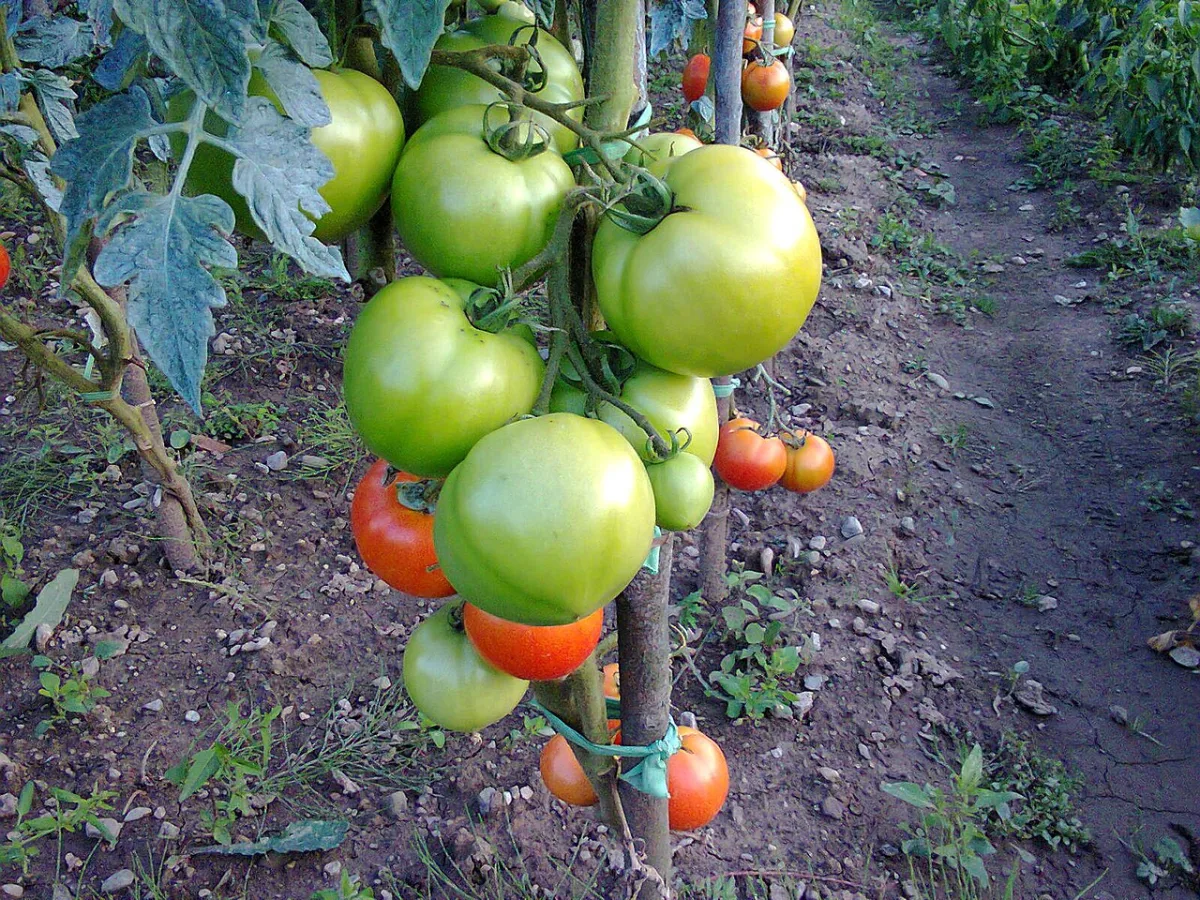
nutrient mixture in a 20 cm layer. If there is a shortage of manure, one can limit the work to digging a trench 30 cm deep and 35 cm wide and placing the manure inside it. The number of beds or trenches is determined by the width of the greenhouse. Along the side walls of the greenhouse, free space is left for sowing leafy green crops or radish. The manure must be fresh, preferably horse or cow manure, mixing the latter with sawdust or chopped straw (in a 1:3 ratio). When the mixture spread over the manure warms up to 27°C, you can plant the transplants. Such a temperature is, of course, insufficient for tomatoes, but it gradually rises in the heated manure, establishing favorable conditions for the growth and development of plants. Transplants are planted in ribbons in two rows with a spacing of 40 cm between rows and 20 cm between plants, and 70 cm between ribbons. As already indicated, the second stem (shoot-side shoot) is left under the first inflorescence, and all other side shoots are removed in a timely manner, not allowing them to grow larger than 5 cm. When pruning side shoots, small shoots often go unnoticed in the leaf axils, which then grow so much that they cannot be removed by simple pinching during the next pruning session. In this case, a mistake is made by cutting such a shoot with a knife and removing the leaves along with it, i.e., the assimilation apparatus that nourishes the fruits. It is more correct not to cut the shoot, but to pinch its top and the excess leaf if it has formed, as it will delay the ripening of fruits on the clusters. The aforementioned plant training is carried out only on short-statured cultivars: Nevsky, Bely Naliv, Talalikhin. Tall-growing cultivars are grown in a single stem on trellises with seven to eight inflorescences. To obtain an early harvest, it is of great importance to maintain the necessary air temperature, soil moisture, and air humidity in the greenhouse. Thus, the optimal temperature before plant flowering will be 22—25°C on sunny days, 17—18°C on cloudy days, and 12—14°C at night. During the flowering of the first cluster, the temperature is increased to 24—26°C on sunny days, to 20°C on cloudy days, and to 16—17°C at night. In the fruiting period, the temperature is raised by 2°C. Relative humidity is maintained within 60—65%. Irrigation should be carried out every three days before fruiting, and every other day during fruiting, taking into account weather conditions. To prevent the formation of puddles, watering should be done in two stages, approximately 10 liters per 1 m². And only with warm water not lower than 20°C. It must be taken into account that sharp fluctuations in soil moisture cause flower drop, and in the fruiting period, fruit cracking. A lack of moisture during the fruit bulking period leads to blossom-end rot. Plastic greenhouses with solar heating can be prepared in mid-April. When the soil is ready, it should be ploughed to a depth of 25—30 cm, without allowing the subsoil to be brought to the surface. It is better to apply fertilizers in the autumn — one bucket of organic matter per 1 m² mixed with superphosphate (0.5 cup), and in the spring — potassium nitrate (three tablespoons per 1 m²). If the predecessor for tomatoes was cucumber, then organic fertilizers should not be applied. Individual mineral fertilizers can be replaced with complex fertilizers: nitrophoska (three tablespoons with the addition of the same amount of superphosphate) or double the amount of garden mixture, also with the addition of superphosphate (three tablespoons per 1 m²). If the soil is heavy, then aged sawdust or sand should be added (up to a bucket per 1 m²). Subsequently, plant nutrition should be maintained by top dressing. When planting transplants, apply a tablespoon of superphosphate or double the amount of wood ash into the planting hole. 10—12 days after planting, feed the plants with a nitrophoska solution (two tablespoons per 10 liters of warm water for 10 plants or three tablespoons of garden mixture). At the beginning of flowering, apply the same dose for five plants, and at the beginning of fruiting — a potassium nitrate solution (three tablespoons also for five plants). At the same time, it is useful to spray the plants with a solution of magnesium sulfate (two tablespoons per 10 liters of water), and during temperature drops — with a superphosphate solution after settling for a day (three tablespoons per 10 liters of water). Foliar top dressing of plants with microelements accelerates fruiting and increases the yield. For this, 2.8 g of boric acid, 1.8 g of manganese sulfate, 0.2 g of zinc sulfate, 0.08 g of copper sulfate, and 0.1 g of ammonium molybdate are dissolved in 1 liter of water. 10 cm³ of this stock solution is given per 10 liters of water, using up to 0.3 liters of the mixture per 1 m². Spray the plants in the morning hours during cloudy weather. For better self-pollination, the plants should be shaken during midday hours daily two or three times with a light tap of a finger. The long-term experience of amateur M. Ya. Shtein in growing a high yield of tomatoes in a non-heated plastic greenhouse in the Moscow region deserves attention. In the 1980 season, which was unfavorable in terms of weather conditions, the transplants planted in the greenhouse soil withstood repeated May frosts of 6—7°C, thanks to the hardening of the seeds and transplants. M. Ya. Shtein hardens the seeds, which have been sorted and kept for 24 hours in a microelement solution, for five to seven days, placing them at night (for 12 hours) on the top shelf of a refrigerator, and during the day — on a heating radiator, having placed a wooden board underneath, ensuring that the temperature does not rise above 25°C. Before this, he keeps the seeds for a day on the radiator on damp felt in a plate with melted snow water, placing the plate in a plastic bag. He sows the sprouted seeds on March 15—20 into a nutrient mixture placed in eggshells from raw eggs with a hole pierced in the bottom with an awl. Mixture composition: peat, turf soil, and humus in equal amounts with the addition of a cup of ash and two tablespoons of finished Riga complete mineral fertilizer per bucket of mixture. To prevent the seedlings from being affected by damping-off, the mixture is watered with a dark-colored potassium permanganate solution. He conducts the hardening of seedlings at a night temperature of 8—10°C on the windowsill with an open vent and a lowered curtain or on the floor near a balcony door. When two true leaves appear, he crushes the shell and transplants the seedlings together with the shell into milk cartons with the same nutrient mixture. Both under the seedlings and under the transplants, he places several granules of superphosphate. After planting the seedlings, he sprinkles the soil with ash (a teaspoon). A week later, he feeds the transplants with diluted skim milk (200 g per 1 liter of boiled water for 80 plants), repeating the top dressing in 10—12 days. A week before planting the transplants, he digs deep holes the size of a bucket at a distance of 50 cm between rows and 40 cm in the row. He piles the soil from them in the middle of the greenhouse and mixes it with humus (20%), sand (10%), and ash (two cups per bucket of mixture), waters it with hot water, and covers it with plastic film. At the same time, he prepares an infusion of mullein (1:6) or bird droppings (1:10) and mixes this solution with collected fallen leaves. He pours hot water over the manure or bird droppings. At the bottom of each hole, he pours two handfuls of leaves, places a 30—40 cm long bundle of raspberry, willow, or straw stems for air exchange, adds half a bucket of the prepared warm mixture of mullein and leaves, sprinkles superphosphate on top, pours in a dark-colored potassium permanganate solution (0.5 liters), and plants the transplants (May 10—15), having previously removed the carton. Then he covers the hole with the transplant with the nutrient mixture prepared in the middle of the greenhouse and waters it again with the potassium permanganate solution (0.5 liters). The plants are tied to twine lowered from the crossbeams and grown as a single stem with side shoot pruning. To protect the plants from cold drops, he stretches an old film at the top. Plant care consists of top dressing with a Riga fertilizer solution in rotation with mullein, as well as carbon dioxide, for which a 10-liter jar with manure is placed in the greenhouse. To prevent plant disease with late blight, he performs spraying with a copper oxychloride solution (50 g per 10 liters of water), and against viral diseases — with skim milk (0.5 liters per 10 liters of water). After watering and spraying, he ventilates the greenhouse. Harvesting begins on July 20. The harvest, even in 1980, for the Prevoskhodny cultivar amounted to 5.2 kg per bush, for the Richy cultivar — 3.5 kg, and for Bely Naliv — 3.2 kg. Growing tomatoes under plastic covers. The transplants are planted in prepared soil, placing them in two rows at a distance of 40 cm between rows and 20 cm between plants, with subsequent removal of the single-stem crop after harvesting. Under the RRP (removable-replaceable cover), transplants are planted in three rows — 50 cm between rows and 30 cm between plants in a staggered pattern. Plant care is the same as when growing plants in a greenhouse; however, it should be taken into account that the air humidity under the film is always high, so the plants should be watered less frequently and only at the roots, followed by intensive ventilation. When the outside air temperature rises to 15°C, the film is usually removed. Frosts in the Moscow region are possible even in early June, so covers made of opaque materials should be kept ready. Newspaper paper can also be used as covering material. On the eve of a possible frost, the film is covered at night, stretching twine over the cover for protection against wind. Plants should not be allowed to come into contact with the film to avoid frost damage. Plant care is the same as when growing plants in a plastic greenhouse. Growing early tomatoes in open ground. If possible, it is better to allocate a part of the plot with a southern, even if slight, slope for tomatoes, with loose, well-warming, highly cultivated sandy loam soil with a water-permeable subsoil layer. "Good predecessors for tomatoes are vegetable crops under which organic fertilizers are applied (cucumbers, cabbage, onions). Let us recall that tomatoes should not be grown after tomatoes and potatoes, and even next to potatoes, to avoid plant infection with late blight. For obtaining an early tomato harvest, mulching the soil with transparent film is of great importance, as it improves the thermal regime and soil moisture, especially in heavy soils that warm up poorly in the spring and lose a lot of moisture through evaporation due to the formation of a soil crust. Tomato transplants are planted into the prepared and fertilized soil when the soil warms up to 10°C. Transplants are planted in holes to a depth of 10 cm. To prevent plants from getting sick with viral diseases like streak and mosaic, a warm solution of potassium permanganate (2 g per 10 liters of water) is poured into the hole before planting the transplants at a rate of 1 liter per plant in light soils, 0.5 liters — in heavy ones, repeating such watering every 10 days. This will also serve as a potassium top dressing, which contributes to accelerating tomato fruiting. The feeding area of plants and the density of transplant planting are determined primarily by the degree of soil fertility, the provision of plants with fertilizers, and moisture. With sufficient provision of plants with nutrients and water, vegetable crops can be spaced
Furthermore, for tomatoes, the planting density is also determined by the plant training method. Thus, when growing a single stem with two fruit clusters, transplants can be planted at a distance of 60 cm between rows and 20 cm between plants; on less fertile soil, the distance between plants is 25 cm. When growing two stems, with two clusters on each, plants are set at a spacing of 60 × 25 cm, and with three stems, where the third shoot is kept from the axil of the lower leaf — 70 × 30 cm. With natural growth, without pruning, when one expects to obtain late fruits for ripening and processing, the feeding area is increased to 70 × 40 cm or even 70 × 50 cm. Once the single or double-stemmed plants have finished fruiting, they are removed and replaced by secondary crops — greens or radishes. High-density planting of tomato transplants when training plants to a single stem and leaving two clusters with a pair of leaves above the top cluster to nourish the fruits accelerates fruit ripening by five to seven days or more, and in some cases even by 24 days. It should be taken into account that in the conditions of the central regions, new floral clusters that appear on the plants after August 1st usually do not produce ripened fruits in open ground; therefore, on plants with three shoots, to obtain a larger quantity of mature fruits, the tops of the plants should be pinched in early August. It is sometimes believed that in order to improve plant heating and accelerate fruit ripening, it is necessary to remove some of the leaves. But this is not so. Well-foliated plants better retain heat during cold nights. Furthermore, the removal of the photosynthetic apparatus reduces the flow of nutrients to the fruits, limits their filling, and decreases the yield. On the contrary, to increase the foliage of plants, even a portion of side shoots (suckers) with leaves is left, pinching their tops to prevent the formation of floral clusters. And when pruning lower shoots, if the leaf in whose axil the shoot has formed begins to yellow, the shoot should be left and its top pinched. Timely pinching of the top of the main shoot and lateral ones stops plant growth and the appearance of new inflorescences, and thereby the nutrients entering the plant provide nourishment to the remaining inflorescences, fruit sets, and fruits, accelerating fruit filling and increasing the yield.
Plant care consists, in addition to top dressing and irrigation, which are intensified during the fruiting period, and loosening the soil after irrigation or rain, also in hilling plants with moist soil to promote the formation of additional roots and enhance plant nutrition. Considering the location of the root system, the first soil loosening is carried out to a depth of 8—10 cm. At the same time, the plants are hilled. Subsequently, as the roots expand, the loosening depth is reduced to 5—6 cm so as not to damage the shallow roots. Hilling is important not only for the formation of adventitious roots. It inhibits the growth of buds from the axils of lower leaves and thereby limits the formation of side shoots (suckers). Harvesting can begin when the fruits start to turn pink. Picked pink fruits ripen quickly at a temperature of 20° C. Plant protection of tomatoes from diseases. Especially in rainy years, tomato plants are severely affected by late blight. Brown spots appear on the leaves, a faint white coating forms on the underside of the leaf, and blurred hard spots appear on the fruits. Against late blight, spraying of plants with 1% Bordeaux mixture is used (better in the evening), repeating the spraying after two weeks. Bordeaux mixture is prepared fresh for each spraying: 100 g of copper sulfate is dissolved in 1 l of hot water, using only non-metallic utensils for this, then 4 l of cold water are added. In another similar container, 100 g of lime is slaked and diluted with water to 5 l, then it is filtered into an enameled bucket and the copper sulfate solution is poured into it, but only in a thin stream while stirring vigorously with a wooden stick. Copper-soap emulsion is also effective (20 g of copper sulfate per 10 l of water and 200 g of soap dissolved in hot water). Zineb solution (10 g per 10 l of water) is used against a number of diseases: late blight and macrosporiosis (brown spots with concentric circles appear on leaves), brown spot (leaf mold), and Septoria leaf spot (white spot disease). Tomato plants can be treated with pesticides only 15 days before harvesting. In rainy weather, to protect plants from late blight infection, they are covered with film, which is stretched at a height of 2 m on stakes, without closing the sides. Among folk remedies against a number of diseases, garlic infusion is used: 50 g of crushed garlic is placed in a liter jar, filled with water, strained after 24 hours, and diluted in a bucket of water, after which the plants are sprayed. Sometimes fruits are affected by blossom-end rot, which is caused by a lack of moisture. Bacterial blossom-end rot with watery spots is also observed. To prevent the disease, seed treatment is carried out. Tomato vines can serve as protection for vegetable crops against pests (caterpillars, aphids). To do this, the vines are dried, and when plants are affected by pests, a decoction is prepared: 2 kg of vines are covered with 2 l of water, boiled for 1 h, and 1 l of the decoction is diluted with 10 l of water with the addition of 40 g of soap. Tomatoes are also affected by viral diseases. One of them is mosaic: dark green and yellowish areas appear on the leaves, the leaves become wrinkled, then such coloration appears on the fruits; they become hard and lose their taste. Another viral disease affecting tomatoes is streak, or striped spotting. Reddish-brown stripes form on stems and leaf stalks, the leaves break easily, depressed ulcers appear on the fruits, and the fruits become inedible. Measures to combat these diseases consist of seed treatment with potassium permanganate and irrigating the transplants before planting with the same solution, but taking 2 g of potassium permanganate per 10 l of warm water, pouring 1 l into each hole, and repeating this irrigation every 10 days three or four times. Growing eggplants and peppers. These plants initially differ by slower growth than tomatoes. Branching in eggplants is less pronounced than in tomatoes, so they are usually not pruned, but in protected ground during plant training, three lateral shoots are left. Fruits, as a rule, are formed at branching points, and the earlier branching begins, the earlier fruiting occurs. Adventitious roots do not form during hilling, so the plants do not necessarily need to be hilled. In peppers, pinching the main stem above the sixth leaf promotes the growth of lateral shoots on which fruits also form, but the main shoot yields an earlier harvest. In eggplants, 41 days pass from transplanting to flowering at temperatures above 15° C, while in tomatoes it takes only 11 days. However, from flowering to the first harvest, it takes 32 days for eggplants and 45 days for tomatoes. Eggplant cultivars like Karlik begin fruiting 10 days later than the Gruntovyi Gribovskii 1180 tomato cultivar. Early-ripening eggplant cultivars when grown under film in the Moscow region conditions begin to bear fruit in the third decade of July, and peppers — a week earlier. When growing eggplants in hotbeds, the layer of hotbed soil before transplanting should be at least 16 cm, bringing it to 22 cm with subsequent additions. The hotbed soil is fertilized with urea and potassium sulfate, 100 g per frame, and superphosphate — 300 g. Eggplants are more demanding of phosphorus nutrition than tomatoes, starting from the transplant age. Transplants developed better when superphosphate was added to the nutrient mixture in triple the amount compared to the amount of superphosphate used for tomatoes. 12 plants are placed under each frame. They are also trained into three shoots, just like in greenhouses. Harvesting can begin in the second half of May. The transplanting of eggplants and peppers should be carried out after the transplanting of tomato transplants. When planting in open ground, it is necessary to have cover for frost protection, even if only paper caps, but they must be covered in such a way that the paper does not touch the plants; otherwise, freezing damage is possible. Soil preparation in the greenhouse and fertilizer application are carried out in the same way as for tomatoes. Eggplants and peppers can be grown in the same greenhouse as tomatoes. Transplants are planted in two rows with a spacing of 50 cm between rows and 25 cm between plants, and the same scheme is used for transplanting under temporary film covers. It should be taken into account that compacted, heavy soils inhibit the development of the root system, which leads to worsened plant nutrition, which can be compensated for by top dressing with the same fertilizers and in the same doses as for tomatoes. Plants should also be watered with warm water. Peppers should be watered more often than tomatoes and eggplants, increasing irrigation for all these crops during the fruiting period. Peppers in both protected and open ground (under film) are planted with a spacing of 30 cm between rows and 20 cm between plants, and between ribbons (double rows), as with eggplants — 60 cm. Eggplant fruits are harvested when they have not yet begun to brown. They are cut with a stem every five to seven days. Pepper fruits are picked without waiting for them to turn red or yellow. EARLY POTATOES. A harvest of early potatoes can be obtained just 50—60 days after planting the tubers. You only need to plant large tubers that have been sprouted for a month in the light, but without direct sunlight, in a ventilated room at a temperature of 12—16°C, of early-ripening cultivars, for example, Priekulskii Rannii. When sprouting tubers in the light, thick, short green sprouts form. Large tubers have more buds sprouting, which means more stems, and hence a powerful root system ensuring better plant nutrition and an early tuber harvest. Acceleration of tuber formation is achieved by additional moist sprouting of tubers with sprouts so that a tuft of primary roots forms on the sprouts. To this end, a week before planting, tubers are laid out on damp peat, humus, or sawdust heated to 15° C, placed in a box or basket in a 5 cm layer, the tubers are covered on top with a three-centimeter layer of insulating material (from the same peat) — and then another row of tubers, and so on up to the very top of the box.
Read next
Greenhouses and covers For agronomists
Technology for growing and preparing tomato transplants for planting in a greenhouse
Greenhouses and covers For gardeners
Sowing and growing technology of tomato transplants for greenhouses
Greenhouses and covers For gardeners