
Specifics of soil tillage for winter crops after grain legumes and perennial grasses
4 min read
Tillage after grain legumes
Grain legumes are one of the best preceding crops for winter wheat. However, after harvesting them, the plough layer is often highly compacted, especially on heavy soils in the western and southern-foothill zones. The degree of compaction depends on the number of machinery passes in spring and soil moisture during sowing. To reduce cloddiness during autumn preparation, reduce the number of tillage operations in spring for the grain legumes themselves.
Immediately after harvesting the preceding crop, perform the first tillage operation, utilizing shading moisture for better soil fragmentation. Under any conditions, the result should be a non-cloddy, leveled, and slightly compacted ploughed field. In the northern and central zones on ordinary, leached, typical chernozems, and chestnut soils, surface tillage is effective. First, use flat-cutting cultivators to the fragmentation depth, then process the soil with disc implements or use disc harrows in several passes followed by cultivation to retain moisture at the seed placement depth seed placement depth.
Avoid ploughing on light and medium soils — it leads to the formation of large clods. In this case, the seedling emergence of winter crops will depend entirely on rainfall, and breaking up the cloddy ploughed field will require enormous costs. Ploughing here is justified only in case of heavy field infestation with perennial weeds.
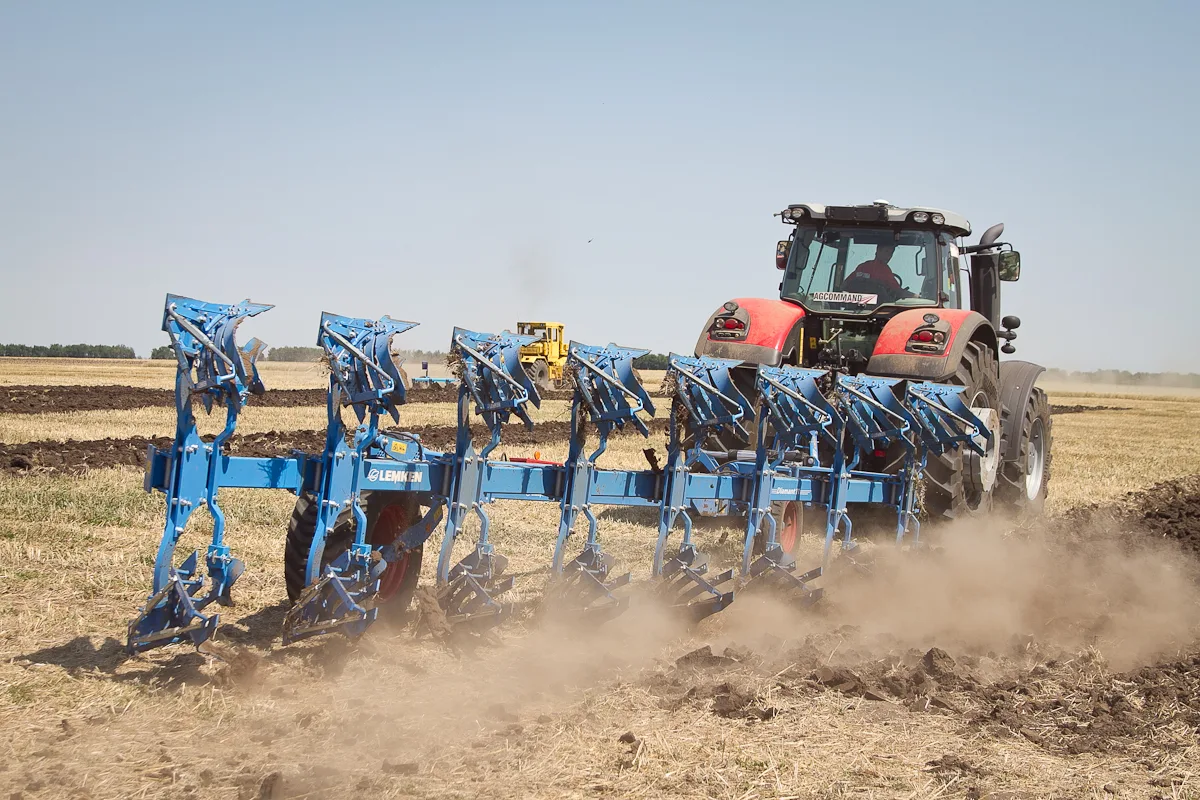
On heavy soils of the western and southern-foothill zones, surface tillage does not yield the desired result. Here, after grain legume predecessors, be sure to carry out ploughing tillage. This will allow for high-quality loosening of the compacted layer and preparation of the seedbed.
Tillage of perennial grass sod
Winter wheat crops following perennial grasses, mainly alfalfa, occupy a firm place in the crop rotation. The main principle of working with this predecessor is to keep the plough layer in a state close to a clean fallow. The main danger lies in the rapid desiccation of the soil: the sod devoid of vegetation dries out and cracks instantly, which sharply increases cloddiness during ploughing. To prevent moisture loss and yield reduction of winter crops, strictly observe the optimal timing for sod ploughing depending on the cultivation zone.
- Share in the structure of winter crops — 3–5%
- Grain losses during late sod ploughing — 8–10 c/ha
- Preliminary stubble breaking depth — at least 8 cm
- Maximum depth of sod ploughing — 22 cm
- Yield increase from subsoiling — 4.2 c/ha
| Cultivation zone | Recommended time for sod ploughing | Impact on yield and conditions |
|---|---|---|
| Insufficiently moistened regions (northern, eastern, Azov region, Taman) | After the first alfalfa or sainfoin cut | Ploughing after the second cut leads to a shortfall of 8–10 c/ha of winter wheat grain. |
| Central zone | After the second cut | Provides optimal conditions for moisture accumulation by sowing time. |
| Southern-foothill zone | Allowed after the third cut | Winter wheat yield does not decrease provided that full mineral fertilizer application is performed. |
In humid regions, alfalfa often regrows after ploughing. To avoid this, immediately after mowing, undercut the root collar of the plants with stubble breakers, disc harrows, or flat-cutters to a depth of at least 8 cm. The dried-out roots will lose the ability to produce shoots, and the quality of subsequent ploughing will improve.
Observe the correct technological cycle for processing perennial grass sod for winter sowing:
- Promptly clear the field of mown hay immediately after cutting.
- Perform stubble breaking to a depth of at least 8 cm to undercut the root system of the grasses.
- Plough the sod to a depth of up to 22 cm. Increasing the ploughing depth beyond this rate does not increase yield but dries out the soil.
- On vertic chernozems and grey forest soils, use subsoilers to 15 cm at a ploughing depth of 18–20 cm.
- Perform ploughing only in an assembly with harrows, rollers, and drags, or use combined ploughing units.
Read next
Soil and tillage For agronomists
Technological features of effective tillage of occupied fallow in crop rotation
Soil and tillage For agronomists
Effective tillage after harvesting cereal crops in the Kuban region
Soil and tillage For agronomists