
Classification and types of vegetative structures of fruit trees
4 min read
Understanding the structure of the vegetative organs of a fruit tree is the foundation for proper pruning and canopy formation. All vegetative structures serve one purpose: to increase the volume of the canopy and replace aging branches with new, viable ones in a timely manner. It is important for an agronomist to distinguish between their types in order to regulate the growth and fruiting of the orchard.
The green growth of the current year with leaves is called a shoot. After the autumn leaf fall, when the growing season ends, it transitions into the status of a branch. All shoots differ in the direction of growth, length of internodes, and the type of buds from which they develop.
How to distinguish shoots by growth vigor and position in the canopy
Based on the growth pattern and length of internodes, all shoots are divided into two main groups. Elongated shoots (auxiblasts) are characterized by strong growth, distinct internodes, and well-formed lateral buds. Shortened shoots (brachyblasts) grow only a few centimeters, and their internodes are so close together that they are difficult to distinguish visually.
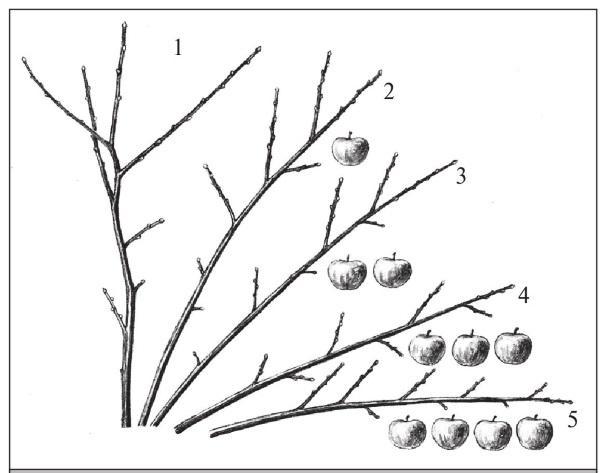
The direction of growth in space determines the future shape of the canopy. Vertical (orthotropic) shoots usually strive upwards and demonstrate strong vegetative growth. Horizontal (plagiotropic) shoots grow sideways and transition to fruiting more quickly.
The type of buds on a shoot determines its purpose. On vegetative shoots, all buds are growth buds. On generative shoots, the terminal bud (and sometimes some lateral ones) is a flower bud; fruits will subsequently form from it.
Functional types of shoots and their role in pruning
Depending on their origin, location on the branch, and role in the tree's life, shoots are divided into several functional groups. Ordinary spring shoots develop at the beginning of the growing season from the terminal and lateral buds of one-year-old branches. Among them, we distinguish extension shoots (leaders), which develop from terminal buds, and lateral shoots.
Special attention during pruning is paid to competitors — shoots that develop from the buds closest to the apex. They emerge at an acute angle and grow just as vigorously as the extension shoot, attempting to seize leadership. Competitors weaken the main branch and are subject to timely removal or bending.
Sometimes, during warm and humid weather in the second half of summer, buds sprout in the same year they are formed. Such structures are called premature, summer, or "Ivanov" shoots. For stone fruits, their appearance from early-ripening buds is a common occurrence.
Water sprouts (suckers or epicormic shoots) are powerful vertical shoots with long internodes and large leaves. They sprout from dormant or adventitious buds on perennial branches after severe pruning, canopy frost damage, or significant bending. The tendency to form water sprouts strongly depends on the cultivar.
Regenerative and adventitious shoots arise as a reaction to mechanical damage or pruning. They develop from dormant buds, additional lateral buds, from primordia in annual rings, or at the sites of wounds. The growth of such shoots begins and ends later than that of regular spring growth.
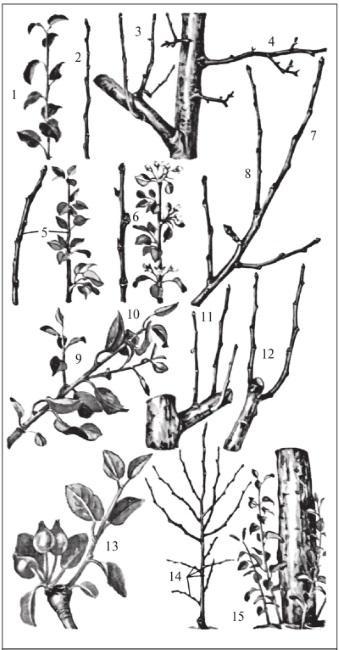
- 1 — growth shoot of the current year;
- 2 — one-year-old branch (shoot after leaf fall);
- 3 — orthotropic (vertical) shoots;
- 4 — plagiotropic (horizontal) shoots;
- 5 — vegetative shoots;
- 6 — generative (fruiting) shoots;
- 7 — extension shoot;
- 8 — competitor;
- 9 — lateral shoots;
- 10 — summer (Ivanov) shoots;
- 11 — water sprouts;
- 12 — regenerative shoots;
- 13 — replacement shoot (develops from a mixed bud together with generative organs);
- 14 — thickening shoots (formed in the zone of the future trunk of first- or second-year nursery plants, traditionally left in summer to accelerate trunk thickening);
- 15 — root suckers.
Root suckers must be systematically removed. They develop on the roots of the rootstock below the grafting site and represent wild growth. If left, they will suppress the scion, consuming water, nutrients, and assimilates of the cultural part of the tree.
Shoot length is an important indicator of the activity of physiological processes, the condition of the tree, and the efficiency of the applied agricultural practices – it is closely related to the prospect of fruiting. An almost complete cessation of shoot growth indicates that tree yield, especially fruit quality, will soon decrease sharply.
For orientation, one should know the following classification of growth increments:
| Shoot type | Young plants (cm) | Fruiting plants (cm) |
| Strong | more than 60 | more than 40 |
| Moderate | 50 | 30 |
| Weak | less than 40 | less than 20 |
A further reduction in the annual length of branch increments necessitates urgent measures to restore growth.
Read next
Pruning and training For students
Apical dominance in growth management of fruit trees
Pruning and training For students
Patterns of cyclic branch replacement and growth of fruit trees
Pruning and training For agronomists