
Anatomy and classification of buds of fruit trees and shrubs
3 min read
Each bud on a fruit tree is a dormant embryonic shoot ready to grow, consisting of an axis, a growth cone, leaf primordia, and protective scales. The point of bud attachment is called a node, and the space between them is an internode. The length of internodes varies along the branch, which is important to consider when choosing the cut zone. An agronomist must distinguish between bud types to accurately predict the tree's reaction to pruning.
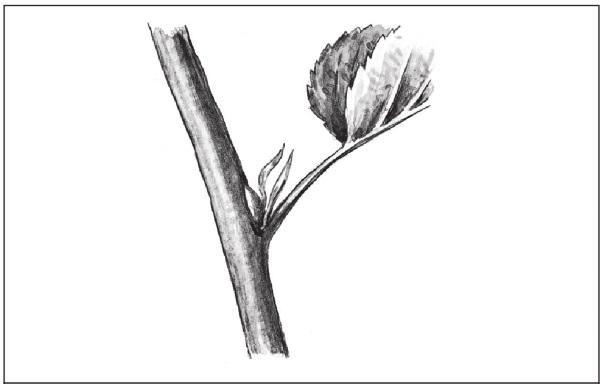
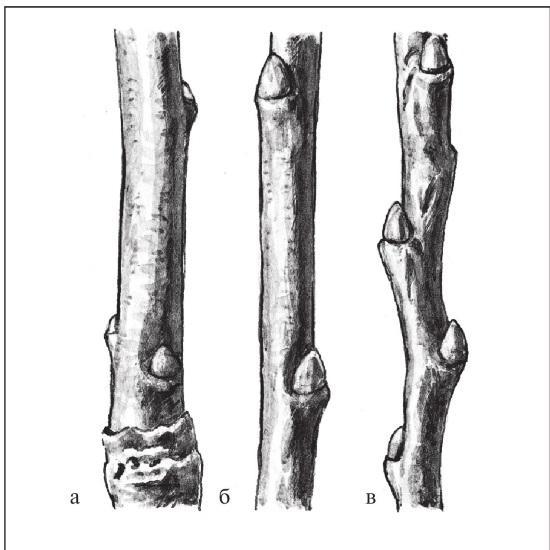
According to their internal structure, buds are divided into vegetative and generative. Vegetative buds give rise only to green parts and are of two types: growth (for shoots of various lengths) and leaf buds. Only a short shoot with a rosette of leaves grows from a leaf bud. In case of severe shortening of branches, breakage, frost damage, or lack of fruiting, leaf buds are capable of transforming into strong growth shoots.
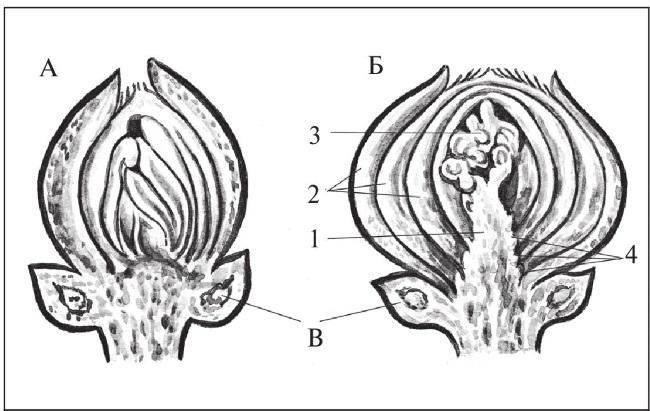
In stone fruits, flower buds are simple — only flowers develop from them. In pome fruits and berry shrubs, mixed buds are formed, producing both generative organs and shoots of various purposes simultaneously. In the leaf axil of pome fruits, only one main bud develops normally. Two almost invisible spare buds are laid on the sides of it, acting as a reserve.
- Shoot length from a leaf bud — up to 0.5 cm
- Number of spare buds in pome fruits — 2 per node
- Number of main buds in the axil — 1
Spare buds start to grow only if the main bud dies or if there is a severe imbalance between the above-ground part of the tree and its root system.
Anatomy of recovery: dormant and adventitious buds
Buds that have not sprouted in the year following their formation fall into the category of dormant buds. As the branch thickens, their axes lengthen, so the growth points always remain near the surface of the bark. This allows dormant and spare buds to maintain viability and give rise to new shoots at any age of the tree. In addition, in case of mechanical damage, frost injury, or rejuvenating pruning, adventitious buds can be laid on the callus, at wound sites, and near annual rings.
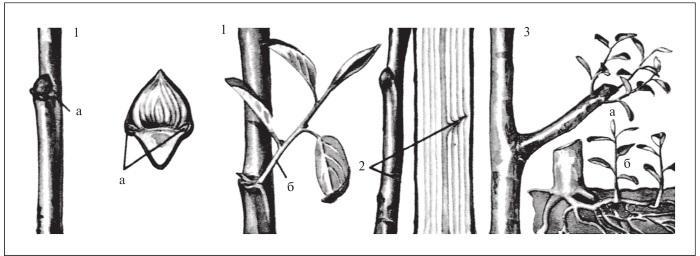
According to their position on the shoot, buds are divided into apical (terminal) and lateral. When pruning, lateral buds are divided into internal (facing the central axis of the canopy) and external (directed toward the periphery). Choosing the correct bud to cut above allows for regulating the growth direction of new branches. This technique helps form an optimal canopy structure and avoid its overcrowding.
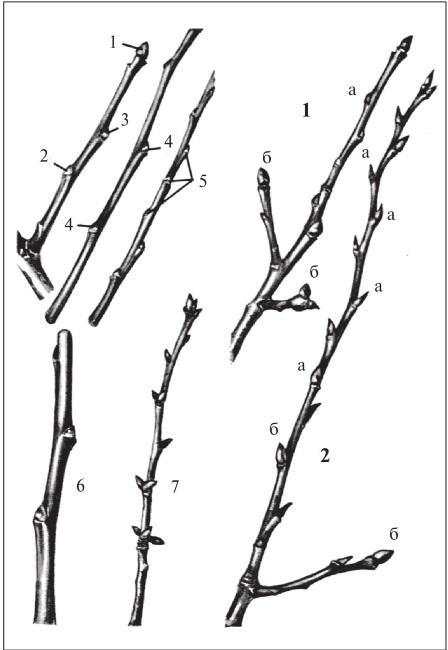
Based on the time of growth initiation, buds are classified as early-ripening and late-ripening. Early-ripening buds bloom in the year of their formation, which is typical for stone fruits. Late-ripening buds sprout only at the beginning of the next growing season. In pome fruits, under temperate climate conditions, the sprouting of early-ripening buds happens rarely — this phenomenon is called secondary growth, or the second growth wave.
Read next
Viticulture For agronomists
Biological features and types of buds of the grapevine plant
Pruning and training For students
Classification and formation of generative structures of fruit trees
Pruning and training For students