
Determining the age of fruit trees and individual branches by external features and cross-sections
1 min read
To correctly plan pruning, regulate fruit load, and rejuvenate the orchard in time, an agronomist must accurately know the age of the branches. It can be determined in two ways: by external bud scars on the bark or by annual rings on a cross-section. In field conditions, it is more convenient to use visual inspection, as it allows for a quick assessment of the tree's condition without causing wounds.
External annual rings remain at the base of each annual growth. A branch elongates due to apical buds, and the fallen scales from these buds leave visible marks on the bark that remain for life. To determine the age of a branch by these scars, move sequentially from the tip to the base.
- Find the apical bud at the end of the branch — this is the starting point for counting.
- Move down the branch, towards the base or the trunk.
- Count every trace left by bud scales — they delineate annual growth increments.
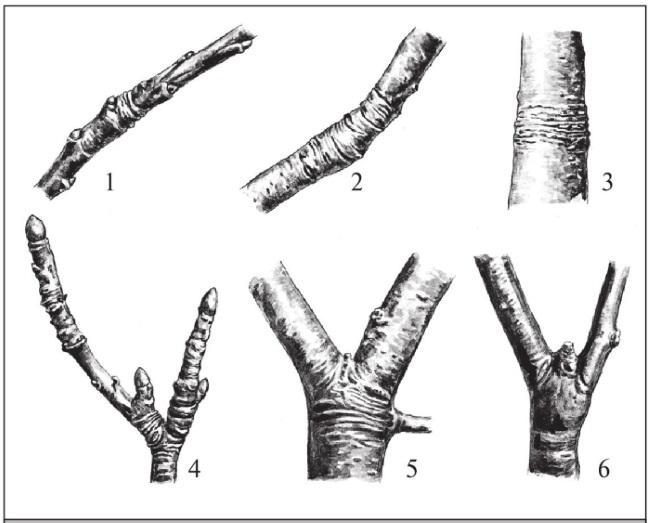
The external method provides an accurate result provided that the shoots formed in a single growth wave each year. If there were two waves in certain years, the age calculations will be inaccurate.
When counting external rings, do not include the constriction that separates the replacement shoot from the fruit-bearing spur. Externally, it looks very similar to an annual ring, but it is not one.
Internal rings: determining age by cross-section
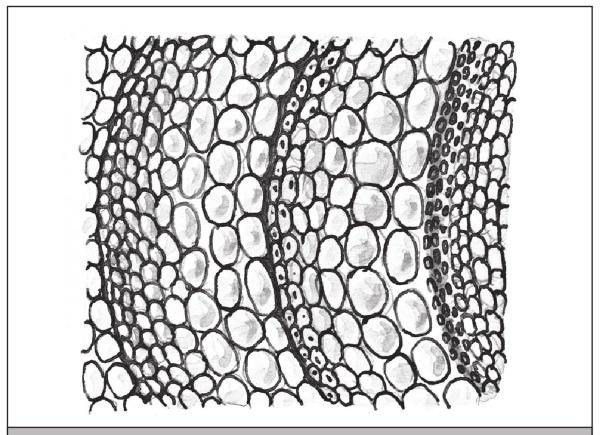
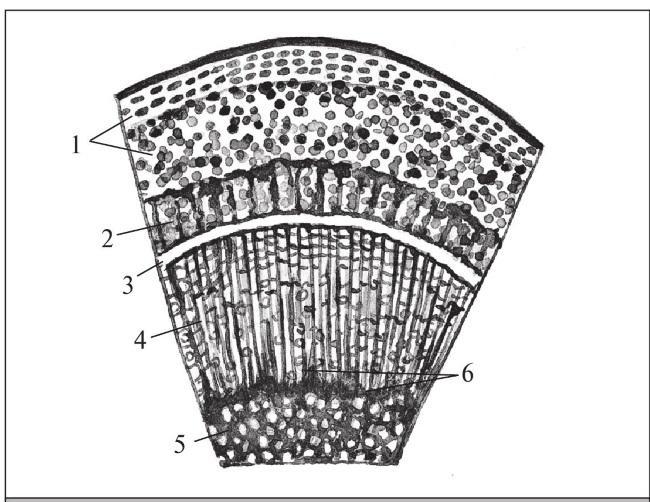
If a branch must be cut, its age is determined by the internal annual rings on a cross-section. They are formed due to seasonal changes in the structure of the tree's tissues during thickening. In the first half of the growing season, more loose conducting tissues are deposited, and in the second half, denser mechanical ones. This difference in density makes the boundaries of annual rings clearly distinguishable visually.
Read next
Pruning and training For students
Classification and types of vegetative structures of fruit trees
Pruning and training For students
Anatomy and classification of buds of fruit trees and shrubs
Pruning and training For students