
Biological features and types of buds of the grapevine plant
16 min read
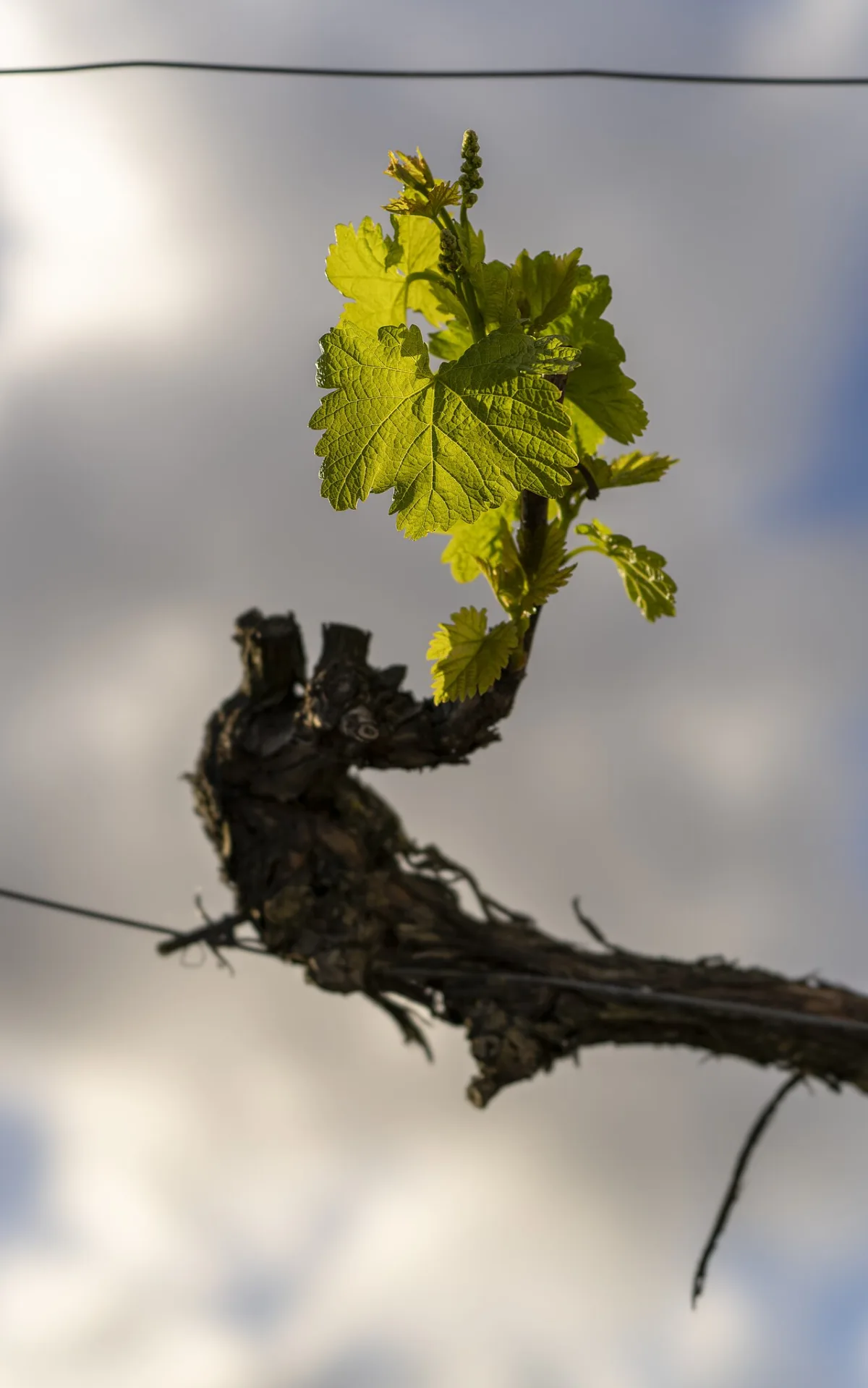
They form in the leaf axil at the base of the petiole on the nodes of growing shoots. As buds develop during each growing season, shoot growth is renewed, which is why buds are growth points. In a grapevine, there are 3 types of buds: axillary early-ripening lateral buds (pasynok), overwintering buds, and dormant buds. All of them represent an embryonic shoot where the vegetative and generative organs of the future plant are formed in a rudimentary state. Buds are formed through the division of the surface layers of the meristem cells at the apex of the growing point.
As the shoot grows, early-ripening axillary lateral buds are first set in the leaf axils. They do not have a dormancy period, they form quickly, and shoots — laterals (pasynki) — develop from them during the same growing season. With the growth of the main shoot, complex overwintering buds, which in viticulture practice are called "eyes," are set in the axils of the lowest leaves of the laterals, regardless of their degree of development (weak or strong). The main shoots develop from these in the spring of the following year.
The eye consists of several buds — the main or central one, and several (3–6) secondary, or replacement, buds of smaller size, located around the main bud. The overwintering bud grows throughout the entire growing season, gradually increasing in volume and differentiating to become an eye. Early-ripening axillary buds also form in the axils of the lateral leaves. Unlike axillary buds, overwintering eyes have a deep dormancy period and only start to grow after this period has passed under favorable conditions, usually in the spring of the next year.
First, the central bud of the eye begins to grow, followed by the replacement buds. Under favorable conditions, as well as in the event of damage to the main bud by low temperatures or other adverse external factors, 1 or simultaneously 2–3 of the most developed replacement buds start to grow. However, the shoots that develop from them (twins and triplets) are weaker than the main one and less productive.
If for any reason the buds of the eye (main or replacement) do not start to grow, they remain on the shoot and by autumn, partially regenerating due to the formation of cork cambium, they gradually deepen into the tissues of the perennial parts of the bush. The outer part of the eyes dries out, and only its inner part remains — the bud trace, which grows along with the thickening of the stem. Such buds are conventionally called dormant. They live for a long time and, under favorable conditions — good nutrition, low load of fruit-bearing shoots on the bushes, or destruction of the growth points of the aerial part of the bush — they can awaken and produce shoots (sucker shoots and water sprouts) similar in their morphological structure to shoots that developed from a lateral or overwintering bud.
In the year of their development, such shoots remain mostly barren, although they grow and thicken rapidly. Fruit-bearing buds may be set in the axils of their leaves, which will produce a harvest the following year.
Fig. 23. Development of a lateral bud and formation of an eye:
1 — sprouting axillary bud forming a lateral on a shoot; 2 — lateral growing point; 3 — tendril; 4 — stipule; 5 — leaf; 6 — first leaf of the lateral; 7 — complex overwintering bud forming (according to Gordeeva).
The awakening of dormant buds and the high shoot-regenerating ability of the grapevine are characteristic indicators of the restoration of the disturbed balance between the development of the root system and the growth vigor of the aerial part of the bush, its load of eyes and shoots, which allows, if necessary, to re-form new arms or replace the entire aerial part of the bush. This biological feature of the grapevine is the basis for rejuvenation of plants (cutting to the head) and the restoration of bushes damaged by frost and other adverse environmental factors. All types of buds: axillary early-ripening lateral (summer), overwintering (main and replacement), and dormant — are identical in their morphological structure. They differ only in the degree of development and the number of rudimentary vegetative and reproductive organs of the future shoot formed within them. In a longitudinal section of a well-formed overwintering bud (eye) under a microscope, one can see the most developed main bud in the center, on the sides of which are 1–2 or more less developed replacement buds. In the center of the main bud, the cone-shaped axis of the rudimentary shoot, widened at the base, and the apex of the growing point are visible. On the axis, alternating light and dark transverse bands are noticeable. These are the future nodes and internodes. On both sides of the embryonic stem, in the form of ribbon-like structures, are the rudiments of leaves, bumpy, cluster-like rudiments of inflorescences, and fork-like rudiments of future tendrils. Depending on its degree of development, the central bud contains up to 13 rudimentary leaves. In the axils of the rudimentary leaves, one can see the bumps of rudimentary axillary lateral buds. The replacement buds have the same structure as the main one, but since they form and develop later than the central bud, they differ from it in smaller size and a lower degree of differentiation of rudimentary organs. While up to seven or eight nodes can be counted on the embryonic shoot of a central bud, no more than three to five can be counted on replacement ones.
Externally, the central and secondary buds of the compound bud are covered by two large scales. In summer they are green, but by autumn they become impregnated with a special substance — suberin — and become corky, leathery, and acquire a brownish-brown color. Beneath the scales of the compound bud lies a protective hair cover that protects the delicate buds from damage by low temperatures. The compound buds on the shoot nodes are located on a small flat elevation — a cushion. Between the cushion and the base of the compound bud, there is a thin (no more than 2 mm) underlying layer consisting of thin-walled parenchymal cells. It was previously believed that this layer contained the rudiments of buds. However, research results did not confirm this. Vegetative and generative processes can occur in all types of grapevine buds. Buds with rudiments of inflorescences are called fruitful, while those with leaves and tendrils are called barren.
Fig. 24. Longitudinal section of a dormant grapevine bud (compound bud):
1 — main bud; 2 — primary secondary bud; 3 — secondary secondary bud; 4 — underlying layer; 5 — embryonic leaf; 6 — inflorescence; 7 — tendril; 8 — scale-like stipules; 9 — hair cover; 10 — outer covering scales; 11 — node of the embryonic shoot; 12 — internodes; 13 — internal parenchymal bud trace (according to Gordeeva).
By appearance, it is impossible to distinguish fruitful buds from barren ones in a grapevine plant. The productivity of the bush depends on the number of fruitful buds initiated on the shoots and the number of inflorescences within them. The best period for the initiation, growth, and formation of buds in the compound buds, and embryonic inflorescences within them, for most grapevine cultivars is the first half and middle of summer, during the plant flowering period and after it, provided there is good illumination and necessary nutrition. The most developed (fruitful) buds are formed in the compound buds of the middle part of the shoot, within the 4th to 7th nodes from its base. The buds of the first three and the uppermost nodes of the shoot are less developed. They are always barren.
In the life of an embryonic shoot (bud), as noted by A. M. Negrul (1959), there are several critical periods during which significant changes occur, in particular the formation and differentiation of inflorescences, which determines whether a bud will be fruitful or remain barren. The more fruitful buds develop, the higher the yield of the grapevine plantations. The first critical period during the initiation and formation of buds occurs at the time when the displaced growth point continues to grow and, depending on the conditions, an inflorescence or a tendril is formed in it.
In most grapevine cultivars of the Black Sea and Western European groups, the rudiments of inflorescences in the compound buds of the main shoots are initiated almost simultaneously, usually at the end of May — beginning of June, which coincides with the flowering period; in cultivars of the eastern group, somewhat later, at the end of July. In cultivars with a short growing season, the initiation of the first inflorescence rudiments ends in the shortest possible time (approximately within a month), whereas in cultivars with a long growing season, this period is more prolonged. In early grapevine cultivars, inflorescences in the buds begin to be initiated 10–14 days earlier than in late-ripening cultivars. The initiation of inflorescences in the compound buds of the lateral shoot begins in the first ten days of July, first on laterals developed in the lower and middle zones of the main shoot, from the 1st to the 7th nodes, and at the end of July — on laterals developed in the upper zone of the main shoot.
The degree of bud fruitfulness along the shoot length is not uniform. The most fruitful and best-differentiated inflorescences are in the compound buds located within the 5th to 7th nodes.
Approximately 22–23 days pass from the initiation of the tubercle to the differentiation of the first inflorescence, and 18–30 days for the second inflorescence, the initiation and differentiation of which begins 10–12 days later than the first inflorescence. The maximum number of inflorescences is initiated in the flowering phase, which is considered the second most critical period in the annual development cycle of a grapevine plant. In the berry growth phase, the initiation and differentiation of inflorescences continue, but to a lesser extent. The largest inflorescences are initiated in the more developed buds of the compound buds in the middle zone of the shoot, within the 5th to 7th nodes from its base, which is explained by the most favorable external conditions — sufficiently high temperature and air humidity, good illumination, and active assimilation of leaves of both main and lateral shoots. All this ensures good nutrition of the buds, and consequently, their initiation and differentiation.
Rudiments of inflorescences in a grapevine plant can be initiated in the central and secondary buds of the compound bud, in early-ripening lateral buds, and sometimes in dormant buds, provided: an optimal water-air regime, availability of nutrients, and good illumination of the bushes. This is achieved by the following measures:
- by choosing well-warmed open areas;
- by using optimal planting designs;
- by application of fertilizer;
- by irrigation of vineyards;
- by other plant and soil care practices.
Incipient inflorescences look like semicircular tubercles on the nodes of the embryonic shoot. A certain rhythm is observed in the growth of inflorescences. At the very beginning of the growing season, their growth correlates with the growth of shoots, and the stronger the growth of green shoots, the stronger the growth of inflorescences. Then it slows down somewhat, and by the time of flowering, it stops completely. By this time, the inflorescences reach 50–60% of their length. During the period of mass flowering, a new wave of inflorescence growth is observed, peaking when the berries reach the size of a pea. The temporary cessation of inflorescence growth during the flowering period symbolizes, as it were, the transition from one qualitative state of the organ to another — from an inflorescence to a cluster.
Development of Inflorescences and Functions of Grape Tendrils
- Number of inflorescences per shoot — from 1 to 5–7 pcs.
- Growth of inflorescence before flowering — 50–60% of the norm
- Growth of inflorescence by the end of flowering — 75% of the norm
- Rotation of the tendril tip in search of support — 2 hours
- Number of stamens in a grape flower — 5 (rarely 6–7) pcs.
The formation of the grape harvest is directly related to the process of inflorescence differentiation. This process occurs continuously throughout the entire growing season, continues in autumn, and ends only in the spring of the following year. The inflorescence grows from the base to the apex, taking the form of a complex cone-shaped cluster or panicle. Anatomically, it consists of a peduncle for attachment to the shoot, a central axis, and branches of the 1st, 2nd, 3rd, and more rarely 4th order. At the ends of the branches, there are buds grouped in sets of 3, with the central one always being more developed than the two lateral ones.
Inflorescences are initiated on the nodes of the vegetative shoot on the side opposite to the leaf, usually within 4 nodes. Their quantity on one shoot varies from 1 to 5–7 pieces and depends on cultivar characteristics and environmental conditions. The potential of the future harvest is determined by the size of the inflorescence and the number of set berries. At the same time, inflorescences located closer to the base of the fruit-bearing shoot are always larger than those located higher up the stem.
| Cultivar type by cluster size | Number of buds in the inflorescence, pcs. |
|---|---|
| Cultivars with small clusters | 50–200 |
| Cultivars with large clusters | 1500 |
Before flowering, the inflorescence grows very intensively, reaching half of its normal size, and by the end of flowering — 75%. The speed of its development is directly related to the growth vigor of the shoot: powerful growth stimulates the formation of large inflorescences. During the organ initiation period, transitional forms from inflorescence to tendril and vice versa may occur, which confirms their common stem origin. Sometimes, developmental anomalies appear in the form of wide, flat axes (fasciations) or condensed clusters of buds on shortened pedicels.
Grape tendrils are modified inflorescences and serve to secure the vine to supports. On fruit-bearing shoots, they are located above the inflorescences, and on barren shoots, they are along the entire length, starting from the 2nd node. The tip of a growing tendril performs a circular (nutational) movement in search of support, completing a full circle within 2 hours. Upon contact with the trellis, the tendril wraps tightly around it, and its free lower part twists spirally, pulling the shoot toward the support.
In tendrils that have grasped a support, mechanical tissue (libriform) develops rapidly, thanks to which they become lignified and acquire high strength. If a tendril does not find a support, it remains green and herbaceous for some time, and then dries up and falls off.
According to their morphological structure, tendrils are divided into three main types:
- simple;
- branched (double);
- highly branched with buds.
At the point where the tendril branches, leaves often form, and sometimes it transforms itself into an extra-axillary shoot with leaves and inflorescences. The anatomical structure of the inflorescence and tendril axes is completely analogous to the primary structure of a young shoot.
Flower Structure and Pollination Features
Grape flowers are small, inconspicuous, yellow-green, and located on thin pedicels. The perianth consists of an underdeveloped calyx with five fused underdeveloped sepals and a corolla of five petals fused at the top, covering the inner parts of the flower. The calyx encompasses the base of the flower with weakly expressed blunt teeth. At the base of the corolla, there is an annular ridge of underdeveloped nectaries, colored green, yellow, or orange.
The nectaries contain essential oils with a pleasant smell, reminiscent of mignonette. However, they do not secrete nectar, so they do not attract bees to the vineyard. Male generative organs are represented by five (rarely six-seven) stamens with two-celled anthers. During flowering, the pollen sacs, of which there are two in each cell, open with longitudinal slits for pollen release.
The pistil, which is bottle-shaped or pear-shaped, has a superior bilocular ovary composed of two carpels. Each locule contains two anatropous ovules with a nucellus core and two integuments, between which a micropyle channel is located. Within the nucellus, an embryo sac develops from an archesporial cell, containing an egg cell, synergids, polar nuclei, and antipodals. The style of the pistil can be short and thick or elongated and thin depending on the cultivar, and the saucer-shaped stigma has smooth or lobed margins.
When growing grapes, deviations from the standard structure of reproductive organs are regularly recorded. A larger number of locules and ovules may form in the ovary, which is why more than four seeds grow in the berries. Such structural anomalies of the ovary occur with varying frequency depending on the cultivar.
| Indicator | Value, % |
|---|---|
| Frequency of deviations in ovary structure | 1–8 |
Four types of flowers: biological features and diagnostics
Proper planning of a vineyard and the distribution of cultivars directly depend on the type of grape flower. Errors at the planting stage lead to reduced harvest and poor berry quality due to insufficient pollination. In modern viticulture, four types of flowers are distinguished: perfect (hermaphrodite), functionally female, truly female, and male. Wild grapes are dominated by male and female forms, while the majority of cultivated European-Asian cultivars are perfect-flowered.
Perfect flowers have a well-developed pear-shaped ovary and upright stamens that are equal in height to the pistil or exceed it. Such cultivars are mainly self-pollinating (autogamous), although some require cross-pollination. Male flowers are characterized by an underdeveloped ovary without a stigma and large upright stamens with an abundance of fertile pollen. Plants with a male flower type form large inflorescences but do not produce berries—they are used in rootstock nurseries and as pollen donors.
For accurate diagnosis of the flower type in field conditions, a laboratory test is conducted. Pollen viability is determined by its shape and ability to germinate in a nutrient medium. Key parameters for conducting a rapid analysis are provided below.
- Sugar concentration for the test — 10–15%
- Germination temperature — 25–30 °C
- Pollinator planting scheme — 1:2
| Flower type | Shape of dry pollen | Reaction in sugar (glucose) solution | Viability |
|---|---|---|---|
| Perfect (hermaphrodite) | Regular, elongated barrel-shaped | Rapidly germinates into a pollen tube | Fertile (viable) |
| Male | Regular, elongated barrel-shaped | Germinates within several hours | Fertile (viable) |
| Functionally female | Irregular (angular, rhombic, spherical) | Does not germinate, only slightly swells | Sterile (infertile) |
Agrotechnics of functionally female cultivars and flowering anomalies
Cultivars with a functionally female flower type have a normally developed pistil, but their stamens are shorter than the pistil and bend downwards after the cap is shed. Due to the sterility of their own pollen, they are completely self-sterile and require mandatory cross-pollination. This group includes valuable old cultivars: Nimrang, Chaush White, Pukhlyakovsky, Tavkveri, and Katta-Kurgan. For their successful fruiting, pollinator cultivars with a coinciding flowering period are planted in the vineyard.
Without timely cross-pollination, functionally female flowers drop en masse, and inflorescences dry up. The remaining berries develop pea-sized fruit, develop without seeds (parthenocarpically), or contain only empty seeds without an embryo and endosperm.
To organize effective cross-pollination in vineyards, a strict planting scheme is used. First, one row of the pollinator cultivar is planted, followed by two rows of the pollinated cultivar, after which the cycle is repeated. During the flowering period, additional artificial pollination with collected pollen is also carried out. However, due to technological complexity and the risk of harvest losses in unfavorable years, new cultivars with a functionally female flower type are no longer accepted for state cultivar testing.
In addition to the main types, truly female flowers are found in vineyards (for example, in a clone of the Mourvèdre cultivar), as well as doubling, rosette or star-shaped blooming, and fasciation — the fusion of several flowers or pedicels into one.
Read next
Viticulture For agronomists
The biological role and anatomical structure of the grapevine stem
Viticulture For agronomists
Biology of grapevine shoot pinching and practical use of lateral shoots
Viticulture For agronomists