
Classification and formation of generative structures of fruit trees
2 min read
Proper pruning and crop load regulation are impossible without precise identification of generative organs. The agronomist's task is to accurately identify the types of fruiting branches when assessing the orchard's fruiting potential for the next season. A mistake in canopy training will be costly: the tree will either lose its fruiting wood or shift into excessive vegetative growth.
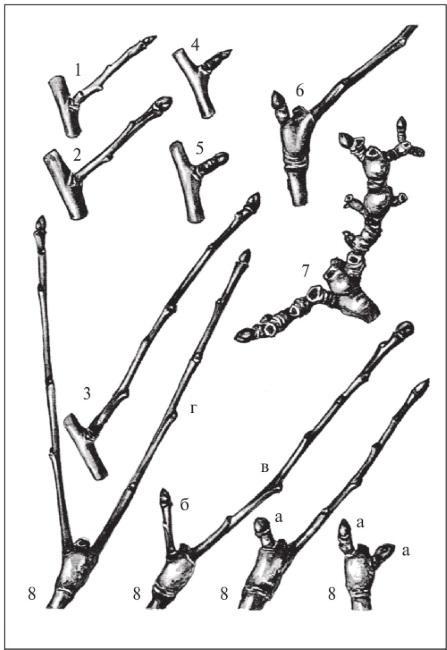
- Spur length — 0.3–3.0 cm
- Darts length — 5–15 cm
- Fruit-bearing twig length — 15–25 cm
Generative formations include spurs, darts, and fruit-bearing twigs. Even if there are no visible flower buds on them at the moment, biologically, these are the branches most adapted for their formation. They differ from one another in length, angle of attachment to the parent branch, and the degree of lateral bud development.
| Branch type | Length, cm | Growth characteristics | Terminal bud |
|---|---|---|---|
| Spur | 0.3–3.0 | Shortened branch, usually emerges at a right angle. Lateral buds are underdeveloped. | Only the terminal bud is well-developed; it can be generative or vegetative. |
| Dart | 5–15 | Straight annual branch, tapering towards the tip. Emerges at a right angle. Lateral buds are weakly developed. | Can be either generative or vegetative. |
| Fruit-bearing twig | 15–25 | Thin, often downward-curving annual branch. Lateral buds are clustered and weakly developed. | Can be either generative or vegetative. |
Insufficient light inside the canopy inhibits spurs. Weak branches with few leaves develop only vegetative terminal buds. They may grow in length for years without fruiting, turning into complex spurs or fully degenerating into vegetative shoots.
Development and aging of fruiting branches
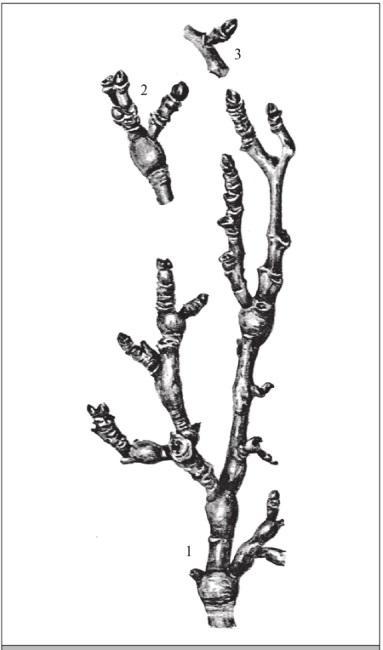
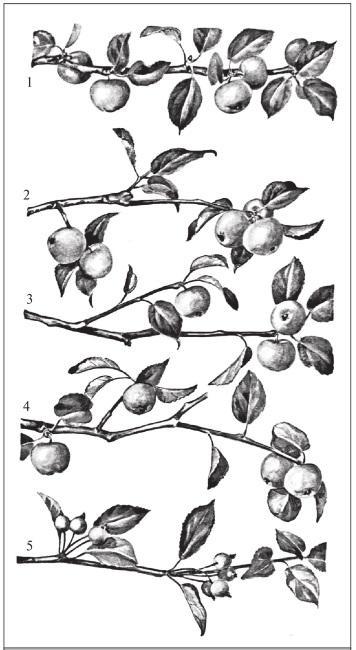
When a floral bud awakens on any of the generative formations, a fruit bursa is formed. This is a characteristic swelling where the fruit develops. Below the fruit attachment point on the bursa, new replacement shoots grow: one or two spurs, darts, fruit-bearing twigs, or full-fledged vegetative shoots.
With age, fruiting formations expand and branch out. Multi-year structures consisting of previously fruiting spurs, bursae, darts, and twigs are called fruit clusters.
Old, highly branched systems with many different types of generative organs are called complex fruiting (mixed fruiting) branches. Traces of past harvests are clearly visible on them. Based on their condition, an agronomist can judge the tree's productivity in previous seasons.
Read next
Pruning and training For students
Classification of apple tree cultivars by types of fruiting structures for pruning
Pruning and training For students
Bud break and shoot formation capacity of fruit trees during pruning
Pruning and training For students