
Classification of apple tree cultivars by types of fruiting structures for pruning
4 min read
Pruning and crop regulation of an apple tree directly depend on its type of fruiting. An error in assessing the biological characteristics of a cultivar leads to a loss of harvest. An agronomist may accidentally cut off fruit buds or provoke the baring of skeletal branches. To prevent this, it is important to understand on which branches the tree forms the bulk of its fruit.
- First group (fruiting on spurs). The harvest is formed on short, well-branched fruiting branches. This includes Grushovka Moskovskaya, Borovinka, Papirovka, Bessemyanka Michurina, Bogatyr, Lobo, Mantet, Orlik, Orlovskoye Polosatoye, Pamyat Voinu. In these cultivars, good bud break ability is combined with weak shoot-forming capacity. The canopy becomes strong and well-lit, but the trees are prone to biennial bearing.
- Second group (fruiting on long spurs). The main harvest is set on long spurs, and partly on fruit twigs and spurs. Representatives of the group: Zvezdochka, Korichnoye Novoye, Renet Kichunova, Tambovskoye, Belfleur-Kitayka.
- Third group (fruiting at the ends of vegetative branches). Fruits are set at the ends of vegetative-type branches and partly on twigs. This includes Korichnoye Polosatoye, Korichnoye Novoye, Kitayka Zolotaya, Quinte, Medunitsa. Buds break poorly, which causes the trees to be prone to forming leggy, bare branches, and many forks with sharp angles form in the canopy.
- Fourth group (mixed type of fruiting). The harvest is evenly distributed on spurs, long spurs, twigs, and the ends of vegetative branches. These are Melba, Veteran, Zhigulevskoye, Mezenskoye, Sinap Orlovsky, Wealthy, Pepin Shafranny, Osenneye Polosatoye, Antonovka Obyknovennaya. Shoot-forming capacity ranges from medium to very high, the canopies become very dense and require regular thinning. Fruiting in this group is regular.
- Fifth group (lateral fruiting). Characteristic of small-fruited crabapples, hybrids of Siberian and plum-leaved apple trees, as well as large-fruited cultivars like Wealthy and Melba. Buds are set in the leaf axils of strong shoots. Spurs are short-lived, so fruiting quickly shifts to the periphery of the canopy. Bud break is very high with low shoot-forming capacity, and the tree framework is strong.
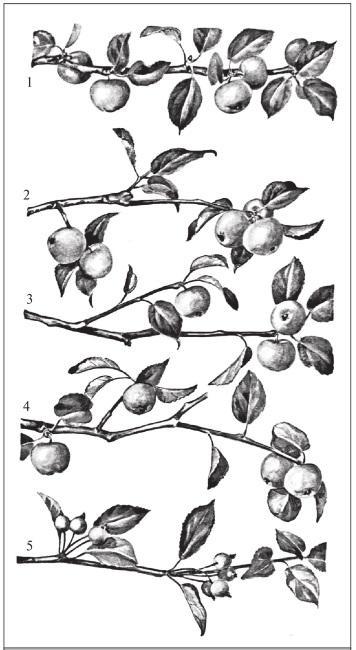
Lateral fruiting is a key criterion when selecting cultivars for intensive meadow (mowing) orchards. It allows for a stable harvest on strong annual shoots.
Age-related changes and biennial bearing
The nature of tree fruiting is dynamic and changes with age. For example, a young apple tree of the Korichnoye Polosatoye cultivar fruits mainly on twigs and shoot tips. In adulthood (in the third age period), more than half of its fruits are already formed on spurs and long spurs. For pears, the situation is different: the bulk of fruit buds is always concentrated on spurs and long spurs, while a powerful fruit bursa forms at the tip of vegetative growth.
| Cultivar group by early bearing | Beginning of fruiting (years after planting) |
|---|---|
| Early-bearing | 3–6 |
| Mid-bearing | 7–8 |
| Late-bearing | 11–15 |
A serious problem in the orchard is biennial bearing, which intensifies in the 3rd–4th age periods. It directly depends on the genetic characteristics of a specific pomological cultivar. Based on the tendency for biennial bearing, apple cultivars are divided into three groups:
- Annually fruiting: Slavyanka, Bogatyr, Medunitsa.
- With weakly expressed biennial bearing: Antonovka Obyknovennaya, Anise, Osenneye Polosatoye, Melba, Borovinka.
- With sharply expressed biennial bearing: Grushovka Moskovskaya, Korichnoye Novoye, Mantet, Sinap group.
In years of excessive harvest, the tree depletes its reserves of plastic substances, spending them on excessive flowering and fruit set. This sharply reduces winter hardiness: overloaded apple trees enter the winter weakened and suffer much more severe frost damage than moderately fruiting trees.
- Growth reduction of shoots during overload — 1.5–3 times
- Period of depression (no harvest) after overload — 1–3 years
- Replacement shoots on the fruit bursa of a pear — 1–2 units
Read next
Pruning and training For gardeners
Peculiarities of canopy formation in young fruit trees, taking into account cultivar characteristics
Pruning and training For gardeners
Peculiarities of pruning and canopy formation of pear trees in the orchard
Pruning and training For students