
Peculiarities of canopy formation in young fruit trees, taking into account cultivar characteristics
6 min read
Proper pruning of a young orchard is the foundation of its future productivity. The agronomist's task during this period is to form a strong tree scaffold that can withstand the weight of the fruit without the use of artificial supports (props). At the same time, the ability of the canopy to maintain integrity under load directly depends on the planting pattern.
| Planting type | Maximum harvest weight per tree, kg |
|---|---|
| High-density | up to 100 |
| Low-density | up to 500 |
Do not abuse the pruning of young trees. Excessive removal of branches severely stresses the nursery plant, slows down its development, and delays the onset of fruiting. The total fruit yield in the first years in areas with heavy pruning will be several times lower than with minimal intervention.
How apple and pear cultivar traits determine pruning strategy
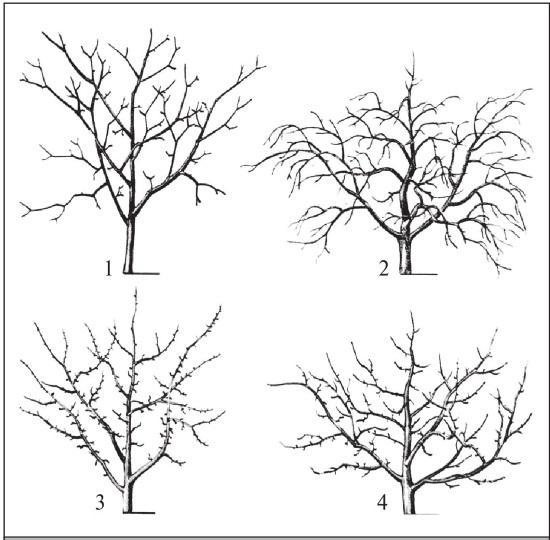
When shaping the canopy scaffold, always consider the growth specifics of the particular cultivar. It is most important to evaluate the bud break capacity and the shoot-forming ability of the nursery plants. Based on these traits, apple cultivars are divided into four main groups, each requiring its own approach.
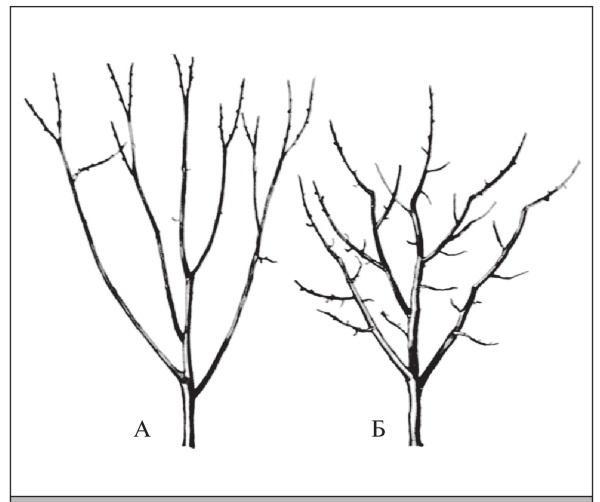
Cultivars with poor bud break capacity (Korichnoye Polosatoye, Kitayka Zolotaya, Korobovka, Aport Alma-atinsky, Renet Bergamotny, Boiken). Without regular intervention, their branches quickly become bare, fruiting moves to the periphery, and narrow crotches lead to canopy splitting under the weight of the harvest. To prevent these problems, shorten annual growths to subordinate branches. To stimulate bud break, make the cut above a lateral branch on two-year-old wood.
Cultivars with good bud break capacity and active shoot formation (Streifling, Babushkino, Suyslepskoye, Anis, Renet Simirenko, Melba). These trees are prone to rapid canopy overcrowding. Shortening their branches without urgent necessity should be avoided, as this will trigger even more vigorous shoot growth. Instead, the canopy should be thinned out: unnecessary branches are removed entirely, or strong shoots are converted into fruiting wood.
Cultivars with good bud break but weak shoot formation (Grushovka Moskovskaya, Borovinka, Bessemyanka Michurina, Parmen Zimniy Zolotoy, Renet Shampanskiy, Wagnera Prizovoye, Titovka Zimnyaya). They form a canopy well on their own and hardly require thinning at a young age. To enhance the development of fruiting spurs, they can be periodically shortened.
Cultivars with average branching ability and good bud break capacity (Antonovka Obyknovennaya, Slavyanka, Desertnoye Petrova, Wealthy, Papirovka). They require minimal control from the agronomist. It is sufficient to remove or convert into fruiting wood only those strong branches that begin to interfere with neighboring shoots.
A pear canopy naturally forms to be sparser and lighter than that of an apple tree, and its scaffold branches fuse firmly with the leader. In the first years, pear pruning is similar to caring for apple trees of the Grushovka Moskovskaya type. However, due to lower frost resistance, the pear has a critical cultivar trait — a tendency to produce a large number of water sprouts.
Cut all poorly positioned water sprouts on a pear tree flush to the collar immediately after they appear. Turn the rest into fruiting branches through pruning. If the tree has suffered significantly from winter frosts, water sprouts can be used to restore damaged scaffold branches.
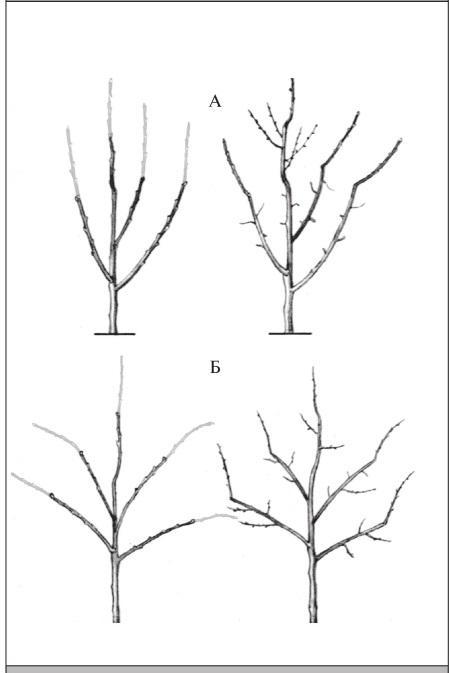
To make the orchard easy to maintain, the canopy of a young tree should be made compact. However, when creating a dense canopy, there is always a danger of it becoming overcrowded quickly. The direction of the cut during pruning is chosen taking into account the natural growth habit of the tree:
- For pyramidal canopies, the cut is made to an outer bud or outer branch to widen the canopy. It is also effective to cut branches to an inner bud followed by bending the shoots — this will prevent the appearance of water sprouts on the upper side of the branch.
- For spreading trees with drooping branches, the cut is made to an inner bud to lift the branches and make the canopy compact.
- To spread out close-growing branches, the cut is performed above lateral buds or lateral branches.
In the first years after planting in the orchard, pruning should be minimal. Branches are shortened only for the purpose of subordination, and growths shorter than 40 cm should not be shortened at all. Growth of the main branches should be regulated if possible by changing the angle of inclination. Instead of removing unnecessary branches, it is better to bend them and leave them for some time. Minimal pruning, supplemented by techniques such as branch bending and girdling, significantly accelerates the start of fruiting. Even on vigorous (seedling) rootstocks, relatively late-fruiting cultivars — Osenneye Polosatoye, Korichnoye Polosatoye, etc. — enter full fruiting as early as the 4th, 5th, or 6th year after being planted in their permanent location.
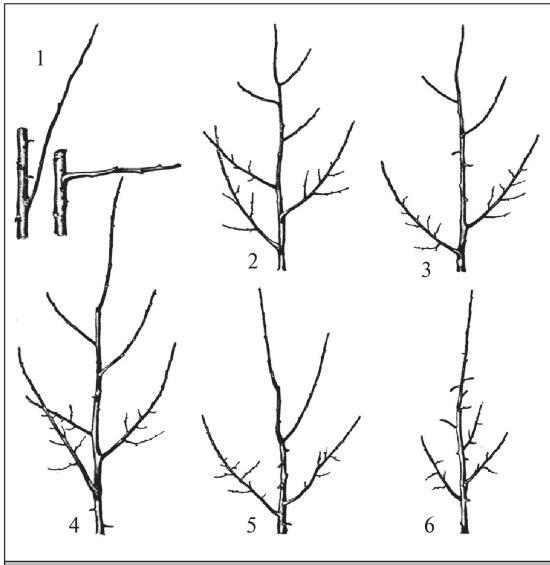
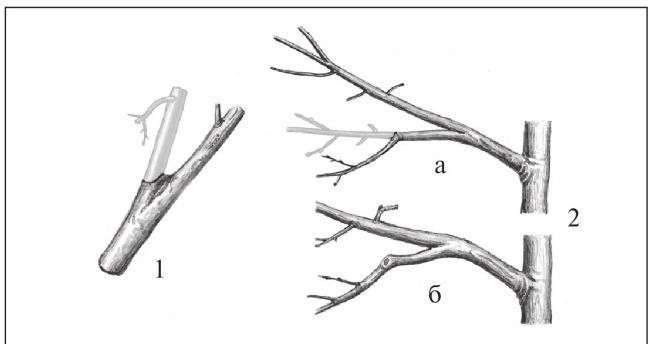
do not select those growing at an angle of less than 40° or horizontally; 2 – above the tier of three main branches, at least three single ones should be set; 3 – above the tier of two main branches, there should be at least two single ones; 4 – when all branches are strong, well-developed, and only one is weak, form the tree without regard for this branch; 5 – with two branches in a tier, the third branch is set at a distance of 20–30 cm, the fourth – at 60–80 cm for trees with a spreading growth habit, and 80–100 cm for others. Between single branches in the upper part of the canopy, the distance should be 20–40 cm; 6 – if the branches of the lower tier are not sufficiently developed yet, do not set subsequent ones, as the branches of the first tier will lag significantly in growth, potentially turning into fruiting wood.
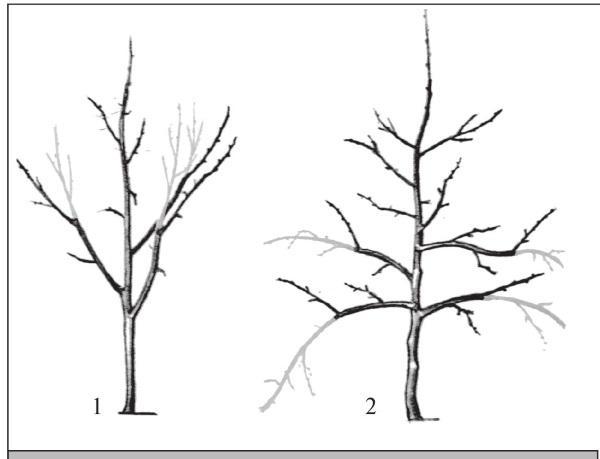
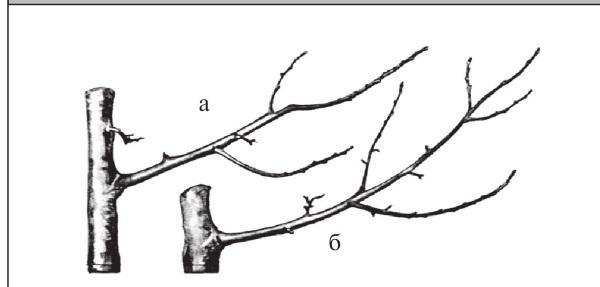
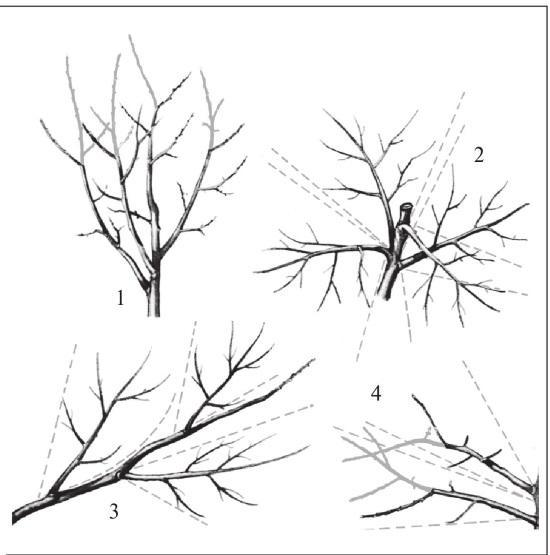
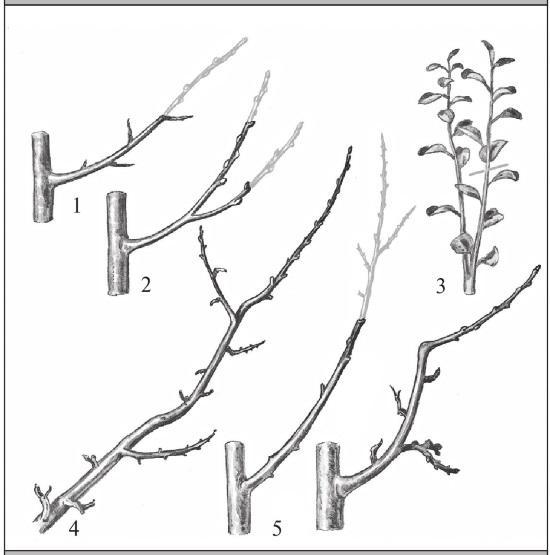
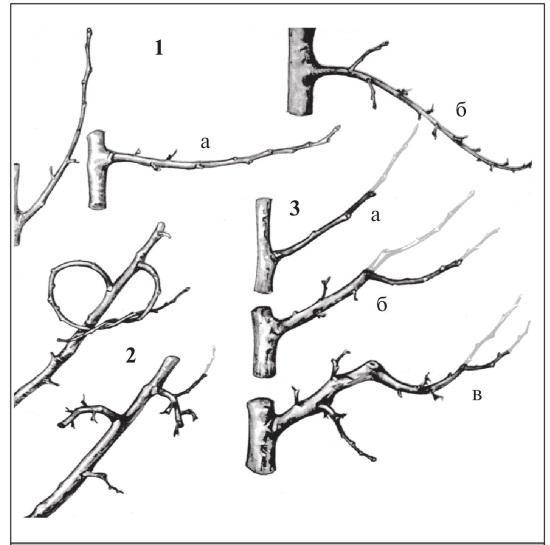
The rapid development of a young orchard depends directly on how actively the canopy is covered with fruiting wood. Traditional topping of shoots yields a weak effect: it does not stimulate the awakening of new buds but merely shifts this zone closer to the base of the branch. Branch bending works much more effectively. This technique forces the maximum number of buds to wake up, on which both vegetative and fruit formations then actively develop.
For vigorous trees, where it is necessary to restrain the rampant shoot growth and stimulate the formation of generative buds, bark ringing is used. Since this technique acts locally only on the treated branch, it must be combined with bending and gentle pruning. Such a combination allows for balancing the tree's growth vigor and accelerating its entry into fruiting.
Do not allow irregular pruning of young trees. A neglected canopy will have to be cut radically, which will inevitably cause vigorous compensatory shoot growth and delay the start of fruiting for several years.
Five rules of formation and a pruning algorithm
When forming the canopy of a young tree, an agronomist must constantly monitor the growth balance. Regular annual care allows for minimal intervention and avoids trauma to the plants. Throughout the entire period of canopy formation, it is necessary to strictly adhere to five basic rules:
- maintain the dominant position of the central leader until the canopy formation is complete or the last skeletal branch is set;
- control the uniform filling of the trunk and skeletal branches with fruiting wood according to the formation scheme;
- set new skeletal branches only with strong attachment and optimal divergence angles;
- strictly observe branch subordination both within individual branches and throughout the entire canopy;
- ensure that each branch develops strictly within its allocated sector.
Optimizing labor in the orchard helps significantly save time during pruning. Do not waste resources on detailed trimming of small branches if, in the end, the entire large branch will have to be removed. Start any pruning work with rough operations, gradually moving to fine-tuning the tree.
- Carry out general thinning. Visually assess the canopy and mark the branches that are clearly overcrowding it and are subject to removal.
- Remove large branches with a saw. Cutting off the unnecessary volume will immediately free up workspace inside the canopy for subsequent operations.
- Finish the work with secateurs and a garden knife. Clean up the cuts and perform detailed pruning and subordination of the remaining branches.
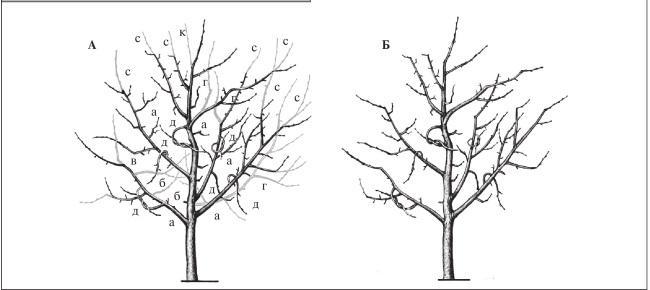
Before finally cutting out a branch, assess the possibility of keeping it in the canopy. Often, a strong shoot can be turned into a productive lateral branch by simply bending it into a horizontal or drooping position. This will spare the tree from unnecessary wounds and accelerate the appearance of the first harvest.
Read next
Pruning and training For gardeners
Peculiarities of pruning and canopy formation of pear trees in the orchard
Pruning and training For gardeners
Fundamentals of canopy formation and pruning of sweet cherry in the orchard
Pruning and training For gardeners