
Basic principles of canopy formation and subordination of fruit tree branches.
6 min read
An incorrectly formed skeleton of a fruit tree guarantees branch breakage under the weight of the harvest, canopy overcrowding, and poor light conditions. To create a reliable structure, an agronomist must control the canopy shape from the first years of the garden's life. The main tools here are the subordination of branches by thickness and the angles of their divergence from the leader.
- Optimal divergence angle — 50–60°
- Minimum permissible angle — 40°
- Permissible angle when the branch grows upward — 70–90°
- Maximum branch thickness — 1/2 of the trunk diameter
The central leader must dominate the canopy in both height and thickness. Each primary branch diverging from it must be no thicker than half the diameter of the trunk above it. If a branch exceeds this limit, it begins to suppress the leader, and an excessively thin branch quickly weakens itself. This same rule of subordination strictly applies to branches of the second and subsequent orders.
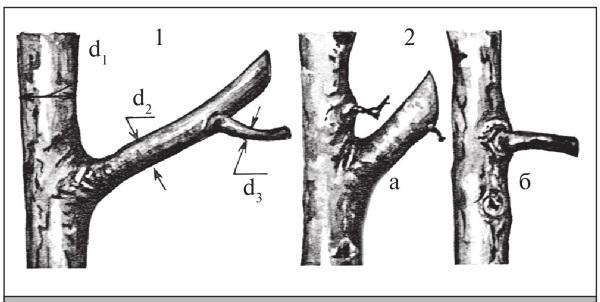
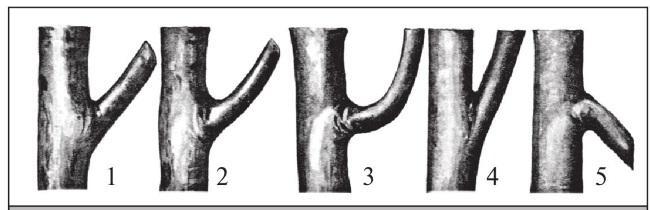
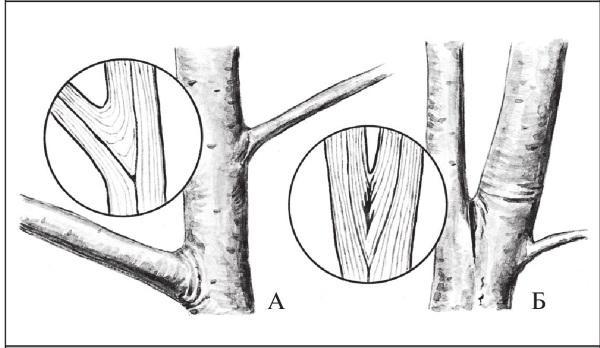
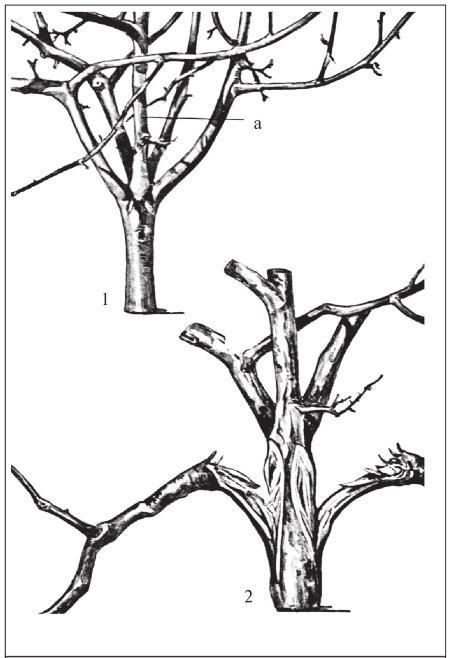
The divergence angle of a branch determines the strength of its fusion with the trunk. With acute angles (less than 40°), dead bark gets trapped in the crotch, making branch breakage under the weight of the harvest or snow inevitable. Excessively obtuse angles are also undesirable, as they inhibit shoot development. The exception is angles of 70–90° if the branch curves and directs upward at some distance from the trunk.
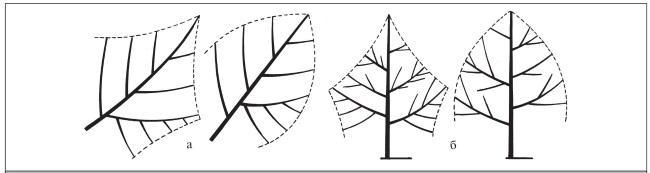
Never establish adjacent skeletal branches in whorls from the same zone. As they grow, their bases will close up and block the access of moisture and nutrients to the upper part of the tree. This will lead to suppression of the leader and inevitable trunk breakage.
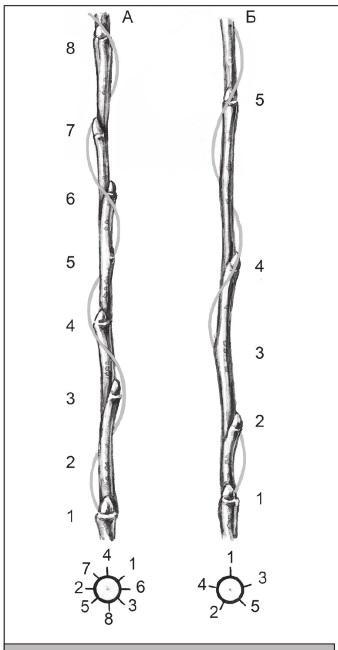
How phyllotaxy determines the branch establishment scheme
The selection of buds for establishing future skeletal branches follows the natural laws of phyllotaxy. Buds along a shoot are arranged in a spiral, forming strictly vertical rows called orthostichies. The cyclicity of this process is expressed as a fraction: the numerator shows the number of spiral turns around the trunk, and the denominator shows the number of internodes between adjacent buds on the same orthostichy.
| Phyllotaxy cycle type | Frequency of occurrence in apple trees |
|---|---|
| 2/5 and 3/8 | Most frequent |
| 1/3, 4/11, 5/13 | Very rare |
With the most common cycles, 2/5 and 3/8, one should not establish five adjacent branches in a row. In the first case, their divergence angle will be about 70°, in the second — less than 60°, which will cause mutual overcrowding. In a group of four branches, two will be deprived of good divergence angles. It is optimal to establish three branches in one tier — with such a scheme, only one angle will turn out to be insufficiently wide, which is quite acceptable for normal canopy development.
The limitation of "no more than three adjacent branches in a tier" is mandatory for classic spherical canopies with a strong framework. If you are forming a canopy without a rigid frame (e.g., spindle-shaped — spindle bush), the number of branches and their divergence angles become secondary, while overall light exposure becomes the main priority.
The strength of a fruit tree's skeleton directly depends on the branch divergence angles. When establishing the first tier, it is important to consider phyllotaxy cycles to avoid overlapping and mutual shading of shoots in the future. Selecting the correct buds during pruning allows for the formation of a reliable canopy framework.
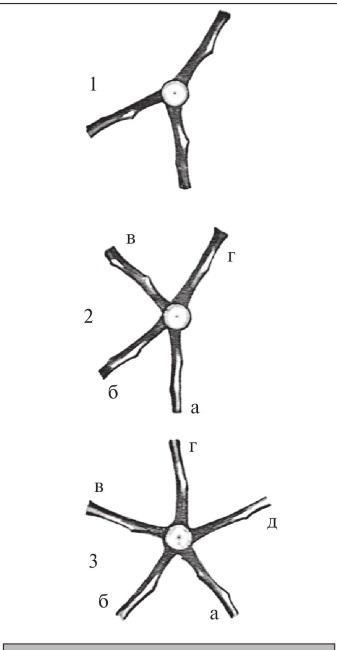
With a 2/5 phyllotaxy cycle, branch divergence angles have their own characteristics:
- With three branches: the presence of one angle of 70–75° is permissible.
- With four branches: two branches do not have good divergence angles, and two others have them only on one side.
- With five branches from adjacent buds: it is impossible to obtain strong divergence angles.
For cultivars with a 3/8 phyllotaxis cycle, different rules apply. When establishing five branches in a tier, only one branch will form reliable divergence angles on both sides. The optimal step for this cycle is to establish three branches from three adjacent buds in the sequence 1–2–3, 2–3–4, or 3–4–5.
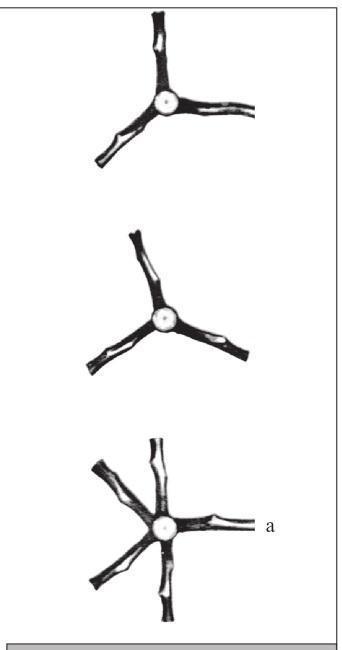
Branches of the second tier must be directed strictly into the gaps between the branches of the first tier. This prevents mutual shading of leaves and improves air circulation within the canopy. Correct distribution of branches by height and horizontal sides ensures maximum access of sunlight to the photosynthetic apparatus.
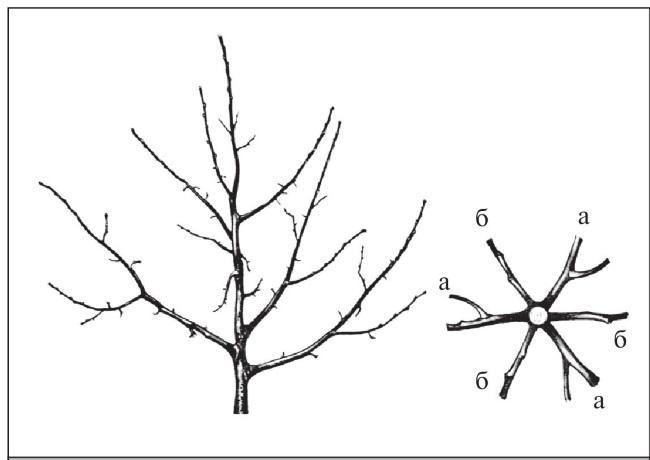
To maintain the strength of the tree framework and prevent breakage under the weight of the harvest, it is important to observe the intervals between the main branches on the central leader. The table shows parameters optimal for most standard rootstocks and cultivars.
| Type of branch placement on the trunk | Recommended distance, cm |
|---|---|
| Between adjacent single branches | 20–30 |
| Single branch above a group (of 2–3 branches) | no less than 40 |
| Between two groups (2–3 branches each) | 60–80 |
| Between tiers with more than three branches per tier | 90–100 |
Canopy formation in the nursery and young orchard
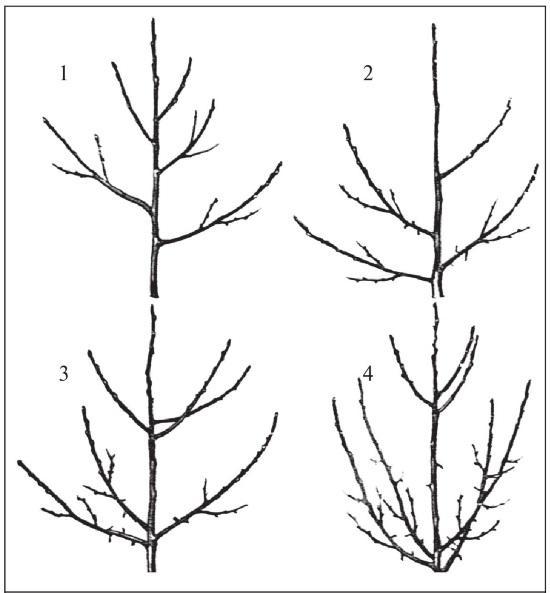
To accelerate the start of fruiting in a young orchard, minimize pruning. Use shortening and thinning only in extreme cases — for example, to remove a clear competitor or prevent crotches. It is more effective to regulate the growth vigor of branches and stimulate the appearance of fruiting wood by changing the angle of inclination. Do not cut off excess branches; instead, bend them to a horizontal or drooping position. The retained leaf mass will accelerate the overall development of the tree and ensure early flower bud initiation.
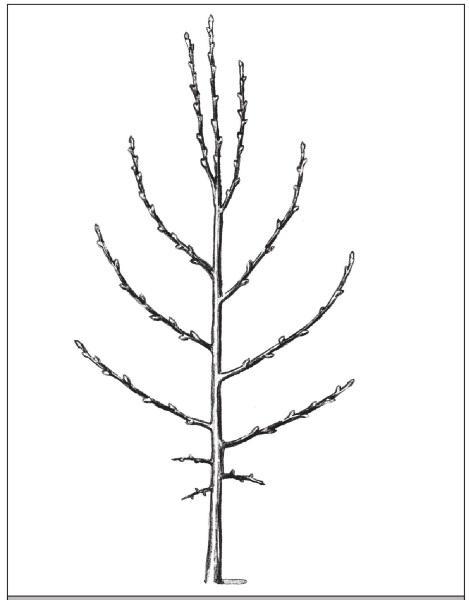
The first canopy formation is carried out in the nursery. The one-year-old plant is cut at a height of about 100 cm. A stub can be left above the top bud to secure the extension shoot. Branches are established on the remaining part of the trunk, taking into account the parameters of the future canopy.
With heavy pruning of one-year-old plants, forming only 3–5 branches, most of them emerge at acute angles, which reduces the mechanical strength of the canopy. Nursery plants with 6–9 branches have more obtuse emergence angles: only 1–2 branches near the extension shoot form acute angles.
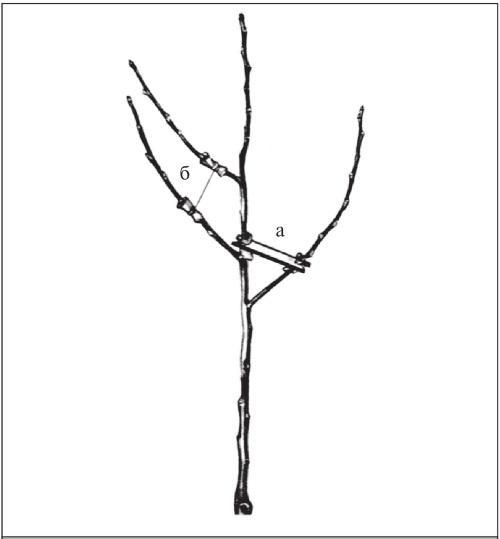
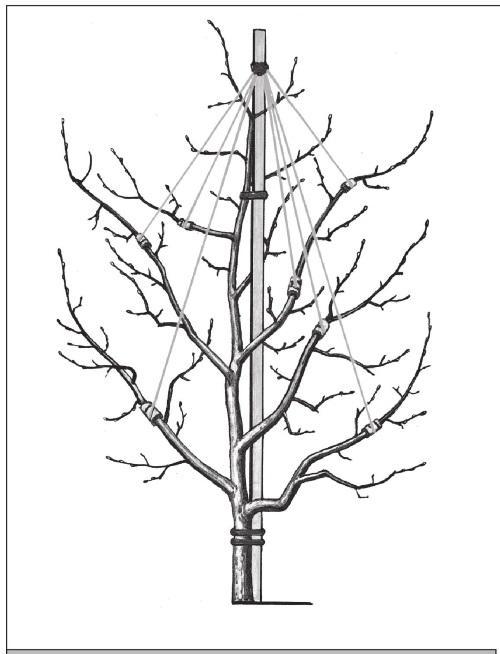
The emergence angle directly affects the strength of the branch-to-trunk union. The closer a branch is located to the top, the smaller its natural emergence angle. This indicator can be corrected artificially — by installing spreaders or ties in the first years of the growing season.
- Cutting height of one-year-old plant — 100 cm
- Number of branches on nursery plants — from 6 to 9 pcs.
- Distance between single branches — 20–30 cm
- Gap between tiers — 60–80 cm
A simple technique for increasing the emergence angle of main branches during canopy formation is installing a small square plastic plate above the bud. Technology for preparing and using the plates:
- Plastic with a thickness of about 0.04 cm is cut into strips 2.5 cm wide.
- Round holes with diameters of 0.5, 0.75, and 1 cm (for branches of different thicknesses) are made in the strips every 2.5 cm.
- The strip is cut into 2.5 × 2.5 cm squares with a hole in the center.
- They are slit on one side and installed above the bud.
Thanks to such plates, the branch emergence angle usually equals 70°. In July, the squares are removed.
A simple and effective method for increasing the branch emergence angle in one-year-old plants is late pruning. The top is removed not before the start of the growing season, but when shoots 2–3 cm long have developed from the buds. Branch emergence angles after such an operation are usually 68–75°. This technique can be used not only when establishing a canopy in the nursery but also in the orchard when it is necessary to significantly change the direction of growth (instead of leaving a protective link and repeating pruning), and in other cases.
When forming the canopy, it is particularly important to prevent the development of competitors. Their branch angles are usually very difficult to correct, so competitors must be:
- pruned out;
- pinched back at early stages of development.
It is possible to establish an orchard using one-year-old nursery plants: growing them is easier and cheaper, the output per unit area is higher, and the risk of canopy deformity during digging, transportation, and planting is eliminated.
Read next
Pruning and training For gardeners
Prevention methods and technologies for canopy strengthening of fruit trees
Pruning and training For students
Morphology and main structural elements of a fruit tree canopy
Fruit growing For agronomists