
Prevention methods and technologies for canopy strengthening of fruit trees
2 min read
Trees with brittle wood and sharp crotches are prone to large branches breaking off under the weight of the harvest. In neglected cases, a complete trunk split is possible, which leads to the death of the entire tree.
To prevent critical damage, the canopy structure must be properly formed from the first years of the orchard's life. Prevention consists of following three pruning rules. It is important for an agronomist to monitor the branch insertion angles, avoid establishing a large number of branches from adjacent buds in one tier, and strictly maintain branch subordination.
Technologies for mechanical and biological canopy strengthening
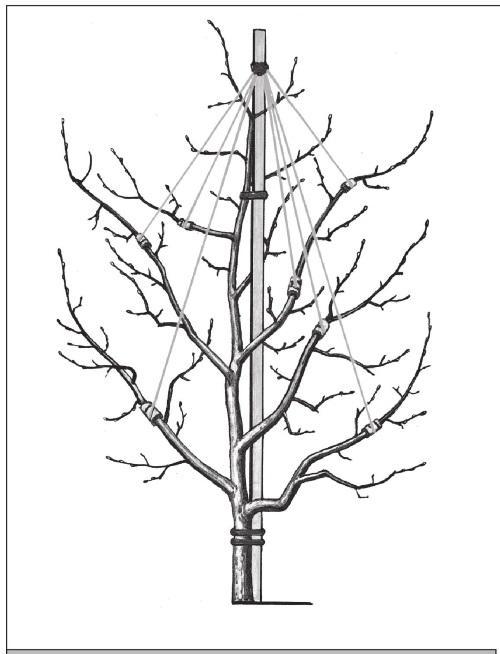
If preventive measures have been missed and there is a threat of splitting, the branches must be secured. The most durable solution is a central wire brace. To create it, screws with welded rings are screwed into the scaffold branches just above their center of gravity. Galvanized wire is attached to them, and the ends are connected to a common ring in the center of the canopy.
The central wire system acts as a reliable internal frame for the tree for several years.
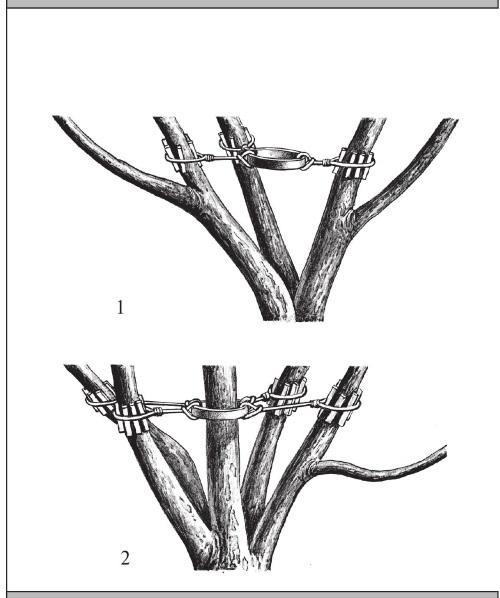
In addition to stationary wire tensioning, other methods of mechanical canopy support are used in horticulture:
- standard and umbrella staking (tying branches to a central mast or props);
- pairing of branches using wire or clamps;
- through-fixation with bolts;
- tying to a rigid wooden slat;
- fastening with metal staples.
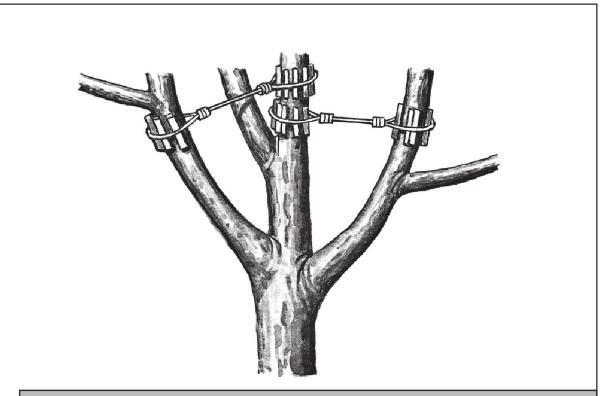
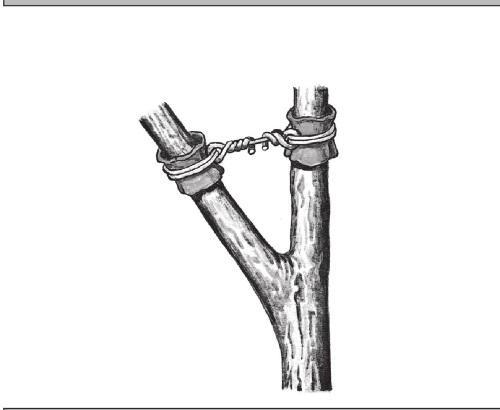
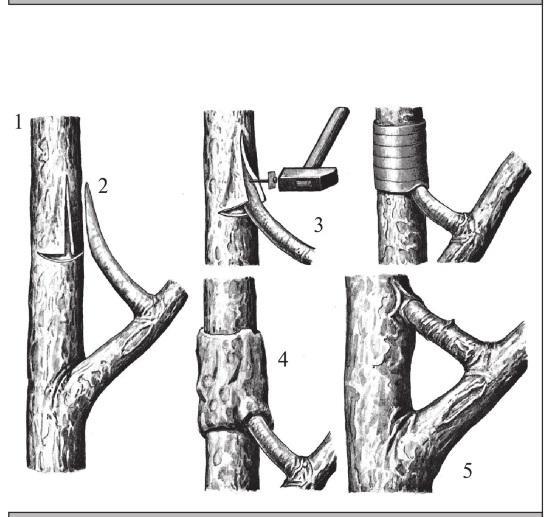
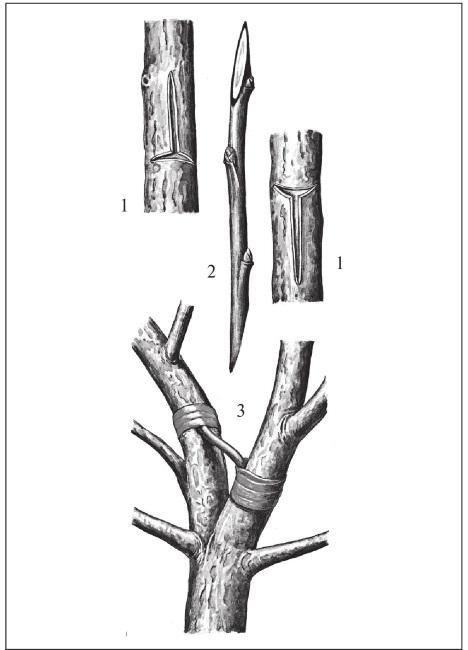
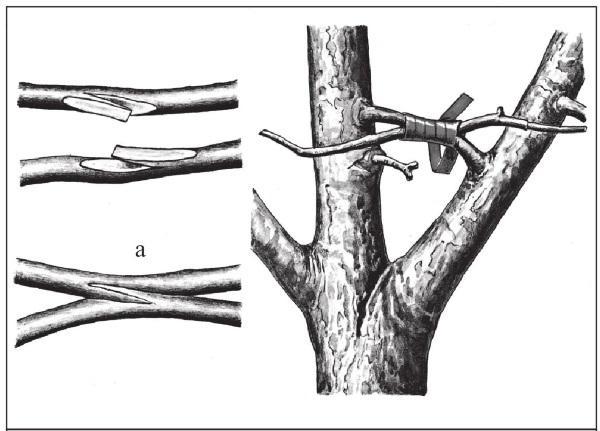
Good results are provided by biological strengthening using grafts that create living bridges. To do this, a strong water sprout or a conveniently located branch is grafted by its end to the central leader. You can also use a separate scion, securing its ends under the bark of two adjacent branches, or connect the branches directly by the approach grafting (ablactation) method. After the tissues fuse, a strong natural connection is formed, which grows and thickens along with the tree.
Read next
Pruning and training For gardeners
Pruning and canopy formation of fruit-bearing trees in the orchard
Pruning and training For students
Morphology and main structural elements of a fruit tree canopy
Pruning and training For gardeners