
Types and features of natural canopy formation for fruit trees
9 min read
The choice of canopy shape directly determines the orchard planting scheme and the method of harvesting fruit. Designs with a pronounced leader require high labor costs for aerial work during pruning. Non-tiered and sparse shapes allow for a reduction in total tree height, facilitating manual harvesting.
A properly selected canopy reduces labor costs for orchard maintenance and ensures the longevity of the fruit tree skeleton.
Technological features of fruit tree canopy formation
The natural tree-like canopy is suitable for crops and cultivars with a strong leader. It is formed without shortening shoots, which prevents the formation of narrow-angled crotches. The tree enters fruiting early, and its strong skeleton withstands heavy loads. However, over time, the lower branches die off, causing the harvest to shift to the top.
The pyramidal (leader) canopy consists of a central leader and three tiers of five branches each. Because there are many branches, the tree handles an abundant harvest without breakage. The main drawback is that the canopy becomes overgrown quickly, and to preserve the lower branches, the upper ones must be severely pruned. The tree height complicates maintenance and harvesting.
The improved pyramidal (non-tiered leader) canopy has one leader and 5–8 primary branches. Thanks to the wide spacing of the branches, they fuse firmly with the trunk. Forming such a canopy is time-consuming and difficult, and retaining the leader results in significant tree height.
The modified-leader shape differs from the non-tiered type by increased intervals between branches. The central leader is completely removed 3–4 years after the last main branch is set, diverting growth to that branch. The canopy is sturdy, well-lit, and moderate in height, although it takes a long time to establish.
The whorled-tiered canopy is easy to form due to the trees' natural tendency for tiered growth. It consists of a leader and 2–3 tiers of branches. However, mature trees often break at the points of branch attachment. Due to the density, the central part of the canopy quickly becomes bare, and the lower branches lag in growth.
The sparse-tiered type combines tiers of 2–3 branches and single branches. The entire structure is completed by removing the leader above the last single branch. This allows for balancing canopy illumination and overall skeleton strength.
When forming tiered canopies with five branches per tier, the central leader begins to suffer from strong suppression. This weakens the upper part of the tree and increases the risk of skeletal branch breakage under the weight of the harvest in mature trees.
The improved tiered canopy is designed for vigorous trees with a drooping canopy. A tier of 3–4 branches is formed at the bottom, with single branches or pairs placed above. The leader is removed after 2–3 years above the top single branch, which helps constrain the tree's dimensions.
The combined variant mixes closely spaced and sparse branches. The first group of 2–3 branches is set densely, while the rest are distributed along the trunk above. Finally, the leader is cut above the top branch, resulting in a sturdy and open framework.
The non-tiered canopy with cross-placement consists of 6–8 branches, where the first four are arranged crosswise in pairs. The framework branches up to the fourth order. Due to the abundance of branches, the canopy becomes very dense, requiring regular detailed pruning.
The moderately natural canopy is characterized by limiting branching orders to two and excellent illumination. Branches are set in groups of 3–4 or sparsely. The disadvantages of this design are the great tree height and overloading with skeletal branches.
The Oeschberg canopy is simple to form and ensures good illumination. Primary branches are set sparsely in groups of four with intervals of up to three meters. The almost vertical position of the branches (at a length of 2 m, they are shifted from an angle of 45° to 10–15°) makes the tree skeleton resistant to breakage.
The cloverleaf (lobed) canopy is formed with open light wells toward the center of the tree. This provides free access to sunlight for all fruit and prevents the center zones from becoming bare. The modern two-tiered version allows for an increase in the productive volume of the canopy without compromising illumination.
- Angle of Oeschberg canopy branches after shifting — 10–15°
- Distance between groups in the moderately natural canopy — up to 200 cm
- Width of openings in the cloverleaf canopy — 60–150 cm
- Height of the second tier of the cloverleaf canopy — 80 cm
Parameters and features of natural canopy formation
The choice of an optimal canopy shape directly determines the longevity of the fruit orchard, the strength of the tree skeleton under harvest loads, and the overall labor costs for orchard maintenance. Practical horticulture utilizes various schemes for branch placement and central leader pruning. Below are the detailed characteristics of the main types of natural canopies that are formed in modern plantations.
| Canopy type | Number of branches | Intervals and distances | Leader pruning features |
|---|---|---|---|
| Natural-arborescent | Numerous, codominant | Formed without shortening | Not removed, a strong leader is maintained |
| Pyramidal (leader) | Up to 3 tiers with 5 branches each | Between tiers — 40–50 cm | Not removed |
| Improved pyramidal | 5–8 first-order branches | First three — 15–20 cm, subsequent — 25–40 cm | Not removed |
| Modified leader | 5–8 branches | Between branches — 25–40 cm | Cut back 3–4 years after establishing the last branch, with a transfer to it |
| Whorled-tier | 2–3 tiers (lower — 4–5 branches) | Between tiers of 5 branches — 1–1.2 m, of 3–4 branches — 0.7–0.8 m | Not removed |
| Spaced-tier | 5–8 branches (tiers of 2–3 and single) | To a single branch — at least 40 cm, to a tier of 2 branches — up to 70 cm, of 3 branches — up to 100 cm | Removed above the last lateral single branch |
| Improved tier | 6–8 (for drooping) or 4–6 (for others) | Lower ones — in a tier of 3–4 branches, others — singly or in pairs every 60–80 cm | Pruned 2–3 years later above the upper single branch |
| Combined | 5–8 branches | First 2–3 — closely spaced every 6–15 cm, next 3–5 — singly every 35–40 cm | Removed above the last branch |
| Tierless with cross-placement | 6–8 branches (4 branching orders) | First 4 — in pairs every 6–20 cm, subsequent — every 20–35 cm | Not removed |
| Moderately natural | 6–10 branches (2 branching orders) | In groups of 3–4 branches — 10–20 cm (or spaced every 30–50 cm), between groups — up to 200 cm, 2nd order — every 70–80 cm | Removed if desired above the upper branch of the second group |
| Eschberg | Groups of 4 branches on the leader | Between groups — 1.5–3 m, lateral branchings — every 40–80 cm (offsetting 30–40 cm from the base) | Not removed; branches are transferred from 45° to an angle of 10–15° at a length of about 2 m |
| Clover-leaf (lobed) | 4 branches (or 2 tiers of 4 branches) | Gaps on the periphery — 60–150 cm; between tiers — 80 cm | Not removed |
Bush canopy completely lacks a central axis. To obtain such a form in practice, gardeners use one of three methods. You can plant 2–3 trees in one planting hole, use low branch establishment followed by hilling, or use own-root plants and form several trunks from basal shoots.
Vase-shaped (cup-shaped) canopy is formed with an open center based on three or five main branches established from adjacent buds. The leader is removed immediately after planting. The main branches are pruned at a distance of 40 cm from the central leader, stimulating their branching into two equivalent second-order branches. Subsequently, the operation is repeated until the canopy is filled with fruiting wood. Improved vase-shaped canopy differs from the standard version only in the spaced arrangement of the three or five main branches.
Ordinary and improved vase-shaped canopies have low structural strength. After the leader is removed, the upper branch tends to take its place and grow vertically, which requires constant pruning and increases labor costs. Training is advisable only for short-lived, low-vigor trees.
Vase-fan canopy with an open center is created based on an ordinary canopy for rapid height reduction and tree thinning. Such reconstruction is advisable to carry out in orchards with sparse tree spacing. During canopy formation, the branches are moved to a horizontal or near-horizontal position.
- Canopy height — 2.5–3.5 m
- Canopy diameter — 6–8 m
- Planting schemes for transition — 8 × 8 m, 8 × 6 m, 7 × 6 m
- Inclination angle of first-order branches — 50–60°
The transition of a standard canopy to a vase-fan form is performed according to the following scheme:
- Remove part of the central leader above a single branch at a height of 2–2.5 m to open the center and reduce the tree height.
- Place 5–6 main first-order branches on a leader segment 0.6–1.5 m long (2–3 lower branches form a tier, the rest are established sparsely).
- Direct the first-order branches at an angle of 50–60° to the vertical using fracturing or pruning to a lateral branch.
- Move the remaining upper branches and middle-tier branches to a horizontal position, placing strong branchings almost horizontally.
Transition to intensive canopy types: canal-fan and horizontally-flattened training
For high-density row plantings, classical rounded canopies are not suitable — they shade the row and hinder the passage of machinery. The solution is to transition to canal-fan or horizontally-flattened training. These canopy types allow opening light corridors for better fruit ripening and clearing technological passages in the row spacings.
- Height of the formed canopy — 3–3.5 m
- Branches towards the row spacing — 45°
- Branches along the row — 60–75°
- Gaps between trees in a row — 0.5–0.7 m
The canal-fan canopy is formed from 5–6 main branches. Four of them are directed at a 45° angle towards the row spacings, and 1–2 more branches are established at a 90° angle to the axis of the row. The central leader is cut strictly above the uppermost single branch. The required inclination of the axes is achieved through deformation and fracturing of the shoots.
| Planting scheme | Row spacing, m | In-row distance, m |
|---|---|---|
| 10 × 5 m | 10 | 5 |
| 8 × 4 m | 8 | 4 |
| 8 × 3 m | 8 | 3 |
When forming the axes of a canal-fan canopy, it is critically important to observe the angles of inclination. Branches directed into the row spacing must have an inclination of exactly 45°, while those directed along the row — from 60° to 75°.
If the orchard already contains thickened plantings with rounded canopies, they can be converted to a canal-fan system. This normalizes the light regime and simplifies mechanized tillage.
- Cut off the central leaders of all trees in the row at a height of 2–2.5 m from the soil surface, immediately above a single main branch.
- In the upper part of the canopy, redirect all main branches growing along the row towards the wide row spacing using the heading-back cut method, or shorten them significantly.
- Completely remove all vertical branches within the light channel being formed.
- Branches that have drooped too close to the ground should be pruned back to an upward-directed lateral branch.
- Clear the light corridor in the wide row spacing to a width of 2–2.5 m, and across the row, form gaps between the trees 0.5–0.6 m wide.
The horizontally-flattened canopy is a simpler alternative to the vase-fan and canal-fan systems. Its main difference is that tree height can be limited to 3 m without following complex pruning rules. This operation is performed using a template or by mechanical means. Any rounded canopy can be converted into a horizontally-flattened one at any age of the planting.
Reference: classification of fruit tree canopies
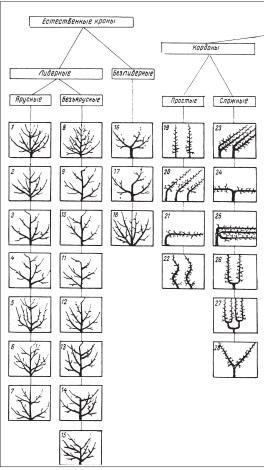
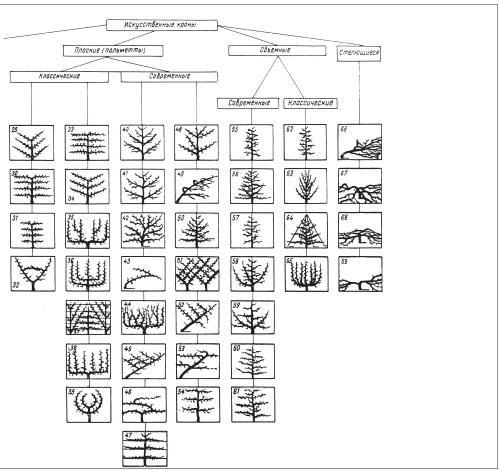
The pomological classification includes 69 main canopy types: 1 – whorled-layered; 2 – pyramidal (leader); 3 – improved layered; 4 – sparse-layered; 5 – Eshberg; 6 – moderately natural canopy with two orders of main branches; 7 – lobed with layered branch arrangement; 8 – naturally tree-like; 9 – improved pyramidal, or leaderless; 10 – modified-leader; 11 – combined; 12 – leaderless with cross-arrangement of lower branches; 13 – cloverleaf (lobed); 14 – vase-fan; 15 – canal-fan; 16 – cup-shaped; 17 – improved cup-shaped; 18 – bush; 19 – vertical cordon; 20 – oblique; 21 – horizontal single-arm; 22 – wavy; 23 – oblique with two arms; 24 – horizontal two-arm; 25 – horizontal three-arm; 26 – U-shaped; 27 – double U-shaped; 28 – Y-shaped; 29 – Italian and its modifications; 30 – with horizontal branches; 31 – New Times; 32 – Upsilon; 33 – four-tier trellis; 34 – with oblique branches; 35 – double Verrier; 36 – Verrier; 37 – Cassone system; 38 – candelabra; 39 – circular, radial; 40 – oblique (free-growing) Italian; 41 – with replacement branches; 42 – fan-shaped; 43 – Lepage; 44 – Montreuil; 45 – Boucher-Thomas; 46 – Ruzin; 47 – Schlosser; 48 – Werder; 49 – Mathé; 50 – Ferrugati; 51 – Delbard; 52 – Marchand; 53 – Seabrook; 54 – Hague trellis; 55 – spindle-shaped; 56 – spindle bush; 57 – columnar (pillar); 58 – free-growing spindle bush; 59 – maple leaf; 60 – flattened spindle bush; 61 – flattened for mechanized pruning; 62 – spindle; 63 – pyramid; 64 – winged pyramid; 65 – vase; 66 – Minusinsk creeper; 67 – arctic; 68 – melon; 69 – Krasnoyarsk two-arm.
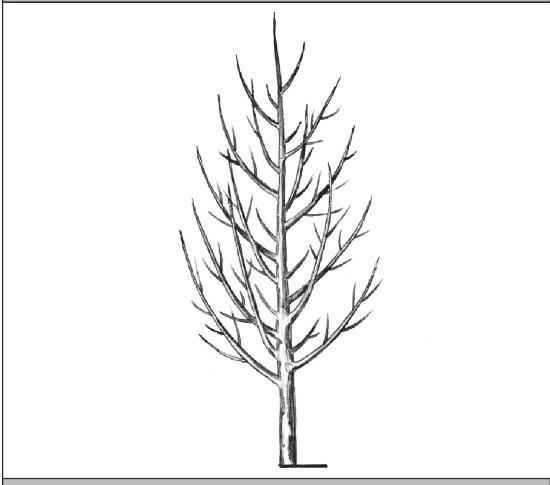
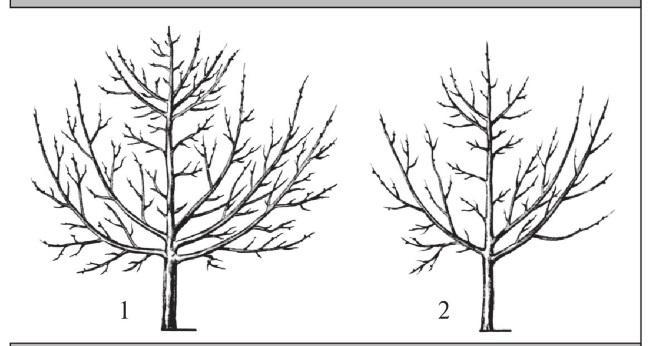
Presented below are schemes of trunk structures and the distribution of skeletal branches for various types of natural canopies:
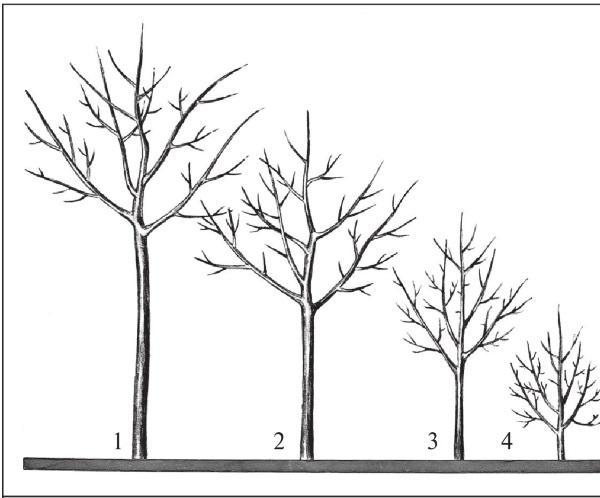
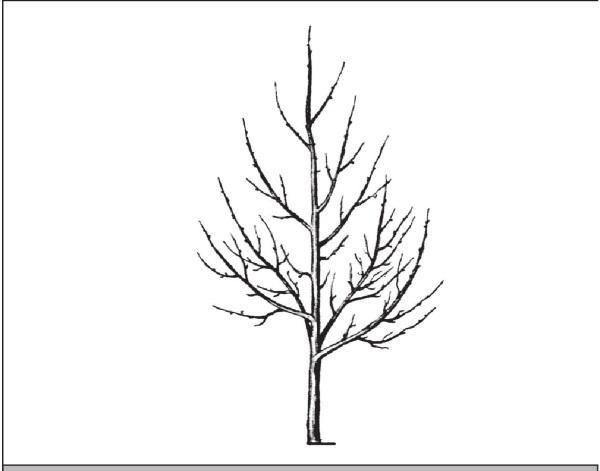
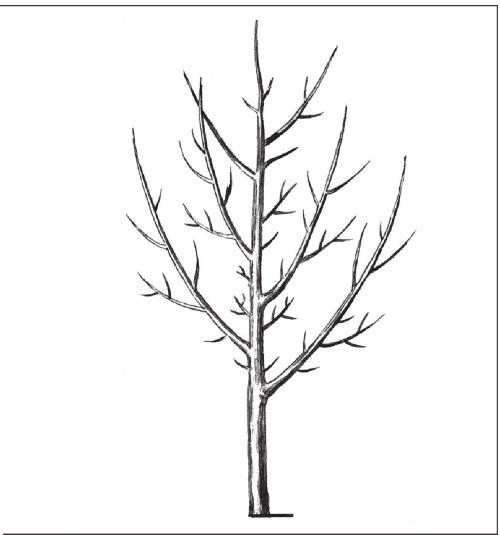
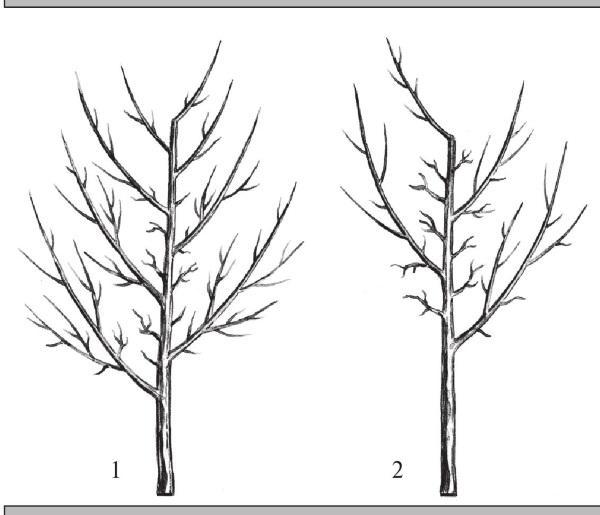
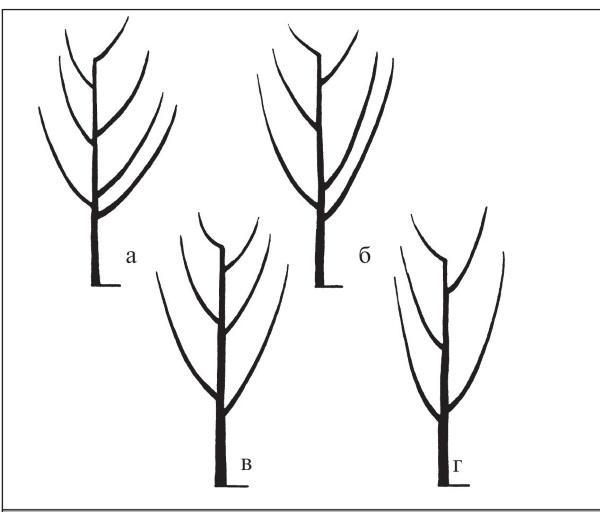
a) 3–2–1–1; b) 3–1–1–1; c) 2–2–1–1; d) 2–1– 1–1.
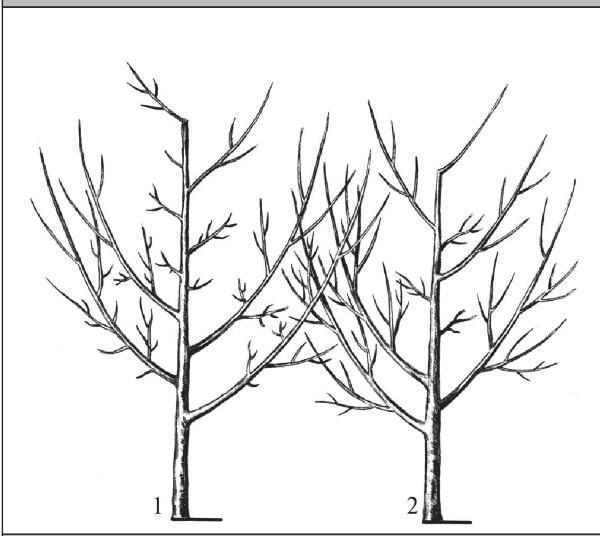
1) 4–1–1; 2) 3–1–1–1.
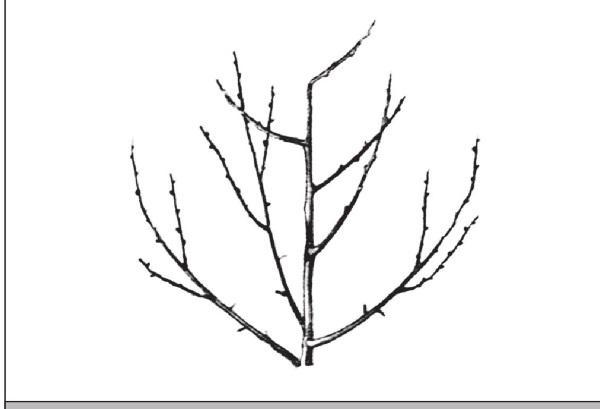
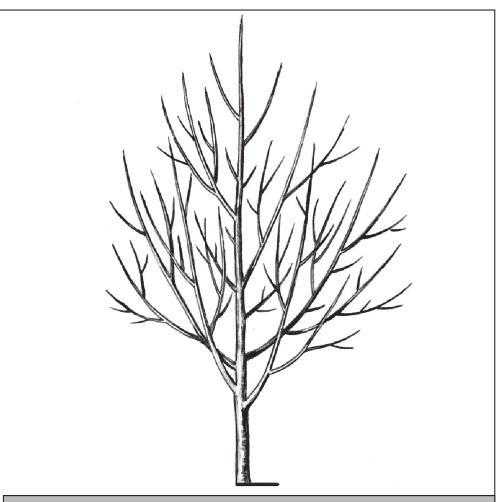
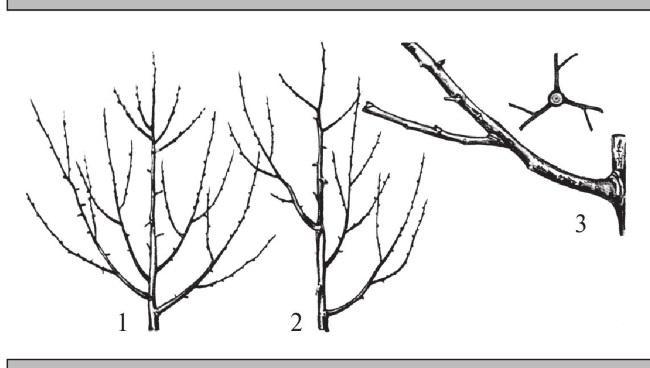
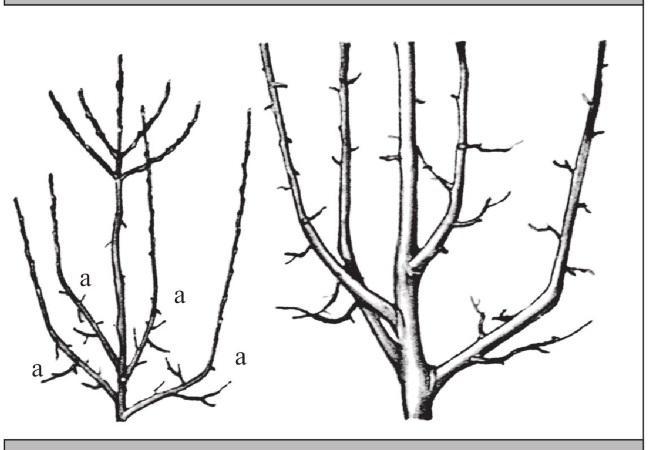
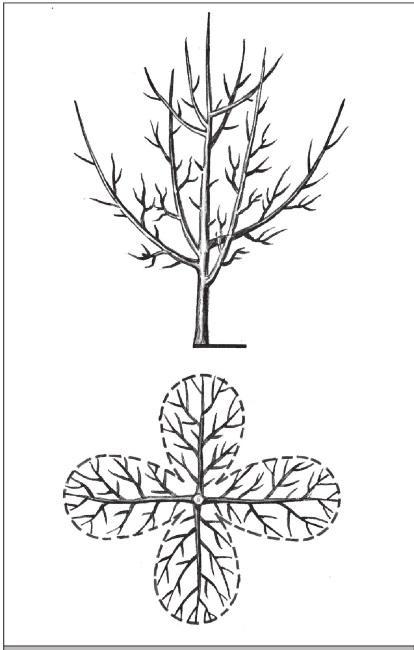
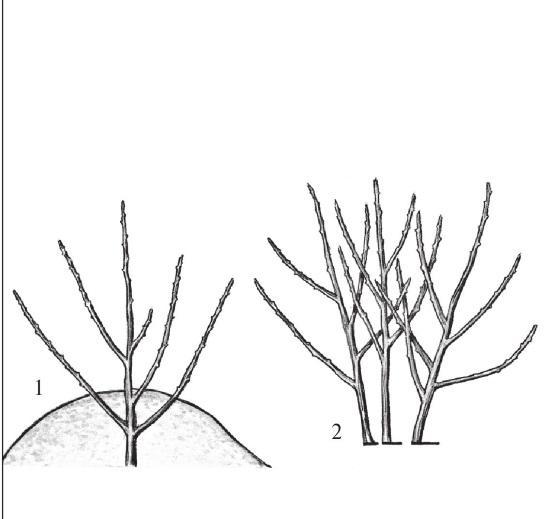
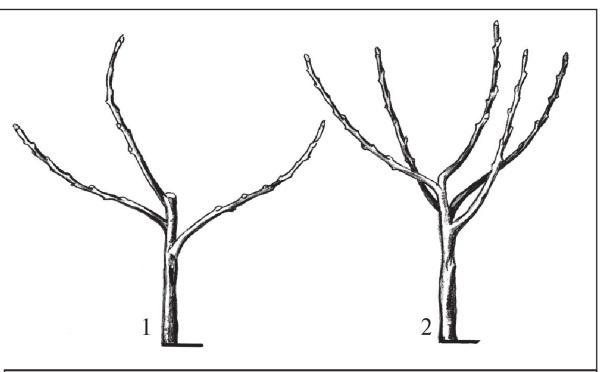
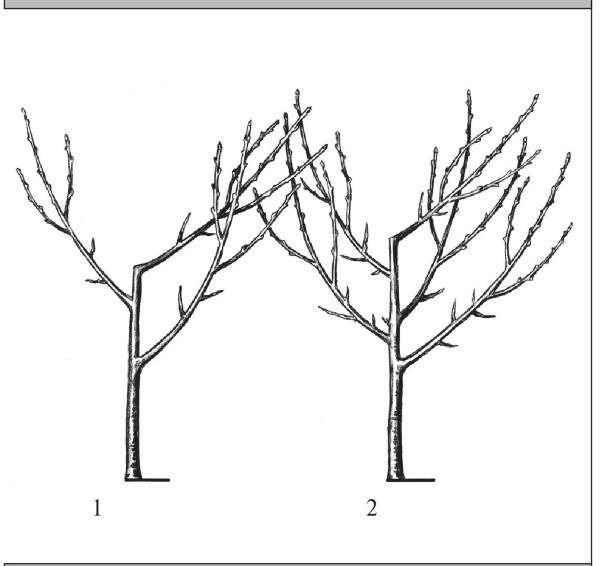
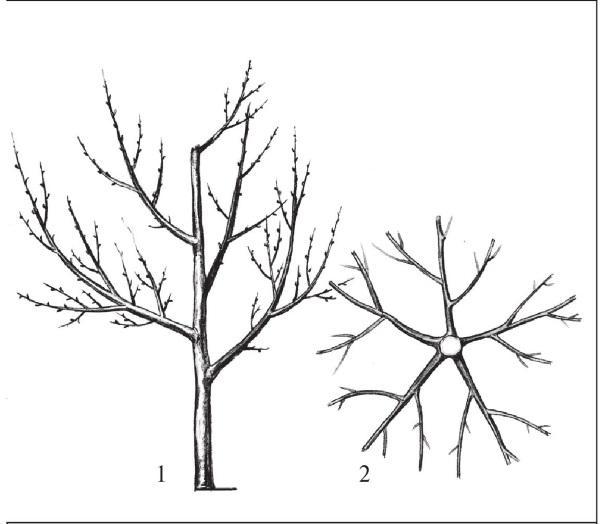
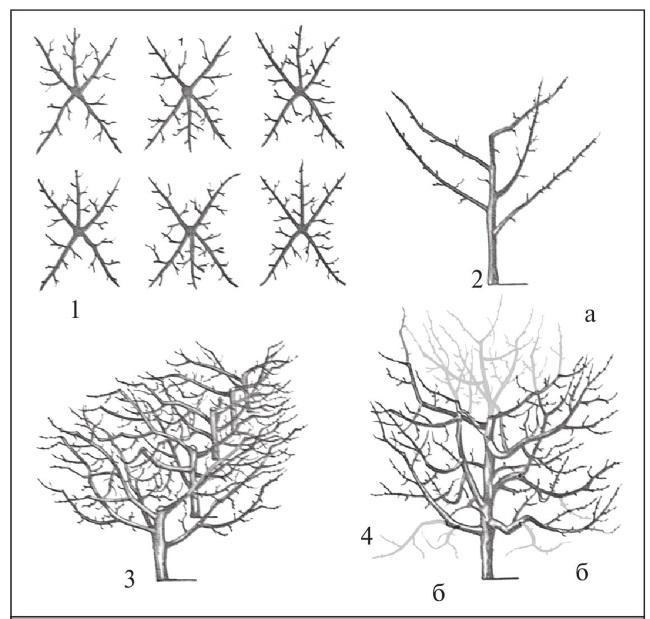
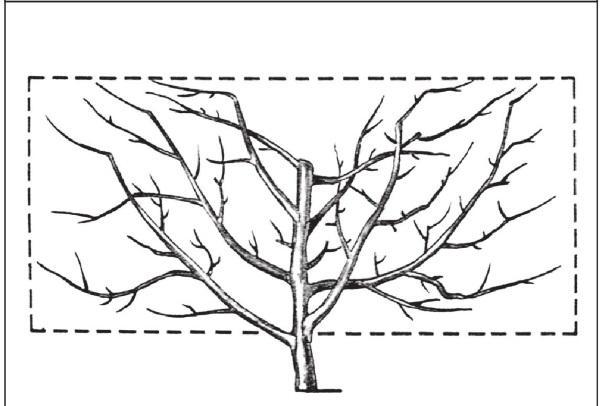
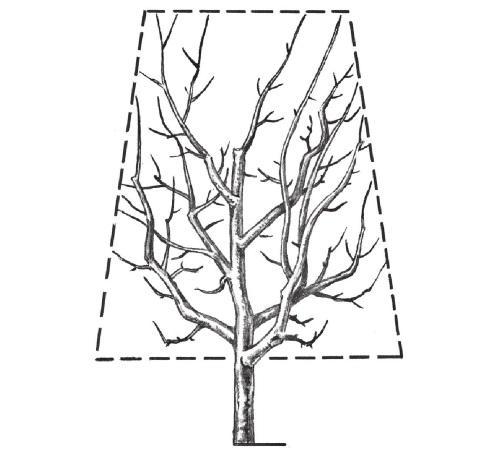
Vertically flattened. Recommended for dense planting (5 × 5 m, 5 × 4 m, 5 × 3 m, 4 × 4 m, 4 × 3 m). If the formation began at a young age, the main branches are directed only along the row. By constantly limiting the growth of branches towards the row spacing, a continuous canopy of the row is created. Its height should be no more than 3 m, thickness across the row – 2–2.5 m, width along the row – until it closes with adjacent trees. The corridor free of branches between adjacent rows is about 2.5 m.
Read next
Fruit growing For agronomists
Technology of shaping a central leader canopy for fruit trees in an orchard
Pruning and training For gardeners
Peculiarities of canopy formation in young fruit trees, taking into account cultivar characteristics
Pruning and training For agronomists