
Tomato streak: biological characteristics and methods of controlling the virus
18 min read
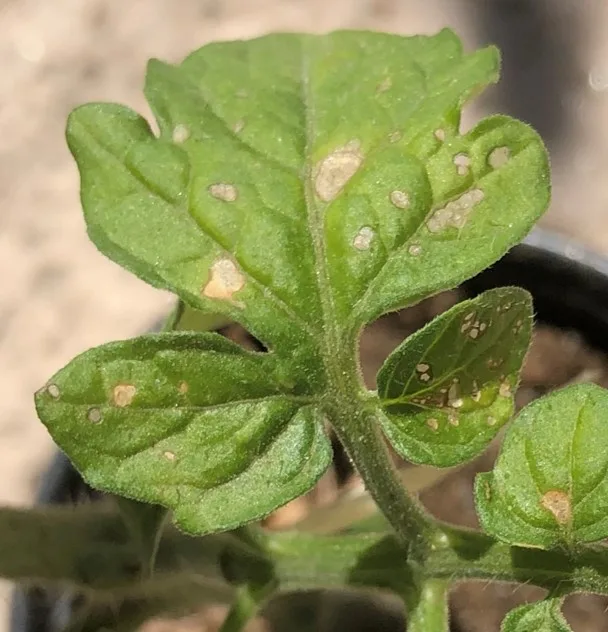
› 5 Хх | г® я | - д ^ `. г г’ ра >. ы. и 1х ^^. Fig. 94. STREAK ON STEMS AND LEAVES кз ом “. ть 2 > р 1 9 < #4 5> о | “ р у С у - - In practice, the Tm-27 gene is used most often. In a homozygous state, it is possible to obtain immune hybrids. However, there are already known cases of their immunity being overcome in Holland and Denmark. Most resistant hybrids are heterozygous for this gene. Symptoms of systemic necrosis, yellow mosaic on the upper third of the plant, and fruit streak may appear on such plants. Such symptoms can manifest only under a combination of several conditions: temperature above 28° for several days, high infectious load, and high insolation.
Spread. The pathogen is transmitted through inoculation with plant sap. This is one of the most contagious phytoviruses: it is enough to damage leaf hairs with contaminated tools or hands during plant maintenance to transmit the infection. The virus moves slowly within the leaf at a speed of 14 µm/hour (at 25°), but upon reaching the phloem, the speed of movement along the stem of the tomato increases to 6-7 cm/hour (Gibbs, Harrison, 1978). The transmission of the pathogen by the leafhopper Euscelis plebejus has been noted. Aphids and thrips can also be vectors of the virus. In the literature, there is information about the presence of the virus in the conidia of powdery mildew Sphaerotheca sp. and Erysiphe sp.; possibly, fungi are also involved in the transmission of this virus (Gibbs, Harrison, 1978).
Sources of infection can be plant residues, seed, and soil, in which the pathogen retains viability for over 22 months.
Host plants. The virus has more than 350 host plant species, including many types of agricultural crops (pepper, eggplant, tomato, beet, potato, spinach, tobacco, legumes, grape, apple, petunia, phlox, zinnia), as well as many weeds.
Identification of ToMV is carried out using mechanical inoculation of tomato plants at the open cotyledon stage. To do this, the sap of a diseased plant with the addition of quartz sand is rubbed into the cotyledons using a cotton swab. The sap is prepared from freshly harvested virus-affected leaves or from frozen leaves stored at — 5°. The expressed sap is diluted with distilled water in a 1:1 ratio. Visual assessment is carried out on the tenth and twentieth days after inoculation on a five-point scale.
Plant protection measures. Seed treatment: heating, treatment with sodium phosphate (III). Removal of plant residues and soil sterilization before starting a new crop rotation. With weak manifestation of the disease, it is recommended to treat plants with a 10% solution of milk whey or skim milk with the addition of trace elements. It is very important to maintain an optimal temperature regime, which in itself restrains the development of the disease and prevents the development of epiphytotics in the presence of a latent form of infection. 2.2.1.2. Leaf shoestring and fern-leaf symptoms
Pathogen — CMV, cucumber mosaic virus.
Harmfulness. The pathogen causes plant deformation and wilting of the apex. The greatest harmfulness is noted during the joint infection of plants with CMV and TMV.
Symptoms: leaf shoestring and fern-leaf. These signs of the disease are significantly sharper than the leaf shoestring associated with TMV. The differences between the symptoms caused on tomatoes by CMV and TMV also lie in the fact that CMV never causes the formation of enations. There are also known necrotic strains of CMV that cause necrosis of the conducting vessels of tomato fruits and death of the plant apex.
Spread through the greenhouse occurs mainly by aphids. The disease has been noted in individual farms in the Far East, the Lower and Middle Volga regions.
The source of infection is, as a rule, centers of infection in the territory surrounding the greenhouse. Host plants. The virus has a wide range of host plants, infecting perennial weeds and ornamental plants, as well as various agricultural crops, including tomatoes. In summer, aphids transfer viruses from reservoir plants growing in the area adjacent to the greenhouse to tomatoes and cucumbers in protected ground. 2.2.1.3. Seedlessness, or tomato aspermy
Pathogen — Tomato aspermy cucumovirus (TAV), tomato aspermy virus. The disease was discovered in the 1940s in greenhouses in England. In subsequent years, it was discovered in greenhouse tomato crops in many countries, and in Russia (Primorsky Krai) — on chrysanthemum (Chuyan, Krylov, 1979). Harmfulness. Affected plants practically do not yield a marketable harvest. Harmfulness depends on the virus strain, the plant cultivar, and growing conditions.
Symptoms. The main symptom of aspermy is the characteristic bushiness of the plants. The growth of the main stem is stunted, and axillary lateral shoots develop poorly. Leaves, more often of the upper tiers and suckers, lighten, deform sharply, become smaller, and acquire a mosaic coloration. Characteristic features are deformation, reduction in size, and asymmetry of leaves, the edges of whose lobes turn pink or bluish. Fruits become small, deformed, hard, with necrotic streaks and cracks, or more often do not form at all. Seeds in the fruits are underdeveloped or completely absent.
Biology of the pathogen. Virions are spherical, with a diameter of about 25 nm. The virus can be diagnosed by serological methods or using indicator plants.
Spread of the pathogen. The virus is transmitted mechanically and by aphids, affecting plants of many families: Solanaceae, Asteraceae, etc. Reservoir plants. In greenhouses, the most common reservoir is the chrysanthemum (Holdinge, Stone, 1971), but the pathogen also infects over 100 species of vegetable, ornamental, and weed plants of 24 families. 2.2.1.4. Tobacco rattle virus. The causative agent is Tobravirus, Tobacco rattle virus (TRV). Harmfulness. The disease causes great economic damage, especially in Northern Europe. A reduction in the photosynthetic surface leads to growth retardation of the entire plant and a decrease in yield. Symptoms. More or less sharp mottling often develops on the leaves, less frequently striate, arcuate, or ring spots. Plants are stunted, leaves are deformed. Symptoms of the disease vary depending on the cultivar. Some plant species and cultivars can be asymptomatic carriers of this virus.
Biology of the pathogen. The virus has rod-shaped particles with dimensions of 190 and 45-115 x 25 nm. Under natural conditions, it is transmitted by 9 species of nematodes of the genus Trichodorus sp. The virus can persist in nematodes for weeks. For instance, in starving Trichodorus pachydermus, TRV persisted for at least 36 days. Trichodorus allius nematodes can acquire the virus while feeding for an hour and transmit it to healthy plants in approximately the same time.
Reservoir plants. The pathogen has a wide host range, including more than 800 species. In greenhouses and the surrounding territory, it can infect plantain, white clover, wallflower, field pansy, and common chickweed. Among the affected plants, economically important ones are potato, tomato, and tobacco.
Diagnosis. Due to the fact that serological diagnosis and electron microscopy are less reliable, it is better to use a bioassay on indicator plants (Chenopodium quinoa, Phaseolus vulgaris, and Cucumis sativus), which react with the appearance of local symptoms on inoculated leaves (necrosis and chlorotic spots). 2.2.1.5. Tomato spotted wilt, or bronzing
The causative agent is Tomato spotted wilt virus (TSWV).
Harmfulness. The disease is rare in greenhouses.
Symptoms. Young leaves on the tops of plants and lateral shoots of tomato have a bronze or dull purple tint. Later, brown necrotic spots develop in the form of rings, zigzag, and intermittent stripes extending along the main vein of the leaf. Within 10 days, they enlarge slightly, areas of chlorotic tissue form around them, and the primary necroses become surrounded by two or three rings of dead tissue (ring necrosis). After 2-4 days following the appearance of primary symptoms, secondary necroses appear on the top 3-4 leaves (a consequence of systemic infection). Brown and black stripes appear on the leaf petioles and stem. The tops of plants often die off. Leaves appearing later have almost normal morphology, although they also contain the virus. The plant enters a stage of chronic illness, which is perceived as a temporary recovery. However, complete recovery does not occur.
On green fruits, there are brown, green, and pale rings; near the stalk, there are brown stripes. When ripening, such fruits have a variegated red-yellow color.
Biology. An RNA-containing virus, unstable in the external environment. Thermal inactivation point is 45°.
Incubation period at 20° is approximately 5 days.
Spread. Vectors are some sucking insects, including thrips, which prefer to feed on curled, affected leaves. 2.2.1.6. Tomato chlorotic curl
The causative agent is Latutis (Nicotiana virus N. K. M. sm.).
Harmfulness. The disease is accompanied by partial flower drop, and, unlike stolbur, their structure does not change. Set fruits are small, hard, and ribbed.
Symptoms. This disease belongs to the yellows group. It is characterized by severe deformation and dwarfing of leaves, which is especially pronounced at the top of the plants. The tissue between the veins is wrinkled and discolored. This is especially visible along the edges of the leaves. Affected plants have a light, uneven color, their growth is delayed, and fruits become small or do not form at all. The leaves acquire a yellow-green, chlorotic, or mosaic color and curl downwards. Often, petioles and internodes are shortened.
Vectors: greenhouse Trialeurodes vaporariorum and tobacco Bemisia tabaci whiteflies. 2.2.1.7. Pepino mosaic virus. The causative agent is Pepino mosaic virus (potexvirus).
Harmfulness. A low-risk disease, not yet registered in our country. In affected plants, output is delayed by two weeks. The total reduction in harvest can reach 14%. The quality of produce deteriorates due to the formation of puffy fruits.
Pepino mosaic virus: symptoms and prevention
Disease symptoms manifest most strongly during periods of low light intensity, typically in autumn or at the end of the growing season. With early infection, tomato shoot tips become thread-like, grey, and droop, while leaves curl or develop dark blisters. Soon, leaf margins become jagged, showing mosaic patterns and mottling, resembling chlorosis caused by iron deficiency. Affected fruit develop a marbled appearance, losing their commercial value. In February-March, leaves turn yellow, with dark swellings or small dots becoming clearly visible on them.
The main route of virus transmission is mechanical, during plant care activities. The virus is also spread by bumblebees. The pathogen is detected on the surface of poorly cleaned seed (although infection of seedlings has not been confirmed) and in irrigation water, where it enters from diseased plants. Reservoirs of infection in a facility include pepino (Solanum muricatum), potato, and eggplant.
- Virus viability in dried sap — up to 4 days
- Recommended UV dose for tobacco mosaic group viruses — 250 MJ/m2
- UV dose for destroying pepino mosaic virus in experiments — 150 MJ/m2
To prevent infection, use only well-cleaned seed. Treating plants with skimmed milk helps prevent the spread of pepino mosaic virus. Note that in moist and cold crop residues, the infection persists longer than in a dry environment.
Tomato apical stunt and spindle tuber
Tomato apical stunt viroid is a dangerous pathogen formerly considered a virus. In our country, the disease was first noted in 1998. The first symptoms of infection appear in the first half of the growing season, usually in January-February. White dots appear on the veins of lower leaves, which gradually darken and expand. The leaf blade elongates, the central vein becomes coarse, and the leaf itself curls downward.
The infection gradually moves up the tiers. By mid-February, the upper leaves elongate and twist, creating an apical stunting effect. In severe cases, lower leaves are positioned at an acute angle to the stem, giving the plant a spindle shape. Plant growth slows down, internodes at the top shorten, veins take on a bluish hue, and leaves become coarse.
White dots appear on the veins, turning into necrotic streaks, which cause the tissue to contract and deform. The flowers also change: petals pale and elongate, the pistil thickens, the number of stamens increases, and buds may fuse. The disease is transmitted mechanically, through seed, pollen, grafting, and by the peach aphid. It is found primarily in greenhouse complexes and in a number of neighboring countries.
Indicator plants are used to diagnose the pathogen: susceptible tomato cultivars, Nicotiana glutinosa, Zinnia elegans, and Scopolia sinensis. They show symptoms characteristic of viroids. In this same group of threats is the potato spindle tuber viroid (PSTVd).
Specific protective measures against the viroid have not been developed. Early roguing of diseased seedlings at early stages of development helps contain the spread of infection. Please note: the disease pathogen is inactivated at temperatures above 75°C.
Harmfulness. Causes a change in plant habit; localized leaf necrosis appears, and seed yield and total harvest decrease. The virus is highly infectious: it is transmitted by sap inoculation, through seed, and mechanically. In infected plants, seed becomes small, and germination is reduced (down to 24 %). Fig. 96. TOMATO APICAL STUNT VIROID. Symptoms. In infected plants, the growth of shoots is delayed, and leaves become smaller and bent. Symptoms of the disease intensify in periods with relatively high air and soil temperatures. The nature of the disease symptoms depends not only on growing conditions but also on the cultivar. Distribution. The potato spindle tuber viroid is considered a quarantine pathogen in European countries. It is widespread in Bulgaria, Poland, and Russia, and has been detected in the Baltic states in recent years.
Pathogen biology. Many strains of PSTVd have been registered in different countries, which can be divided into two groups. In potato, they are easily identified by their ability to cause spindle tuber.
PSTVd is characterized by vertical transmission of infection through the plant, resulting in the pathogen entering the seed. It is known that the PSTVd pathogen exhibits resistance to the action of inhibitors that trigger seed maturation, which are capable of inactivating many viruses. The duration of infection persistence in seed reaches 17 years. With an increase in storage duration, seed infection levels decrease. Furthermore, different crops have varying degrees of susceptibility; for potato, it is 7-24 %. This viroid can be transmitted mechanically during plant care and through contact between healthy and diseased plants.
Vectors and reservoirs. There is a large number of different vectors of PSTVd. They include several species of aphids: Myzus persicae, Macrosiphum euphorbiae, Aulacorthum solani, etc., flea beetles, mirid bugs, larvae of the Colorado potato beetle, and leaf-feeding beetles. Leafhoppers of the genus Empoasca can also act as vectors.
The host range of the viroid includes about 140 species, mainly from the Solanaceae family, but most of them are infected asymptomatically.
Diagnosis of PSTVd is difficult because this pathogen lacks a protein coat. It cannot be detected by serological methods based on the antigen-antibody reaction. Methods of electrophoresis and RNA-DNA hybridization have been developed to detect PSTVd, but they are quite complex and require special equipment. The best test plants for determining the viroid are certain tomato cultivars, which, when infected, show apical stunting; petunia, physalis, and various species of tobacco, which become systemically infected, can also be used. Scopolia (Scopolia sinensis) is used as an indicator plant with a local reaction to PSTVd; local necroses appear on its inoculated leaves 7-15 days after infection (Agur, Villemson, 2000).
Plant protection measures. There is currently no effective protection against the viroid. It is necessary to rogue out affected plants and obtain seed only from healthy specimens. However, it has been noted that seed treatment before sowing in a 0.01% sodium humate solution reduces disease manifestation by 40-80%, which leads to an increase in yield by 70-80%. 2.2.1.10. Protection measures against viral infections
In the case of viral and viroid infections, chemical and biological methods widely used against fungal and bacterial diseases do not yield positive results. Control measures against viruses and viroids are aimed at limiting their spread, as well as breeding and cultivating resistant cultivars. A complex of measures is performed to prevent viral infections. It includes strict control over imported seed and nursery plant material, cultivation of resistant cultivars, destruction of reservoir plants and vectors of infection, and compliance with crop rotation, placing seed crops far from commercial plantings of tobacco and other solanaceous crops. It is also important to store seed material in airtight containers or foil packaging.
The widespread introduction into production of hybrids carrying the resistance gene to tobacco mosaic virus (TMV) significantly curbs the prevalence and harmfulness of this pathogen on tomatoes; however, it does not exclude the appearance of new anomalous strains or new broad-spectrum viruses. The cucumber mosaic virus (CMV) and potato virus X are the most active in occupying the vacant niche.
In mixed infections, destabilization of the TMV resistance gene was often observed, which led to the development of streak mosaic epiphytotics (Tsyplenkov, Misko, 1996).
Measures to prevent infection from entering greenhouses:
Sanitary regime of the greenhouse and protection against tomato stolbur
To prevent the spread of viral and bacterial infections in greenhouse operations, a strict quarantine protocol is necessary. Any visits to production areas by unauthorized persons must be pre-approved by agronomists. Access to greenhouses is permitted only in clean work clothes (gowns or overalls, gloves) and special footwear, and individual kits should be provided for permanent visitors. Passing through disinfection stations at the entrance and exit is mandatory, as is washing hands with warm water and soap before and after work. Pets should not be allowed into the greenhouse.
Perform all technological operations in the greenhouse strictly in one direction throughout the entire operation. Instruct the staff, including left-handed employees, on the necessity of following this order to eliminate the chaotic transfer of pathogens on hands and tools.
When plant infection with viruses or phytoplasmas is suspected, it is important to quickly localize the focus. To do this, a step-by-step control algorithm must be implemented at the facility:
- Mark suspicious plants and check their condition daily at the end of the shift.
- Do not perform any work in rows with suspicious plants until an expert determines the cause of the anomaly.
- Upon confirmation of infection, remove the affected bush and neighboring plants in the direction of work — at least 20 plants in a row, or better yet, the entire row.
- Eliminate any contact between plants from adjacent rows.
- When replanting is necessary, use only new mats, drippers, and plastic tubes, marking these aisles with tags for the new season.
- Keep tools and equipment used on diseased plants separate. Workers assigned to this area must not move to clean aisles without full disinfection.
- Be sure to disinfect recirculating water using thermal heating, ultraviolet irradiation, or ozonation methods.
- Stolbur incubation period — about 30 days
- Timing of the first treatment of transplants — 25–30 days after sowing
- Incubation period of crown gall on indicator plants — 10–12 days
Tomato stolbur (phytoplasmosis) causes serious damage to the harvest, leading to a sharp decrease in the number of fruits. It is most dangerous for seed-production crops, as practically no seeds are formed in the affected fruits. The disease manifests as the shrinking and chlorosis of leaflets, which often acquire a pinkish or purple hue. Flowers become deformed: sepals grow and fuse, the pistil shortens, stamens remain underdeveloped, and petals decrease in size and become discolored or turn green. Fruits become lignified; a white, heavily developed vascular tissue is clearly visible in cross-section, and roots become covered with numerous cracks with browning of the bark and lignification of internal tissues.
The pathogen develops in the phloem of the plant, where it forms pleomorphic bodies. The infection is not transmitted by seed, and its main persistent vector is the planthopper Hyalesthes obsoletus. Disease outbreaks are sporadic and directly related to the growth of planthopper populations in hot and dry weather. The insects overwinter on the roots of weeds and crops, with field bindweed acting as the main reservoir of infection. In open field conditions, the northern boundary of the pest's distribution passes through the Samara Region.
There are no drugs for the direct treatment of plants against phytoplasma. Protective measures must be entirely directed at the destruction of vectors — planthoppers — and the control of weed vegetation in the territory of the greenhouse complex.
To protect against vectors during the summer period, the farm's territory is regularly treated with pyrethroid or organophosphate pesticides. Tomato transplants for the second growing season are sprayed twice with insecticides of the neonicotinoid group (Aktara, Confidor, or Mospilan). The first treatment is carried out on the 25–30th day after sowing seeds, the second — at the end of the transplant period, immediately before planting in the permanent location.
Tomato crown gall: diagnostics and prevention
The causative agent of crown gall is the bacterium Agrobacterium tumefaciens. The disease leads to stunted growth of tomatoes and a general weakening of the plantings. The outgrowths and galls developing on the roots disrupt the normal uptake of nutrients and water into the aerial part of the plant. The galls have a hard, woody structure, inside which clusters of the causative bacteria are localized.
The pathogen is a gram-negative, short, motile, aerobic bacillus. On nutrient agar, they form small, round, slightly raised, moist-shiny, white colonies. Agrobacterium tumefaciens is a typical wound parasite, penetrating the root system exclusively through fresh mechanical damage. Bacteria are capable of maintaining viability in the soil for several years, which, along with plant residues, serves as the main source of infection.
To identify the pathogen, indicator plants are used: Kalanchoe and pea seedlings. They are inoculated with a two-day bacterial culture through a fresh wound, after which the appearance of symptoms is evaluated. To isolate a pure culture of the pathogen from soil or plant tissues, lactose-containing Clark's medium is used. The physiological and biochemical properties of the isolated strains are determined using standard laboratory testing methods.
Control of crown gall is based on the prevention of root injury during crop maintenance. The pathogen is unable to overcome undamaged plant surface tissues. In greenhouses, a reliable method for destroying bacteria in the substrate is soil steaming or sterilization with methyl bromide, during which the pathogen is completely eradicated.
Read next
Plant protection For agronomists
Diagnosis and prevention of rare viral diseases in greenhouse lettuce
Plant protection For agronomists
Viral diseases of crops and their pathogens
Plant protection For agronomists