
Viral diseases of crops and their pathogens
9 min read

Viruses are non-cellular submicroscopic microorganisms consisting of nucleic acid covered by a protein coat, leading an exclusively parasitic lifestyle inside living cells. When discussing the size and structure of viruses, reference is made to virions or viral particles, the sizes of which are in most cases about 30-100 nm (nanometers). Viral particles have a shape characteristic of each virus, which is determined by the method of spatial orientation of the nucleic acid and the structure of the protein coat. There are basically four forms of viral particles: rod-shaped, filamentous, spherical or isometric, and bacilliform. The protein plays a protective role and also determines the virus's ability to penetrate the host plant's tissues, while the nucleic acid (predominantly RNA) is the carrier of infectivity and hereditary traits.
Many viruses are capable of causing serious diseases, often leading to a significant loss of harvest or a decline in its quality; in particular, seed germination and the reproduction coefficient, plant resistance to infections of any etiology, and much more are reduced. Diseases caused by viruses are called viroses. Viruses directly or indirectly affect the physiological processes of the infected plant, and the altered metabolism resembles the normal state of an aging organism. Interestingly, when virosis symptoms appear in plants, respiration increases; this is associated with the uncoupling of respiration and oxidative phosphorylation.
Under greenhouse conditions, the following pathogens are most common: tobacco mosaic virus (TMV), cucumber green mottle mosaic virus (CGMMV), potato virus X (PVX), and tobacco necrosis virus (TNV). The specialization of viruses can be narrow or broad. For example, the cucumber green mottle mosaic virus (CGMMV) infects only cucumber, while the cucumber mosaic virus (CMV), in addition to cucurbits, infects buckwheat, tomato, primrose, etc.
A number of viruses found on vegetable crops can spread to ornamental, berry, and fruit crops and, conversely, move from other plants to vegetables.
Table 1. Plants as reservoirs of viruses affecting crops in greenhouses
Pathogen Plants as reservoirs Tobacco mosaic virus - TMV P. sp., P. sp., P. plantago-lanceolata, P. major, Solanum nigrum, Lychnis sp., Tulipa sp. Tobacco necrosis virus - TNV Sonchus canadensis, Lactuca sativa, Fragaria vesca, Tulipa sp. Many species, including Achillea millefolium, Agropyron repens, Centaurea cyanus, Chenopodium sp., Capsella bursa-pastoris, Cirsium arvense, Tobacco rattle virus - TRV V. sp., V. sp., V. sp., V. sp., V. sp., Rumex sp., Solanum nigrum, Stellaria media, Urtica sp., Vicia arvensis Potato virus X - PVX V. sp., V. sp., V. sp., V. Rumex acetosa, Sonchus arvensis, Taraxacum officinale Tomato spotted wilt virus tomato - TSWV Peperomia sp., Hyoscyamus niger, Lathyrus odoratus, Papaver sp., Plantago major, Polygonum convolvulus tomato - TRSV A. sp., Fumaria officinalis, Sambucus nigra, Senecio vulgaris, Stellaria media Tomato aspermy virus - TAV Chenopodium album, Chrysanthemum sp. Many species, including Alyssum sp., Amaranthus retroflexus, A. sp., Barbarea sp., Campanula sp., Capsella bursa-pastoris, Chenopodium sp., Cucumber mosaic virus - CMV Centaurea sp., Convolvulus arvensis, Peperomia sp., Lamium sp., Rumex acetosa, Salvia sp., Sonchus canadensis, Solanum nigrum, Sonchus oleraceus, Trifolium pratense, Vicia urens, Viburnum opulus Alyssum sp., Barbarea vulgaris, Capsella bursa-pastoris, Digitaria sanguinalis, Lettuce mosaic virus lettuce - LMV Lychnis chalcedonica, Papaver sp., Sinapis sp., Sisymbrium sp., Stellaria media
Most viruses cause systemic infection of plants, i.e., viral particles are able to move independently from cell to cell via plasmodesmata, through intercellular fluid via conductive vessels to other plant organs. The speed of spread depends on temperature: the higher the temperature, the higher the speed. The estimated speed of spread within a leaf is equal to several µm/hour, while in the phloem it is already several cm per hour. Most viruses spread via the phloem with the flow of carbohydrates and extremely rarely via the xylem. That is why the speed of virus transfer from bottom to top (against the flow of carbohydrates) is lower than from top to bottom.
Viruses accumulate only in those cells where their reproduction takes place. They are practically unable to multiply in vessels. The maximum number of viral particles accumulating in cells depends on the host plant species (5-10 times more TMV accumulates in tobacco leaves than in tomato leaves) and on growing conditions (the better the conditions for the host plant, the higher the concentration of the virus). The symptomatology of the same virosis can vary on different plants. This should be taken into account when diagnosing the disease.
Symptoms of viral diseases in plants are diverse. Systematizing them has allowed for the identification of several MAIN TYPES.
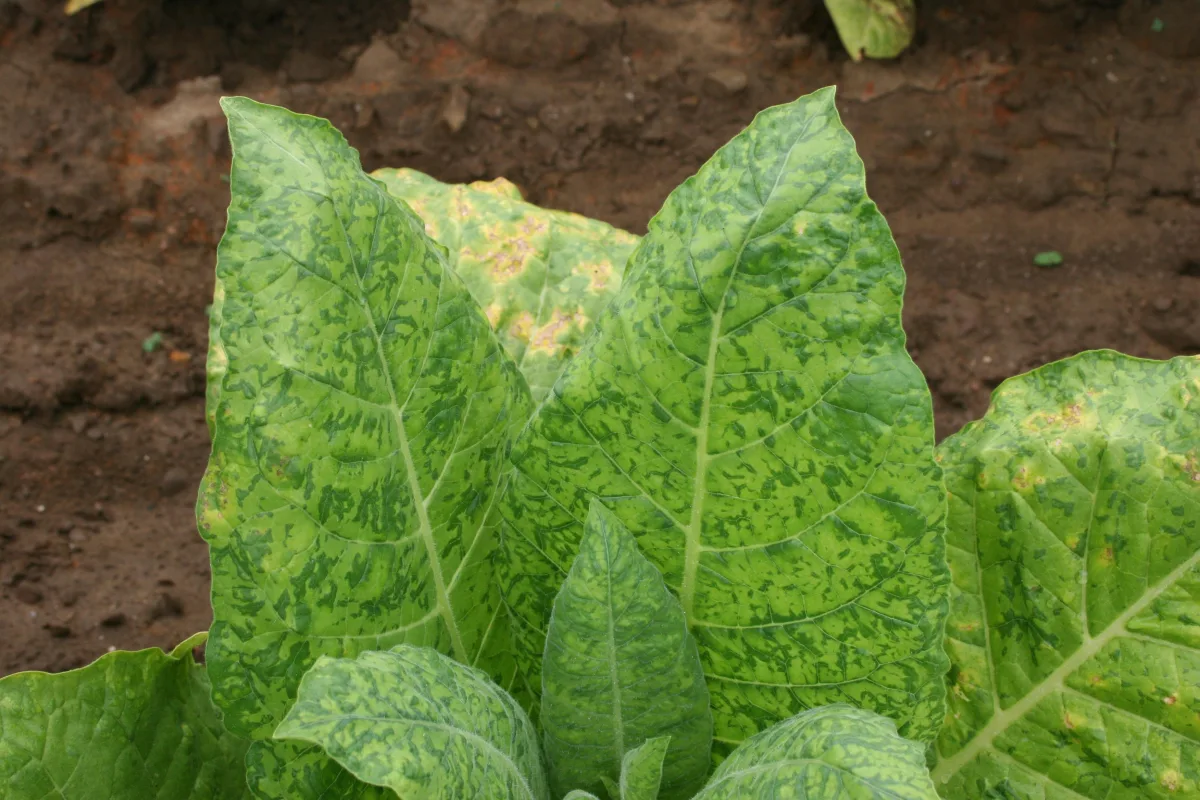
Mosaic — uneven green coloration of the leaf blade or the presence of yellowish or light green spots. The spots are scattered
TABLE 2. DIFFERENCES IN THE MANIFESTATION OF VIRAL DISEASES ON CERTAIN CROPS (according to WILLEMSON, AGUR, 1999).
Plant species Signs of viral infection (cultivar) - Tomato aspermy Cucumber mosaic virus Potato Cucumber chlorotic spots mosaic, mosaic, growth inhibition | growth inhibition Pumpkin m chlorotic chlorotic yellow spots (Almond) spots spots oo Soybean leaf loss, Pepper (Podarok mosaic, mosaic, fruit, growth Moldovy) growth inhibition | growth inhibition inhibition mosaic, leaf deformation mosaic, Tomato mosaic, chlorosis - growth inhibition growth, plant death randomly or form a specific pattern. There are several varieties of mosaic, differing in color, arrangement of spots, or pattern: a) common mosaic — light green spots, clearly defined or diffuse, randomly alternating with normally colored areas. Examples: tomato mosaic virus, cucumber common mosaic. b) interveinal mosaic — light areas are located mainly between veins, while leaf tissues adjacent to the veins remain green (examples: arabis mosaic on cucumber, strawberry mosaic); c) veinal mosaic (net mosaic) — lightening or yellowing is observed along the veins, causing a light or yellow net to appear on the leaf; d) yellow mosaic — bright yellow spots, located randomly, in most cases bounded by veins (example: aucuba — mosaic of Solanaceae). Fig. 20. MOSAIC ON A ZUCCHINI LEAF. e) marble mosaic — light green or yellow stripes and arcs, sometimes crossing leaf veins (examples: tobacco rattle virus on tobacco); f) ring mosaic — light yellow rings or closed linear patterns, sometimes with a necrotic border (examples: tomato ring spotting, strawberry ring spotting); g) stripe mosaic — longitudinal light green or yellow stripes or chains of small spots on the leaves of some liliaceous plants (example: lily mosaic).: Fig. 21. VEINAL MOSAIC ON PEPPER LEAVES. m: h “7.: | B. - ii | 2 to 3 d: 3 IA: 1 “, gi } S 2. Chlorosis -- general or symmetrical yellowing of leaf tissues. The most common varieties of chlorosis are: a) general chlorosis — yellowish coloration of the entire leaf blade, veins do not stand out; b) marginal chlorosis — yellowing of leaf margins (example: strawberry marginal chlorosis); c) apical chlorosis — yellowing of only the upper leaves (example: alfalfa mosaic virus on tomato). 3. Necrosis — death of plant tissues, often a consequence of mosaic or chlorosis when they are severe, but it often develops independently: a) local necrosis — forms at the sites of infection entry in a plant that has hypersensitivity to a given pathogen. Under natural conditions, such necroses are observed at the sites of punctures by the stylets of viruliferous insects; under artificial infection, as a result of juice inoculation by rubbing; b) systemic (scattered) necrosis — can manifest on any parts and organs of the plant in the form of brown, brownish-black or black spots, stripes, dashes, and rings. Varieties of systemic necrosis include: engraving, necrotic veinal banding, and blackening of veins on the underside of the leaf (example: streak of Solanaceae), apical necrosis — death of the tips of shoots or axillary buds (example: tomato tip necrosis when infected with alfalfa mosaic virus). Fig. 23. RING NECROSIS OF TOMATO FRUIT INFECTED WITH TOMATO SPOTTED WILT VIRUS $ y l Fig. 24. ENGRAVING OF TOMATO LEAVES - 4. Deformations of plant organs are very diverse and can be caused by various physiological disorders that lead to changes in the morphology of individual organs or the entire plant. Most often, the growth rate of different parts of the plant turns out to be uncoordinated, and as a result, wrinkling, folding, curling, blister-like swellings of leaves, and bending of shoots in general develop. 5. Growth inhibition can manifest as general stunting of plants, shortening of internodes at the shoot tip, and inhibition of the growth of main stems with increased growth of lateral shoots (example: tomato aspermy). 6. Wilting is observed with severe damage to the vascular system. Example: complex tomato streak. 7. Proliferation — The direct causes of proliferation can be the disturbance of the dormancy of axillary and overwintering buds or the degeneration and vegetative growth of generative organs (cucumber proliferation, etc.). A concomitant sign of proliferation is often the thread-like appearance of stems and sprouts. 8. Neoplasms — tumors on various parts of the plant (proliferation of lettuce veins), leaf-like outgrowths — enations (example: deforming tomato aspermy). 9. Abortiveness — dropping of flowers and fruit set, drying out of set fruits or individual seeds in the fruit (bean mosaic), seedlessness of fruits (tomato aspermy). and No» _ Fig. 26. WILTING OF THE TOMATO TIP INFECTED WITH COMPLEX STREAK ” t #2 with |. to $ „ Ma x%, chi ^ u E “ sk K E > , 2 - G Ch o ”. ira k -.,. e. u i.% u s a Khx 7 in 35,, - 90». 3 4, u ‚ *.. Ra.* * - ^ G is =” 10. Anthocyanosis — purple, red-violet, or blue-violet coloration of leaves or their edges, veins, stems (example: tomato spotted wilt virus). 11. Flower breaking — uneven coloration or partial discoloration of petals Example: Tulip flower breaking. G a | Fig. 27. TULIP FLOWER BREAKING Uu\ \ « %0_ o The listed symptoms do not exhaust the entire diversity of manifestations of viral plant diseases; however, signs not described here, with few exceptions, can be attributed to one of the cited groups. In most cases, a combination of symptoms is present on an infected plant, changing with the development of the disease and the age of the host. For example, when a tomato is infected with tobacco mosaic virus, mosaic and leaf deformations appear first. Later, streak, fruit and ovary necrosis manifest, especially with a lack of light and against a background of low temperature. Such climatic conditions in the middle zone of Russia occur in March and in September-October. External symptoms of fruit damage are similar to those of late blight; however, necrosis of seeds is often noticeable inside the fruits, and the fruit consistency is woody. Fruits affected by late blight can crack, they are more watery in consistency, and a whitish mycelium coating is sometimes visible on their surface; seeds blacken very rarely. Therefore, signs of diseases must be studied in dynamics. In some cases, if abiotic environmental factors are favorable, symptoms do not appear at all on virus-infected plants, i.e., latent or asymptomatic infection occurs. › you and In Fig. 29. TOMATO FRUIT AFFECTED BY
Read next
Plant protection For agronomists
Diagnosis and prevention of rare viral diseases in greenhouse lettuce
Plant protection For agronomists
Diagnostics and prevention of viral diseases of sweet pepper in a greenhouse
Plant protection For agronomists