
Combating blossom-end rot and agrotechnical methods of plant protection for tomatoes
12 min read
Causes of blossom-end rot and risks of plant overloading
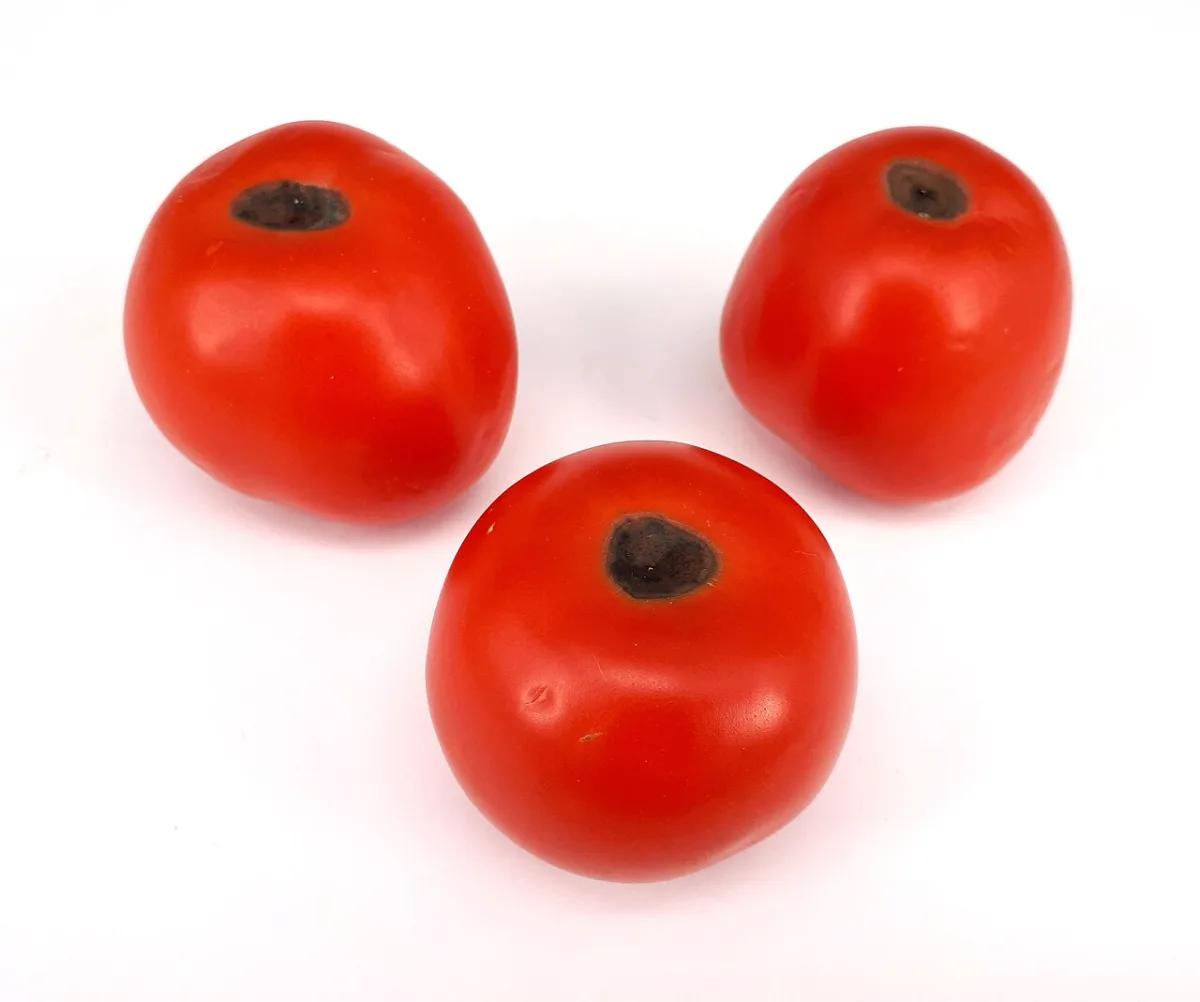
Blossom-end rot of tomatoes appears in the second half of summer. Unlike late blight, which requires cold nights and fog, this disease successfully develops even in favorable dry weather. The disease affects green fruits in the lower part (the botanical apex), where a characteristic flattened dry spot forms. The damage is often widespread: all fruits on a plant may be affected, and loss is observed en masse within a single cultivar or hybrid.
The physiological essence of the disease is the shedding of fruit set that the plant is unable to provide with building material. Blossom-end rot is traditionally associated with a potassium deficiency in the soil, which is particularly evident in poor sandy soils. However, fruit necrosis also occurs in clay soils with high potassium content if the plants are overloaded with the harvest or if a general nutrient imbalance has occurred in the tissues.
Overloading plants with harvest and dense planting due to irregular removal of side shoots are critical agrotechnical errors. They not only provoke blossom-end rot but also create favorable conditions for a late blight outbreak.
Affected fruits do not have time to ripen on the plant. The optimal solution upon detecting symptoms is to immediately harvest the damaged green tomatoes, trim off the affected areas, and use the raw material for processing or pickling. Most of these fruits are at the white stage of ripeness and are quite suitable for culinary use.
Prevention using agrotechnical methods and pest control
The basis of plant protection for tomatoes is the prevention of systemic stress and maintaining a balance of nutrients. To rule out diseases, it is sufficient to control the soil pH level according to the crop requirements, precisely dose top dressing, and avoid an excess of mineral nitrogen. Proper agrotechnics allows for the complete elimination of risks of plant infection with late blight, streak, sooty mold, and powdery mildew.
Pests are less selective about the state of the crop, although an excess of background nitrogen makes plantings more attractive for attack. On tomatoes and companion crops, damage is caused by May beetle larvae, mole crickets, Colorado potato beetles, weevils, caterpillars, and spider mites. Upon early detection, mechanical control methods show high effectiveness.
- Remove pests from the plants by hand.
- Set up traps and catch adult specimens.
- Suppress egg clutches directly on the leaves.
- Dig up and destroy nests or larvae in the soil.
In greenhouse conditions, the spider mite poses the greatest danger. In open ground, the pest does not multiply en masse due to exposure to direct sunlight and precipitation. In greenhouses, the mite primarily affects cucurbit crops (cucumbers, melons, watermelons) weakened by crowding and a deficit of irrigation water.
An outbreak usually begins from the lower tiers, which turn yellow due to lack of moisture. The mite, located on the underside of the leaves, quickly increases its population and covers the plant with webbing from bottom to top within a few days. To prevent the loss of plantings, it is important not to allow the soil to dry out and to perform sanitary pruning of lower leaves in a timely manner.
You will not be able to protect the greenhouse from the entry of the mite: even if you imagine total disinfection, you will still bring it in from the plot on your soles, or it will be brought in by the wind or insects. You just need to have a good understanding of the ongoing processes and not lead to the mass reproduction of this tiny pest. A slight yellowing of the lower leaves in adult plants is actually normal for any crop in the second half of summer and is not a cause for concern. Good irrigation ensures a stronger growth of fresh green foliage on the tops of shoots, maintaining a balance in favor of growth. However, it does not hurt to take a closer look. If you see that the plants are yellowing in earnest, more and more, and webbing is visible here and there on the stems and leaves — this is the spider mite, there is no one else. At this stage, it can be suppressed and driven away completely.
Yellowing leaves lose their ability to defend themselves, so if you ask the question of why the mite builds a web at all, the answer is obvious. It creates a web to suffocate the leaves and force them to yellow faster. And also, to facilitate its movement across the foliage.
Once that is the case, you need to immediately water everything with a sprinkler hose, both from the top and bottom, as thoroughly as possible. You do not need to worry that the water is cold.
In the height of summer, water running through pipes buried shallowly has a temperature of about 15 °C; this is completely safe for melons and watermelons, considering that the greenhouse will heat it up immediately.
Early, proactive daily inspection of foliage is the key to timely detection of such pests as spider mites and whiteflies. When all plants are massively infested, mechanically wiping all leaves with a sponge soaked in garlic infusion and crushing clusters of eggs on their undersides is already difficult and, frankly, does not make much sense. The vitality of the plants is severely undermined.
While performing any routine work in the greenhouse, always check for any issues with the leaf apparatus and look for causes of various damages. A greenhouse grower should have a keen eye for the safe drying of lower leaves and signs of pests.
When people say that "it is impossible to inspect all plants," I would like to say: you have only one watermelon or melon planted per square meter! While they are small, a preventive inspection during weeding takes seconds. One should be most attentive when inspecting the oldest and largest leaves.
It is useful to lightly apply top dressing to plants with compost slurry or poultry manure to stimulate the growth of fresh foliage. And then, continue to pressure the mite with regular irrigation, with a frequency depending on the crop:
| Eggplants and cucumbers | twice a day, morning and evening (the mite may persist for several days, then it will retreat anyway) |
| Melons and watermelons | once a day and quickly, just by wetting the foliage |
Whitefly. Early detection of this pest is possible by observing drying and curling lower leaves. This small white moth and its larvae hide under the underside of the leaf. The first generation is not numerous, and this is the time when it should be detected; afterwards, inspect all lower leaves and crush egg clutches and larvae.
It is the larvae that harm the plant by feeding on its sap and poisoning it. Sooty mold (a concomitant disease) settles on their sticky secretions. Overfeeding plants with nitrogen mineral fertilizer increases the outbreak of both.
Unlike the spider mite, the whitefly likes a humid environment. However, wiping the foliage with an infusion of garlic or dandelion (after crushing it) is also effective against it. I recommend applying heating of a tightly closed greenhouse in the sun during the peak of heat for about four hours; the insects die from the overheating of the air.
Conclusion: while plants are in favorable conditions, their growth is so great that pests cannot keep up with them. This is what preventive defense is built on. Do not allow pests to multiply with such force that their numbers are sufficient to suppress the plants and take over the growing foliage.
A few of any pest is normal and not dangerous. It is not a reason to disinfect and kill everything living in the greenhouse. For example, if you suddenly see a few Colorado potato beetles on eggplants (which have made their way from potato furrows), it is easier to pick them off and crush them than to perform general treatment with a preparation.
- The soil should be dry and clean from any pots, boxes, and other possible shelters.
- Crowding and weeds interfere with plant monitoring; they largely contribute to the hidden spread of whitefly.
- The second and third generations, with pauses of a few weeks, become increasingly numerous; this is already an obvious project failure.
Let's look at some other, significantly less dangerous inhabitants of every greenhouse. Some consider them pests, although with proper agricultural practices they do not pose any significant threat.
Slugs and snails. We constantly emphasize the need to adhere to classic greenhouse agricultural practices:
- avoid overcrowding;
- plant crops with enough space;
- remove weeds down to the last blade of grass;
- loosen the soil while doing so;
- regulate irrigation and soil drying.
Snails do not favor such conditions and crawl away. It is dry, there is no feed in the form of grass, and there is nowhere to hide…
Conversely, when you have created a "snail paradise" in the greenhouse (wet soil and stagnant humid air, a dump of various old building materials, or even the walls covered with a film of green algae due to dampness), they multiply and swarm there.
When maintaining proper agricultural practices, it remains for us to occasionally place traps near plants at night in the form of a plastic garbage bag, just in case, to collect any remaining surviving snails under them in the morning. And that's it, the problem is solved.
A slug can only pose a threat to a very young seedling at the cotyledon stage. A single snail cannot do anything to an adult greenhouse plant. Judge for yourself: where would it climb daily from its daytime shelter in the soil up a rough stem to the ceiling? It’s not a strawberry lying directly on the ground where snails eat out caves…
To be fair, it must be said that gardeners sometimes attribute too much to snails. Suppose a red pepper on a plant has rotted for some reason (a snail won't just chew on an unripe pod, but it will crawl onto a rotting one as if it were its rightful food), so the owner finds it inside the pod and decides that it caused the rot. This is how myths about the dangerous pest — the snail — are born.
Ants. I consider ants in this chapter conditionally, only because many people consider them pests. Actually, they are not pests at all, although they settle everywhere in greenhouses and feel like they own the place. They cause no harm.
On the contrary, I have noticed with the "tomatoes in bags" method that in the bags where an anthill has established itself (the black film heats up in the sun, which they like), the plants fruit more abundantly. Moreover, the anthills here become permanent.
At first, I started fighting them by heating the greenhouse in the sun, but then I decided to compare the fruiting of the tomato plants with ants to all the others. After that, I began to only welcome the appearance of ants! Moreover, they significantly facilitate irrigation: water passes through their tunnels directly to the bottom of the bag, and there is no need to wait for it to gradually soak in from the surface.
Toads. Here is another unfairly maligned creature! They are by no means pests. Different toads like to settle in greenhouses; sometimes several of them live there, especially in the first half of the summer, after last year's pair has bred and young toads are encountered everywhere.
These are nocturnal animals; at night they explore every corner of the greenhouse in search of food, and they check everything; there is no place to hide from them there. Thanks to their acrobatic agility, they can climb plants and greenhouse equipment. During the day, toads hide under boards or in loose soil; they like to burrow into sand. With their large mouths, they are capable of eating almost any creature that enters the greenhouse: flies, all sorts of beetles, snails of any size, ants, and moths, including, probably, whitefly adults. The quantity of consumed victims can be judged by the large droppings found everywhere in the morning.
By the way, they actually actively feed on ants: for example, I observed how, during a massive flight, three or more toads were constantly grazing near an anthill.
I also had such an incident. Sorrel was growing in the greenhouse, and I noticed that someone was actively chewing on it, and apparently, it was a caterpillar as thick as a pencil. I decided to catch it early in the morning, as I usually do with caterpillars when they are still feeding before heading down for their daytime rest. And I witnessed the following scene: on the top leaf, among scatters of caterpillar excrement, lay a large toad dropping. I never saw the caterpillar again, and its chew marks were also gone... This means the toad heard it and climbed up.
Toads are more likely to settle in your greenhouse if you grow plants in spacious containers, barrels, or if there are other shelters available.
Toads are the guards of the greenhouse. While a frog swims and jumps better, a toad climbs better and enters various cracks. Children are taught in school that frogs and toads are beneficial, but gardeners tend to attribute various gardening crimes to them as well. Where did the yellow melon go? — a toad must have eaten it, no doubt!
Let us draw a general conclusion for the chapter on diseases and pests. In vegetable growing, one must know how to lose sometimes, so as to get by with minimal damage (without the use of "chemicals") and learn lessons, learning from mistakes.
The key to victory consists of the following factors:
- Selection of resistant cultivars.
- Comprehensive agricultural practices (and not just fertilizing, while economizing on irrigation and not removing weeds).
In gardening, it is not difficult at all to become a consistent winner over time. I observe this all the time: how people, merely by gaining a little experience, begin to confidently obtain harvests of vegetables. If you managed to prevent diseases and pest outbreaks, this is our regular annual victory. If you failed somewhere, with a specific crop, it is a rare defeat.
Read next
Greenhouses and covers For gardeners
Integrated sanitary preparation and disinfection of greenhouse structures
Soil and tillage For students
Influence of soil structure and composition on capillary moisture transfer
Soil and tillage For students