
Stages of organogenesis and patterns of cereal crop development
19 min read
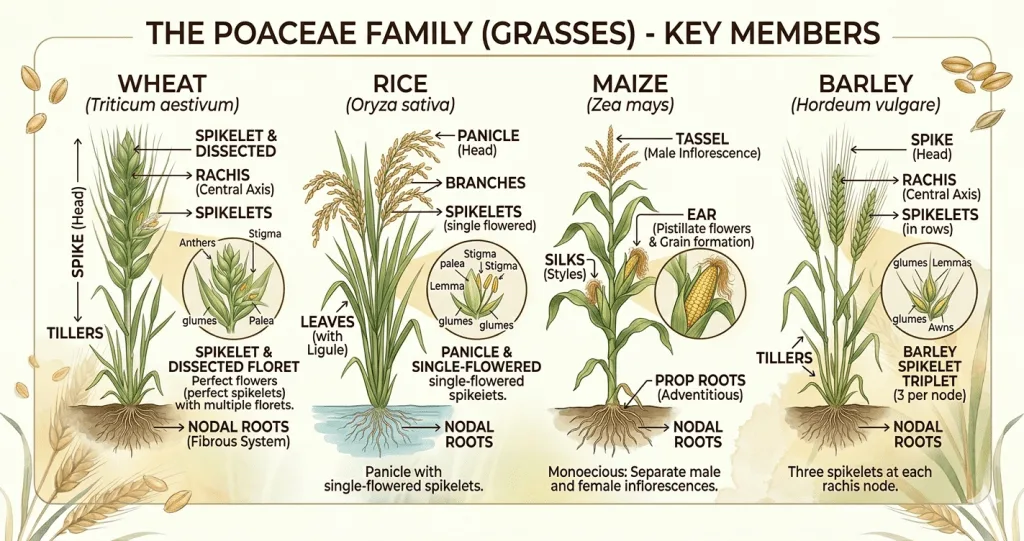
Stages of organogenesis and development phases of cereal crops
Plant development is a continuous process of qualitative changes passing through specific stages. Each species and cultivar utilizes environmental conditions differently and shapes productivity according to hereditary patterns. To monitor the state of crops and plan treatments, an agronomist must clearly record the onset of phenological phases. Each phase reflects profound internal reorganizations of the organism and is directly linked to the stages of organogenesis.
It is standard to distinguish 6 main phenological phases in the cereal development cycle. These include emergence, tillering, stem elongation, heading, flowering, as well as seed formation and maturation. The latter phase is further divided into 3 ripening periods: milk, dough, and full ripeness. At the same time, grain filling biologically corresponds exactly to the milk ripeness stage.
- Number of phenophases for cereals — 6
- Number of organogenesis stages — 12
- Onset of a phenophase — 10 % of plants
- Full phenophase — 75 % of plants
- Optimal swelling temperature — 10—21 °С
For practical recording of development phases, clear quantitative thresholds have been established. The beginning of a phase is considered the moment when at least 10 % of the plants in the field have entered it. A full phase is recorded when the corresponding trait is observed in 75 % of the plants. The six described phenophases pass sequentially through 12 biological stages of organogenesis.
- Differentiation and growth of embryonic organs.
- Differentiation of the cone base into primordial nodes, internodes, and stem leaves.
- Differentiation of the main axis of the primordial inflorescence.
- Formation of the second-order growth cone (spikelet primordia).
- Formation of floral envelope organs, stamens, and pistils.
- Formation of inflorescence and flower (micro-, macrosporogenesis).
- Gametophytogenesis, growth of envelope organs, elongation of rachis segments.
- Gametogenesis, completion of the formation processes of all inflorescence and flower organs.
- Fertilization and zygote formation.
- Growth and formation of the caryopsis.
- Accumulation of nutrients in the caryopsis (seed).
- Conversion of nutrients into storage substances in the caryopsis (seed).
Physiology of germination and moisture requirements
Any wheat caryopsis has a complex anatomical structure that determines its viability. It includes fruit coats (1 and 2), seed coats (3 and 4), the aleurone layer of the endosperm (5), the scutellum (6), and the plumule (7). The central part of the embryo (8) is surrounded by primordial roots (9), endosperm (10), and the coleoptile (11). All embryonic structures consist mainly of active meristematic cells.
Seed germination is always preceded by their swelling, which requires a strictly defined volume of water. The demand for moisture directly depends on the seed size, their chemical composition, and the presence of husks. Legumes require the largest volume of water for swelling, exceeding their own weight. Husked grains absorb moisture significantly slower than naked grains.
| Crop | Water requirement for swelling, % of seed weight |
|---|---|
| Rye | 55—65 |
| Wheat | 47—48 |
| Barley | 48—57 |
| Oats | 60—75 |
| Corn | 37—44 |
| Millet and sorghum | 25—38 |
| Grain legumes | 100—125 |
During swelling, enzymes are activated in the seed, converting starch, proteins, and fats into soluble compounds. They are transported through the scutellum into the embryo, providing it with nutrition for the transition to growth. Endosperm protein breaks down into amino acids with the release of a small amount of asparagine and glutamine. These nitrogenous substances react with carbohydrate breakdown products and trigger the synthesis of new proteins in the growing tissues of the embryo.
The favorable temperature for seed swelling is 10—21 °С. Sowing in soil with a high salt concentration is strictly undesirable, as this severely delays the processes of swelling and subsequent germination.
Mealy wheat grain and small seeds absorb moisture faster than vitreous and large grain. To obtain uniform and even seedlings, be sure to use well-calibrated seed material.
Emergence becomes the first visible phase of plant growth and development in the field. Under the influence of moisture, oxygen, and heat, the embryonic roots are the first to start growing, followed by the stem shoot. In naked grains, the shoot breaks through the coat near the scutellum, while in husked grains, it passes under the floral glume and emerges at the apex of the grain. On the way to the soil surface, the young shoot is reliably protected by a thin transparent sheath — the coleoptile.
From emergence to the tillering phase
The viability of cereal crops is determined at the earliest stages of development. The growth of the young stem and the first leaf in the soil is supported by the coleoptile — a modified primary leaf that protects the seedling from mechanical damage. As soon as the stem emerges to the surface, sunlight stops the growth of the coleoptile; it ruptures, and the first true leaf comes out. It is important for the agronomist to accurately record the development phases of the field to plan subsequent treatments and assess the field emergence of seeds.
- Beginning of emergence — 10% of emerged plants
- Full emergence — 75% of emerged plants
- Tillering node depth — 2–3 cm
Immediately after emergence, plants begin to tiller, forming lateral shoots and adventitious roots from underground stem nodes. The primary role in this process is played by the tillering node, which is usually formed at a depth of 2–3 cm. Light directly regulates its placement depth: in low-light conditions, the node forms closer to the soil surface. A deep tillering node increases the lodging resistance of cereal crops, and winter crops tolerate low winter-spring temperatures better as a result. Durum wheat cultivars form the tillering node deeper than common wheat.
The tillering node is the main life center of a grass, where the primordia of all future organs and nutrient reserves are concentrated. Any damage to it leads to a sharp weakening of growth or the complete death of the plant.
Root system development and tillering structure
Parallel to the development of lateral shoots, a secondary (nodal) root system is formed, which is concentrated in the topsoil. Roots account for only 20–30% of the total dry matter mass in cereals. Among winter crops, rye and triticale form the most developed root system, while oats do so among spring crops. Tall crops such as corn and sorghum produce powerful aerial (brace) roots longer than 100–120 cm, but even in their case, 75 to 95% of the root mass is concentrated in the tilled, aerated layer at a depth of 15–25 cm.
Tillering intensity depends on the sowing date, humidity, temperature, and the species and cultivar of the crop. In timely sown winter rye, this process occurs mainly in the autumn, whereas winter wheat and triticale actively tiller both in the autumn and in the spring. With favorable humidity and optimal temperature, the tillering period is prolonged, increasing the number of shoots per plant. However, to obtain the maximum harvest per unit area, the optimal density of the productive stand is more important than excessive tillering of individual plants.
| Crop | Number of productive stems per plant under normal conditions, pcs. |
|---|---|
| Winter cereals | 3–6 |
| Barley and oats | 2–3 |
| Spring wheat | 1–2 |
In crop production practice, total tillering (total number of shoots per plant) is distinguished from productive tillering (number of heading stems). Shoots that have formed inflorescences but have not managed to form full-fledged grain by the time of harvesting are called secondary growth ("podgon"). Shoots that have not formed inflorescences at all are called non-heading tillers ("podsed"). Both of these groups do not participate in forming the harvest but consume the plant's resources.
A leaf consists of a blade and a sheath; at the point where they meet, there is a thin membrane called the ligule (with thin, membranous, crescent-shaped side auricles). This ligule and the auricles fit tightly against the stem, preventing water and pathogens from penetrating inside the leaf sheath. Based on the purpose and shape of the ligule and auricles, cereal grasses can be identified at a young age, i.e., even before the inflorescences emerge. For example, in barley, the ligule is short, and the auricles are very long, overlapping each other and wrapping around the stem. In oats, the ligule is long and well-developed, while auricles are completely absent. In wheat, rye, and barley, the ligule is short, and the auricles are small but clearly defined, with cilia (in rye without cilia, and in barley they are longer and without cilia). The number of leaves in some plants serves as a good indicator of their earliness. For example, early-maturing northern corn cultivars develop 10-11 leaves, mid-maturing ones 14-15, and in late-maturing southern cultivars, the number of leaves on the main stem reaches 18–20 and even 23–25 (Georgian cultivars).
Cereal leaves are linear and narrow (in wheat, rye, triticale, oats, rice), medium (in barley), or wide (in corn, sorghum, millet). The size and number of leaves vary quite significantly depending on the crop, cultivar, and growing conditions. One distinguishes embryonic, rosette (basal), stem leaves, and the flag leaf. The upper (flag) leaf ensures the formation and filling of the grain. Leaves of the middle tiers determine the grain density of the ear (panicle) and the creation of nutrient reserves in the stem. The lower stem leaves and basal leaves ensure rooting and stem growth during tillering.
The stem of cereal crops, known as a culm—hollow or filled with parenchyma—consists of 5–7 internodes separated by nodes (partitions). In late-maturing corn cultivars, the number of internodes increases, sometimes reaching 20–25. Stem growth occurs as a result of the elongation of all internodes — this is called intercalary growth. The lower internode begins to grow first, followed by the subsequent ones, which outpace it in growth. Each internode grows from its lower part. The stem grows most intensively during the jointing phase (when the ear is located in the upper part of the stem tube) and the heading phase (when the ear emerges from the sheath of the upper leaf), reaching its maximum length during the flowering phase, after which stem growth slows down sharply and stops completely by the beginning of grain filling.
The stem of cereal crops is capable of tillering, forming secondary roots and lateral stem shoots from the lower underground nodes.
The strength of the stem depends on the condition of the mechanical tissue, especially in the lower internode: the thicker and stronger the lower internode, the higher the resistance of the plants to lodging. Internodes usually have the greatest thickness in the middle part of the stem and the smallest in the lower and upper parts. Such a structure of the stem does not ensure its resistance to strong pressures from wind, rain, hail, etc. elements.
Heading (earing) is characterized by the appearance of the inflorescence from the sheath of the upper leaf, called the flag leaf: first on the main shoot, and 2—3 days later — on the lateral ones.
The inflorescence in cereal crops is of two types:
- compound spike — in wheat, rye, barley;
- spreading spike (panicle) (fig. 7, B, V, G) — in foxtail millet, oats, proso millet, rice, sorghum.
In maize, two inflorescences are formed on one plant: at the top of the stem — a panicle with male flowers, and in the leaf axils — ears with female flowers; often 2-3 ears are formed at one point on the stem.
A panicle has a central axis with nodes and internodes. Lateral branches are formed in the nodes, which, in turn, can branch and thus create branches of the first, second, third order, etc. At the ends of each branch sits one single- or multi-flowered spikelet.
A spike consists of a jointed spike rachis (a continuation of the stem) and spikelets located on its notches (alternately on both sides). On each notch of the spike rachis in wheat, rye, and triticale, there is one spikelet consisting of two glumes and two or more flowers.
In barley, three identical spikelets sit on each notch of the spike rachis. In multi-row barleys, grain is formed in each of the three spikelets; in two-row barleys, only in the middle spikelet, while the two lateral spikelets are reduced (underdeveloped). The wide side of the rachis is called the face, and the narrow one is the side.
Organogenesis, phenophases, and stages of ontogenesis 61
Fig. 7. Inflorescences (infructescences) of cultivated grasses: A — spike of emmer wheat; B — spike-like panicle (sultan) of foxtail millet; V — dense panicle of sorghum; G — loose panicle of oats; D — maize ear (in the husk)
Glumes can have different degrees of development:
- in wheat, they are wide, multi-nerved, with a longitudinal keel;
- in rye — very narrow, single-nerved;
- in barley — narrow, almost linear;
- in oats — wide, with many convex longitudinal nerves;
- in triticale — narrower than in wheat, multi-nerved, with a keel.
In awned forms, the lemma ends in an awn, while the palea does not.
The flower consists of two floral scales: the outer (lower) lemma and the inner (upper) palea. In awned forms, the lemma ends in an awn (fig. 8, 1 and 2). Between the floral scales are the generative organs: the female pistil with a superior ovary and a two-lobed feathery stigma, and three male stamens with two-celled anthers containing pollen inside (rice has six stamens).
Flowering and pollination: pollination characteristics and timing of phase progression
The process of flower opening in grasses is triggered by the swelling of two delicate scales (lodicules) located at the base between the floral scales and the ovary. Multi-flowered spikelets are formed in oats, whereas in proso millet, rice, and sorghum, they are single-flowered. Flowering begins directly during heading (earing) or shortly thereafter.
The timing of the onset of flowering varies significantly depending on the crop:
| Crop | Time of flowering onset relative to heading |
|---|---|
| Barley | Before full heading |
| Wheat | After 2—3 days |
| Rye | After 8—10 days |
| Triticale | After 7—12 days |
By the method of pollination, cereal crops are divided into two groups:
- Self-pollinating: wheat, barley, triticale, oats, proso millet, rice. They are pollinated primarily by their own pollen while the flowers are closed.
- Cross-pollinating: rye, buckwheat, maize, sorghum.
The direction of flowering also depends on the type of inflorescence. In spike crops (wheat, rye, triticale, barley), this process begins from the middle part of the spike. In paniculate crops (oats, proso millet, sorghum), flowering proceeds from top to bottom — from the upper part of the panicle.
Grain filling and ripening: phases of dry matter accumulation
The first part of the fruit formation stage — milk stage (filling) — includes two consecutive periods: seed formation and seed development.
- Seed formation lasts 7—9 days from the moment of fertilization until the appearance of the upper and lower growth points in the embryo. At this moment, the seed is capable of producing only a weak sprout. The weight of 1000 seeds is about 1 g.
- Seed development takes 5—8 days. The caryopsis length reaches its final size, and embryo differentiation is completed. The endosperm content changes from watery to milky; starch grains appear in it, and the seed coat turns green. The moisture content of the grain at this stage is 65—80 %, and the weight of 1000 seeds reaches 8—12 g.
The actual grain filling — the period of active starch accumulation in the endosperm — continues until this process ceases. Soil moisture content in the grain decreases to 37—40 %, and the filling itself lasts on average 20—25 days, passing through four phases:
- Watery stage (6 days): endosperm cell formation begins, dry matter accounts for only 2—3 % of the maximum.
- Pre-milk phase (6—7 days): the seed content is watery with a milky tint, the share of dry matter increases to 10 %.
- Milk stage (7—15 days): the grain is filled with a milky white liquid, 50 % of the dry matter of a mature seed's mass has been accumulated.
- Dough stage (4—5 days): the endosperm acquires a doughy consistency, the dry matter content reaches 85—90 % of the maximum.
- Mass of 1000 seeds at formation — ~ 1 g
- Mass of 1000 seeds at development — ~ 8—12 g
- Decrease in moisture during grain filling — to 37—40 %
- Duration of the grain filling period — 20—25 days
The seed ripening phase begins when the influx of plastic substances ceases. It is divided into periods of waxy and hard maturity, each of which lasts from 3 to 6 days.
In the waxy maturity phase, when grain moisture is 30 %, two-phase (separate) harvesting begins. Direct combining is carried out strictly in the hard maturity phase, when the endosperm becomes elastic and firm, moisture content is 30 %, and the yellow-brown color of the husk becomes brighter.
During the post-harvest ripening period, which can last from several days to several months, protein synthesis is completed in the grain, free fatty acids are converted into fats, carbohydrates increase in size, and respiration slows down. Seed germination at the beginning of this process is low, but reaches normal values by the end.
Remember that growth (quantitative increase in mass and volume) and development (qualitative changes in cells and organs) are closely linked, but their rates do not always coincide. In field conditions, one can observe both rapid growth with slow development and vice versa.
The speed at which each developmental stage progresses depends on the state of the plant itself and the volume of available external resources. At the same time, qualitative changes in the growing points proceed strictly sequentially and irreversibly. These processes are transmitted only to new dividing cells and do not spread to adjacent, previously formed tissues. Because of this, different parts of the stem may be at different stages: the tissues of the lower part are usually younger than the apical ones. Developmental stages proceed from old cells to young ones, forming the basis for such properties as winter-hardiness, frost resistance, and drought tolerance.
Vernalization and light stage: managing plant development
In the ontogenesis of cereal crops, two stages play a key role — vernalization and the light stage. During their progression, reproductive organs are initiated and the qualitative traits of the future harvest are determined. Without the successful completion of the vernalization stage, the plant is unable to normally pass the light (vegetative) phase of development and begin fruiting.
If winter crops do not pass the vernalization stage under the influence of low positive temperatures, they will not be able to complete vegetative development, form reproductive organs, and produce grain.
The physiological targets for the temperature factor are enzymes, the nuclei of dividing cells in apical meristems, as well as histone and acidic chromatin proteins. Under the influence of cold, biochemical changes are triggered within them, which are then transmitted to subsequent generations of cells. In agronomic practice, this process can be simulated artificially even before seed sowing.
- Slightly moisten the seed.
- Bring them to swelling and the beginning of germination.
- Place the germinating material in a refrigeration chamber to expose it to low temperatures.
- Seed vernalization temperature — 0–7 °C
- Cooling period for winter crop seed — 1–2 weeks
After completing vernalization, plants require proper lighting, its periodicity, and the sum of active positive temperatures. Light and heat help crops switch their behavior from winter type to typical spring type. As a result of normally passing both stages, cereals develop full-fledged reproductive organs, in which seeds are formed after pollination.
In general, growth, development, and total crop yield are determined by two groups of factors. Cosmic factors act directly on plants, providing them with light and heat. Terrestrial factors — water and nutrients — manifest their effect indirectly, primarily through the soil.
| Factor group | Environmental factors |
|---|---|
| Cosmic | Light, heat |
| Terrestrial | Water and nutrients |
Read next
Agrochemistry For students
Specifics of mineral nutrition and fertilizer application system for winter wheat
Crop production For students
Classification and economic importance of cereals and grain legumes
Vegetable growing For students