
Technologies for growing grape nursery plants with a ready-made high trunk
18 min read
Technologies for producing nursery plants with a ready-made trunk
Converting vineyards to a high-trunk cultivation system with wide row spacing requires high-quality nursery plants. Using plants with an already formed trunk allows for accelerating the onset of fruiting and facilitates plant care in non-covering zones. In practice, four technological solutions are used to grow such material.
- The ratio of peat, soil, and sand in the substrate — 2:1:1 or 1:1:1
- Diameter of the upper cross-section of long cuttings — at least 7 mm
- Soaking time for nursery plants before storage — 2 days
- Height of the temporary trellis in the second method — 1.7 m
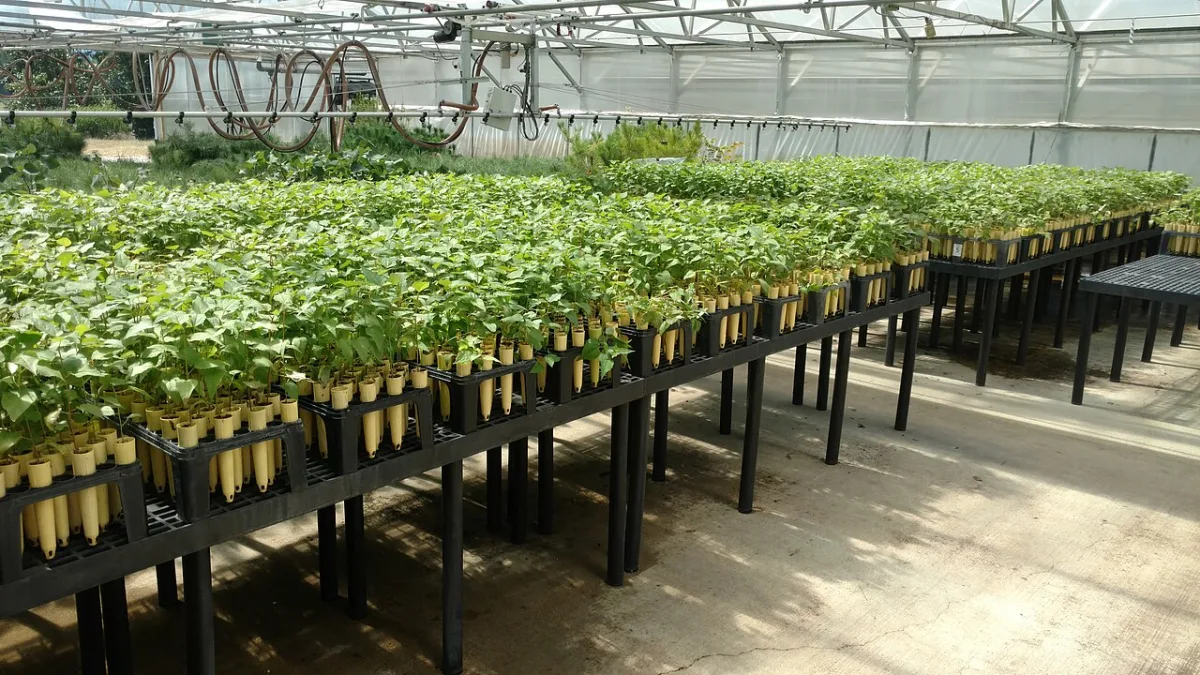
The first method allows obtaining ready-made nursery plants in one growing season in protected ground. Prepared cuttings are planted in special greenhouses or hotbeds, where optimal nutrition and soil moisture regimes are maintained. The formation of the trunk follows a clear schedule.
- In January–March, plant callused non-grafted or stratified grafted cuttings into greenhouses or hotbeds with nutrient substrate.
- Leave one shoot on the growing plant and regularly remove all emerging lateral shoots.
- In late June – early July, pinch the shoot 15–20 cm above the established trunk height to stimulate the growth of upper lateral shoots from early-ripening and overwintering buds.
- In October–November, dig up the ready-made nursery plants, thoroughly remove all buds from the trunk, and prune the shoots that developed above it, leaving two to three buds on each.
- Paraffin the above-ground part of the plants, tie them into bundles, and send them for winter storage.
The second method is based on growing nursery plants in an open-ground nursery for two years. This method requires more time but allows for obtaining well-hardened plants for commercial vineyards. The technology includes several consecutive stages.
- Plant non-grafted or grafted cuttings in the nursery and grow them using standard technology during the first year.
- In the second year, during disbudding, leave one most developed shoot and tie it vertically to a temporary trellis 1.7 m high.
- Regularly remove lateral shoots along the entire length of the forming trunk, and perform pinching when it reaches the target height.
- In autumn, dismantle the trellis, dig up the nursery plants mechanically, remove the buds on the trunk, and shorten the upper shoots to two or three buds.
- Soak the finished material for two days in water, paraffin it, and put it into storage.
The third method involves using long cuttings. Their length is calculated in advance by adding the planting depth at the permanent location and the planned trunk height. For own-rooted crops, cuttings are pre-callused, and when growing grafted material, single-bud scion cuttings are grafted onto long rootstocks, followed by stratification and hardening. Nursery plants are grown for one year in open or protected ground using standard technology.
The fourth method is focused exclusively on growing grafted nursery plants over two years. The technology is based on performing green grafting using simple whip grafting or chip budding methods. The work is carried out either on pre-rooted rootstocks in greenhouses or nurseries, or directly on growing shoots of rootstock cultivar mother vines.
When preparing trunk-based nursery plants for storage, be sure to thoroughly remove the buds along the entire length of the trunk. This will prevent the development of unwanted shoots after planting the grapes in a permanent location.
Prevention of viral and bacterial diseases
The widespread occurrence of chronic grape infections causes serious damage to the industry. The most harmful viral diseases are rugose wood complex, leafroll, fanleaf, and infectious chlorosis. Among bacterial pathogens, crown gall and bacterial necrosis pose the greatest danger. Diseased vines gradually degenerate, reduce yield and berry quality, and provide a low output of grafted nursery plants.
Viral diseases are dangerous because they are incurable: the plant remains infected for its entire life, and the infection is present in all its organs. Viruses are transmitted during vegetative propagation and transport of material, and in field conditions, they are transferred from diseased to healthy vines through the soil by nematodes. In this regard, American grape species used as rootstocks suffer more from viruses than European Vitis vinifera cultivars.
The only reliable way to combat chronic infections remains phytosanitary selection. In nursery production, strict clonal selection is conducted to identify virus-free mother plants. The selected healthy material is multiplied under laboratory conditions on nutrient media. Purity control of the nursery plants is based on a system of consecutive, interrelated stages of clone testing, which guarantees the production of completely virus-free and bacteria-free planting material.
Production of pathogen-tested nursery plants
High-trunk grapevine cultivation requires an impeccable phytosanitary condition of the vine. Any chronic diseases reduce the longevity of plantings and negate the costs of trunk formation. Before propagation, clones are visually inspected for bacterial blight and then tested for viruses using herbaceous indicators. Pathogen-tested material is grown strictly according to the hierarchy: from super-super-elite (SSE) to super-elite (SE), and then to certified elite.
Special attention is paid to the cleanliness of the soil, as viruses are transmitted by nematodes living in it. The roots of uprooted diseased grapevines remain alive in the soil for another 5–6 years, serving as a food source and a reservoir of infection for pests. To clean the site, the soil is left to rest from grapevines or treated chemically.
Application of a liquid 50% technical DD nematicide reduces the required soil rest period by 2–3 times. The preparation is applied strictly 30 days before planting.
- Application rate of DD nematicide — 2000 l/ha
- Depth of incorporation of the preparation — 15 cm
- Temperature during thermotherapy — 38–40 °C
- Humidity in the thermochamber — 50–70%
- Light intensity during warming — at least 2500 lx/m²
For each stage of propagation of pathogen-tested material, there are specific requirements for spatial isolation and crop rotation. Original SSE mother vines are grown in greenhouses, inspected annually in spring, summer, and autumn, and re-tested for infection every 5–6 years. Super-elite nursery plants are propagated in specialized farms with mandatory triple inspection every year. Certified elite is planted on plots following strictly defined predecessors.
| Nursery plant category | Soil rest period from grapevine | Mandatory predecessors |
|---|---|---|
| Super-super-elite (SSE) | at least 7 years | any crops, except grapevine |
| Super-elite (SE) | at least 12 years | any crops, except grapevine |
| Certified elite | at least 7 years | grain crops |
Cultivars of scions and rootstocks, for which natural healthy clones could not be found, undergo forced sanitation. To do this, the thermotherapy method is used, which allows releasing apical buds from viral infection. The procedure is carried out according to a standard scheme:
- Plants are grown for a year in pots, and after winter dormancy, at the beginning of active growth, they are moved into thermochambers.
- Nursery plants are kept in the chambers for 2–6 months at a constant temperature, controlled humidity, and illumination.
- From the warmed shoots, 1 cm long tips are cut, rooted in pots, and grown in a greenhouse for a year.
- In the spring of the following year, the plants are transplanted into the field on nematode-free plots for subsequent testing.
- Healthy virus-free vines are propagated by green cuttings to establish super-elite mother blocks.
Designing and preparation for vineyard establishment
The productive period of a vineyard is at least 20–30 years. Any mistakes made during site selection, land surveying, or soil preparation cannot be corrected during the growing process. They will reduce the yield and profitability of the plantings throughout the entire period of operation. Therefore, design is carried out by specialized institutes under a contract with the farm.
The design brief is drawn up by the customer together with the specialists of the design organization based on the actual conditions of the farm.
The entire process of project creation is divided into consecutive stages that guarantee investment protection and the compliance of the plantings with agro-ecological standards:
- Preparation and delivery to the design institute of the brief for the general technical and economic feasibility study and the site development project.
- Conducting survey works: topographical, geological, and soil studies followed by the compilation of cartograms.
- Compiling a general scheme and a technical and economic feasibility study for the development of viticulture in the farm or district.
- Development of detailed designs for shelterbelts, hydraulic and anti-erosion structures, slope terracing, and planting.
- Staking out the completed project on-site with subsequent author supervision of the work progress.
In the process of this work, the fundamental feasibility and expediency of industrial grapevine culture in a specific farm are determined, as well as the specialization of the viticulture sector (cultivation of table, seedless, raisin, and wine cultivars), and methods of cultivation are established (cover — non-cover, irrigated — non-irrigated, own-rooted — grafted).
Taking into account the relief of the area, the land organization scheme for flat or sloping lands and the irrigation system are determined.
To solve these basic issues, appropriate criteria have been developed, the main of which are as follows.
The fundamental feasibility of industrial grapevine culture in certain ecological conditions is established primarily by the sum of active temperatures (as a rule, at least 2800–3000°C with a duration of the growing season of at least 150 days). In individual cases, for a group of ultra-early and early cultivars, as well as micro-zones for sparkling wine production, regions with a sum of active temperatures of 2500°C are allowed. To determine the sector specialization based on the sum of ecological factors indicated in Table 6, the direction of grapevine product utilization is established.
When deciding how to cultivate grapes — with or without covering the bushes for the winter, one should use the indicators provided in Table 7, taking into account the degree of frost resistance of the cultivars.
The first group of cultivars with high frost resistance (critical temperature 25°C) includes: Riesling Rhine, Sauvignon Vert, Traminer Rose, Terbash, Rkatsiteli, Saperavi, Pinot Noir, Cabernet Sauvignon; the second group of moderately resistant cultivars (critical temperature 22°C) includes: Aligoté, Bastardo Magarachskii, Sylvaner, Csaba Gyöngye, Rubinovyi Magaracha, Pinot Gris, Chasselas Blanc and Chasselas Rose, Albillo Krymskii, Cinsaut, etc.; the third group of weakly resistant cultivars 7. Indicators for determining covered and uncovered grape culture With a recurrence of critical temperatures no more than once every 10 years,
Resistance: 1 – 2 Highly resistant, Moderately resistant, Weakly resistant
« « 6. Agro-climatic indicators for the specialization of viticulture and processed products Sum of active temperatures above 10°C.
Table grapes, Wine grapes, Champagne wine materials, Table wines, Fortified and dessert wines, Cognac wine materials (critical temperature 20°C) — Agadai, Aleatico, Bayan Shirei, Kokur Belyi, Queen of the Vineyards, Muscat Blanc, Muscat of Alexandria, Chaush Belyi, Nimrang, Furmint.
However, when using the above-mentioned criteria for damaging temperatures, it should be borne in mind that these indicators characterize the upper threshold, calculated for the optimal condition of the plants, good shoot maturation, and the cultivation of bushes on a high trunk with wide row spacing. With such a technology, plants acquire increased frost resistance. In other cases, the threshold of permissible critical temperatures is reduced by 1–2°C.
The water supply of the zone where grape cultivation is planned is determined by evaluating indicators of the annual precipitation sum, taking into account the amount of precipitation during the growing season and the value of the hydrothermal coefficient, which more accurately characterizes the water supply of the zone since it also takes into account the sum of active temperatures. Tentatively, with a precipitation sum below 400–450 mm and their unfavorable distribution by seasons of the year, grape culture must be irrigated. Hydrothermal coefficient indicators are evaluated as follows: over-moistening — above 1.6, optimal water supply — 0.9–1.2, insufficient — below 0.6–0.7. If the coefficient is below 0.5, it is concluded that irrigated grape culture is necessary.
An equally important issue is determining the method of grape culture management: own-rooted or grafted.
The quarantine service has developed and approved regulations for each viticultural region, which must be strictly followed. Selecting a site for establishing vineyards, evaluating the terrain, soil, and soil types
In terms of terrain, the plot can be located on flat or sloping lands. The criteria for evaluating a plot located on slopes are exposure, slope steepness, and soil variations.
Significant areas of grape plantations are located on sloping lands. According to the classification of M. N. Fisun (1982), sloping lands allocated for grape culture, depending on the steepness and morphology of the surface, are divided into groups: steepness up to 6–8°, slightly dissected, with "soft" changes in exposure; gentle, steepness from 8 to 12°, slightly dissected; sloping, steepness 12–18°, slightly dissected; steep, from 18 to 25°, slightly dissected; very steep, more than 25°.
This classification cannot be considered unified; each republic has developed its own classification taking into account the specific orographic, soil, and climatic conditions.
As previously noted, when considering slope steepness, schemes for territory organization are selected, and the parameters of its structural units are adjusted—primarily the size of the blocks, row orientation, row length, the construction of various types of terraces, etc. All these issues are discussed below.
In zones with insufficient heat supply, warm slopes (southern, south-western, and south-eastern) are most preferred for viticulture; in zones with high heat supply, cooler slopes (northern, north-western, and north-eastern) are also suitable. When evaluating sites with different slope steepness, one should keep in mind the varying costs of their development: the steeper the slope, the more expensive its development.
Lowlands and basins are unsuitable for viticulture because cold air from the slopes collects in them, creating a real danger of damage to vineyards from winter frosts, as well as autumn and spring frosts. Furthermore, they have poor air circulation, which sharply increases the degree of plant disease.
Warmer sites should be allocated to late-ripening grape cultivars, as well as cultivars with higher berry sugar content (table, seedless/raisin types), and conversely, cooler sites to early-ripening cultivars, as well as cultivars whose harvest is intended for the production of sparkling and light table wines with low sugar content and high acidity.
Plots with shallow (less than 1 m) occurrence of solid rock, gleyed and saline horizons, as well as a high water table, are unsuitable for viticulture.
On saline soils, the depth of the salt horizon under rain-fed conditions should be at least 1.5 m, and 2 m under irrigation. This depends on the amount of harmful salts. Their content, including chlorine, is permitted no more than, %: in the 0—60 cm layer — 0.07 and 0.01; 60—100 cm — 0.15 and 0.03; 100–150 cm — 0.5–0.65.
The scheme for the organization of an industrial vineyard territory is developed based on the solution of the main task — creating optimal organizational and economic conditions for the application of modern progressive cultivation technologies for intensive-type grapes, designed for maximum mechanization of labor-intensive processes for soil and vine maintenance.
Based on many years of grape growing experience, a classic scheme for territory organization has been refined, which is acceptable for all zones of industrial viticulture in our country with appropriate adjustments when placing vineyards on slopes of varying steepness. This model is adopted as a basis by design institutions when developing the organizational plan for each specific farm.
The main structural unit of this scheme is a block, or a plot with an area of 50—100 hectares. Currently, due to the organization of tractor brigades with a corresponding set of machinery, the size of blocks is being increased where possible. This allows for the organic integration of the labor of field and mechanized brigades into a single process, subordinating it to the solution of a unified task.
The most convenient form for a block is an elongated rectangle with the following parameters:
| Area | 50 ha |
| Length | 1000 m |
| Width | 500 m |
Each block is divided into 10 five-hectare plots 100 m long. The plots are separated from each other by internal block roads 6 m wide. These roads are used for the passage of machinery, the transport of materials (fertilizer, pesticides, containers), and the removal of the harvested crop and vines after pruning. Roads 8—10 m wide are constructed around the block. In addition to transport functions, they serve as turning areas for machines used in the vineyard.
Fig. 36. Scheme of territory organization on a plain.
Taking into account that all work in the vineyard regarding tillage and plant protection of vineyards from diseases and pests is carried out using tractors and a set of other agricultural machines, and their productivity largely depends on the length of the run, the rows are arranged along the direction of the long part of the block and intersected every 100 m by cross-roads within the block.
Windbreak strips are placed around each block. The selection of species for protective strips, their width, and planting schemes depend on specific natural conditions.
When choosing the orientation of rows, the goal is to provide better illumination for the vineyard row as a unit of the biocenosis. This is achieved by arranging the rows from north to south. In this case, the side of the row facing east is well lit in the first half of the day, and the side facing west is well lit in the afternoon.
In the zone of irrigated viticulture, the choice of row orientation is determined by the slope of the terrain where irrigation by furrows or slots will be applied. When growing grapes on sloping land, the row orientation is chosen taking into account the slope direction, observing the mandatory condition of arranging rows across the slope, following the contour lines.
After designating a plot for establishing a vineyard, work begins on its development. If there are trees and shrubs on the allocated plot, they are uprooted. At the same time, stones, stumps, and other foreign objects are removed.
In the case of establishing a vineyard on a plot where grape plantations previously grew and need to be uprooted, trench ploughs and special devices designed by viticulture farm mechanics and mounted on the PRVM–3 frame are used.
The surface of the plots is leveled using bulldozers, scrapers, and graders. This work should be performed especially carefully on plots planned for irrigation. In this case, a slope (20–60 cm for every 100 m) is created in the direction of the future rows.
On plots infested with weeds, especially persistent ones—Bermuda grass, couch grass, and creeping knapweed—control measures are carried out through mechanical destruction and with the use of herbicides. This is an important part of pre-planting preparation of the soil.
To increase soil fertility and improve its structure on newly developed and reclaimed plots where grapes or other perennial crops were previously cultivated, perennial grasses (grass-legume mixtures, clover, alfalfa) are sown. As a result of their three-year cultivation, a stable, fine-grained soil structure is created.
In this process, the following positive changes occur:
- the soil is enriched with organic matter and nutrients;
- its aeration is improved;
- water permeability and water-holding capacity increase;
- favorable conditions for the development of microorganisms are created.
If such soil preparation is not possible, annual grasses are sown with mandatory ploughing-in of the green mass during the flowering period. If, for any reason, this method is also unfeasible, organic and mineral fertilizers are applied at increased rates before the trench ploughing.
On plots with high groundwater levels (higher than 1 m), open or closed drainage is implemented. On dense soils, mole drainage is appropriate.
An important measure is the protection of the soil from erosion. This is of particular importance when using sloped land for vineyards. In the fight against erosion in vineyards, the following measures are carried out:
- construction of water-retaining embankments combined with water-absorbing ditches;
- grassing of inter-rows and rows;
- carrying out other anti-erosion measures.
Read next
Viticulture For agronomists
Excavation, sorting, storage and marketing of grafted grape nursery plants
Viticulture For agronomists
Preservation technologies and preparation of grafted grape scions for planting
Viticulture For agronomists