
Technology of soil preparation and planting of nursery plants in a grapevine nursery
7 min read
Preparation of the site and planting material
A grapevine nursery requires careful preparation, as the timing of the future vineyard's fruiting and its overall yield directly depend on the quality of the nursery plants. For a nursery, choose areas that warm up well, with light, water-permeable soil on southern, southwestern, or southeastern slopes with a gradient of up to 6–8°. Include these areas in special or vegetable crop rotations with mandatory irrigation to clear the soil of pests. The predecessor crop should be one that frees up the field early for deep ploughing and does not share common pests and diseases with grapes.
If the cuttings have many damaged buds, be sure to inspect and cull them before planting.
- Soak the cuttings in water.
- Transfer them to a room with a temperature of 20–25 °C and cover them with damp sawdust.
- Keep the cuttings until the buds sprout and cull all specimens with non-sprouted buds.
- Carry out pre-planting stratification in trenches under direct sunlight or in water.
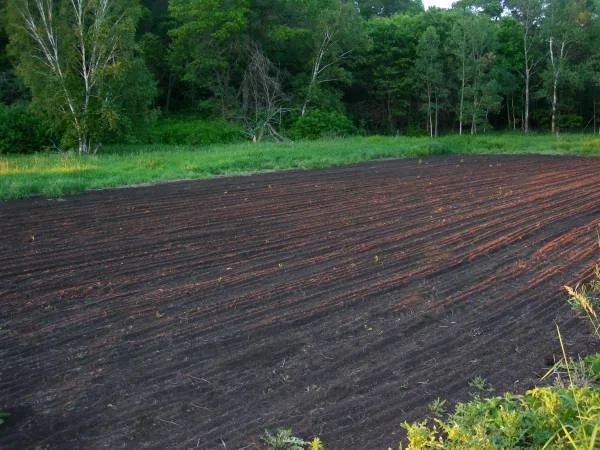
Soil preparation on the site should begin in late summer or autumn. Perform deep ploughing to a depth of 40–50 cm with the simultaneous application of organic and mineral fertilizers: 20–60 t/ha of humus or well-rotted manure, as well as 100–150 kg/ha each of superphosphate and potassium salt. In early spring, harrow and cultivate the site, then divide it into blocks of 1–2 ha. The length of rows in flat areas should be up to 100 m, and on slopes — from 50 to 75 m. Design 5-meter roads between the blocks for laying the irrigation network, and leave passages around the site for turning tractor equipment.
Cuttings planting technology and nursery maintenance
Plant the cuttings in late April or early May, when the soil at the planting depth warms up to 12–15 °C. Prepare the cuttings before planting: dip the lower ends into a clay slurry, and immerse the upper ends together with the sprouts for 12–15 cm into molten technical paraffin.
Strictly observe the planting depth depending on the soil type. On heavy and poorly warming soils, plant the cuttings at a depth of 25 cm, on chernozems and humic-carbonate soils — at 35 cm, and on light and well-warming soils — at 40 cm.
Use machinery (for example, KhBS-1) for planting. Cut slits along the rows, supplying water into them under pressure using an overhead irrigation unit until a soil slurry is formed. Insert the cuttings vertically into the slurry at the bottom of the furrow at a distance of 8–10 cm from each other. Maintain the row spacing within 100–125 cm, immediately after planting mechanically covering the cuttings with a mound of loose soil. With this scheme, from 100 to 125 thousand or more cuttings are planted per 1 ha of own-rooted nursery.
- Soil moisture — 80–85% of field capacity
- Planting density — 100–125 thousand plants/ha
- Water consumption for irrigation — 400–800 m³/ha
- Soil temperature for planting — 12–15 °C
- Depth of ploughing — 40–50 cm
Throughout the growing season, regularly cultivate the soil, clearing it of weeds. Over the summer, carry out 2 to 5 irrigations at a rate of 400–800 m³/ha: perform the first two irrigations by overhead sprinkling, and the subsequent ones through furrows. Maintain soil moisture at the level of 80–85% of field capacity. Time three root top dressings at a rate of 10–15 kg/ha of NPK to coincide with the irrigation.
During the final root top dressing in early August, completely exclude nitrogen so that the vine has time to mature before the onset of cold weather.
Combine foliar top dressing with spraying the bushes against downy mildew. Use a tank mixture: 7% superphosphate (aqueous extract), 1.5% potassium chloride, and 0.5% ammonium sulfate (or 0.3% ammonium nitrate). Additionally, apply micronutrient fertilizers based on their effectiveness in your specific soil conditions.
| Micronutrient fertilizer | Application rate, kg/ha |
|---|---|
| Boric acid | 2 |
| Zinc sulfate | 3 |
| Manganese sulfate | 0.5 |
| Ammonium molybdate | 1 |
If you planted non-paraffined cuttings, be sure to perform de-rooting (cataract removal) in late May or early June. To do this, unearth the plants and remove all developed surface roots, which will allow the formation of a powerful, deep basal root system.
Throughout the entire growing season, careful pest and disease control is carried out. Against downy mildew, which causes the greatest damage to grapevine seedlings, the plants are sprayed up to 6 times per season with a 1% solution of Bordeaux mixture. For each spraying, 10–15 kg of the preparation is consumed per 1 ha. To protect against powdery mildew, the grape bushes are dusted with ground sulfur at a rate of 15–30 kg/ha. At the end of the summer, an inventory and evaluation of the nursery plants are carried out in the nursery, removing cultivar mixtures and severely affected plants, especially those with viruses. In the autumn, for better maturation of the shoots, topping is performed — the removal of the shoot tip with three to four not yet fully developed leaves.
Nursery plants are excavated in the autumn after leaf fall before the onset of frost, usually in late October or early November. If the leaves have not completely fallen by the time of excavation, they are removed by defoliation — spraying with a solution of 60% magnesium chlorate powder magnesium (7 kg/ha).
Nursery plants are excavated strictly by cultivar. For this purpose, the PRVM-15000 attachment for the PRVM-3 plough is used.
To avoid freezing and drying out, the excavated nursery plants are immediately covered with tarpaulin and transported to the storage site, where they are sorted in accordance with the requirements of the OST standard. Nursery plants must be of regionalized cultivars, true to type, well-developed, healthy, and without any damage to the trunks, shoots, or roots. The length of the nursery plants from the heel to the point of shoot emergence, depending on the region of planting in a permanent location, should be 35–40 cm or more. The length of the ripened part of a one-year-old shoot should be at least 20–25 cm, the thickness at the base of the shoot — at least 5 mm, and in the case of two shoots, their total diameter must be at least 8 mm. The number of roots should be at least two to three, and their length at least 12 cm. The main roots should emerge from the lower node (heel) and be arranged evenly around the circumference. When cut, the roots should be succulent and white in color. Nursery plants with less developed growth and roots are classified as second grade. First-grade nursery plants are used for planting in a permanent location, while second-grade ones are replanted in the nursery for another year for further growth. Sorted nursery plants are tied into bundles using special machines: first-grade — 25 pieces per bundle, and second-grade — 50 pieces per bundle. A label is attached to each bundle, indicating the cultivar, the number of nursery plants in the bundle, and the name of the farm. In this form, the nursery plants are sent for winter storage at their farm or are sold to other farms.
Nursery plants are stored in the same way as cuttings, in storage facilities or earthen trenches at a temperature from 0 to -4°C. In storage facilities, bundles of nursery plants are stacked by cultivar up to 1.5 m high, with roots facing each other, and the root system of each row of bundles is layered with moistened sand. The storage facility is periodically ventilated to prevent the appearance of mold on the nursery plants; the sand is moistened if it dries out.
First-grade grape nursery plants are the best planting material. They have a 90–98% survival rate, ensure good vine development, and lead to earlier fruiting.
Read next
Viticulture For agronomists
Technologies for growing grape nursery plants with a ready-made high trunk
Viticulture For agronomists
Technology for accelerated growing of own-rooted grapevine nursery plants in greenhouses
Viticulture For agronomists