
Technology for accelerated growing of own-rooted grapevine nursery plants in greenhouses
3 min read
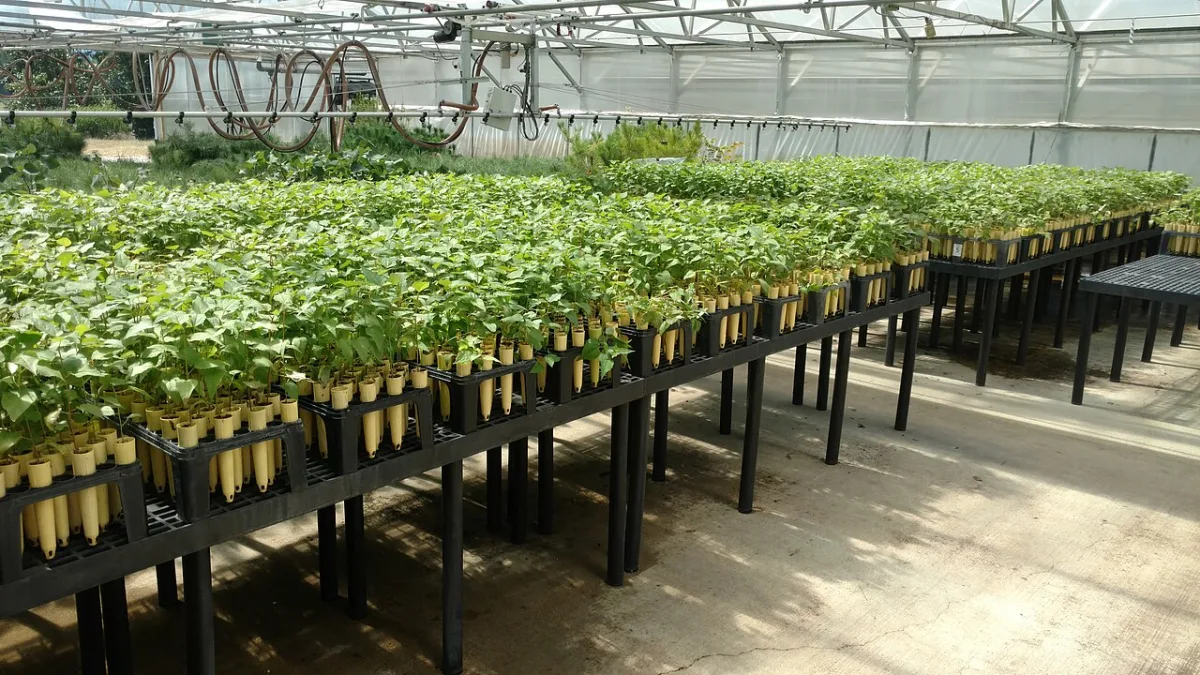
- Standard nursery plant yield — 80–90%
- Sawdust consumption per 10,000 sleeves — 1.2–1.5 t
- Growing period in the greenhouse — 45–50 days
- Cutting length — 45–55 cm
- Transportation box capacity — 60 units
The technology is intended exclusively for viticulture regions not infested with phylloxera. Since the nursery plants are grown own-rooted, there is a high risk of plant death in infested soil.
Stages of nursery plant preparation and growing season
- Substrate preparation and sleeve filling. From November to December, polyethylene sleeves 7–8 cm wide and 20–25 cm long are tightly filled with damp sawdust from coniferous or soft deciduous trees. They are placed densely, 150–200 per box, tray, or on greenhouse shelving.
- Cutting preparation. Cuttings are cut to a length of 45–55 cm depending on the planting depth adopted in a specific zone. Then, the cuts are renewed, the cuttings are soaked, and callusing is performed.
- Planting in the greenhouse. In heated greenhouses, cuttings are planted in February; in unheated ones — from the second half of March, when the threat of frost has passed. A hole is made in the sleeves with a sharp object, and the cutting is planted to a depth of 1–1.5 internodes, followed by abundant irrigation.
- Irrigation regulation and ventilation. Irrigation is carried out regularly, based on solar activity. In hot weather, plants are watered every hour, and if the optimal temperature is exceeded, the greenhouse is ventilated.
- Plant formation. During the growing season, all developing inflorescences are removed from the plants. Excess shoots are snapped off, leaving no more than 1–2 of the strongest ones.
- Preparation for field planting. By the end of the growing season, the number of irrigations is reduced to two, and the air temperature is gradually lowered. 2–3 days before planting, the plants are sprayed with a 1–2% solution of Bordeaux mixture, removed from the sleeves, and sorted.
For successful rooting, it is necessary to control the temperature and humidity regime in the greenhouse in accordance with technological standards.
| Greenhouse type | Day temperature, °C | Night temperature, °C | Air humidity, % |
| Heated | 26–28 | 20–22 | 80–90 |
| Unheated | Depends on the environment | Depends on the environment | Not regulated |
The time of root emergence depends on the preparation of the cuttings: in callused root system, it forms on the 7th day, in non-callused — on the 18th. Until root formation begins, the plants are irrigated with clean water. With the appearance of the first roots, top dressing with a 0.2% hydroponic solution of mineral fertilizers with an equal ratio of elements (NPK 1:1:1) is applied. Potassium nitrate, potassium sulfate, magnesium sulfate, and other salts are used to prepare the solution. During intensive irrigation, the nutrient solution is applied twice a day — in the morning and evening hours.
A standard nursery plant is ready for planting after 45–50 days of the growing season. By this moment, it should have a shoot growth of at least 20 cm and 4–5 developed roots at least 10 cm long. Weakened plants are culled and left for further growing.
Read next
Viticulture For agronomists
Excavation, sorting, storage and marketing of grafted grape nursery plants
Viticulture For agronomists
Effective technologies for the rapid propagation of rare grape cultivars
Viticulture For agronomists