
The influence of maturity stage and growing conditions on the phytosanitary status of greenhouse crops
7 min read
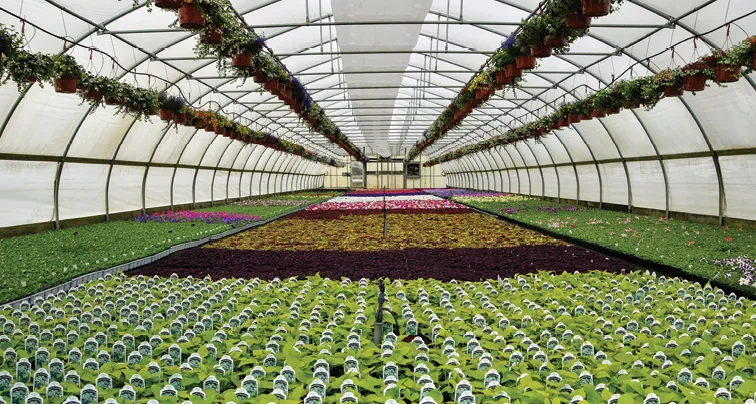
This relationship has already been examined using the examples of tomato mosaic virus tomato, cucumber green mottle mosaic, and root rots of both crops, since with these diseases, damage is maximized when infection occurs during the early stages of plant development. A similar relationship has been established for certain foliar diseases. For example, tomato leaf mold (Fulvia fulva) causes yield losses only after the pathogen has colonized at least 50% of the leaf surface over a period of approximately 6 weeks. This is very important to know when growing tomatoes, as the costs of controlling a disease that develops toward the end of the season are not always justified. However, there are other factors that require attention, namely: the potential spread of the pathogen to the next crop (if conditions for its development are favorable) and, in the case of tomato leaf mold, the risk of allergy development in staff due to a high concentration of pathogen spores in the greenhouse air. This is why disease control is sometimes carried out even when it is known in advance that it will not provide a yield increase.
Environment, crop care, and yield losses
Many environmental parameters and plant care practices have a direct or indirect effect on disease development, and thus the magnitude of damage caused by pathogens can depend on them. Pre-sowing treatment of the soil" Pre-sowing tillage, the correct choice of cultivar, the nutrient regime, and, naturally, the use of fungicides are factors that determine the intensity of infection in greenhouse crops. These will be discussed in Chapter 5.
Further reading
P1cK!lson, S. N. apa Glsas, T. A. (1982) P/an Panovv apa P1atЁ Pa povep$z. 2na ea on. BlacK\ue I SoeenIIs PibIcaIons, Eon4on.
SbacHer, U. T. (1973) C1asshoise Crop$ D1sea5e Conto! — CirrenЁ Beséopmet$ apa Eguire Prospeci. Proceeades$ 711 Bush TnzesIcIides an Pinp1c!es CoIherence, 857—64.
suHer [rom 4seaze. Acadeptus Prezz, [.onqon.
Jamez, \. C. (1974) Azzezztete oЁ p!ap 4izeaze ap 10zzez, Apzia! Revez o} PhyopaIoioiy, 12, 27—48.
OtgiZH, a. (1951) UpiuIen Haroesz. Conzfa e, ron4on.
The impact of certain diseases on the yield of greenhouse crops was shown in Chapter 3. Economically important losses usually arise as a result of disease development at an epiphytotic level, i.e., through the rapid and severe infection of the majority of plants in a planting.
Every epiphytotic begins with the primary arrival of a pathogen. The source of infection may be located within the current planting or in its vicinity; sometimes it is introduced from a significant distance. Regarding most diseases of greenhouse crops, the source of infection is usually local, most often found within the crop itself. There are many potential sources, and the role of any of them increases under conditions favorable for plant infection, pathogen spread, and epiphytotic development. When studying sources of infection, it is necessary to know the mechanisms of pathogen survival.
Pathogen survival
During the intervals between periods of active parasitic activity, pathogens survive in a wide variety of ways depending on the type of organism. Some pathogenic fungi form resting structures capable of existing for long periods. These include resting spores, thick-walled mycelium cells (chlamydospores, aleuriospores), and sclerotia. Other phytopathogenic fungi survive for most of their lives in an active form on their permanent or intermediate hosts, the latter of which may be weeds growing near the greenhouse, or the same crop in a neighboring greenhouse or in the open field. Some species of fungi exist as saprophytes, colonizing and utilizing any available source of non-living food.
Viruses, as a rule, die quickly outside of living plants, although some are exceptions. Primarily, this is the tomato mosaic virus, which remains viable for a particularly long time (up to 50 years) in dry plant residues. Certain viruses infect several plant species, including weeds, although their host range is generally limited. The cucumber mosaic virus occupies a special position: of all phytopathogenic viruses currently known, it has the
3 order No. 484 65 Fungi Inactive forms: Active forms: Spores (asexual and sexual) saprophytic growth in soil and water Sclerotia Pathogen growth on other Resting mycelium hosts (cultivated and weed plants) Host plant Inactive Active Other crop-host plants, Inactive forms: forms: weeds, viruses in vectors, Forms!: Active for instance, saprophytic Inactive growth in soil and spores, compost, manure, nematodes Fig. 4.1. Mechanisms of pathogen survival. broadest range of host plants and affects many cultivated and weed plants, including common chickweed (Stellaria media), stinging nettle (Urtica urens), and purple dead-nettle (Lamium purpureum). Bacterial pathogens often survive in a resting form in dry plant residues or soil. PATHOGEN SOURCES The intervals between two successive crops in a greenhouse are very short, and spores capable of short-term survival can persist for long enough to infect successive plantings. For example, lettuce, mushrooms, potted crops, and chrysanthemums can be grown in a crop rotation with intervals of a few days, and sometimes crop cycles in the same greenhouse partially overlap in time. Under such conditions, pathogens survive very easily, moving from one host to another. However, crop rotation is not frequently practiced in greenhouses; only the use of mobile structures allows for some avoidance of infection by certain soil-borne pathogens. Very often in nurseries or mushroom farms, the first crops of a rotation are relatively free of disease. Of course, one could say that beginners are always lucky, but a more accurate and logical explanation is as follows: the pathogen is either absent or its population is too small to infect the crop during its early developmental stages and thus cause an epiphytotic. Over time, the situation most often changes drastically, and farmers in the majority
Fig. 4.2. Mobile greenhouse; a three-sided crossbar and roller system (a) allows for changing the site occupied by the greenhouse. Growers too quickly accumulate sad experience calculating the damage from major diseases developing in greenhouses.
It can be said that soil is the sole and most dangerous source of many economically important pathogens. Compost, used for growing transplants, plays a lesser role. The role of soil as a reservoir of infection has long been established by farmers, who use various methods to combat soil-borne pathogens — expensive steam heating, chemical or mechanical tillage. The spread of a pathogen in the soil that attacks roots occurs in parallel with the development of the root system; consequently, there may be a need for disinfecting a layer up to 60 cm deep to suppress the causal agents of root rots or vascular wilts.
Plant residues in the soil or in any other place also serve as an important source of infection, and even with the most thorough cleaning of the greenhouse after a crop, some amount of plant material always remains in it. Accumulations of production waste on the farm premises pose a constant threat, especially if plant residues are carried into greenhouses on the footwear of staff, or with tools or machinery. Another important source of infection is surfaces where wind-borne pathogen spores settle, for example, greenhouse covers, benches, posts, and trellis wire. Potential reservoirs for contaminated plant residues and spores include various containers
3* 67 (pots, seedling trays), as well as water, especially if it is drawn from ponds that receive drainage water from neighboring fields or from greenhouse roofs. Even tap water, when stored in open tanks, can contain pathogens.
Sources of infection can also be located at some distance from greenhouse crops. Many fungal spores are easily carried by the wind, sometimes for several kilometers, and enter greenhouses through open vents or doors. Finally, certain pathogens have vectors, which include not only insects but also other organisms, as well as humans.
Read next
Plant protection For agronomists
Lettuce mosaic virus: symptoms of the disease and methods of plant protection
Plant protection For agronomists
Biology of fungal pathogens and classification of greenhouse crop disease agents

Plant protection For agronomists