
Design features and advantages of double-drum threshing units of Yenisei combine harvesters
6 min read
For different yields and grain moisture levels, the "Yenisei" combine harvester design has been developed with one or two threshing drums. The single-drum design is intended for harvesting dry crops with medium and low yields.
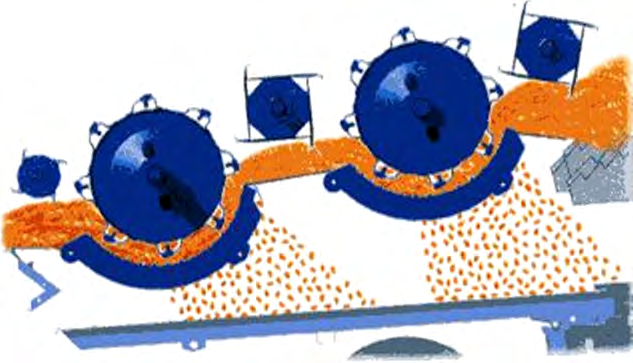
A two-drum threshing and separating unit is optimal for harvesting high-yield crops, especially those that are moist and difficult to thresh. The first threshing drum is equipped with a reverse mechanism that helps to easily clear drum blockages caused by crop mass.
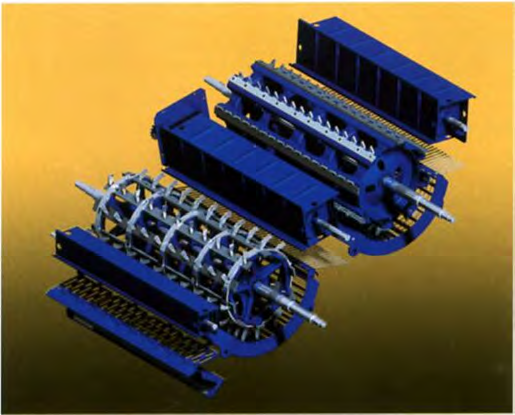
Most parts and components of the threshing and separating unit are unified for the entire "Yenisei" family of combine harvesters. They use three types of threshing drums:
- beater;
- toothed;
- pin (peg-tooth).
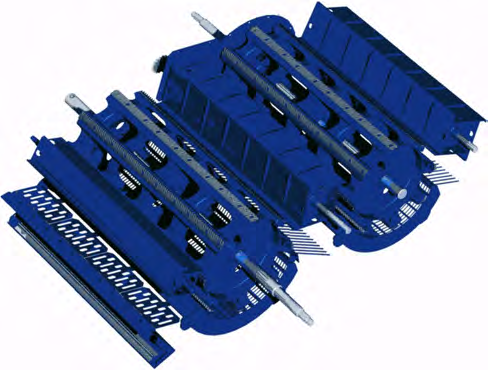
In two-drum models, different types of drums can be installed in various combinations. The toothed drum ensures high-quality processing even with uneven feeding of the crop mass, reduces energy consumption for threshing, and decreases grain damage.
drum combined with a beater drum combined with a beater
The pin drum combined with a toothed or beater drum is used for harvesting rice; the toothed drum combined with a beater drum is used for difficult harvesting conditions, i.e., high moisture, long-stemmed crops (medium to high yield). The single-drum scheme is applied for fields with low and medium yields in dry zones.
The threshing apparatus has to be adjusted to a "rigid" operating mode – maximum rotation speed and minimum threshing clearances. This leads to an increase in the energy intensity of threshing and higher fuel consumption. Under field conditions, as research shows, the probability of correct combine adjustment is 15–20%. At the same time, grain losses are 3 times or more higher than losses with correctly adjusted combines.
The situation can be corrected by using a threshing apparatus that does not require adjustment during operation. In this case, the probability of correct combine adjustment increases 3 times, and grain losses are reduced by 1.5–2.0 times. This property is possessed by a threshing apparatus with a toothed drum, developed by specialists from SZNIIMESKH and OJSC "PO Krasnoyarsk Combine Plant".
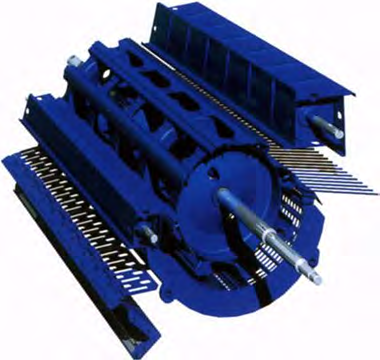
The threshing apparatus contains a toothed drum and a grid concave, which does not differ from the concaves of beater threshing apparatuses. The drum consists of a frame similar to that of a beater drum and toothed beaters bolted onto the support plates. The latter are working elements stamped from sheet steel with trapezoidal teeth. Some of the teeth have a lower height than the others due to the installation of streamlined strips.
When harvesting grain with increased moisture, this threshing apparatus allows for lower losses than a beater threshing apparatus even when the latter is correctly adjusted. When harvesting the Suzdalets cultivar of barley with a grain moisture of 37.2–38.8% at the North-Western Machine Testing Station, the combine harvester "Yenisei-KZS-957", equipped with two toothed drums, had grain losses behind the thresher 1.5–2.0 times lower than the two-drum combines "Yenisei-KZS-954", "Yenisei-1200-NM", and single-drum combines "Yenisei-1200-I NM" and "SR-2065" (equipped with beater drums), while having lower specific fuel consumption (by 13.6%) and less grain crushing.
| Combine type | Grain loss forecast, % |
| "Yenisei-KZS-957" | 2.8 |
| Other combines | 8.3–11.6 |
Thus, the use of a threshing apparatus with toothed drums on combine harvesters allows for more efficient grain harvesting with minimal grain losses and fuel consumption.
The "CHALLENGER" combine harvesters are equipped with an advanced harvesting system, which allows for:
- faster harvesting;
- more comfortable operation;
- virtually eliminating the possibility of grain damage.
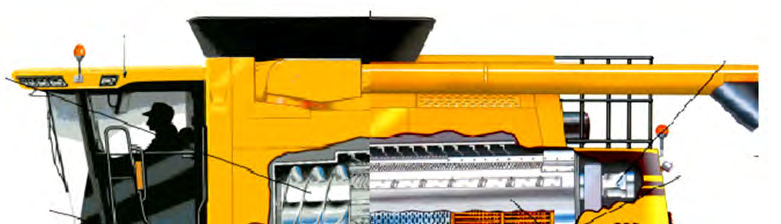
The rotor installed on the combine performs four main tasks: intake, threshing, separation, and discharge of residues. It is easy to change the rotor configuration to achieve maximum productivity in various harvesting conditions.
Feeder house:
- The feeder house drive shaft with a chain drive acts as the drive for headers. The drive chain has optimal tension, ensuring a long service life.
- A cam clutch protects the feeder house from unexpected loads.
- A powerful hydraulic reversing mechanism helps clear blockages in the feeder house by reversing both the elevator and the header.
- A spring-loaded lower drum maintains positive contact with the incoming mass and improves feeding.
The feed beater with a constant speed system accelerates grain flow from the feeder house through the conical intake zone of the rotor with 360° feeding. The feed beater levels the grain flow and directs stones into the standard stone trap located at the bottom.
High-capacity rotor intake section: grain damage is minimized while overall productivity is increased through the rigid design of the auger conveyor, which ensures 360-degree feeding into the threshing section. The rotor intake section is designed for a long service life and can be replaced if necessary.
The threshing quality and cleanliness of the grain pile directly depend on the design of the threshing and separating unit. Modern combines utilize various threshing and separating unit designs, including single-drum, twin-drum, and rotor systems. For instance, in Challenger 600 series rotary combines, gentle threshing of the mass occurs in seven concave sections with a rotor wrap angle of 140°. The design allows for the quick adaptation of the machine to various crops. The concave clearance is adjusted by an electric actuator from the cab via the harvest control center panel.
When switching from harvesting corn to small grains, there is no need to change the concave. It is sufficient to install quick-release cover plates from the standard supply kit.
- Concave rotor wrap angle — 140°
- Rotor length — 3.55 m
- Number of standard rotor knives — 21 units
- Rotor speed range — 175–970 rpm

Rotor design and features of the cleaning system
The 3.55 m long rotor provides an increased separation area compared to its counterparts. Its threshing elements have a wear-resistant carbide coating; they are interchangeable and reversible for operation in difficult conditions. To protect against straw wrapping, 21 knives are installed as standard. The design allows for the mounting of up to 21 additional knives or their complete removal.
The design utilizes a patented straight-discharge rotor from which the straw is ejected directly. This simplifies the combine's kinematics, reduces engine power consumption, and preserves straw quality for subsequent pick-up by a baler. Electronic control of the hydrostatic rotor drive maintains the set rotation speed stable regardless of engine load or crop density.
| Transmission type | Rotor speed range |
|---|---|
| Two-speed gearbox | 175–970 rpm |
The speed range is switched by a mechanical lever above the machine's left rear wheel. The "Aerodynamic Tunnel" cleaning system, with a turbine fan controlled from the cab, maintains constant air pressure on the sieves in any conditions. Preliminary cleaning of the grain pile begins immediately after the mass exits from behind the grate under the rotor, where the airflow separates the grain from the straw fraction.
If the thresher becomes clogged with plant mass, the operator does not need to manually clear the rotor. Its direction of rotation can be reversed directly from the cab by engaging the full power of the hydrostatic drive.
Read next
Farm machinery For agronomists
Threshing and separation technologies in CLAAS combine harvesters
Farm machinery For agronomists
Influence of design and power parameters on the operation of a combine harvester threshing unit
Farm machinery For agronomists