
Design and technological process of the TORUM 740 combine harvester
13 min read
Combine 740 – a self-propelled axial-flow grain harvester – is designed for harvesting small grain crops using direct or two-phase harvesting. It is oriented towards fields with a yield of over 60 c/ha. It can be effectively used in machine and tractor station conditions. With the use of additional attachments, it can harvest sunflower, grain maize, peas, soybeans, and rapeseed.
Design. The combine consists of a header or a pickup platform, a feeder house, a threshing unit, an undercarriage, an operator's station, an engine installation, hydraulic equipment, electrical equipment, a system for monitoring and controlling the operation of units and working components, and a straw chopper-spreader straw – SCS.
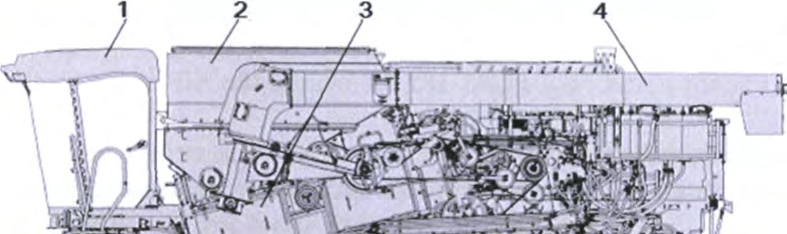
a – left view; b – right view; 1 – cabin; 2 – grain tank; 3 – threshing and separating device (TSD); 4 – unloading auger; 5 – SCS; 6 – toolbox; 7 – chassis; 8 – fan; 9 – feeder house; 10 – fuel tank; 11 – air system; 12 – re-thresher; 13 – grain elevator; 14 – drive axle; 15 – battery box; 16 – tailings elevator; 17 – steered axle
Technological process. The reel delivers a portion of stems to the cutter bar and then to the auger. The cut stems are transported by the auger to the center of the header, where they are grasped by the fingers extending from the auger and moved to the intake beater of the beater-type feeder house with a reverse gear, and then into the threshing and separating device (TSD).
1 – cabin; 2 – grain tank; 3 – TSD; 4 – main countershaft drive; 5 – engine installation; 6 – unloading auger; 7 – SCS; 8 – battery box; 9 – cleaning system; 10 – drive wheel; 11 – feeder house
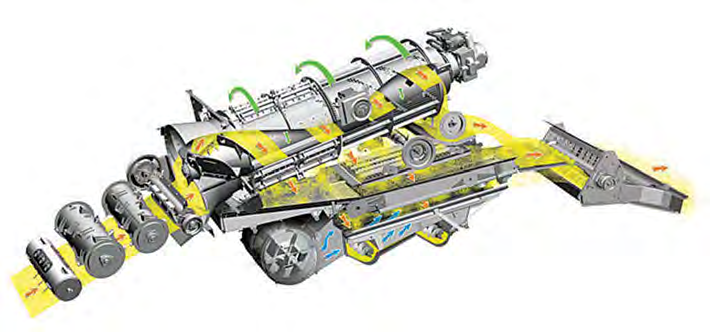
Threshing and separating device – a longitudinally positioned rotor that performs the threshing of the incoming technological product. During threshing, the mass separated from the ears along with a significant portion of chaff is separated through the concave grate onto the transport board. After threshing, the grain mixture is transported along the transport board to the additional sieve.
During the transport of the mixture, it is pre-separated into fractions. Grain moves downward, while chaff moves upward. In the drop zone between the finger grate of the transport board and the additional sieve, it is blown through. The layer of the grain mixture falling through the finger grate is loosened, which allows the grain and heavy impurities to fall through more easily under the action of the fan's air jet and the oscillating movement of the sieves, while chaff and other light impurities are blown out of the thresher.
After the additional sieve, the grain mixture enters the second drop zone and then the top sieve. Having fallen through the additional, top, and bottom sieves, the grain reaches the grain auger. The process then continues as follows:
- grain is transported by the auger to the elevator, which moves it to the grain tank loading auger;
- the loading auger delivers the grain into the grain tank;
- from the grain tank, the grain is delivered by the unloading auger to a transport vehicle.
Unthreshed spikelets, falling through the top sieve and the top sieve extension onto the bottom sieve, are transported to the tailings auger and into the tailings elevator, which moves the resulting mixture to the re-thresher. There, re-threshing occurs, after which the threshed mixture is evenly distributed by an auger across the width of the return board and transported to the cleaning system again.
The combine's design incorporates progressive technical solutions:
- machine layout: cabin – grain tank – engine;
- centrally positioned two-seat comfortable cabin with air conditioning, heater, and an auxiliary seat;
- push-button control for fuel supply and gearbox;
- rotor with a rotating concave;
- rotor drive with a continuously variable transmission;
- increased-volume grain tank with a tower-type unloading auger;
- autonomous grain unloading;
- automatic control system for technological process stability;
- new onboard computer with an improved interface;
- header with hydraulic reel drive;
- beater-type feeder house (for harvesting both small grain crops and sunflower/maize).
To reduce the labor intensity of operation and maintenance, the following functions and elements have been introduced:
- reverse of harvesting components when clogged with crop mass, controlled from the cabin;
- low-positioned battery boxes;
- hard-to-reach lubrication points grouped together.
The thresher "Don-2600" served as the basis for the new combine. However, the combine differs significantly from its predecessor. The main differences are presented in the table:
| Header | with hydraulic reel drive |
| Cabin | central positioning |
| Grain tank volume | 11 m3 with tower-type unloading |
| Engine power | 360–400 hp |
| Rotor drive | with continuously variable transmission |
| Cleaning system | increased area |
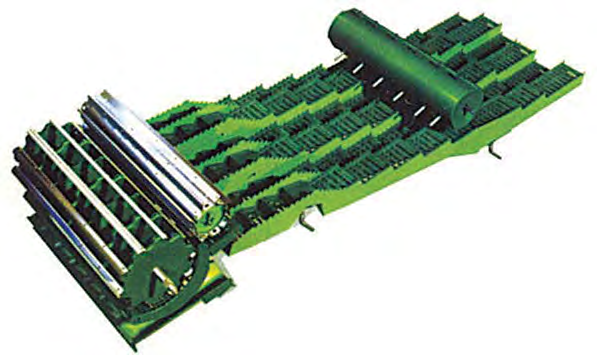
Harvesting part. Consists of a header and a feeder house, which is pivotally connected to the combine thresher and supported by two hydraulic cylinders on the drive axle beam. Combine 740 is equipped with a newly designed header (Figure 97). Similar headers are installed on "Don-1500M", "Vector", and "Don-1500B" combines (since October 2006).
Modernization of the header and feeder house: increased productivity and reliability
The new design of the header differs significantly from the previous model ZHU-6. The changes are aimed at lightening the structure, increasing cutting stability, and accelerating the workflow on various agricultural backgrounds. Modernization allowed the combine to be adapted for harvesting both short-stalked and long-stalked crops.
- Knife speed — 1080 strokes/min
- Upper beater diameter — 300 mm
- Reel tine diameter — 6 mm
- Pick-up platform width — 3.4 m
- Header attachment time — 5 min
The working components of the header have received a number of design upgrades. The reel hydraulic drive based on the EPRMW 80 CBM hydraulic motor reduced total weight and increased the reliability of the assembly (in the future, the chain drive is planned to be replaced with a gear drive). The header table has been extended by 130 mm, which improved the feeding of crop mass. An optional Schumacher planetary drive increases the cutting frequency to 1080 strokes per minute instead of the previous 946, allowing the combine to move faster without loss of cutting quality. As an alternative, other planetary drives or oscillating knife heads can be installed.
The strength and durability of the design are increased due to a reinforced table bottom in the mass feeding zone, an increased diameter of the reel tine tubes, and double reel tines, which reduce labor intensity during installation. The cutting apparatus is equipped with an additional upper counter-cutting plate for a clean cut, and the guards are stamped and welded. The "Autocontour" electro-hydraulic ground tracking system operates using two extended shoes as sensors. The header can be attached and connected in just 5 minutes without the use of special tools.
Clogging of the header with crop mass or foreign objects is cleared without stopping work. The hydraulic reverse of the header components and the feeder house is started directly from the operator's cab, which eliminates manual labor in the field.
In the feeder house, instead of the classic chain-and-slat conveyor, a beater system with a normalizing beater is installed. Due to active acceleration and leveling of the mass flow, it increases combine productivity by 20%. The diameter of the upper beater was increased from 252 to 300 mm for protection against stalk wrapping. The electromagnetic clutch of the header drive allowed the tensioning roller (lenix) to be excluded from the design. A special tray is provided on the bottom of the housing to catch stones.
For two-phase harvesting, the combine is equipped with a 3.4 m wide pick-up platform with the ability to work with double windrows. The device accurately tracks the field relief in two directions and is protected against clogging, wrapping, and wind-blown mass dispersion.
Axial-rotor thresher: design features and mass movement scheme
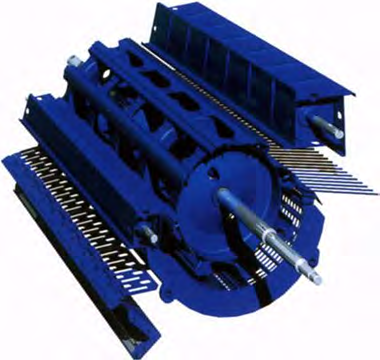
The axial-rotor type thresher consists of a housing, a rotor with a rotating concave, a beater-separator, transport devices, a grain tank, and drive mechanisms. The Torum threshing system handles grain gently and operates stably on weedy or wet backgrounds. The rotating concave eliminates the occurrence of "dead" zones and ensures 360° threshing, while the continuously variable rotor drive allows for precise parameter adjustments for specific harvesting conditions.
| Rotor parameter | Value |
|---|---|
| Diameter | 762 mm |
| Length | 3200 mm |
| Threshing and separation area | 5.4 sq. m |
The technological process of crop mass movement in the thresher is organized sequentially:
- The mass is fed by the feeder house beaters into the rotor intake section.
- Threshing occurs in the rotor's threshing zone, and the grain with chaff falls onto the grain pan.
- Residual grain is separated in the rotor's separation zone, heading toward the transport inclined board.
- At the rotor exit, straw enters the beater-separator with a concave for final separation.
- The separated grain falls onto the transport inclined board.
- The grain pan moves the threshed material to the upper small cascade.
- Further, the mass is distributed across the upper and lower cleaning sieves.
- The unthreshed material is sent to an autonomous rotor re-thresher, and chaff is discharged onto the chaff spreader.
The rotating type concave has replaceable perforated sections. The rotation of the concave allows for improved grain quality, ensures concave self-cleaning, and enhances performance in difficult crops. The rotor has straight rasp bars in the threshing section and intermittent feeding flights in the separation section. The rotor's working elements in the threshing section are replaceable to ensure quick conversion for rice harvesting.
To ensure continuously variable adjustment, as well as to exclude the belt drive from the transmission, a hydromechanical continuously variable rotor drive is used. In order to reduce the number of belts, the cleaning fan drive is carried out by a hydraulic motor controlled from the cab. Unlike the "Don-2600", a beater-separator is installed behind the rotor, which performs final separation and delivers straw to the shredder-spreader. The area of the cleaning sieves has been increased from 4.5 to 5.1 m2. Sieve adjustment is carried out by electric motors (standard manual adjustment is implemented in the prototype combine).
To improve the balance of the threshing unit, the cleaning sieve operation scheme has been modified. On the 740, the straw walker and the lower sieve move in the same direction, while the massive part of the upper sieve moves in counter-phase. Hopper with unloading device. Hopper volume
11 m³ (in the "Don-2600" – 6 m³) is designed for a truck body with a load capacity of 10 t.
The hopper roof is transformable (increasing its volume from 9 to 11 m³). The transformation is carried out by an electric mechanism controlled from the cab. The hopper is equipped with two diaphragm fill-level sensor alarms located on the front panel inside the hopper. The lower sensor signals that the hopper is 75% full, and the upper one signals that the hopper is at maximum capacity. When the hopper is 75% full, a flashing beacon turns on automatically, signaling trucks that they need to pull up for grain loading. A large inspection window is provided for visual control of the grain level in the hopper. A vibration exciter with two hydraulic pulsators installed on the bottom of the hopper facilitates the quick unloading of moist grain. The unloading device with a hydraulic discharge auger has been completely updated.
A tower-type unloading system with a 105° discharge angle is used. To save fuel during unloading, the threshing unit drive can be disengaged. 2. Grain delivery from the bottom of the hopper is carried out by two augers located at different heights. This reduces the load on the bottom auger (compared to the ACROS 530) and increases the unloading speed by 5%. Grain unloading takes no more than 2 minutes. Compared to the "Don-2600", the unloading speed has been doubled – from 43 to 95 l/s. The unloading height has been increased to 4.3 m. The length of the unloading auger has also been increased to 4.7 m. Such dimensions allow for easy grain discharge into any truck, even with a 9 m header. The sampler is located on the platform in front of the cab entrance. Shredder-spreader. To process the non-grain part of the harvest, the 740 combine is equipped with a new design of shredder-spreader.
The shredder-spreader consists of a shredder unit, a spreader, and electric mechanisms for adjusting the spreading width and switching to the swathing position. In addition to straw spreading, the new shredder can spread chaff without the use of a separate chaff spreader. To improve the quality of straw shredding compared to the IRS on the "Don-1500B", the shredder drum speed has been increased from 2800 to 3200 rpm. The shredder drive is engaged/disengaged from the cab. Managing the shredder drive (based on a lenix – a tensioning pulley) from the cab increases the combine's safety and reduces the time required to switch from the shredding mode to the swathing mode (only the straw deflector lever needs to be switched).
The pivoting guide vanes of the spreader are controlled by an electric motor managed from the cab. The combine's hydraulic system has been significantly redesigned compared to the "Don-2600" system. This is due to the aim of minimizing the number of mechanical transmissions, including belt drives, to increase drive reliability and reduce maintenance labor intensity.
Hydraulic system of the combine is represented by two supply tanks with a volume of 50 l each and consists of seven independent systems (the "Don-2600" had three):
| Tank No. 2 |
|
| Tank No. 1 |
|
To provide the necessary amount of working fluid for driving the steered axles, a second hydraulic tank has been installed.
The electrical system is a single-wire, direct current, 24 V and 12 V, with a 2 kW AC generator with a built-in rectifier. In the electrical equipment, a system has been applied for the first time that allows not only to reduce the number of connectors and wires but also to solve the task of automating the threshing unit operation. Automation of the threshing unit operation implies assessing losses to ensure optimal loading of the threshing unit and/or obtaining maximum combine productivity. This will reduce the requirements for the combine operator's qualifications (which is important nowadays), as the adjustment of the threshing unit's working elements will be performed by the combine's electronics.
The industrial CAN network connects the combine's sensors into a unified control system. It is characterized by high data transmission speed, is resistant to interference, and is capable of independently detecting errors in the circuit. For the engineer and the combine operator, this means the ability to instantly perform a full diagnostic of all onboard electronics directly in the field.
The use of a unified CAN bus simplifies machine modernization. New electronic systems, including satellite navigation for yield mapping, can be connected to the common circuit without changing the factory wiring.
The combine's electronic complex automates key work processes. The base configuration includes an automatic reel speed control system that adjusts to the machine's operating speed. Other intelligent systems were absent on the prototype combine but are provided for by the general platform:
- automatic threshing unit load stabilization;
- assessment of threshing output and current grain losses;
- automatic working speed adjustment to prevent clogging at maximum crop feeding;
- automatic equipment start-up with output to saved or recommended agrotechnical parameters;
- automatic system for preventing and resolving emergency situations.
Comparison of conventional and rotary threshing in field conditions
The type of threshing and separating device directly affects the combine harvester's productivity and the quality of grain in the hopper. According to this technological scheme, all modern machines are divided into conventional, rotary, and hybrid ones. During comparative field trials conducted in 2012, the performance efficiency of two different threshing concepts was evaluated under identical conditions.
Two high-performance machines were selected for comparison. The John Deere W 650 model represented the conventional scheme with a threshing drum and a straw walker. It was compared against the TORUM-740 (RSM-181) combine, equipped with an axial-rotor threshing system. The trials allowed for a clear comparison of the operational features of both systems during the harvesting of crops.
Read next
Farm machinery For agronomists
Design features and advantages of double-drum threshing units of Yenisei combine harvesters
Farm machinery For agronomists
Technical features of mower-choppers and modern CLAAS forage harvesters
Farm machinery For agronomists