
Influence of design and power parameters on the operation of a combine harvester threshing unit
5 min read
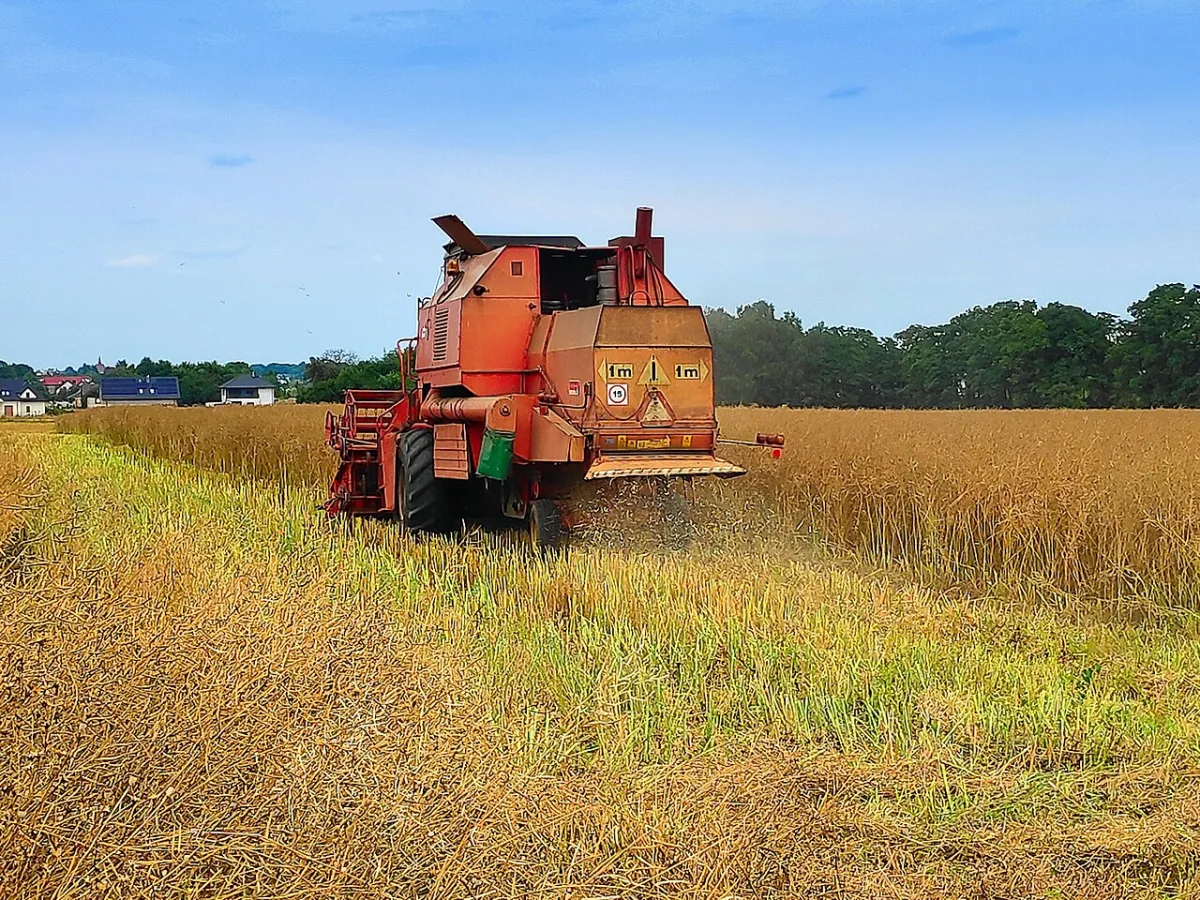
and energy parameters of combine harvester threshing units, taking into account their operating conditions. High-quality performance of the threshing unit at a specified level is ensured with a drum rotation speed deviation of no more than 5 %. The deviation of drum rotation speed during the threshing process is caused by the limited engine power and non-uniform feeding of crop mass into the threshing unit. Changes in crop mass feeding are caused by non-uniform yield in the field, variations in stubble cutting height, disturbances in flow formation, and step-wise increases in the speed of transport mechanisms moving the crop mass after mowing or swathing into the threshing unit. Given that the power required for the threshing unit operation at certain moments due to batch feeding of the crop significantly exceeds the power transmitted from the engine to the threshing unit, the energy deficit for threshing is covered by the kinetic energy of the rotating drum. The relationship between the input power, threshing unit parameters, and crop mass feeding is established using the fundamental threshing drum equation derived by Academician V. P. Goryachkin.
Vasily Prokhorovich Goryachkin. A Soviet scientist in the field of agricultural machinery, honorary member of the USSR Academy of Sciences (since 1932). Honored Scientist and Engineer of the RSFSR (1935). Academician of VASKhNIL since 1932.
BIOGRAPHY. Born into a family of craftsmen, originally from the town of Vyksa. In 1890, he graduated with honors from the Faculty of Physics and Mathematics of Moscow University, and in 1894, from the Moscow Imperial Technical School. A student of N. E. Zhukovsky, the "father of Russian aviation." An outstanding scientist, founder of the new scientific discipline "Agricultural Mechanics," he demonstrated his talents as a science organizer, educator, citizen, and patriot. The scientific works of Academician V. P. Goryachkin are classics in the field of technical sciences. Beyond the development of agricultural machinery theory, they advanced fundamental theoretical issues such as the theory of masses and velocities, impact and material destruction, the wedge, cutting, similarity, and a general scheme of natural phenomena and processes. He created instruments used in agriculture, metalworking, and mechanical engineering: soil density meters, profilographs, dynamographs, etc. In October 1980, the V. P. Goryachkin Memorial Museum was opened at the Moscow State Agroengineering University. The memorial museum is located in the premises of the former machine testing station, organized and opened by Professor V. P. Goryachkin in 1913. The museum houses interesting materials and exhibits dedicated to the country's achievements in the field of agricultural machinery and the testing of agricultural equipment.
Using the fundamental equation of the threshing drum, one can: 1. Determine the feeding of crop mass into the threshing unit of a combine harvester during harvesting of various crops: q=
0.01 where Q – grain yield, c/ha; V – combine speed, m/s; B – combine header cutting width, m; β – grain content in the crop mass.
Feeding of crop mass into the threshing unit of various combines: Combine model
"Don 1500" "Niva-Effect" "MF-7270 540"
50 c/ha 50 c/ha 50 c/ha 50 c/ha
3.1 km/h 2.1 km/h 4.5 km/h 4.5 km/h
6.0 m 5.0 m 6.6 m 9.0 m
1: 1.5 1: 1.5 1: 1.5 1: 1.5
Feeding is determined by the throughput of the combine thresher. It depends on the weight ratio of grain to straw in the threshed crop mass. The nominal throughput is accepted for crop mass with a grain-to-straw weight ratio of 1:1.5, with total grain losses by the combine thresher of 1.5 %. In low-straw crops, throughput is higher, while in long-straw crops, it is lower. 2. Determine the maximum permissible speed of the combine during grain harvesting: V =
qf ∙ β, 0.01 ∙ Q ∙ B where Q – grain yield, c/ha; B – combine header cutting width, m; β – grain content in the crop mass; qwork – working feed of crop mass into the threshing unit.
Since qwork corresponds to the maximum permissible feed (q) under conditions of proper grain threshing, the actual average feed will be 1.33 times lower, i.e., q f = q work / 1.33 = 0.75 q work.
Ratio of grain mass to straw mass
1: 0.8–1: 3.0 1: 1.8–1: 4.0 1: 1.8–1: 3.0 1: 1.0–1: 1.8
"Don 1500" "Niva-Effect" "MF-7270 540"
50 c/ha 50 c/ha 50 c/ha 50 c/ha
11.63 6.56 18.56 25.31
6.0 m 5.0 m 6.6 m 9.0 m
1: 1.5 1: 1.5 1: 1.5 1: 1.5
Determine the rotation frequency of the beater threshing drum required for high-quality threshing of wheat, barley, rye, peas, and grass seed crops. Calculated drum rotation frequency, rev/sec: ωb =
π ∙ Vb, d where Vb – peripheral speed of the beater bar, depending on the condition and properties of the harvested crop and the concave setting; d – drum diameter.
Peripheral speed of the beater drum: Crop
Wheat, rye, barley, oats Beans, peas, soybean, sunflower Clover, alfalfa
Calculation of drum rotation for various crops: Combine model Vb barley Vb peas Vb alfalfa d ωb barley ωb peas ωb alfalfa
28.0 m/s 12.0 m/s 28.0 m/s 800 mm
28.0 m/s 12.0 m/s 28.0 m/s 600 mm
28.0 m/s 12.0 m/s 28.0 m/s 600 mm
28.0 m/s 12.0 m/s 28.0 m/s 800 mm
Read next
Farm machinery For agronomists
Features of combine threshing units and increasing the efficiency of grain threshing
Farm machinery For agronomists
Threshing and separation technologies in CLAAS combine harvesters

Farm machinery For agronomists