
Features of growing peppers, eggplants and tomatoes in greenhouses
6 min read
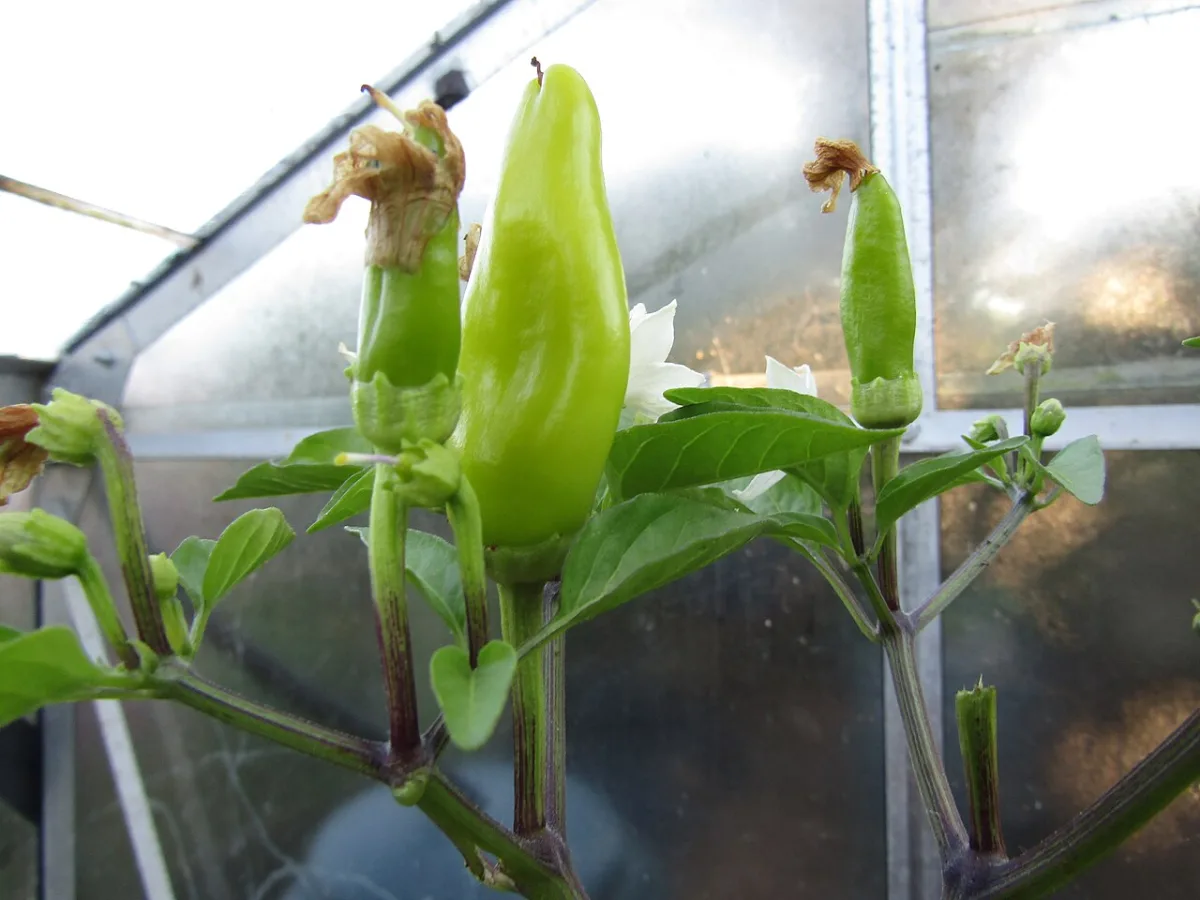
Anyone taking up the cultivation of tomatoes would do well to theoretically acquaint themselves with their natural characteristics. That is the purpose of this chapter. Like any vegetable crop, the tomato has its own nature in accordance with its origin. It has its own preferences and dislikes.
If cabbage, for example, is of Mediterranean origin, and carrot and garlic are from Asia Minor, then the tomato hails from South America. This involves completely different climates and, consequently, different soil. There are details here that a gardener would do well to understand. After all, we are dealing with a very complex crop.
The eggplant originates from South Asia; it is a plant of an entirely different origin than the tomato, although it is also a nightshade. Sweet and hot peppers, although also South American in origin, have significant differences from the tomato. Let us briefly outline these differences between the three nightshade crops, because, as we know, everything is understood through comparison.
Judging by its properties, the pepper is not an island plant, but a continental one. Sweet pepper is no longer an endemic; it is one of those species that initially successfully managed to occupy vast territories located in quite different climatic landscapes. It is more flexible and resistant to pests and diseases. Furthermore, sweet pepper is a true heat-lover, as a typical subtropical plant. The eggplant is also a heat-lover. In its wild form, it was initially distributed even more widely, albeit on a different continent, in Asia. The eggplant is also quite resistant to pests and diseases; it is even armed with thorns against herbivorous animals.
What these three — the tomato, peppers, and eggplant — have in common is that they are all self-pollinating crops; they do not need insects for pollination. Pollen is shaken from the stamens onto the pistils by the following means:
- through mechanical movement of the bushes (being touched during weeding);
- during irrigation;
- when walking past them;
- during pruning (suckering);
- the pollen falls off by itself as it ripens and dries out.
When choosing tomato cultivars and hybrids in a store, do not place too much importance on the resistance to various diseases indicated on the label. This reference information is more important for professional agronomists. For amateur (dacha) gardening, the health or disease of tomatoes is influenced much more by mistakes made in cultivation techniques than by cultivar resistance.
Conclusion: due to their modest size, people easily grow sweet peppers and eggplants in ordinary low film and lutrasil tunnels, or hotbeds, but tall tomato cultivars and hybrids cannot be kept in them, as it is too cramped. This is further confirmation that a full-fledged greenhouse is built instead of a hotbed specifically for the sake of tomatoes.
Sweet peppers and eggplants, as plants more accustomed to heat, are not afraid of overheating in a greenhouse. Let us compare temperature preferences:
| Crop | Reaction to temperatures above 30-40 °C |
| Sweet pepper | Thrives |
| Eggplant | Thrives |
| Tomato | Fears severe overheating |
This is an important distinction that sets the tomato apart from all our greenhouse crops. Neither peppers, nor eggplants, nor melons, nor watermelons fear overheating, but the tomato does.
It does not matter if a particular cultivar is labeled as "resistant to late blight" or "moderately affected by late blight": if you make a serious mistake, they will all get sick without exception. And conversely, if you create favorable conditions for the tomatoes, you can plant any cultivars and hybrids you wish, and no one will get sick.
..."And he habitually dived into his tomatarium..." Perhaps this is about you, but let's not judge biasedly: for some, it is a watermelonarium. All heat-loving crops are worthy of such passion.
Let us talk a little more about tomatoes. It is interesting to analyze the situation with the cultivation of tomatoes in our country.
Statistics show that over the last ten years, greenhouse tomato production has more than doubled. This is a clear manifestation of the greenhouse revolution in our country in the Central region. (And if our population could manage to solve the ever-present problem with late blight, this figure would double again!)
However, according to statistics, people still only meet their needs for fresh tomatoes by 1/4; the rest has to be imported from other countries. And the reason for this is not that there is a shortage of summer tomatoes, but strictly a shortage of fresh vegetables in the winter-spring months. In the summer, there are so many fresh tomatoes for us in greenhouses and on the market that experts have adopted a recommendation at the national level not to expand the sown area for tomatoes any further.
This will not change the situation. It is precisely in winter and spring that they are in short supply. We have imperceptibly started eating more tomatoes than in the Soviet era, readily buying any imported tomatoes, despite the pesticides, nitrates, preservatives, and other toxic chemicals they contain.
Having a greenhouse on your plot allows you to extend the consumption of your own fresh tomatoes by 1.5–2.5 months, even when using our common cultivars and hybrids. This means up to and including October–November. And it is possible to extend the consumption of fresh tomatoes even until New Year.
Experienced gardeners, in addition to dessert and pickling types, are also mastering special cultivars for fresh storage.
Auxiliary ("intermediate") greenhouses can be used to create a winter supply of tomatoes. 2–3 plants of long-storage cultivars are planted in them. It is also common practice to plant 1–2 tomato "trees" isolated from the soil in bags. This allows for fresh fruits during the off-season without compromising the area of the main tomato greenhouse.
Before planting on a large scale, be sure to check the long-storage cultivars for taste. Advertised hybrids often turn out to be tasteless, so first test several different candidate cultivars based on your own experience.
Choosing a proven cultivar for winter storage
As a reliable option for late consumption, the 'Sakharnaya sliva malinovaya' (Sugar Plum Raspberry) cultivar is suitable. It forms a very tall and spreading bush with abundant and continuous fruiting. Small, numerous fruits hold firmly to the branches and ripen gradually. By November, a mass of green tomatoes remains on the plants, which are harvested for ripening. Due to high firmness, the fruits are successfully stored until New Year and longer.
- Number of plants in bags per greenhouse — 1–2 pcs.
- Fruit weight — 20–30 g
- Green fruit harvesting period — November
- Storage period — until New Year and longer
Read next
Greenhouses and covers For gardeners
Greenhouse tomato cultivation: cultivar selection and yield
Greenhouses and covers For gardeners
Selection of cultivars and cultivation techniques for melons and watermelons in a greenhouse
Greenhouses and covers For gardeners