
Technology of plot, circular, and even soil ploughing
7 min read
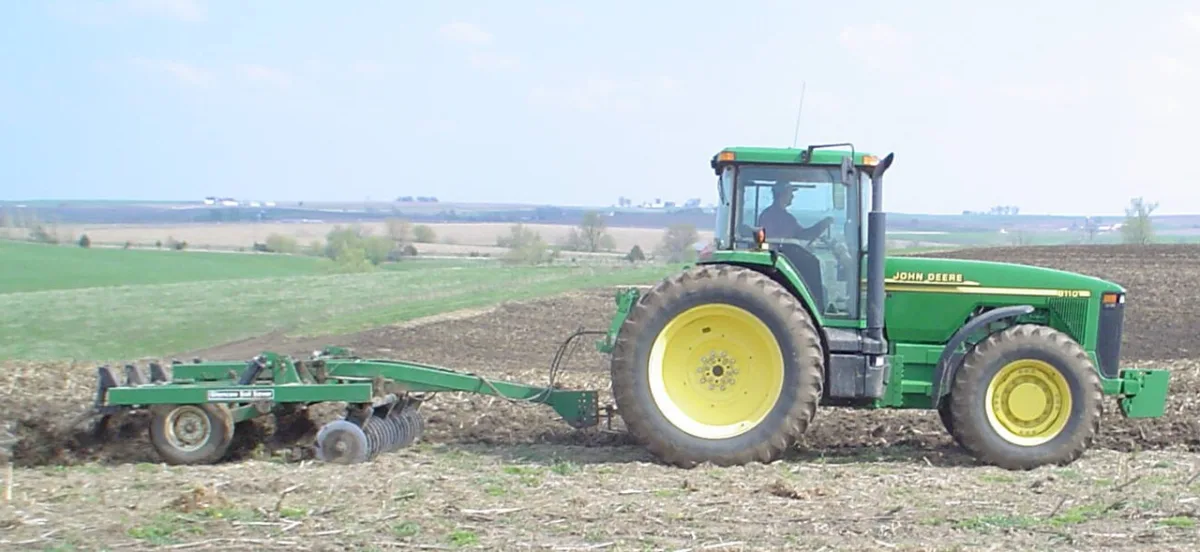
Choosing a ploughing method and field preparation
The choice of ploughing method—land-based, non-stop circular, or reversible—is made taking into account the design of the plough, the relief, and the size and shape of the field. The land-based method remains the most common in production. For this, the plot is divided into rectangular sections, the length of which depends on the dimensions of the field. It is important to calculate the width of the section so as to minimize idle machine travel, save fuel, and increase unit productivity. This value must be a multiple of the working width of the plough.
Sections that are too narrow lead to the formation of a large number of ridges and furrows, while those that are too wide increase the time spent on idle tractor turns. At opposite ends of the sections, headlands must be marked out for turning the unit. Their width depends directly on the dimensions of the machinery and the method of coupling.
| Plough type | Headland width, m |
|---|---|
| 4- and 5-bottom ploughs | 10—15 |
| Trailed and semi-mounted 5- and 6-bottom ploughs | 15—20 (sometimes up to 30) |
Land-based ploughing is performed either as "in-turning" (starting from the middle of the section with a right turn) or "out-turning" (starting from the edges with a left turn). When working "in-turning," a ridge is formed in the center of the section, and when working "out-turning," a split furrow is formed. The quality of these elements is strictly regulated by technological requirements.
Quality requirements for land-based ploughing:
- the ridge must not protrude above the general surface of the ploughed field;
- the depth of ploughing under the ridge must be at least half of the target field tillage depth;
- the depth of the split furrow must be within 10—12 cm.
The non-stop circular method is suitable for large square fields. Ploughing begins "in-turning" from the center of the field until the distance to all four edges is equalized, after which the plough turns the furrow slice toward the processed area, moving in a circle. At the corners, the unit is raised to the transport position and turned 270 degrees to the left. This method eliminates split furrows in the field; however, due to frequent one-sided tractor turns, it reduces productivity and is rarely used.
Reversible ploughing with reversible ploughs is the most technologically advanced option, in which furrow slices are thrown strictly in one direction. In this case, the field does not need to be divided into sections, and no ridges or furrows are formed. The direction of furrow slice turnover changes with each pass from right to left and vice versa. If the field has a triangular shape, it is more rational to process it using the "out-turning" method.
Technologies for deepening and cultivating the topsoil
Historically, the depth of the topsoil on sod-podzolic soils did not exceed 14—15 cm, and in a significant area, it was no more than 12 cm. Due to the development of farming practices and the application of fertilizers, this indicator was increased to 20—22 cm. Currently, a topsoil with a depth of 30—35 cm is considered economically advantageous. However, it makes no sense to mechanically increase the tillage depth without applying organic matter, mineral fertilizers, lime, and green manure crops.
When creating a deep plough layer on sod-podzolic soils, it is important to keep the top layer in place, while loosening and cultivating the underlying layers specifically. This rule is followed particularly strictly when the initial plough layer is shallow. On sod-podzolic light-loamy soils with a humus layer thickness of 20—22 cm, correct agricultural practices allow for high yields of major crops.
- Cereal yield — 4.5—6.0 t/ha
- Potato yield — 35—40 t/ha
- Root crop yield — 60—80 t/ha
- Perennial grass hay yield — 10—12 t/ha
If the humus layer of the soil is already 20 cm or more, deepening it by ploughing in the podzolic horizon is ineffective. Such soil must be cultivated, and subsoil horizons in over-compacted areas should be loosened using non-inversion tillage tools.
To increase the depth of the plough layer, several proven methods are used in practice:
- ploughing in the underlying soil layer by bringing it to the surface;
- complete inversion of the plough layer with simultaneous loosening of a portion of the subsoil horizon;
- loosening of the subsoil zone using chisel ploughs or ploughs without skim coulters and mouldboards to a specified depth;
- simultaneous ploughing in of a portion of the subsoil layer with additional loosening of the lower horizon;
- tillage with multi-tier ploughs involving the mutual displacement of soil horizons.
Specifics of cultivating drained peat-bog soils. One of the main tasks of the tillage system">tillage system in crop rotation on cultivated peat-bog soils is the regulation of the accumulation and decomposition of peat organic matter. It has been established that the decomposition of peat organic matter is related to the intensity of loosening.
On peat soils with a medium degree of peat decomposition and low ash content in crop rotations with a three-year field period and crop rotation (perennial grasses of several years of use, winter cereals, spring cereals, row crops), it is recommended to perform ploughing only for the first crop after perennial grasses, and for the others — surface tillage with disc implements. On moderately decomposed peat soils, it is better to plough the perennial grass layer with marsh ploughs to a depth of 25—30 cm for row crops and 20—22 cm for cereals, with preliminary breaking of the layer using discs.
Tillage in inadequately drained areas begins with ploughing to a depth of 30—35 cm. Deep ploughing contributes to an increase in non-capillary porosity, which slows the movement of water from the lower, waterlogged horizons into the arable layer, allowing the soil to warm up and dry out faster in the spring. In inadequately drained areas, mole drainage is installed in the spring before sowing. This is a special land-reclamation technique for diverting water through tubular channels created in the soil, known as mole drains.
For centuries, ploughing has been the primary form of tillage, although the search for alternatives using shallow cultivation has never ceased. The prominent Russian scientist D. I. Mendeleev wrote over 120 years ago: "...Many fall into the error of believing that the more times one ploughs, the better." At the end of the 19th century, I. E. Ovinsky was an active advocate of shallow non-plough tillage in Russia. At the first Kiev Agricultural Congress in 1890, he stated: "I reject deep ploughing with a plough and acknowledge the necessity of loosening the soil, but this should not be done by a plough that turns over the lower layer every year, but by a subsoiler and a cultivator. I recognize only the necessity of shallow ploughing of 2—3 inches (5.0—7.5 cm) for the destruction of weeds and the incorporation of manure."
The idea of shallow tillage in the 1930s was promoted in the southeast of Russia by N. M. Tulaikov, who proposed switching completely from mouldboard ploughing to surface tillage with disc implements. However, shallow tillage led to increased weed infestation of the fields, and since chemical means of weed control did not yet exist, such tillage was prohibited.
In 1943, the book "Plowman's Folly" by American farmer E. Faulkner was published, in which the author considered annual ploughing to be the main reason for the decline in soil fertility and the development of water and wind erosion processes. E. Faulkner recommended the widespread use of surface tillage to a depth of 7.5 cm, which provides a more favorable water and nutritional regime. This book had a significant impact on the further development of agriculture in various countries.
In 1954, T. S. Maltsev proposed a no-mouldboard system for primary and Pre-sowing tillage soil">pre-sowing tillage. His Tillage system soil">tillage system provided for alternating deep no-mouldboard ploughing with special ploughs featuring narrow streamlined standards and surface tillage with disc harrows to a depth of 10–12 cm by year and field in grain-fallow and grain-fallow-row crop rotations. This fundamentally differ-
Read next
Farm machinery For agronomists
Technologies and agrotechnical requirements for primary tillage

Economics For students
Economic efficiency of organizing production processes in agriculture
Farm machinery For agronomists