
Design features and advantages of Lemken Europal reversible ploughs
8 min read
The requirements of modern agricultural enterprises for reversible ploughs are constantly growing. Semi-mounted ploughs fully meet these requirements, especially such as: ease of operation, high quality of ploughing, high productivity; the ploughs possess high maneuverability: at maximum productivity, a quick turn on a narrow headland is ensured; convenient adjustment of the working width, depending on soil and climatic conditions – an important contribution to improving the ecology and economics of farming; high strength of the ploughs – an important factor in the conditions of increasing tractor traction power, which requires an increase in working width; despite the large working width, the ploughs effectively plough the field edges, as well as areas along fences and ditches; the skimmers are adjusted quickly, simply, and practically without tools; road transport can be carried out at high speed without causing a load on the tractor; high wear resistance of working parts ensures cost savings on ploughing.
Advantages of company reversible ploughs 1. Mounted reversible plough with the possibility of step-by-step adjustment of the working width of each body from 30 to 50 cm in four positions. 2. Options from two- to six-furrow ploughs for tractors with a capacity of 33 to 184 kW (45–250 hp). 3. Distance between bodies is 90 or 100 cm, and frame height is 75 or 80 cm.
Possibility of equipping bodies with a mechanical or hydraulic automatic non-stop overload protection mechanism. Turnover mechanism
All Lemken ploughs are equipped with a modern hydraulic Uniturn turnover mechanism and a double-acting reversing cylinder with an automatic switching valve, as well as automatic locking of the vertical plough position in the furrow. This means that precise switching and a quick turn are ensured. When ploughing, there is no need to additionally adjust the plough tilt even in case of leaks or pressure loss in the tractor's hydraulic system. The switching valve is located in a protected place next to the hydraulic cylinder. Due to this, quick replacement and expansion of control devices are possible. With a separate return line to the tractor's oil tank, all Lemken reversible ploughs can be connected to the tractor with just one single-acting control device.
Replaceable headstock shaft with variable height To ensure the optimal position of the tractor's lower link, the height-adjustable headstock shaft meets all possible operating conditions. If necessary, the shaft can be replaced quickly and easily. The spring-loaded headstock shaft absorbs shock loads and thereby protects the tractor and the implement.
Optiquick adjustment center is an unsurpassed system. It ensures minimal traction resistance of the plough. Setting the front furrow width and the optimal line of draft between the tractor and the plough is carried out simply and quickly.
Adjustment of the vertical plough position in the furrow
The vertical position of the plough in the furrow is adjusted by cap nuts independently of each other. They are easily adjusted and protect the threads from contamination. Thanks to this, it is always possible to easily change the plough tilt in the furrow.
Toolbox in the plough frame
Lemken ploughs are easy to maintain. Tools, shear bolts, and other small parts are always at hand in the toolbox.
The front furrow width is set using the outer spindle. The tractor is still pulling to the side because the imaginary line of draft between the tractor and the plough (connection between points Z and PZ) does not intersect the rear axle of the plough in the center (M). Side draft is eliminated using the inner spindle. Now the line of draft between the tractor and the plough intersects with the tractor's rear axle in the center (M). Side draft is completely eliminated. The correction of side draft did not affect the front furrow width.
A strong and thick-walled frame made of rectangular section profiles, manufactured from a special fine-grained micro-alloy steel, ensures high stability of the new frame design. The frame is light in weight and provides a long service life for the plough. A flange is welded to the rear part of the frame, which allows for attaching one additional pair of bodies.
The Europal working width adjustment brackets are not welded, but bolted to the frame. This results in greater stability, increased strength, and assembly precision. Four different working widths are set quickly and simply by loosening the central bolt and repositioning the adjusting screw:
| Minimum width | 30 cm |
| Maximum width | 50 cm |
The optimal position of the skimmers and disc coulters is also adjusted automatically.
The body frog is strengthened by heat treatment and is therefore very durable. The angle of attack of the plough bodies can be adjusted individually if necessary, which ensures good penetration of the plough into the soil. Thanks to the smooth transition from the share to the moldboard, the traction resistance is reduced to a minimum.
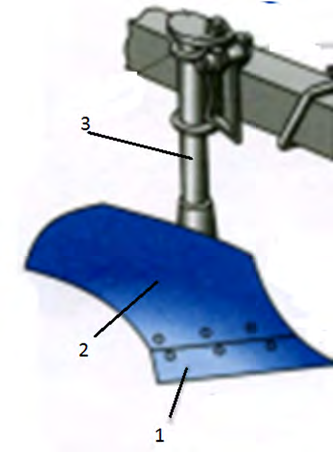
The mouldboards, manufactured from special hardened steel, have a wear-resistant shape, with no bolts in the primary wear area. The particularly large mouldboard edge can be replaced individually without high costs.
The design of Lemken Evropal ploughs is engineered specifically for working in heavy or crop residue-covered fields. Large clearance under the frame, lateral mounting of the bodies, and the special shape of the legs prevent the implement from clogging even at minimum working width. Shear bolts reliably protect the legs from breakage when encountering obstacles, while the double-sided mounting prevents them from twisting.
The replaceable share point, thanks to its shape, thickness, and material, ensures easy penetration of the plough and wears down slowly, saving funds on purchasing spare parts.
Design of working elements: wear resistance and anti-clogging protection
To reduce draught resistance, the designers have implemented a roller mechanism for beam movement. When the plough is lifted out of the soil and re-enters, there is virtually no friction. This ensures smooth movement without jerking, quick entry into the furrow, and reduces tractor power loss. All elements of wearing parts are built with an increased safety margin.
- The strips of the strip mouldboard are made of fully hardened steel, fixed with deep-set bolts, and can be replaced independently of one another. They can be easily replaced with solid mouldboards if necessary, as they are mounted on identical body frogs.
- Separate shares made of micro-alloy boron steel have an overlap that prevents weed roots and wire from winding around the working elements.
- Wide landside plates guarantee stable tracking of the plough in the furrow. The mounting of their knives is located on the shadow side of the cutting elements to protect against wear, and the chamfered edge shape prevents stones and roots from getting stuck.
- Disc coulter diameter — 500 mm
- Skim coulter leg removal — 2 bolts
- Skim coulter models — D1, M2, M3
- Share material — micro-alloy boron steel
Field adjustment: hydraulics and depth regulation without tools
The plough support wheel is positioned in such a way that it allows for working the soil right up to the edges of the field, fences, and boundaries. The ploughing depth is adjusted by resetting a pin, and when the working width is changed, the wheel position is corrected automatically. A hydraulic adjustment system is provided for working on variable terrain.
The operator can adjust the wheel depth directly from the tractor cabin using a double-acting hydraulic distributor, which is especially convenient when finishing the last furrow. Control is performed via a scale that is clearly visible from the operator's seat. The hydraulic cylinder itself is hidden inside the wheel's profile frame, which protects it from dirt and mechanical damage in the field, and the standard scraper prevents soil from sticking to the wheel.
The integrated locking block guarantees that the set working depth is maintained even if there is a pressure drop or oil leak in the tractor's hydraulic system.
Preparing the plough for different soil types and volumes of crop residue is performed with minimal time expenditure. The adjustment of additional working elements is performed according to the following algorithm:
- Set the working depth of the skim coulters using the punch-in pin without using wrenches.
- Adjust the throw angle of organic mass by locking the circular leg with a bolt.
- Adjust the depth of the disc coulter by vertically rotating the leg and locking it via the toothed profile.
- Set the depth of the subsoil loosener without using additional tools.
For clean ploughing of large volumes of green manure or straw, skim coulters of types D1, M3, and M2 are used. Guide legs with holes allow for setting them to the same height without using wrenches. When working without skim coulters, their legs are completely removed. For Evropal and Variopal ploughs, a system for adjusting the organic mass throw angle into the furrow is also available, and D1 and M2 skim coulters can be equipped with special mouldboard strips.
The smooth disc coulter has lateral radial grooves, which ensure its constant rotation even in fields with an abundance of plant residue. The coulter's bearing assembly has a double seal and is made smooth, so it does not snag on freshly ploughed soil. The subsoil loosener effectively crumbles the lower soil layers, is easily dismantled, and its leg is protected from wear by a special shield.
Practical assignment: Knowing the technical specifications of PLN-3-35, PLN-4-35, PLN-4-40, and PLN-5-40 ploughs, determine the total draught resistance of the plough when ploughing stubble. Which tractor models should be paired with these ploughs, and what gear should be used during ploughing?
Read next
Farm machinery For agronomists
Design and operation features of ploughs for reversible ploughing
Farm machinery For agronomists
Classification and design of modern agricultural tractor ploughs
Farm machinery For agronomists