
Production and properties of single superphosphate as a mineral fertilizer
12 min read
Single superphosphate is a classic fertilizer, which accounts for about half of the world's production of phosphorus fertilizers. It can be applied to all types of soil for any crop in a wide variety of ways. It is important for an agronomist to take into account the relatively low concentration of the active ingredient and the specific characteristics of its physical state. The principle of producing the fertilizer was proposed by a German chemist, and the first production plant was built in England in 1843 on the basis of an agricultural experimental station.
Composition and properties of single superphosphate
The active ingredient of superphosphate (Ca(H2PO4)2·H2O + 2CaSO4 with an admixture of free H3PO4) provides plants with easily accessible phosphorus. Most of the contained element (from 88 to 98 %) is in an assimilable form. Depending on solubility, this phosphorus is divided into water-soluble and citrate-soluble fractions.
- P2O5 content — 14–20 %
- Share of assimilable phosphorus — 88–98 %
- Share of water-soluble phosphorus — 75–90 %
- Share of citrate-soluble phosphorus — 10–25 %
| Phosphorus form | Share of assimilable phosphorus, % | Chemical compounds |
|---|---|---|
| Water-soluble | 75–90 | Monocalcium phosphate Ca(H2PO4)2·H2O and free phosphoric acid H3PO4 |
| Citrate-soluble | 10–25 | Dicalcium phosphate CaHPO4 |
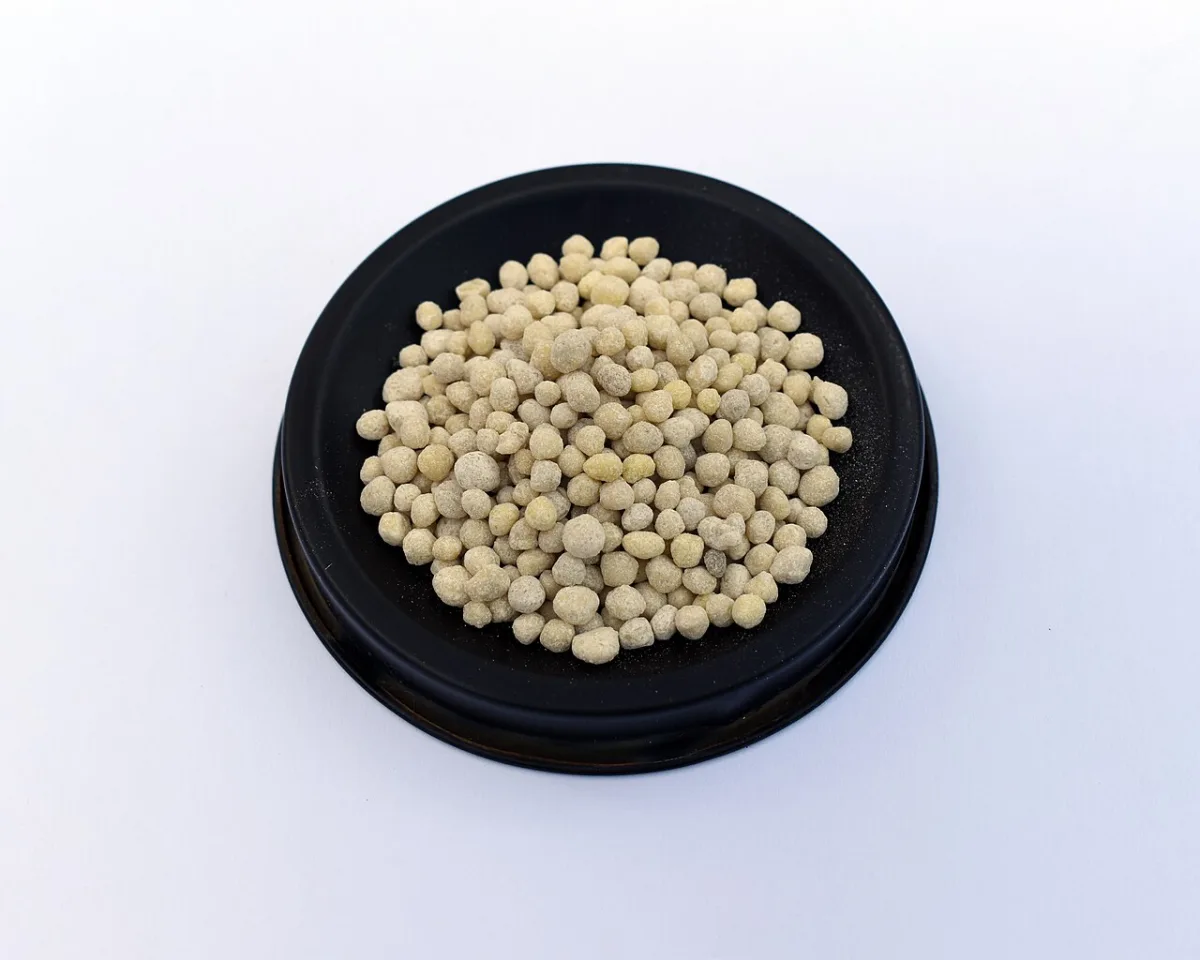
Powdered superphosphate has unsatisfactory physical properties: it cakes during storage, forms lumps, and is difficult to sow with fertilizer drills. For the convenience of mechanical application, the industry also produces a granulated form.
Chemical foundations of production and storage
The essence of production lies in the decomposition of natural fluorapatite [Ca3(PO4)2]3·CaF2 with sulfuric acid H2SO4. As a result, insoluble neutral calcium phosphate is converted into soluble acid salts, primarily into Ca(H2PO4)2·H2O, as well as dicalcium phosphate CaHPO4 and free phosphoric acid. The overall reaction of raw material decomposition is as follows:
[Ca3(PO4)2]3·CaF2 + 7H2SO4 + 3H2O = 3Ca(H2PO4)2·H2O + 7CaSO4 + 2HF
Sulfuric acid also decomposes the calcium carbonates CaCO3 and magnesium carbonates MgCO3, as well as aluminum and iron compounds contained in the phosphorite. The presence of calcium carbonate CaCO3 in an amount of up to 5 % is a desirable impurity. The resulting gypsum crystallizes with two molecules of water, binds moisture, and promotes the hardening of the product, while the released carbon dioxide gives the superphosphate porosity and looseness. When apatite is used, the fertilizer is lighter and less porous than that made from phosphorite.
During the reaction, calcium fluoride CaF2 is decomposed by sulfuric acid with the formation of hydrogen fluoride HF: CaF2 + H2SO4 + 2H2O = CaSO4·2H2O + 2HF. Fluorine gases at a concentration of 0.005 % are extremely toxic to humans and animals. For this reason, during the production process, they must be captured and neutralized with water, soda, or potash.
The presence of iron and aluminum compounds in the raw material is undesirable, as an excessive amount of sulfuric acid is consumed for their decomposition. The resulting iron and aluminum phosphates are chemically unstable and undergo retrogradation during storage — the conversion of phosphoric acid into poorly soluble compounds. A certain excess of sulfuric acid in superphosphate, although it acidifies the fertilizer, helps to delay this process. Conversely, an increase in temperature and pressure in the warehouse can further intensify the retrogradation of phosphorus.
Ca(H2PO4)2·H2O + Fe2(SO4)3 + 3H2O = 2FePO4·2H2O + CaSO4 + 2H2SO4
FePO4·2H2O + CaSO4 = CaSO4·2H2O + FePO4
When storing superphosphate, for every percent of iron and aluminum sesquioxides, one can expect a decrease in the amount of water-soluble P2O5 by approximately 0.65 %. Apatite after flotation contains no more than 2.5 % sesquioxides, which is significantly less than in phosphorite.
Due to uneven mixing of components, local deviations from the norm occur in certain parts of the reaction mass. With an excess of sulfuric acid, fluorapatite decomposes completely, releasing free phosphoric acid, calcium sulfate, and hydrogen fluoride: [Ca3(PO4)2]3·CaF2 + 10H2SO4 = 6H3PO4 + 10CaSO4 + 2HF. The final product always contains 5.0–5.5 % of free phosphoric acid, which causes its increased acidity and hygroscopicity. In places with a deficit of acid, dibasic calcium phosphate — precipitate — is formed: [Ca3(PO4)2]3·CaF2 + 4H2SO4 + 12H2O = 6CaHPO4·2H2O + 4CaSO4 + 2HF.
The production of superphosphate requires almost equal amounts of phosphate raw materials and sulfuric acid. In this process, the concentration of phosphorus in the finished fertilizer turns out to be almost 2 times lower than in the original raw material. For this reason, low-grade phosphorites are unsuitable for processing, and Kola apatite concentrate is used in Russia. The technological process for producing superphosphate is organized according to one of three schemes.
- Batch process: mixing phosphate rock with sulfuric acid and curing in mixers or Beskov wagon chambers are carried out cyclically in batch-operated equipment.
- Semi-continuous process: mixing phosphate with acid is continuous, while curing of the superphosphate in Beskov wagon chambers occurs periodically.
- Continuous process: all stages of the technological process are carried out in a continuous flow.
How superphosphate works in the soil: application rules
After being applied to the soil, calcium dihydrogen phosphate quickly turns into hydrogen phosphate. In neutral soils, this reaction proceeds according to the following scheme:
Ca(H2PO4)2 + Ca(HCO3)2 = 2CaHPO4·2H2O↓ + 2CO2
If carbonates are present in the soil, the process continues until the formation of poorly soluble compounds — hydroxylapatite and fluorapatite:
Ca(H2PO4)2 + 2Ca(HCO3)2 = Ca3(PO4)2 + 4H2O↓ + 4CO2
Such chemical absorption reduces the mobility of phosphorus in neutral soil. However, freshly precipitated calcium phosphates dissolve well in weak acids and remain available to the root system. In acidic soils with a high content of sesquioxides, the situation is different — there, phosphorus is bound into aluminum and iron phosphates that are insoluble and practically inaccessible to plants:
Ca(H2PO4)2 + 2Al(OH)3 = 2AlPO4↓ + Ca(OH)2 + 4H2O
A portion of phosphate anions on all soil types is adsorbed by colloidal particles in exchange for other anions (predominantly HCO3–) — in this state, they are easily absorbed by plants. A further amount of phosphates is temporarily bound by soil microorganisms, incorporating them into the protoplasm of their cells.
To avoid rapid binding of phosphorus in acidic soils, do not mix powdered superphosphate with a large volume of soil. To increase the effectiveness of the fertilizer, be sure to perform liming of acidic soils, adjusting the pH of the soil solution to a slightly acidic or neutral reaction.
Ordinary superphosphate does not cause permanent acidification of the soil. Plants quickly absorb phosphoric acid, and its excess in acidic soils is bound by iron and aluminum oxides.
Granular ordinary superphosphate is universal. It is used for basal, pre-sowing, and at-sowing application, as well as for top dressing for any crops on all soil types. The most effective and economical method is localized application into rows during sowing.
- Dose reduction with localized application — 3 times
- Sulfur content in gypsum composition — up to 8–12%
- Commercial granule size — from 1 to 4 mm
- Free phosphoric acid in granules — 1–2.5%
- Humidity of the finished fertilizer — 1–4%
To preserve the physicochemical properties, it is recommended to transport superphosphate in bulk or in water-resistant bags.
Granular and double superphosphate: technologies and properties
Granulation allows for a significant reduction in phosphorus retrogradation — the process of its conversion into insoluble forms. Granular fertilizer does not cake, does not clump, and contains more phosphorus and less moisture compared to its powder analog. Granules dissolve slowly, the contact area with the soil is reduced, which protects the active ingredient from rapid chemical binding.
The technology of granulating ordinary superphosphate does not require binding agents and consists of several sequential steps:
- Moistening the finished powdered superphosphate.
- Rolling the mass in a drum granulator to form granules.
- Drying the obtained granules in a drying drum.
- Sorting on a screen to select a fraction with a diameter of 1 to 4 mm.
- Crushing large granules and returning the fine fraction (fines) for re-granulation as centers for the formation of new granules.
Double superphosphate is a concentrated water-soluble fertilizer obtained by decomposing crushed natural phosphate with phosphoric acid. Visually, it resembles ordinary superphosphate (light gray granules) but contains 2–3 times more available phosphorus. Its base is calcium dihydrogen phosphate monohydrate Ca(H2PO4)2·Н2О. The product also contains impurities: calcium sulfate, iron and aluminum phosphates, monomagnesium phosphate, silicofluorides, as well as undecomposed phosphate, dicalcium phosphate, free phosphoric acid (up to 2.5%), and free moisture. The total content of available phosphorus ranges from 37 to 54% in terms of P2O5.
| Fertilizer grade | Cultivar | Content of available P2O5, % |
|---|---|---|
| Grade A | — | 49 |
| Grade B | I cultivar | 46 |
| Grade B | II cultivar | 43 |
According to the international classification of the ISMA (International Superphosphate and Compound Manufacturers Association), double superphosphate is a product containing 25% P2O5. Fertilizers with a concentration of 43–49% are classified abroad as triple superphosphate.
The production of double superphosphate consists of two main stages. In the first stage, phosphoric acid is obtained. The most common method is the extraction method, in which phosphorite is treated with a 20–25% solution of sulfuric acid:
Ca3(PO4)2 + 3H2SO4 + 6H2O = 2H3PO4 + 3CaSO4·2H2O
The resulting phosphoric acid is separated from the gypsum by filtration and then directed to the second stage for the decomposition of phosphate raw materials. The main stages of the process are carried out in continuous-flow apparatuses, which are replacing batch units.
A more advanced method of producing phosphoric acid is the sublimation of phosphorus from low-percentage phosphorites at temperatures of about 1400–1600 °C in electric or blast furnaces with coke or anthracite. The released elemental phosphorus is collected under water, then burned in the presence of air, and the resulting phosphorus pentoxide is combined with water:
Р2О5 + 3Н2О = 2Н3РО4.
Then (phase 2), the resulting phosphoric acid is used to treat high-concentration phosphate raw materials:
Ca3(PO4)2 + 4H3PO4 + 3H2O = 3Ca(H2PO4)2·H2O,
[Ca3(PO4)2]3·CaF2 + 14Н3РO4 + 10Н2О = 10Са(Н2РО4)2·Н2О + 2HF. The released HF reacts with silicic acid to form H2SiF6 and SiF4:
4 2 = SiF4 + 2H2O,
SiF4 + 2HF = H2SiF6.
Hydrofluorosilicic acid is converted into calcium, sodium, and potassium fluorosilicates, while silicon tetrafluoride is partially released in a gaseous state.
The phosphorus content in the fertilizer and the composition of impurities depend on the initial phosphate raw material used in the second technological phase. The best triple superphosphate is obtained from apatite. It contains 45–49% plant-available phosphorus, no more than 2.5% free acid, and at least 85% water-soluble P2O5.
Triple granular superphosphate is an exceptionally valuable, transportable, and cost-effective fertilizer: compared to simple superphosphate, its application rate is 2 times lower, both for broadcast and localized application.
Triple superphosphate, like simple superphosphate, turns into less soluble compounds during interaction with the soil, leading to retrogradation. In soils with a neutral or slightly alkaline reaction (chernozems, calcareous soils) saturated with bases (calcium, magnesium) and containing calcium bicarbonate 3)2], superphosphate turns into dicalcium phosphate (CaHPO4) and calcium phosphate [Ca3(PO4)2]:
Ca(H2PO4)2 3)2 = 2CaHPO4 + 2H2O + 2CO2,
Ca(H2PO4)2 + 2 3)2 = Ca3(PO4)2 + 4H2O + 4CO2,
ППК 2PO4)2 ⇄ ППК]2H + 2CaHPO4.
Dicalcium phosphate is available to plants; calcium phosphate is less accessible but can be gradually utilized by plants.
Superphosphate undergoes a somewhat different transformation in acidic sod-podzolic soils rich in mobile forms of iron and aluminum. Here, iron and aluminum phosphates, which are poorly soluble and have low accessibility to plants, can form:
3Ca(H2PO4)2 + 4 3 = 4AlPO4↓ + Ca3(PO4)2↓ + 12H2O,
Ca(Н2РО4)2 3 = FePO4H2 4·H2O↓+ H2O. Aluminum phosphate also forms during the interaction with exchangeable aluminum:
[ППК]2 2 PO 4) 2 ⇄ ППК Са
4Н + 2AlPO 4 ↓
The chemical fixation of superphosphate by the soil is a negative phenomenon, as it leads to a decrease in its availability. The strength of chemical phosphorus fixation can be reduced by various techniques: granulating superphosphate during its production; localized application near the plant; using powdered superphosphate mixed with a small amount of humus, peat, and other organic additives.
In terms of their effect on plant productivity, triple and simple superphosphate are similar. Triple superphosphate, which contains no gypsum, is preferable for application to tea bushes and other calcifuge plants, while simple superphosphate, with its significant amount of gypsum, is more useful for plants with a high demand for sulfur. With a single local application, these fertilizers are equivalent. With systematic application of simple and triple superphosphate in the same place, there may be differences due to the varying content of calcium and sulfur in them.
Enriched superphosphate. Obtained from apatite concentrate by treatment with sulfuric acid and a small amount of non-evaporated extraction phosphoric acid. It is produced in powdered and granular form. Enriched powdered superphosphate contains at least 23.5% plant-available phosphorus and no more than 5% free phosphoric acid; granular – 24.5% and 1–2.5%, respectively. The gypsum content in enriched superphosphate is lower than in simple superphosphate. It is applied in the same way as simple superphosphate.
Superphos. Contains 36% P2O5 (60% in water-soluble form and 40% in a less accessible form) in the form of di- and tricalcium phosphate. In appearance, these are angular dark-gray granules. This fertilizer is obtained by chemical enrichment and activation of phosphate rock with a mixture of sulfuric and phosphoric acids. To produce 1 ton of P2O5 in superphos, 1–1.3 tons of H2SO4 and 0.36 tons of H3PO4 are used. Superphos is produced in granular form. It is used as a basal fertilizer on acidic and neutral soils. In terms of agronomic efficiency, superphos is not inferior to superphosphates.
Read next
Agrochemistry For students
Production, properties and application specifics of precipitate as a phosphorus fertilizer
Agrochemistry For students
Natural sources of raw materials for the production of mineral phosphate fertilizer.
Agrochemistry For students