
Production technologies for nitrogen-phosphorus fertilizers nitrophos and nitrophoska
16 min read
Combined concentrated fertilizers differ significantly from standard fertilizer blends due to their high uniformity of composition. Thanks to a unified production technology, all salts are distributed evenly throughout the mass. Each granule contains an identical set of nutrients, which eliminates non-uniformity in fertilizer application in the field.
The use of combined fertilizers helps avoid segregation of the mixture during transport and application, ensuring uniform plant nutrition across the entire sowing area.
Nitrophos: purification methods and application features
Nitrophos is a dual nitrogen-phosphorus fertilizer (a mixture of NH4NO3 + Ca(H2PO4)2 + CaSO4) obtained through the nitric acid decomposition of phosphates. During its production, a large amount of calcium nitrate (Ca(NO3)2) is formed. This is an undesirable impurity: it causes the fertilizer to become highly damp during storage, and the excess calcium binds phosphorus into tricalcium phosphate, which is difficult for plants to access.
To remove excess calcium from the reaction mixture, five technological schemes are used:
- Freezing. The solution is cooled, resulting in the precipitation of Ca(NO3)2 · 4H2O. The degree of purification depends on the temperature, solution concentration, nitrogen acid application rate, settling time, and the CaO:P2O5 ratio. The remaining solution is treated with ammonia and evaporated, yielding a mixture of ammonium phosphates, dicalcium phosphate, and ammonium nitrate.
- Carbonate scheme. Calcium is removed from the solution by passing carbon dioxide through it.
- Sulphate scheme. The reaction mixture is treated with ammonium sulphate. By dosing the ammonium sulphate, it is possible to regulate the amount of water-soluble phosphorus in the finished product.
- Sulphuric acid scheme. Calcium is bound with sulphuric acid, and the precipitated gypsum is filtered out. After ammoniation of the residue, dicalcium phosphate and ammonium phosphate are obtained.
- Phosphate scheme. A mixture of nitric and phosphoric acids is used to decompose the raw material, followed by neutralization with ammonia.
Regardless of the production method, phosphorus in nitrophos exists in two forms: rapidly accessible water-soluble (NH4H2PO4) and gradually assimilable citrate-soluble (CaHPO4). The fertilizer has excellent physical properties and is suitable for all soil and climatic zones for any crop when plants require nitrogen and phosphorus but have no need for potassium.
- Share of water-soluble phosphorus — no less than 40%
- Composition of Grade A (N-P-K) — 23.5–17–0
- Composition of Grade B (N-P-K) — 24–14–0
Nitrophoska: preventing retrogradation and rules for working on different soils
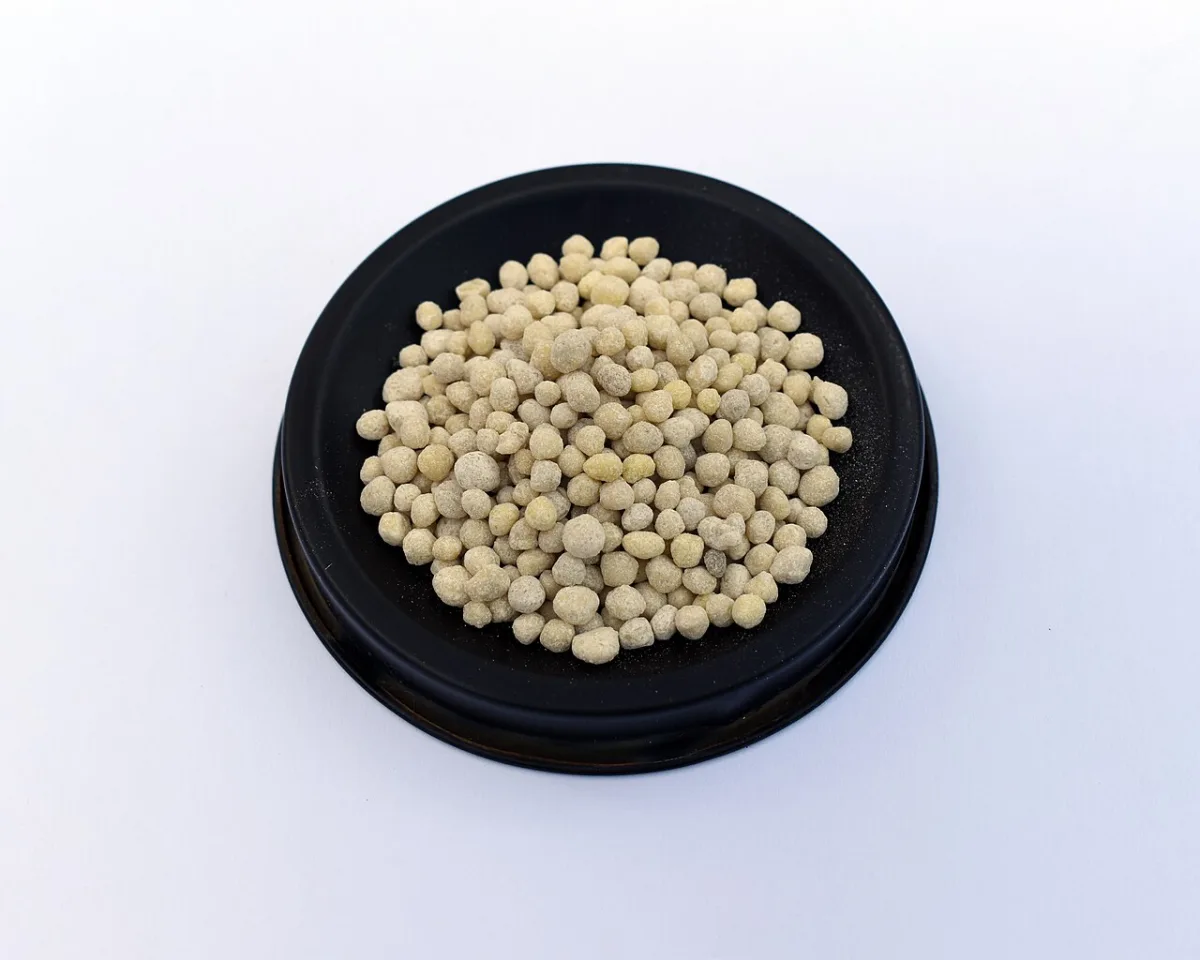
Nitrophoskas are triple granular fertilizers of a light grey or light pink color, obtained by adding potassium chloride to nitrophos. Nitrogen and potassium are contained in them in readily soluble forms (NH4NO3, NH4Cl, KNO3). Phosphorus is present partly in the form of water-soluble compounds (ammonium phosphate, monocalcium phosphate) and partly in the form of dicalcium phosphate, which is not soluble in water but is easily accessible to the root system of plants.
Depending on the production technology, the total content of active ingredients in nitrophoskas ranges from 35 to 50%.
| Active ingredient (element) | Content in fertilizer, % |
|---|---|
| Nitrogen (N) | 10–17 |
| Phosphorus (P2O5) | 8–30 |
| Potassium (K2O) | 12–20 |
Nitrophoska is produced only in granules. Thanks to this, the contact area between the fertilizer and the soil is minimal, which significantly reduces phosphorus retrogradation — the process of its conversion into compounds that are sparingly soluble and inaccessible to plants. The presence of the citrate-soluble fraction of phosphates also contributes to this.
Phosphorus retrogradation occurs especially intensely in acidic soils with a high content of mobile aluminum and iron. Using granular nitrophoska on such plots helps maintain phosphorus availability for plants.
When choosing a grade of nitrophoska, always consider the form of phosphates it contains:
- Carbonate nitrophoska, containing water-insoluble phosphates, is advisable to apply exclusively on acidic soils.
- Nitrophoskas with water-soluble phosphates are universal and suitable for application on acidic, neutral, and alkaline soils.
Two-component fertilizers: nitroammophos and nitrodiammophos
Nitroammophos (NH4H2PO4 + NH4NO3) is a nitrogen-phosphorus granular fertilizer of a light grey color. The acids for its production are neutralized with ammonia either together or separately. Manufacturers produce the fertilizer in five standard grades with a nutrient ratio of 1:1:0, 1:1.5:0, 1:0.8:0, 1:2.2:0, and 1:0.6:0.
Nitroammophos production reactions:
- Joint method: 2NH3 + HNO3 + H3PO4 = NH4NO3 + NH4H2PO4
- Separate method: NH3 + HNO3 = NH4NO3 and NH3 + H3PO4 = NH4H2PO4
- Commercial fraction (1–4 mm) — no less than 90%
- Large granules (4–5 mm) — no more than 5%
- Fine fraction (less than 1 mm) — no more than 5%
- Packaging temperature — no higher than 50 °C
- Shelf life without caking — 1 month
The physical and mechanical properties of nitroammophos allow for the full mechanization of its distribution across the field. Apply this fertilizer as a base treatment, at sowing, or for top dressing. It is effective for all agricultural crops on soils that are well-supplied with available potassium.
Nitrodiammophos (diammonium nitrophosphate) has the formula NH4NO3 + (NH4)2HPO4. The production of diammonium nitrophosphate is similar to that of nitrophosphate, but phosphoric acid is neutralized with ammonia more thoroughly. It is produced by the recycle process from thermal or extraction phosphoric acid based on flotation concentrates of apatite ore. The product is supplied exclusively in granular form.
- Nitrogen content (N) — 23%
- Phosphorus content (P2O5) — 31%
- Granule size — 1–4 mm
Due to its good flowability, nitrodiammophos is easily applied by all types of fertilizer spreaders. Use it for basal application, application at sowing, and top dressing on soils with sufficient potassium content. The fertilizer shows high efficiency on grain and forage crops, as well as on meadows and pastures, not inferior in its effect to equivalent mixtures of simple fertilizers.
Three-component fertilizers: nitrophosphate and nitrodiammophosphate
Nitrophosphate (NH4H2PO4 + NH4NO3 + KCl) is a granular nitrogen-phosphorus-potassium fertilizer of light pink color. In the production process, nitric and phosphoric acids are ammoniated, or nitric acid decomposition of apatite is carried out to obtain ammophos and ammonium nitrate. The solution is evaporated, mixed with potassium salts, dried, and granulated. Manufacturers offer grades with different nutrient ratios.
All salts in the composition of nitrophosphate are completely soluble in water. A high concentration of active ingredients (at least 50% in total of N, P2O5, and K2O) reduces transport and storage costs compared to simple fertilizers. In terms of impact on yield, the fertilizer is equivalent to a physical mixture of simple fertilizers. The greatest effect is achieved on chernozems and sierozems under irrigation, as phosphorus from ammonium phosphate is absorbed by plants faster than from calcium phosphates.
Nitrophosphate is used for basal application and application at sowing, as well as for root-zone top dressing. The optimal timing and methods of fertilizer incorporation directly depend on the particle-size distribution of the soil and the cultivation zone. This helps avoid unproductive nitrogen losses due to leaching.
On chernozems and heavy clay soils of the Non-Chernozem zone, it is advisable to apply nitrophosphate in the autumn before winter ploughing. On light soils, delay application until spring.
Nitrodiammophosphate (diammonium nitrophosphate) consists of NH4NO3 + (NH4)2HPO4 + KCl. The production technology of this triple complex fertilizer differs from nitrodiammophos only by the addition of a potassium component at the granulation stage. It has a light pink color and is characterized by excellent physical and mechanical properties. This fertilizer does not cake, is easily distributed by any fertilizer spreaders, and is recommended for all crops on any soil type.
Urea-containing and chlorine-free complex fertilizers
Carboammophos CO(NH2)2+NH4H2PO4 contains nitrogen in amide and ammonium forms, and phosphorus in a completely water-soluble form. The fertilizer is produced from urea, phosphoric acid, and ammonia. In the production process, phosphoric acid is ammoniated to monoammonium phosphate, urea is added to the resulting pulp, after which the mixture is dried and granulated. Carboammophos can also be obtained by mixing powdered ammophos with urea melt followed by drying and granulation.
The technology allows for the production of fertilizers with virtually any ratio of nutrients. This allows for flexible selection of grades for specific soil-climatic conditions and the requirements of the crops being grown. Currently, three main grades of this fertilizer are produced.
| N:P₂O₅:K₂O ratio | Total N, % | Amide N, % | Ammonium N, % | P₂O₅, % | Total N+P₂O₅, % |
|---|---|---|---|---|---|
| 2:1:0 | 35.3 | 29.0 | 6.3 | 17.1 | 52.4 |
| 1:1.5:0 | 22.9 | 14.4 | 8.4 | 37.3 | 60.2 |
| 1:1:0 | 29.6 | 25.5 | 4.2 | 28.3 | 57.9 |
Carboammophos is most effective on soils with high potassium availability. In such areas, its effectiveness is not inferior to mixtures of simple fertilizers, and under irrigated agriculture, it even surpasses them.
Carboammophosphate CO(NH4)2+NH4H2PO4+KCl is a three-component granular fertilizer with good physical and mechanical properties. It is produced based on urea melt, ammonium phosphates, and potassium chloride, which are mixed, ammoniated, granulated, and dried. The phase composition of the finished fertilizer includes 21% KCl, 13.3% KH2PO4, 14.4% NH4H2PO4, 9.7% (NH4)2HPO4, 11.0% [CO(NH2)2]₂·NH₄Cl, and 0.7% H₂O with a conversion rate of potassium chloride of 26–27%.
Nitrogen in carboammophosphate is represented by urea, so it is less mobile in the soil than nitrate nitrogen. For this reason, it is recommended to primarily use the fertilizer on light soils in areas with excessive humidity, on irrigated lands, as well as for basal application for any agricultural crops.
| N:P₂O₅:K₂O ratio | Total active ingredients, % | Total N, % | Amide N, % | Ammoniacal N, % | P₂O₅, % | K₂O, % | Biuret, % |
|---|---|---|---|---|---|---|---|
| 2:1:1 | 48.8 | 23.5 | 20.0 | 3.5 | 12.7 | 12.6 | 0.2 |
| 1:1:0.5 | 57.3 | 21.4 | 16.4 | 5.0 | 25.7 | 10.2 | 0.6 |
| 1:1:1 | 59.8 | 19.1 | 12.5 | 6.6 | 21.9 | 18.8 | 0.1 |
Phosphorus in carboammophoska is present in the form of water-soluble ammonium phosphate. It performs more effectively than calcium phosphates, which is especially noticeable in neutral and slightly leached soils, such as chernozems and sierozems. In terms of efficiency, this fertilizer is completely equivalent to a mixture of urea, superphosphate, and potassium chloride.
To address specific tasks, Superphoska, Carboammopolyphoska, and Crystallin are used within the line of complex fertilizers.
- Carboammopolyphoska grade — 21:21:21 (N:P:K)
- Active ingredient content in Superphoska — 11–16% P₂O₅ and 12–21% K₂O
- Crystallin humidity — no more than 1.5%
- Total NPK in Crystallin — from 41 to 66%
Superphoska is a complex phosphorus-potassium powdered fertilizer obtained by the decomposition of phosphorites with sulfuric acid in the presence of potassium chloride. It is used as a base fertilizer for all crops. Carboammopolyphoska is a granular three-component fertilizer with good physical properties, in which a portion of the phosphorus is in a condensed form. It is applied to all agricultural crops both as a base fertilizer and for at-planting application.
Crystallin is a chlorine-free water-soluble fertilizer. Its composition includes 10–20% total nitrogen (including 5–12% ammoniacal and 2–8% nitrate nitrogen), 10–20% available phosphorus, and 10–20% potassium. Crystallin is obtained by neutralizing a mixture of thermal phosphoric and nitric acids with gaseous ammonia, followed by evaporation to a melt, the addition of potassium sulfate, and subsequent granulation. The fertilizer is optimal for use in greenhouses by spraying an aqueous solution.
Application features and risks of retrogradation of ammoniated superphosphate
Ammoniated superphosphate [Ca(H₂PO₄)₂·H₂O+2CaSО₄+NH₄H₂PO₄] is obtained by saturating superphosphate with anhydrous ammonia, ammonia solution, or ammoniates. Solutions of calcium nitrate Ca(NО₃)₂·NH₄NO₃ and urea CO(NH₂)₂ in anhydrous ammonia are used as ammoniates. The composition and properties of the finished fertilizer depend on the volume of added ammonia, which determines the depth of chemical reactions.
- Neutralization of free acidity. At low ammonia rates, free phosphoric acid (H₃PO₄) is neutralized to form ammonium dihydrogen phosphate (NH₄H₂PO₄). At this stage, the amount of water-soluble P₂O₅ in the fertilizer does not decrease.
- Formation of calcium diphosphate. As the ammonia dose increases, a portion of calcium monophosphate converts to citrate-soluble calcium hydrogen phosphate via the reaction: Ca(H₂PO₄)₂·H₂O + NH₃ = CaHPO₄ + NH₄H₂PO₄ + H₂O. The proportion of water-soluble phosphorus decreases accordingly.
- Phosphorus retrogradation. Further excessive addition of ammonia leads to a decrease in the total amount of available phosphorus due to the formation of insoluble tricalcium phosphate via the reaction: 3CaHPО₄ + 2NH₃ = Ca₃(PО₄)₂ + (NH₄)₂HPО₄.
The addition of ammonia causes a local rise in pH, which triggers phosphate retrogradation. The technological regime must exclude the reaction forming tricalcium phosphate Ca₃(PO₄)₂. If ammoniation is carried out until the complete conversion of calcium monophosphate to diphosphate, no water-soluble phosphates will remain in the fertilizer, rendering it unsuitable for at-planting application.
Economics and methods of applying liquid complex fertilizers
Liquid complex fertilizers (LCF) are aqueous solutions or suspensions of nutrients. They contain nitrogen and phosphorus or nitrogen, phosphorus, and potassium, and certain grades also include meso- and microelements. Unlike liquid nitrogen fertilizers, LCF do not contain free ammonia, so they can be transported and stored in ordinary non-pressurized containers.
In the field, LCF are free from the disadvantages of dry fertilizers: they do not create dust, do not cake, and maintain free fluidity. Damp weather and even rain do not affect the physical properties of the solutions during storage in a warehouse.
Liquid complex fertilizers can be applied to the soil in two ways:
- by spraying over the field surface followed by mandatory incorporation with a harrow, cultivator, or plough;
- locally in bands directly into the row zone.
The use of LCF completely eliminates manual labor if simple mechanisms for handling liquid phases are available. Switching to a liquid form allows for the optimization of farm costs compared to using solid fertilizers:
| Cost item | Resource savings, % |
|---|---|
| Capital investments | 27 |
| Operating expenses | 15 |
| Manual labor costs | 50–60 |
LCF are produced as transparent solutions without solid suspensions and as suspensions, where small particles of undissolved fertilizer or inert matter are distributed in the liquid phase.
Production technology of LCF and risks of salt crystallization
The basis for producing liquid complex fertilizers (LCF) is the neutralization of orthophosphoric or superphosphoric acid with ammonia (aqueous or anhydrous) until a pH of 6.5 is reached. Superphosphoric acid is a mixture of ortho- and polyphosphoric acids with a P2O5 content of 72–80%. An increase in the nitrogen proportion in the solutions is achieved by adding urea, ammonium nitrate, or a mixture thereof.
- pH level during neutralization — 6.5
- Hot mixing temperature — 210–250 °C
- Cold mixing temperature — 35–45 °C
- P2O5 content in superphosphoric acid — 72–80 %
- Total active ingredient content in ortho-LCF — 24–30 %
The technological process of fertilizer preparation includes the following stages:
- Neutralization of the initial phosphoric acid with ammonia to the target pH value.
- Hot mixing at a temperature of 210–250 °C to obtain base solutions of ammonium ortho- and polyphosphates at large-scale plants.
- Cold mixing at a temperature of 35–45 °C at small rail-side facilities with the addition of urea, ammonium nitrate, and potassium salts.
LCF based on thermal orthophosphoric acid are nearly transparent liquids. Solutions based on extraction acid are cloudy due to the formation of dispersed particles — ammoniated aluminum and iron phosphates, as well as silicic acid. The total concentration of elements in orthophosphoric LCF is 24–30% (with 5–10% nitrogen, 5–14% P2O5, and 6–10% K2O), as more concentrated solutions crystallize and precipitate at low temperatures.
The introduction of potassium into LCF is complicated by the low solubility of potassium chloride, especially in the presence of ammonium nitrate. As a result of an exchange reaction, potassium nitrate forms in the solution — the least soluble salt, which quickly clogs the nozzles of spraying equipment.
LCF based on superphosphoric acid are more concentrated. From polyphosphoric acids with a concentration of 76% P2O5, a base solution of 10–34–0 is produced, and with 78–80% P2O5, the 11–37–0 grade is produced. These liquids can be applied immediately or used as a base for preparing triple NPK suspensions.
During long-term storage of LCF, polyphosphates gradually hydrolyze into orthophosphates, leading to precipitation. The rate of this process increases with higher storage temperatures.
To increase the total concentration of active ingredients without the risk of salt freezing, technicians adjust the ratio of elements in the mixture. The main formulation grades of LCF are shown in the table:
| N : P2O5 : K2O ratio | Grade composition | Formulation features |
|---|---|---|
| 1 : 1 : 1 | 9–9–9 | Standard domestic grade |
| 1 : 2 : 2 | 5–10–10 | Solution with an increased potassium background |
| 1 : 2 : 1 | 7–14–7 | Grade for balanced nutrition |
| 1 : 3 : 1 | 6–18–6 | Phosphorus-potassium grade |
| 1 : 3 : 0 | 8–24–0 | Base nitrogen-phosphorus solution without potassium |
| 0,95 : 3 : 0 | 9–29–0 | Maximum phosphorus concentration without salt crystallization |
To increase the nutrient concentration in liquid complex fertilizers (LCF) and prevent precipitation, stabilizing additives are introduced into the solution. For this purpose, colloidal clay — attapulgite or bentonite — is used, which prevents the supersaturated solution from settling into a solid phase. Such fertilizers are called suspended fertilizers, or slurries. The use of additives allows for the production to utilize cheaper extraction phosphoric acid and to enrich LCF with micronutrients.
- Dry clay application rate — 9–22 kg per 1 t of LCF
- Nutrient content — more than 40%
Suspended fertilizers are produced in various grades with high content of active ingredients. The ratio of elements in the main LCF grades is presented in the table:
| Suspended LCF grade | Nitrogen content (N), % | Phosphorus content (P₂O₅), % | Potassium content (K₂O), % |
|---|---|---|---|
| 12–12–12 | 12 | 12 | 12 |
| 8–10–16 | 8 | 10 | 16 |
| 5–15–20 | 5 | 15 | 20 |
| 10–30–10 | 10 | 30 | 10 |
| 15–15–15 | 15 | 15 | 15 |
| 20–20–0 | 20 | 20 | 0 |
All LCF grades are safe to handle: they are non-toxic, explosion-proof, and fire-resistant. They cause virtually no corrosion to ferrous metals because a protective phosphate film forms on their surface upon contact.
Application rules and effectiveness of suspensions on various soils
According to the results of field trials on various soils of the North Caucasus, liquid fertilizers work as effectively as an equivalent amount of dry fertilizers. On certain crops and chernozem subtypes, the liquid form even surpassed solid analogs in its impact on harvest and product quality. Therefore, LCF should be applied to agricultural crops at rates recommended by research institutions and the agrochemical service for solid fertilizers.
Suspended LCF can be applied using the following methods:
- as a base (pre-sowing) fertilizer;
- at sowing in rows;
- as a top dressing.
All nutrients in LCF are in a fully water-soluble form. On irrigated lands, these fertilizers can be applied directly with irrigation water, but only provided that there is no leakage in the canals.
Phosphorus in LCF dissolves in water better than in solid orthophosphates. Because of this, it is more easily washed away by surface runoff. When determining the timing, methods, and application rates of LCF, be sure to consider the field topography.
Read next
Agrochemistry For students
Production technology and application features of ammophos in agriculture
Agrochemistry For students
Characteristics and features of ammonium sulfate application in agriculture
Agrochemistry For students