
Soil liming and the application of micro-fertilizers to increase vegetable yield
19 min read
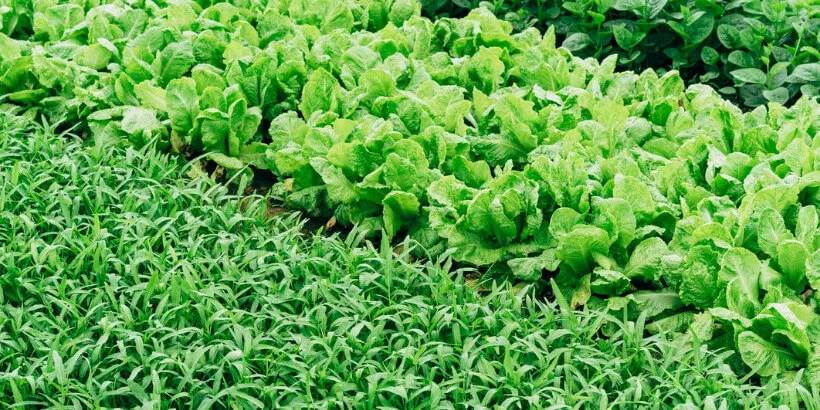
How to properly lime acidic soil and combat micronutrient deficiency
Increased soil acidity directly reduces the yield of vegetable crops. You can identify an acidic soil reaction in your garden by indicator weeds: wild radish, hemp-nettle, corn spurry, creeping buttercup, soft rush, and marsh Labrador tea grow actively here. To neutralize acidity, liming is performed. This can be done once every 5–6 years with large doses of liming materials, based on the soil type and pH values.
| Soil pH value | Application rate of liming materials for light soils, kg per 100 m² |
|---|---|
| up to 4.5 | 50–40 |
| 4.5–5 | 135–25 |
| 5.1–5.5 | 10–20 |
On heavy soils, the doses of lime indicated in the table must be increased by one and a half times. It is important to follow the correct sequence of applying the full rate of liming materials.
- Apply 2/3 of the calculated dose of liming materials before ploughing or digging the soil.
- Distribute the remaining 1/3 of the dose for harrowing, rake it in, or apply it directly into the furrows before sowing.
Instead of periodic application of large doses, you can lime the soil annually directly in the rows, mixing chalk or lime with peat or humus. Applying just 2–3 kg of the mixture per 100 m² in rows is equivalent in effectiveness to 10 kg of lime scattered on the surface. For sandy soils, it is better to use dolomite flour instead of limestone, which will additionally enrich the soil with magnesium.
Be sure to mix slaked lime (calcium hydroxide) with peat or humus exactly two weeks before applying it to the soil. Keep in mind that slaked lime contains up to 75% calcium, while ground limestone or chalk contains up to 56%.
Micronutrients play a crucial role in vegetable nutrition. Their deficiency sharply reduces plant resistance to bacterial and fungal diseases. Nutrient deficiency can be identified by characteristic symptoms:
- Boron: growing points die off, nodules do not form on the roots of legumes, unfertilized flowers fall off, and leaf stalks break. In cauliflower, heads turn brown and the stalk becomes hollow, in beet the heart rots, and cucumber leaves become concave.
- Manganese: leaves become brittle, and small light-yellow spots appear on them.
- Copper: on peat and sandy soils, the tips of young leaves turn white, and their edges become yellowish-grey.
- Zinc: a bronze tint appears in the leaf color, and chlorosis develops.
Excess manganese in acidic soils is toxic to plants. Its negative impact can be reduced through liming and regular application of organic matter. Also, strictly observe the dosages of any purchased micro-fertilizers (for example, from the "Latsbupkhnm" company) — overdosing leads to an excessive content of micronutrients in vegetables, which is dangerous for human health.
If ready-made micro-fertilizers are not available, simple salts can be used on limed acidic soils. For uniform distribution, be sure to mix them with other mineral fertilizers or peat crumb before application. Application rates are: gzhurnodatolitic fertilizer — 2.5–5 g per 1 m², magnesium borate — 3–7 g per 1 m², manganese sulfate — 1–1.5 g per 1 m², copper sulfate — 2–2.5 g per 1 m². If manure is systematically applied to the plot, there is no need to add micro-fertilizers additionally.
An alternative source of calcium, potassium, phosphorus (its share is 2–8%), and all micronutrients is wood ash. It does not contain chlorine, which makes it a valuable potash fertilizer. The quality of ash depends on the burned raw material.
| Raw material for ash production | Potassium content, % | Calcium content, % |
|---|---|---|
| Pine firewood | 7–13 | 42 |
| Birch firewood | 10–14 | up to 36 |
| Spruce firewood | 3 | 25 |
| Sunflower stalks | 30–40 | — |
| Potato haulm | 21 | 32 |
For liming and top dressing, apply 1 1/2 cups of wood ash, ъi cups of potato ash, or Уг (1/2) cup of sunflower ash per 1 m². Before application, it is recommended to mix the ash with peat or humus in a 1:2 ratio. Protect the ash from rain and snow to avoid leaching of nutrients.
Organic fertilizers: improving soil structure and nutritional norms
Organic fertilizers — manure, humus, composts, and poultry manure — are indispensable for increasing soil fertility. Manure contains nitrogen, phosphorus, potassium, calcium, magnesium, and micronutrients. It stimulates the development of beneficial soil microorganisms, which suppress root rots and convert inaccessible nutrients into an assimilable form. Manure application reduces the acidity of podzolic soils and enriches the surface air with carbon dioxide, which is especially important for cucumbers.
Organic matter radically improves the physical properties of the soil. Heavy clay soils, with systematic manure application over several years, become loose and crumbly, allowing air and moisture to reach the roots better. Light sandy soils become more cohesive and darker, thanks to which they retain water better and warm up faster in the sun, ensuring an early harvest. Manure is necessary for cucumbers, onions, cabbage, and beets, and in the second year after them, leafy crops grow excellently in this place.
The nutritional value of manure depends on the bedding material. Straw bedding enriches it with potassium, sawdust bedding with potassium and calcium, and peat bedding with nitrogen. Peat absorbs animal urine better and allows manure to be stacked more densely, reducing nitrogen losses. To preserve nitrogen, sprinkle the manure with superphosphate during layering at a rate of one handful per 1 m² and cover the pile with peat, soil, or plastic film.
- Potassium uptake in the 1st year — 60%
- Phosphorus uptake in the 1st year — 50%
- Nitrogen uptake in the 1st year — 25%
- Effect of manure on light soils — 2–3 years
- Effect of manure on heavy soils — up to 5 years
Despite the long-lasting residual effect of manure, in the first year, plants utilize nutrients only partially. For example, out of 1 ton of horse manure, containing 6 kg of potassium, 3 kg of phosphorus, and 5 kg of nitrogen, plants will absorb only 3.6 kg of potassium, 1.5 kg of phosphorus, and 1.2 kg of nitrogen in the first year. Since the uptake of nitrogen from organic matter occurs only in the middle of the growing season, it is necessary to apply additional mineral nitrogen fertilizers for a quick start for onions, cabbage, and leafy crops.
Manure decomposed into humus contains 1.5 times more nitrogen than fresh manure, and in a form more accessible to plants. Fresh humus is used for preparing a nutrient mixture in which seedlings are grown, and aged humus is used for application in rows or planting holes mixed with mineral fertilizers. Cow manure on straw bedding is poorer in nutrients than horse manure. Cow manure on peat bedding is similar in nutrient content to horse manure. Mullein is also used for preparing a nutrient mixture for seedlings and for top dressing plants; in this case, it is diluted with water in the following ratios: fresh — 1:10, aged — 1:8. Liquid manure is also used for top dressing plants. It is diluted with water 1:4 and, if necessary, a tablespoon of superphosphate is added to 10 liters of the solution. Poultry manure is the richest in nitrogen, especially chicken manure. It is also better used for top dressing plants by diluting it with water: fresh — 1:20, aged — 1:12. The manure solution is left to steep in a tub of water for 24 hours. To avoid nitrogen losses, fermentation of the infusion should not be allowed. Many regions of the Non-Chernozem zone have peat deposits. Valuable fertilizer can be prepared from peat. It contains more nitrogen than manure, but in freshly harvested peat, it is unavailable to plants, and most importantly, peat contains ferrous compounds that are harmful to plants. Therefore, peat should be used for various composts. In the process of preparing compost, when turning the pile, ferrous compounds are converted into ferric compounds as a result of exposure to atmospheric oxygen, which are harmless to plants. Aerobic microorganisms begin to develop in the compost, converting the nitrogen in the peat into a form accessible to plants. During a dry summer period, peat is freed from ferrous compounds during turning within three to seven days, and excess water evaporates. Often, an excess of iron is found in peat. Such peat has a rusty color and should not be used for preparing composts. Peat is composted with manure, liquid manure, and feces, with the addition of mineral fertilizers to the compost. During composting, peat absorbs ammonia from manure, liquid manure, or feces, which binds into a stable, non-volatile, yet plant-available compound — ammonium sulfate. When setting up compost in winter, one to two parts of well-decomposed, aerated peat (degree of decomposition at least 25% and humidity no more than 60%) are taken per one part of manure; when setting up compost in summer, the amount of peat is three to four parts. The higher the degree of decomposition of the peat, the more of it can be used for preparing compost. If composting peat with feces, then three to four parts of feces are taken per one part of high-moor peat, and one to two parts of feces per one part of low-moor peat. Unlike manure, compost is laid loosely, which contributes to an increase in its temperature, and the higher the temperature, the more nitrogen is converted into a form accessible to plants. By the fourth or fifth day after setting, the temperature in the compost rises to 60–70° C, which kills helminth (worm) eggs. Peat, when composted with feces, absorbs chlorine, which is present in significant quantities in fecal matter, and thus mitigates the adverse effect of chlorine on plants, especially on tomatoes and potatoes. During the summer, the compost is turned two to three times and mineral fertilizers are added at a rate of one cup of superphosphate or 1.5 cups of phosphate rock and 0.5 cups of potassium chloride per 1 m³ of compost. When preparing compost in early winter, to avoid freezing, the manure is placed in a pile and its edges are covered with peat; first, a 30–40 cm layer of peat is placed on cleared ground, then manure in a 70–80 cm layer is placed on top, retreating 50–75 cm from the edges of the pile, and finally, another 40–50 cm layer of peat is added on top. If the compost is set up in summer, peat and manure are alternated in layers of 10–15 cm, bringing the height and width of the pile to 1.5–2 m, with length being arbitrary. For peat-fecal compost, the top of the pile is made with a small, wide depression where the fecal mass is poured and immediately covered with a 10–15 cm layer of peat or soil. The compost with manure is ready after
Procurement of turf soil and high-quality compost
To create nutrient-rich soil for greenhouses and hotbeds, especially in regions with a peat deficit, agronomists procure turf soil and composts. Compost made from a mixture of peat, manure, and excrement matures within nine months (if laid out at the beginning of summer, it takes two to three months), while peat-excrement compost matures in one year. A sign that the fertilizer is ready is the complete absence of a specific unpleasant odor after shoveling the pile.
For preparing compost, any decomposing materials can be used: household waste, kitchen scraps, seed-free weeds, as well as vegetable and potato tops, provided they show no signs of late blight. Each layer of the stacked mass should be covered with peat or soil and dusted with superphosphate at a rate of one glass per 1 m².
Do not place compost in a pit. Due to the lack of oxygen in the deep layers, the mass will turn acidic, and instead of high-quality humus, you will obtain a spoiled substrate.
Turf soil is procured in areas dominated by grasses and leguminous herbs. It is important that the field is not infested with winter cress, shepherd's purse, or field pennycress, as these weeds carry the dangerous pathogen for cabbage clubroot. The turf is cut into slices 10–12 cm thick and stacked up to 1.5 m high. The first layer is placed with the grass facing up, the second with the grass facing down, then a layer of manure 10–15 cm thick is added, and the cycle is repeated. During stacking, the turf is sprinkled with lime or chalk at a dose of 1–2.5 kg per 1 m³, depending on the initial soil acidity.
The top of the turf pile should be made trough-shaped. This is necessary to retain rainwater and prevent the runoff of manure slurry, which is periodically poured over the pile to accelerate maturation.
If there is no ready-made area with good grass cover, turf can be grown independently. After harvesting early crops, the area is ploughed, mineral fertilizers are applied, and a grass mixture is sown no later than the end of July. Seed mixture composition per 100 m²:
- meadow fescue — 120 g;
- orchard grass — 120 g;
- tall ryegrass — 90 g;
- timothy grass — 60 g;
- blue alfalfa — 60 g;
- annual ryegrass — 50 g;
- red clover — 170 g.
In case of seed shortage, one may limit the mixture to one leguminous component (clover or alfalfa) and one grass component (timothy, fescue, or orchard grass), proportionally increasing their application rates.
- Turf cutting thickness — 10–12 cm
- Turf pile height — up to 1.5 m
- Lime consumption for the pile — 1–2.5 kg/m³
- Superphosphate for compost — 1 glass/m²
- Readiness of artificial turf — 1 year
The technology for sowing and caring for artificial turf follows this scheme:
- Before ploughing, apply 2 kg of ammonium sulfate, 3.5 kg of superphosphate, and 2.5 kg of potassium chloride for every 100 m² of the area.
- Sow large seeds of grasses in one direction by broadcasting and incorporate them with a rake.
- Mix small seeds with dry sand in a 1:5 ratio, sow them crosswise, and incorporate them using the back of the rake.
- Roll the sown area with a light wooden roller to improve seed-to-soil contact.
- During the growing season, regularly mow the grass and provide top dressing with phosphorus-potassium fertilizers at a rate of 2 kg of superphosphate and 1.5 kg of potassium chloride per 100 m².
Development of virgin land and determination of soil type
When reclaiming virgin lands in the Non-Chernozem zone, one most often has to work with acidic sod-podzolic soils. Their fertile layer is not very deep, averaging 13–15 cm, and in some cases up to 18 cm. Below the humus horizon lies a dense, whitish podzol layer. Such land can only be ploughed strictly to the depth of the dark layer: turning up the barren podzolic horizon to the surface will drastically reduce yield.
Sod-podzolic soils are initially poor in nutrients. They experience an acute deficiency of nitrogen (critical for cucumbers, onions, cabbage, table beets, and leafy greens), as well as phosphorus and potassium (necessary for tomatoes and cucumbers). To obtain stable harvests, the mechanical composition of the soil is determined in advance.
| Soil type by mechanical composition | Sand content, % | Agronomic soil properties |
|---|---|---|
| Heavy clay | less than 20 | High water-holding capacity, tendency to waterlogging and formation of a dense crust |
| Heavy loam | less than 40 | Tendency to form a crust, obstructed air exchange |
| Light loam | about 75 | Optimal water and air regime for early vegetables |
| Sandy loam | more than 80 | Rapid warming, weak water-holding capacity |
For a quick assessment of the mechanical composition in the field, the cord-rolling method is used. A handful of soil is moistened with water to the consistency of thick dough, formed into a walnut-sized ball, and an attempt is made to roll it between the palms into a cord, which is then bent into a ring. If the ring bends without cracking — the soil is clay; if it cracks — it is loamy; if the ball forms but cannot be rolled into a cord — it is sandy loam.
For a more precise analysis, mix a handful of soil with water in a tall glass vessel, shake, and let it settle. Heavy sand will settle at the bottom, and a layer of clay will form above it. The ratio of the height of these layers as a percentage will show the exact proportion of sand in the sample.
On clay and heavy loamy soils, moisture is retained well, so irrigation is performed less frequently. However, after rain or irrigation, they easily become waterlogged, dry slowly, and become covered with a dense crust. The crust evaporates moisture through capillaries, blocks air access to roots, inhibits soil microflora, and interferes with seed emergence. To improve the structure of such plots, 1 to 2 buckets of organic fertilizer per 1 m² (depending on the crop), river sand, and weathered sawdust—pre-soaked in a solution of nitrogen fertilizers—are incorporated during digging.
Light sandy and sandy loam soils are well-aerated and warm up quickly in spring; organic matter applied to them mineralizes faster. However, they do not retain moisture and nutrients: water drains deep, leaching out nitrogen and potassium. Such plots require frequent irrigation with low application rates and regular fractional top dressing of plants.
Sandy soils usually lack magnesium, which cucumbers, tomatoes, and cabbage need in particular. Organic fertilizers are applied to improve sandy soils.
On a new plot, one may also encounter peat-bog soils. Their characteristics are that they contain a lot of organic matter, are distinguished by high absorption capacity, and therefore hold potassium and phosphorus well, preventing leaching. The content of carbon dioxide in the surface air layer over peatlands is significantly higher than on mineral soils, which is why photosynthesis in plants proceeds much more intensively. However, peat soils warm up and thaw very slowly in the spring, which delays the start of work. At the same time, tillage can be started without waiting for the soil to thaw completely, when the subsoil horizon is still frozen.
Cultivating peatlands is a complex task. First of all, one must know the depth of the groundwater level (this, however, should be determined for any soil); it is better if it is no closer than 70 cm from the soil surface.
- To drain groundwater, small ditches are made at the depth of the water table, and all ditches must converge into one trench with a deep pit at the end (sump).
- For drainage, gravel, pebbles, or shards are poured into the bottom of the ditches and covered with soil.
Due to the constant excess of moisture and lack of air, peat-bog soils are almost always devoid of aerobic soil microorganisms; therefore, in the first year of developing peatlands, the mineralization of organic matter proceeds slowly, and plants suffer from a lack of nitrogen, even though it is contained in the peat in large amounts. To create favorable conditions for the decomposition of organic matter and to convert inaccessible forms of nitrogen into an assimilable form for plants, it is necessary to dig the soil and simultaneously apply manure or humus (1—1.5 kg per 1 m2) and mineral fertilizers:
| Application option | Application rate per 1 m2 |
|---|---|
| Garden mixture | up to 100 g |
| Nitrophoska | 80 g |
| Nitroammophoska (mixed with 2.5 g of copper sulfate) | 60 g |
| Potassium nitrate, superphosphate, and potassium chloride | 30 g of each |
Copper sulfate needs to be applied only once every four to five years. Acidic peat must be limed. Over the years, a large supply of phosphorus accumulates in the arable layer of peat-bog soil, but most of it is in a bound form, as organic compounds. As the peatland is cultivated, some phosphorus converts into a mineral, assimilable form for plants, and to replenish this portion, it is necessary to apply superphosphate (up to 50 g per 1 m2); as is known, there is very little potassium in peat, it does not accumulate in the soil as it is cultivated, so it is necessary to apply potassium chloride annually (up to 100 g per 1 m2 depending on the crop).
Sanding of peatlands is a method for their accelerated cultivation. Applying one bucket of sand per 1 m2 simultaneously with mineral fertilizers improves the water properties of peatlands, contributes to the activation of biochemical processes, and improves the nutrient regime of the soil. After breaking up the peat layer and leveling it, the soil surface must be rolled. If the peat soil is heavily intertwined with plant roots and is difficult to dig, the top soddy layer can be removed (if the peat layer is sufficiently deep) and used for making compost, while the exposed layer can be dug up, also adding sand, organic, and mineral fertilizers.
When developing a new plot, regardless of the soil type, do not reach for a spade before outlining a layout plan for vegetable crops. Divide the part of the plot intended for vegetables into four sections:
- in the first, place crops requiring large amounts of organic fertilizer — cucumbers and cabbage;
- in the second — tomatoes and onions;
- in the third (after application of mineral fertilizers) — root crops, and carrots should be placed next to the onions of the second section, as these crops will protect each other from flies: onions will protect carrots from the carrot fly, and carrots will protect onions from the onion fly;
- and in the fourth section, place early potatoes.
Beware of growing potatoes next to tomatoes or after tomatoes, and tomatoes after potatoes, as both crops are affected by the same fungus — late blight. Leafy vegetables (lettuce, Chinese cabbage, spinach, dill, etc.) and radishes can be grown either before cucumbers and tomatoes (they will be successive crops), or after early cabbage and early potatoes.
Read next
Agrochemistry For students
Specifics of the mineral nutrition system for vegetable crops in greenhouses and during seed production
Agrochemistry For students
Characteristics and application features of simple potash fertilizers
Nutrition and fertilizers For gardeners