
Classification of canopy types and principles of fruit tree training
2 min read
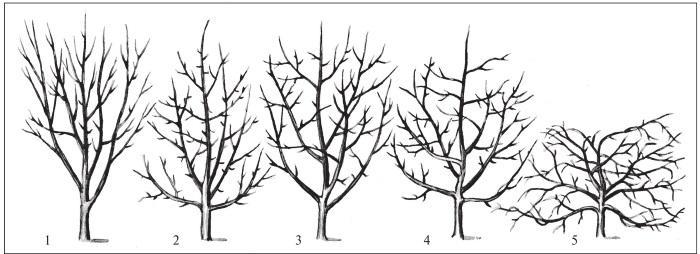
Correct selection and canopy training determine the planting pattern, garden illumination, and ease of tree maintenance. In practice, all canopy types are divided into two main groups — natural (or free-growing) and artificial. When training a natural canopy, the agronomist preserves a silhouette close to the tree's natural form, regulating only the quantity and growth vigor of the branches. Artificial canopies are created by positioning and securing branches in a strictly defined configuration, and in projection, they can be flattened or rounded.
Natural canopies are categorized depending on the presence and role of the central leader. This allows for the selection of an optimal pruning scheme for the specific growth vigor of the rootstock and cultivar. There are three main types of such canopies:
- Leader — formed with a pronounced central leader;
- Leaderless — grown without a central leader;
- Intermediate — the leader is removed after the required number of branches has been established or when the tree reaches a specified height.
Based on the spatial arrangement of branches, natural canopies are also divided into tiered and non-tiered. Intermediate canopy forms, such as spindle or free palmette, combine elements of both groups. Understanding these basic construction principles makes it easy to train a canopy of any transitional type.
To increase branch crotch angles, mechanical spreaders or special pruning are used. Plastic spreaders are installed in the nursery above the bud of one-year-old shoots, which results in a shoot crotch angle of 70–75°. Late spring pruning when shoots are approximately 3 cm long allows for angles within the range of 68–75°.
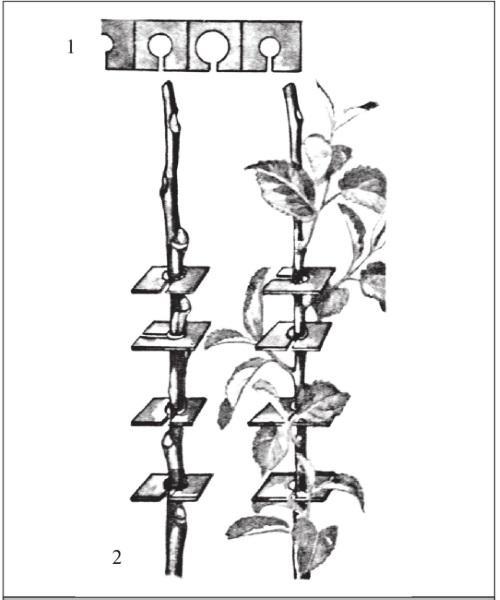
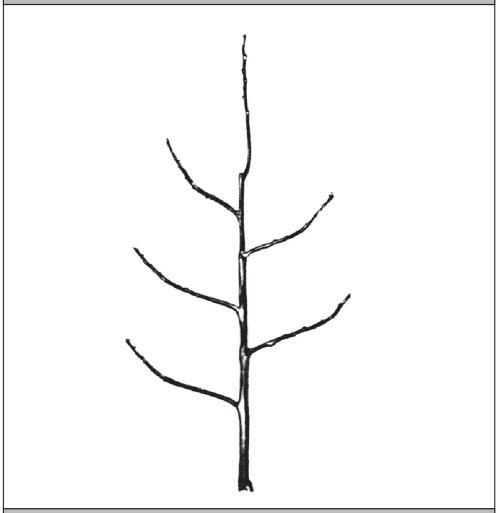
- Crotch angle with spreaders — 70–75°
- Crotch angle with late pruning — 68–75°
- Shoot length for late pruning — approx. 3 cm
- Trunk for modern orchards — 40–60 cm
- Trunk for mechanical harvesting — 60–100 cm
Trunk height and specifics of its selection
The trunk height directly influences orchard management technology and the method of harvesting. Based on this parameter, all fruit trees are classified into four main groups, ranging from high-trunk to bush-like. The parameters for each group are clearly defined by horticultural standards.
| Tree type by trunk height | Trunk height |
|---|---|
| High-trunk | Over 150 cm |
| Medium-trunk | 80–150 cm |
| Low-trunk | 50–80 cm |
| Bush-like | Less than 40 cm |
For most modern commercial orchards, a trunk height within the range of 40–60 cm is considered optimal. However, when designing an orchard, it is necessary to consider the geographical zone and the fruit harvesting method. For these cases, there are strict technological exceptions.
For Siberia and the Far North, standard recommendations do not apply — here, the trunk in fruit trees is practically non-existent. Furthermore, the standard height is not applicable for machine harvesting, where a trunk height of 60–100 cm is required.
Read next
Pruning and training For agronomists
Methods for forming columnar and spindle-shaped canopies of fruit trees
Pruning and training For agronomists
Modern methods of canopy training for flat crowns and palmettes in fruit trees
Pruning and training For students