
Physiological disorders and deformations of mushroom fruit bodies
8 min read
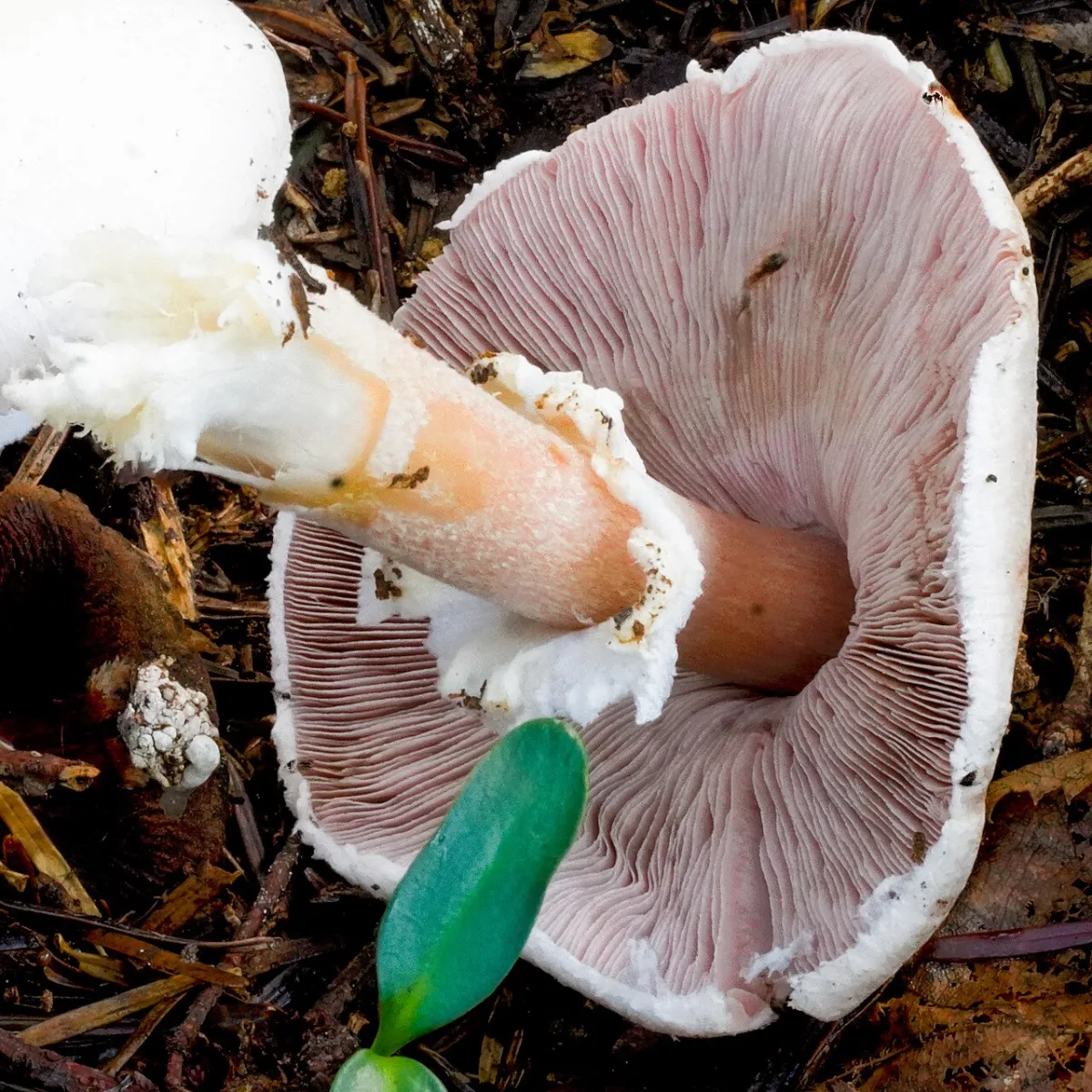
Physiological disorders and deformations of button mushrooms
Physiological defects of fruit bodies reduce the marketability of mushrooms and can lead to harvest losses. Most of them are associated with microclimate disturbances in the growing rooms or chemical contamination of the substrate and air. Timely detection of symptoms helps to quickly adjust the cultivation conditions.
- Favorable CO₂ concentration for fruit set — 340–1000 mg/l
- Critical CO₂ level for cap growth — more than 3000 mg/l
- Disinfection interval for roads — at least once a week
Hardgill, or open veil. In damaged mushrooms, gills are poorly formed or absent entirely. None of the white button mushroom cultivars have immunity to this disorder. The degree of damage depends on temperature fluctuations and successive changes in relative humidity of the air.
Rose or cockscomb. With this disorder, the edges of the caps curl upwards, and gills form on their surface, sometimes in the form of vertical rose-like outgrowths. Deformation usually appears during the first flushes of fruiting. Neoplasms arise under the influence of chemical contaminants: mineral oils, creosote, phenols, and diesel oil vapors.
Stroma (surface mycelial overgrowth). Under conditions of excessive humidity and poor air circulation, the mycelium emerges to the surface of the casing material, forming a dense, waterproof crust. Slight overgrowth can be stopped by frequent but brief irrigation. In case of a pronounced process, it is necessary to take measures to restore the structure of the bed.
- Loosen the casing material shallowly at the first signs of stroma.
- Apply an additional layer of casing material on top.
- Increase the air speed over the surface of the beds, otherwise the mycelial overgrowth will recur.
Massive pinhead formation. In the autumn months, button mushrooms can set an excessive number of fruit bodies that cover the compost with a dense crust and prevent irrigation water from penetrating. A significant portion of these pinheads turns brown, dies, and remains on the beds until the end of the season. The yield of the crop drops sharply, and it is almost impossible to prevent such losses.
Substrate contamination of mushrooms. If the casing material dries out, pinheads form too deep. Emerging mushrooms carry particles of substrate on themselves and lose their marketability. To prevent this defect, keep the casing layer constantly moist, especially during the first flushes of fruiting.
Carbon dioxide damage. With poor ventilation or overly high bed edges, CO₂ accumulates in the surface air layer. At first, the mushroom stalks begin to elongate. If the concentration of carbon dioxide exceeds the critical threshold, cap growth stops, while the stalks continue to grow, taking on a bulbous shape. At the same time, a moderate and controlled increase in the CO₂ level is used deliberately: slight stalk elongation facilitates mechanical harvesting.
General deformations of button mushrooms. In autumn and early winter, during the first flushes of fruiting, conjoined twin mushrooms or amorphous clusters of undifferentiated tissue may appear en masse. This usually happens after the phase of rapid mycelial development. It is believed that the provoking factor is high relative humidity of the air">relative humidity of the air.
Sanitary measures and prevention on the farm
The foundation of combatting button mushroom diseases is strict hygiene. It allows keeping the number of pathogens to a safe minimum. Protective measures will only work with the precise execution of technological sanitary requirements at every stage of production.
Do not allow the mixing of fresh intake air with exhaust air coming from neighboring growing rooms. During design, avoid creating common central corridors, and if they already exist, regularly perform their complete disinfection.
Clean zones of the enterprise (casing material storage, spawn laboratory, warehouses) must be located at the maximum distance from pasteurization rooms and strictly upwind of the growing rooms. All internal roads and access routes must be concreted so that they can be regularly washed and treated with disinfectant solutions.
Disinfection of concrete roads is carried out according to a schedule: mandatory before the start of any technological work (compost preparation, mixing of casing material) and repeated at least once a week.
Farm personnel easily transport spores of diseases and pests on footwear and clothing along with compost residues. To reduce this risk, strict movement rules for employees are introduced at the production site:
- Every room (pasteurization room, spawn production unit, mushroom house, warehouse) must have only one working entrance, equipped with a disinfectant mat.
- Technological inspection of rooms is organized strictly in the direction from young crops to older ones, but never in the opposite direction.
- Workwear is regularly cleaned and changed. It is easiest to control the change of coveralls using color coding for different zones or shifts.
Hygiene on a mushroom farm: from preparation to containment of outbreaks
Infections in growing rooms spread rapidly, so disinfection must be a mandatory daily process. Any work tool must be rinsed in a disinfectant solution before use. This rule is especially critical when switching from unloading spent substrate to spawning or applying casing material. Assign an individual set of equipment to each chamber — this will significantly reduce the risk of pathogen transfer.
Wooden containers, crates, and shelves are treated with wood protection agents with the addition of a wetting agent before filling. Such treatment not only disinfects the containers but also prevents mycelium from growing into the pores of the wood, which will facilitate subsequent cleaning and unloading of the substrate. Areas for compost storage are washed with high-pressure water before each new filling. During compost pasteurization and cooling, ventilation must operate through fine filters to protect the clean substrate from spores.
- Maximum compost pasteurization temperature — 60 °C
- Air filter density for ventilation — 1 µm
- Casing material pasteurization temperature — 60–70 °C
- Casing material heating time — 30 min
- Consumption of 1% formalin solution for the casing mixture — 27 l/m³
Compost pasteurization at a temperature of 60 °C destroys most pathogens, harmful insects, and nematodes, but does not ensure complete sterility of the substrate. Strict control of air and tool cleanliness is necessary up until the moment of casing layer application.
Casing material is one of the main sources of infection on the farm. Store it strictly in a closed room, isolated from sources of contamination. The casing mixture must be disinfected by thermal or chemical means before application. During the growing period, it is important to ensure high-quality lighting in the chambers, as this allows for timely detection of the first symptoms of disease and prompt start of control measures.
A special crew of workers is assigned to control diseases on the farm. They are provided with protective clothing resistant to regular treatment with disinfectants. For manual culling of diseased mushrooms, it is convenient to use special gloves with a sponge coating soaked in a disinfectant agent. The containment of a detected outbreak is carried out according to a strict procedure.
- Carefully remove the affected fruit bodies from the bed.
- Cover the affected area with a plastic cap and press it deep into the substrate to isolate the pathogen spores.
- Sprinkle the isolated area with common table salt.
Pathogen spores are easily washed by water onto the floor of the growing room. If the floor is allowed to dry and swept while dry, the spores will rise into the air and infect new beds. For this reason, floors in the rooms must be kept constantly moist.
Final disinfection and selection of agents
After the completion of harvesting, full sterilization of the growing chambers must be carried out. This allows for the destruction of accumulated pathogen populations and prevents them from spreading to new cycles. The main method is thermal treatment with steam. If steaming is impossible, the crop is sprayed with formalin or fumigated with methyl bromide before unloading.
During thermal sterilization with steam after the completion of harvesting, it is necessary to raise the temperature in the coldest part of the compost to 70 °C.
When chemically treating surfaces, always choose agents purposefully, as universal disinfectants do not exist. The effectiveness of treating cement, brick, or wooden walls can be increased by adding a wetting agent (detergent) to the solution. Most commercial agents are toxic, so they must be used strictly according to the instructions.
| Active ingredient | Product name | Application |
|---|---|---|
| Formaldehyde | Formasan, Steriform, Dynaform | For surface disinfection and room fumigation using the aerosol method. A 2–5% formalin solution is also used for spraying and fumigation. |
| Phenol mixtures | Environ, Wesphen DZ9 | For disinfecting equipment surfaces, crates, and beds. |
| Phenol distillates | Various names | For disinfecting thresholds, wooden structures, and other wooden objects. |
| Dichlorophen | Panocide M (Preventol) | For disinfecting work surfaces, wooden crates, and structures. |
| Sodium and calcium hypochlorite | Chloros, Deo | For wet disinfection of hard surfaces. |
| Sodium phosphate with bromine | Diversol BX BIX | For disinfecting surfaces and wooden objects, especially after viral disease outbreaks. |
| Fatlyamine with lactic acid | Nuodex 87 | For disinfecting planting areas and equipment surfaces. |
Read next
Greenhouses and covers For agronomists
Technological features of cultivating button mushrooms in greenhouse conditions
Plant protection For agronomists
Mummy disease and viral diseases of mushrooms: diagnosis and prevention
Plant protection For agronomists